Potassium – Essential Mineral for Human Health
Interactive Visualization How Your Body Controls Blood Pressure Watch the kidney fire renin, angiotensin clamp the arteries, and aldosterone hold sodium — then eat salt, or take an ACE inhibitor. Launch → Interactive Visualization Magnesium — the mineral that makes ATP work Bare ATP is useless and enzymes reject it. Watch magnesium clamp the phosphates and switch it on, plug the NMDA channel, and let a cramping muscle finally let go. Launch → Interactive Visualization The Sodium–Potassium Pump — why you have a voltage Run the pump that gives every cell its charge — three sodium out, two potassium in, on Mg-ATP — then drop the magnesium and see exactly why low potassium refuses to correct. Launch → Interactive Visualization Potassium & the Heartbeat — bend the ECG with one slider Slide your blood potassium up and down and watch the ECG morph in real time — peaked T waves and a widening QRS as it climbs, U waves and a stretched QT as it falls. Launch → Interactive Visualization Membrane Transport — every way in and out of a cell See every way things cross a cell membrane — oxygen slipping through, water following salt, channels and carriers ferrying downhill, and pumps hauling uphill on ATP — the framework behind nerves, kidneys and drugs. Launch → Interactive Visualization Osmosis and Tonicity: Why Cells Swell or Shrink Drop a cell into salty or plain water and watch it shrivel or burst as water chases solute — then see why an IV bag has to be mixed to just the right strength. Launch →
Table of Contents
- Potassium-Rich Foods (Ranked)
- Electrolyte Balance and Fluid Regulation
- Nerve Impulse Transmission and the Sodium-Potassium Pump
- Muscle Contraction
- Heart Rhythm Regulation
- Blood Pressure Control
- Kidney Function
- Acid-Base Balance
- Bone Health
- Metabolic Functions
- Dietary Sources and Recommendations
- Deficiency and Excess
- Key Research Papers
- Connections
- Featured Videos
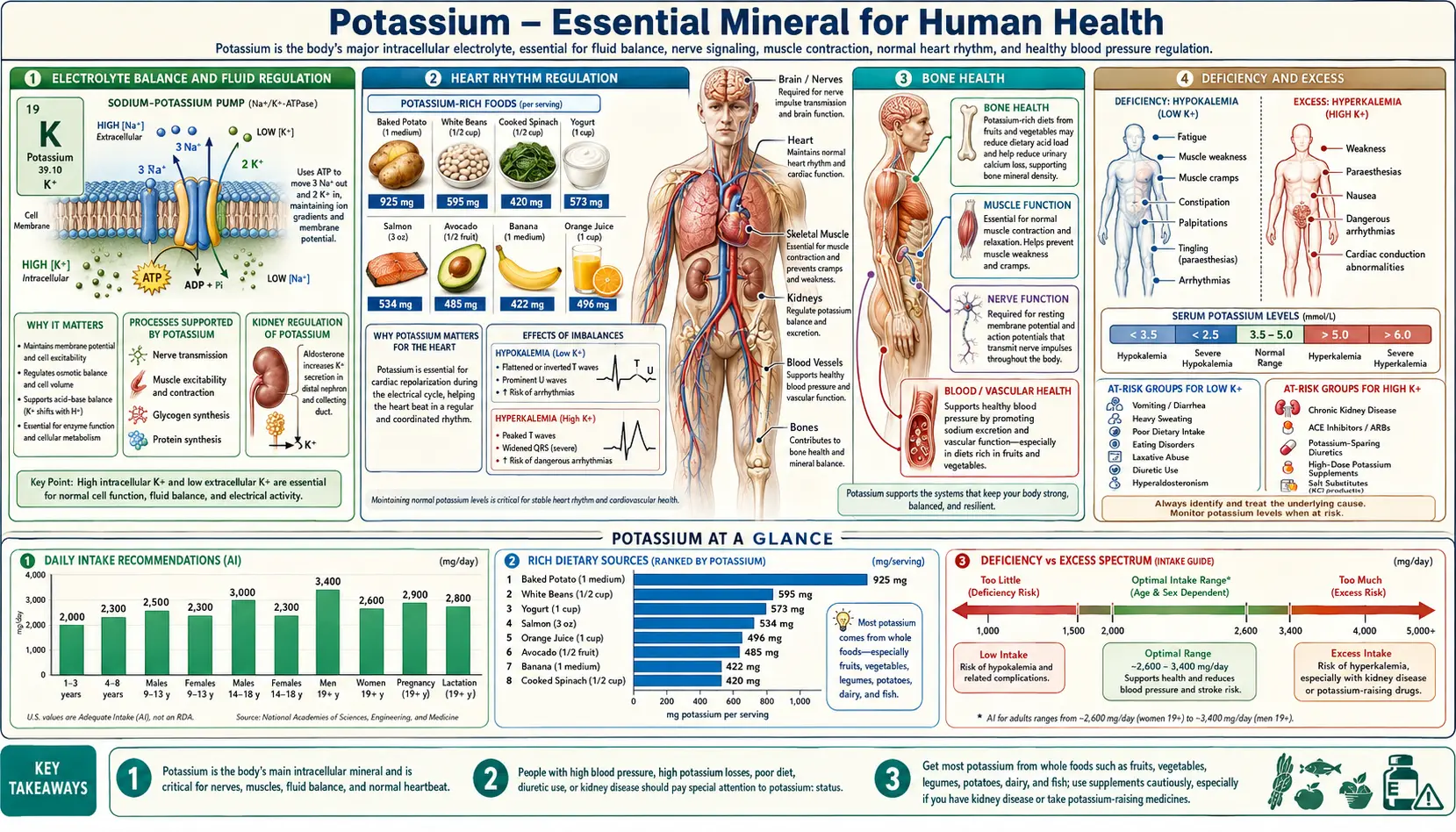
Potassium (chemical symbol K, from the Latin kalium) is the most abundant cation in the fluid inside cells. Approximately 98% of total body potassium is found within cells (National Academies, 2019), and the extracellular fluid holds only about 2% of the body’s store (Cheng 2013). This steep concentration gradient across cell membranes underlies the membrane potential, nerve signaling and muscle contraction. The 2019 National Academies report set adequate intakes (AIs) for adults of 3,400 mg/day for men and 2,600 mg/day for women, replacing the single adult AI of 4,700 mg/day from the 2005 report; the committee found too little evidence to set a Tolerable Upper Intake Level (UL). The AIs are median intakes of healthy people, not a threshold for deficiency.
Electrolyte Balance and Fluid Regulation
Potassium is one of the body's principal electrolytes, working in concert with sodium, chloride, and bicarbonate to maintain fluid homeostasis across all tissue compartments.
- Intracellular fluid volume – Potassium is the dominant osmotic force inside cells. Changes in intracellular potassium concentration directly alter cell volume, which in turn affects enzyme activity, protein synthesis, and metabolic rate.
- Extracellular fluid balance – Although extracellular potassium concentrations are low (a MedlinePlus example reference range for blood is 3.7 to 5.2 mmol/L, the same as mEq/L for potassium; ranges vary slightly among laboratories), even small deviations can have profound physiological consequences, particularly on cardiac and neuromuscular function.
- Osmotic equilibrium – Potassium and sodium together determine the osmolarity of body fluids. The distribution of water between intracellular and extracellular compartments is governed by the relative concentrations of these two ions.
- Transcellular fluid shifts – Hormones such as insulin and catecholamines, as well as changes in acid-base status, can rapidly shift potassium between intracellular and extracellular compartments, providing a rapid buffering mechanism for serum potassium levels. Because so little potassium sits outside cells, a shift of just 1% of its distribution can change plasma potassium by about 50% (Unwin 2011).
Nerve Impulse Transmission and the Sodium-Potassium Pump
The transmission of electrical signals throughout the nervous system depends critically on the potassium gradient across neuronal membranes.
The Na+/K+-ATPase Pump
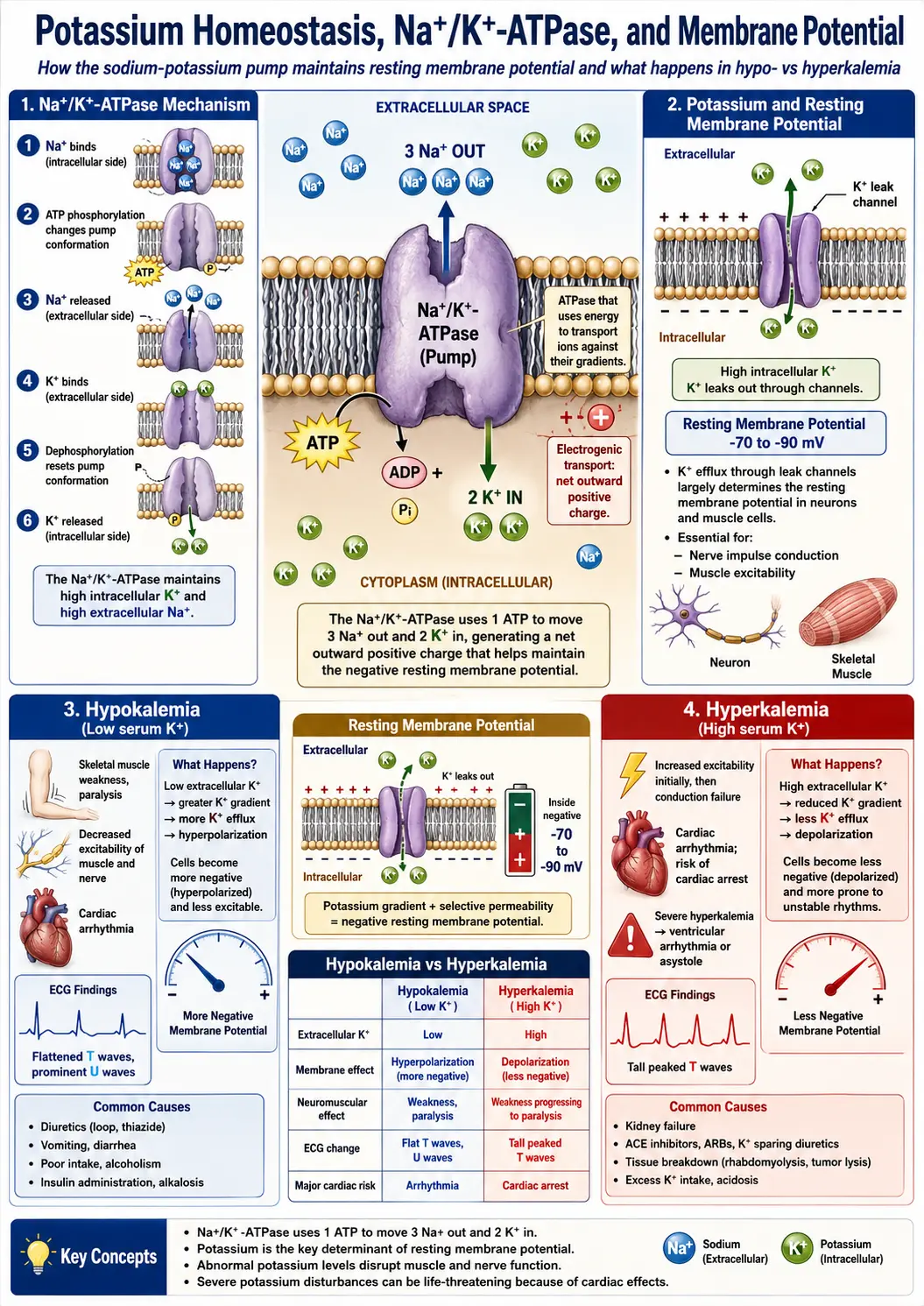
The sodium-potassium pump (Na+/K+-ATPase) is a membrane-spanning enzyme found in virtually all animal cells. It actively transports three sodium ions out of the cell and two potassium ions into the cell for each molecule of ATP hydrolyzed. In neurons the pump accounts for up to two-thirds of the cell’s energy expenditure (Mohan 2019), and it is responsible for establishing and maintaining the electrochemical gradient that underlies all electrical signaling.
- Resting membrane potential – The activity of the Na+/K+-ATPase, combined with the selective permeability of the cell membrane to potassium through leak channels, establishes the negative resting membrane potential of excitable cells.
- Action potential generation – Nerve impulses are generated when sodium channels open, causing depolarization, followed by potassium channel opening for repolarization. Without adequate potassium, repolarization is impaired and neurons cannot reset for subsequent signaling.
- Signal propagation velocity – The speed and reliability of nerve signal transmission depend on the rapid cycling of depolarization and repolarization, both of which require proper potassium gradients.
Neuromuscular Junction
At the neuromuscular junction, potassium plays a role in terminating the action potential at the motor end plate, enabling the muscle fiber to relax and prepare for the next contraction cycle. Disturbances in extracellular potassium levels can alter neuromuscular transmission, leading to weakness, cramping, or paralysis.
Muscle Contraction
Potassium is indispensable for normal function of all three types of muscle tissue: skeletal, smooth, and cardiac.
- Skeletal muscle function – Skeletal muscle holds most of the body’s potassium – about 80% of the intracellular store, according to a 2013 review – so potassium uptake into muscle by the Na+/K+-ATPase and release through inward-rectifier channels is central to keeping blood potassium steady (Cheng 2013). During intense exercise, potassium efflux from contracting muscle fibers can transiently raise local extracellular potassium concentrations, contributing to muscle fatigue. Recovery requires reuptake of potassium via the Na+/K+-ATPase.
- Smooth muscle tone – Potassium channels in vascular smooth muscle regulate arterial tone. Opening of potassium channels causes hyperpolarization and vasorelaxation, while closure promotes depolarization and vasoconstriction. This mechanism is central to blood pressure regulation.
- Excitation-contraction coupling – The sequence from electrical excitation to mechanical contraction depends on proper membrane potential, which in turn depends on potassium homeostasis. Both hypokalemia and hyperkalemia disrupt this coupling and can cause muscle weakness or paralysis.
Heart Rhythm Regulation
The heart is exquisitely sensitive to potassium levels. The cardiac action potential, which governs the orderly sequence of atrial and ventricular contraction, depends on precisely regulated potassium currents at multiple phases.
- Pacemaker activity – Specialized pacemaker cells in the sinoatrial node rely on the “funny” current (If), an inward current through HCN channels that switches on at the end of each beat and sets the slope of the slow depolarization toward the next one (DiFrancesco 2010); potassium currents repolarize each beat.
- Repolarization – Potassium efflux through voltage-gated potassium channels (IKr, IKs, IK1) is responsible for repolarizing the cardiac myocyte after each contraction, resetting the cell for the next beat.
- Arrhythmia risk – Hypokalemia (serum K+ below 3.5 mEq/L) prolongs repolarization, predisposing to dangerous arrhythmias including torsades de pointes and ventricular fibrillation. Hyperkalemia (serum K+ above 5.0 mEq/L) can cause conduction delays, bradycardia, and ultimately cardiac arrest.
For more detailed discussion, see Potassium and Heart Rhythm.
Blood Pressure Control
Potassium plays a central role in blood pressure regulation through multiple complementary mechanisms.
- Natriuresis – Potassium supplementation increases urinary excretion of sodium chloride, which may be part of why “salt-sensitive” hypertension responds particularly well; the blood-pressure response to potassium is slow to appear, taking about 4 weeks (Haddy 2006).
- Vasodilation – Potassium relaxes vascular smooth muscle by stimulating the electrogenic Na+/K+ pump and activating inwardly rectifying (Kir) potassium channels, which hyperpolarize the muscle cell; potassium released by endothelial cells also contributes to endothelium-dependent relaxation (Haddy 2006).
- Sympathetic nervous system – An effect on sympathetic activity has been proposed, but the 2013 meta-analysis below found no significant change in catecholamine concentrations with higher potassium intake (Aburto 2013).
- The DASH trial – In the 1997 DASH trial (459 adults, 8 weeks, with sodium intake and body weight held constant), a diet rich in fruits and vegetables lowered systolic pressure 2.8 mm Hg more than the control diet. The “combination” diet, which also added low-fat dairy foods and cut saturated and total fat, lowered it 5.5 mm Hg more overall and 11.4 mm Hg more among the 133 participants with hypertension (Appel 1997).
- Meta-analyses of trials – A 2013 meta-analysis of 22 randomized trials (1,606 participants) found that higher potassium intake lowered systolic pressure by 3.49 mm Hg and diastolic pressure by 1.96 mm Hg in adults, an effect seen in people with hypertension but not in those without. In 11 cohort studies, higher intake was associated with a 24% lower risk of stroke (risk ratio 0.76); the associations with cardiovascular disease and coronary heart disease were not statistically significant (Aburto 2013). A 2017 meta-analysis of trials in people with hypertension (supplementation for at least 4 weeks) found systolic pressure fell by 4.48 mm Hg and diastolic by 2.96 mm Hg, with larger effects in people whose baseline potassium intake was below 90 mmol/day, in high sodium consumers, and in people not taking antihypertensive drugs (Filippini 2017).
- Salt substitution and hard outcomes – The Salt Substitute and Stroke Study (SSaSS) cluster-randomized 600 villages in rural China; its 20,995 participants had a history of stroke or were 60 or older with high blood pressure. Villages switched to a salt substitute of 75% sodium chloride and 25% potassium chloride or kept regular salt. Over a mean follow-up of 4.74 years, rates of stroke (rate ratio 0.86), major cardiovascular events (0.87) and death from any cause (0.88) were lower with the substitute, and serious adverse events attributed to hyperkalemia were not significantly more frequent (rate ratio 1.04) (Neal 2021). The findings apply to the population studied; the hyperkalemia section below lists the groups the National Academies regards as vulnerable to high potassium intake.
- The 2019 reference values – Reviewing this literature, the 2019 National Academies committee judged the evidence insufficient to set a Chronic Disease Risk Reduction Intake for potassium (National Academies, 2019).
For more detailed discussion, see Potassium and Blood Pressure Regulation.
Kidney Function
The kidneys are the primary regulators of potassium homeostasis, adjusting urinary potassium excretion to match dietary intake and maintain serum levels within the narrow physiological range.
- Glomerular filtration – Potassium is freely filtered at the glomerulus, and much of the filtered load is reabsorbed in the proximal tubule and loop of Henle. Secretion in the distal nephron then determines final urinary excretion; the kidneys account for about 95% of potassium excretion and the colon for about 5%, against a typical intake of about 100 mmol a day (Unwin 2011).
- Distal secretion – Fine-tuning of potassium excretion occurs in the distal convoluted tubule and cortical collecting duct, where principal cells secrete potassium into the tubular lumen under the regulation of aldosterone.
- Aldosterone regulation – Rising serum potassium stimulates aldosterone release from the adrenal cortex. Aldosterone increases the number and activity of Na+/K+-ATPase pumps and epithelial sodium channels (ENaC) in the collecting duct, promoting potassium secretion and sodium reabsorption.
- Renal compensation – In chronic kidney disease, the kidneys' ability to excrete potassium diminishes, making patients increasingly susceptible to hyperkalemia, particularly with medications that reduce potassium excretion. A 2018 KDIGO controversies conference noted increasing evidence of beneficial associations between plant-based diets and outcomes in kidney disease, and little data on how far dietary change restores an abnormal serum potassium to the normal range (Clase 2020).
Acid-Base Balance
Potassium and hydrogen ion (H+) homeostasis are intimately linked, and disturbances in one frequently produce disturbances in the other.
- Transcellular exchange – In acidosis, excess hydrogen ions move into cells, displacing potassium into the extracellular fluid. In alkalosis, the reverse occurs: hydrogen ions leave cells, and potassium moves inward. Acid-base disturbances therefore change serum potassium, a long-observed relationship whose explanations at the level of individual transporters and channels are reviewed by Aronson and Giebisch (2011).
- Renal acid excretion – In the distal nephron, potassium secretion and hydrogen ion secretion are partially competitive processes. Hypokalemia stimulates renal hydrogen ion secretion and ammoniagenesis, contributing to metabolic alkalosis. Conversely, hyperkalemia inhibits ammoniagenesis and can worsen metabolic acidosis.
- Clinical significance – The simple exchange picture has limits. In a 1986 study of 142 admissions for diabetic ketoacidosis, plasma pH, glucose and the anion gap each independently predicted plasma potassium on admission, and the authors concluded that insulin deficit itself, rather than hydrogen-for-potassium exchange alone, may be the major initiating cause of the high potassium seen in that condition; experimentally induced organic-acid acidosis does not produce hyperkalemia (Adrogué 1986).
Bone Health
Research on potassium and bone has examined several possible mechanisms; the trial evidence covers urine and blood markers, not fractures.
- Acid-base buffering and calcium conservation – Diets high in potassium-rich fruits and vegetables generate alkaline precursors (bicarbonate and citrate) that buffer metabolic acid. This reduces the need for bone to serve as an alkaline reservoir, thereby limiting calcium mobilization from the skeleton.
- Reduced urinary calcium loss – A 2015 meta-analysis of 14 studies found that potassium bicarbonate and potassium citrate lowered urinary calcium and acid excretion, and lowered calcium excretion more than potassium chloride did, consistent with an effect of the alkaline load (Lambert 2015).
- Bone markers and bone density – In the same meta-analysis, both alkaline salts lowered the bone-resorption marker NTX, with no effect on bone formation markers or bone mineral density (Lambert 2015). In an observational study of Scottish women around the menopause, the lowest quartile of potassium intake had 6–8% higher urinary markers of bone resorption than the highest, and among the 337 premenopausal women bone mineral density differed by 8% between the highest and lowest quartiles (Macdonald 2005).
Metabolic Functions
Beyond its roles in electrical signaling and fluid balance, potassium participates in a range of metabolic processes essential for cellular health.
Carbohydrate Metabolism
- Insulin and glucose – Hypokalemia has been associated with impaired insulin secretion and glucose intolerance. A 2006 review of 59 thiazide-diuretic trials found that falls in serum potassium tracked rises in blood glucose (weighted correlation −0.54), and its authors suggested that thiazide-induced hypokalemia contributes to the higher rate of new diabetes seen with these drugs (Zillich 2006).
- Insulin moves potassium into cells – Insulin and beta-adrenergic tone are major regulators of how potassium is distributed between cells and blood (Palmer & Clegg 2016), which is why insulin lowers serum potassium.
Protein Synthesis
- Intracellular environment – Adequate intracellular potassium concentration is necessary for ribosomal function and protein synthesis. Potassium depletion reduces the rate of protein synthesis and promotes protein catabolism.
- Cell growth – Potassium influx is one of the early events in the cell cycle following mitogenic stimulation. Potassium channel activity has been linked to cell proliferation in both normal and neoplastic tissues.
Enzymatic Reactions
- Cofactor role – Pyruvate kinase, a key enzyme of glycolysis, requires K+ for maximal activity (Ramírez-Silva 2001).
Dietary Sources and Recommendations
Potassium is widely distributed in foods, with the richest sources being fruits, vegetables, legumes, dairy products, and fish. Notable high-potassium foods include bananas, oranges, potatoes, sweet potatoes, spinach, tomatoes, avocados, beans, lentils, yogurt, and salmon. Blood potassium is usually not influenced by dietary intake, because the kidneys and hormones regulate it closely (National Academies, 2019); intake matters mainly through its long-term links with blood pressure and cardiovascular health.
Reference values and labels
- Adequate intakes – The 2019 National Academies AIs for adults are 3,400 mg/day for men and 2,600 mg/day for women (2,900 mg/day in pregnancy from age 19, 2,800 mg/day in lactation from age 19). They replaced the 2005 adult AI of 4,700 mg/day. No UL, Estimated Average Requirement or Recommended Dietary Allowance could be set for potassium (National Academies, 2019).
- Food labels – The FDA Daily Value used on Nutrition Facts labels for adults and children 4 years and older is 4,700 mg (21 CFR 101.9), the same figure as the old 2005 AI rather than the 2019 AIs.
- The 99 mg figure – No FDA rule caps the potassium in a dietary supplement at 99 mg. The regulation behind the number, 21 CFR 201.306, covers potassium chloride and other potassium salts taken by mouth: tablets supplying 100 mg or more of potassium per tablet (and liquids supplying 20 mg or more per milliliter) must carry prescription labeling, and coated tablets carry a warning about small-bowel lesions – stenosis, obstruction, hemorrhage and perforation – reported with enteric-coated potassium tablets. Tablets under 100 mg fall outside that rule.
For a ranked, side-by-side comparison of common potassium-rich whole foods (mg per 100 g and calories per 100 g, excluding leafy vegetables, edamame, baked white potato, and avocado), see Potassium-Rich Foods.
Deficiency and Excess
Hypokalemia
Hypokalemia (serum potassium below 3.5 mmol/L, the cut-off used by a 2011 review; Unwin 2011) can result from inadequate dietary intake, gastrointestinal losses (vomiting, diarrhea), renal losses (diuretic use, hyperaldosteronism), or transcellular shifts. Symptoms range from mild fatigue and muscle cramps to severe weakness, ileus, rhabdomyolysis, and life-threatening cardiac arrhythmias. For a patient-friendly, symptom-by-symptom guide, see the Hypokalemia (Low Potassium) hub and its dedicated pages on neck tightness, muscle weakness, muscle cramps, fatigue, nausea, and constipation.
Hyperkalemia
Hyperkalemia, generally defined as serum potassium above 5.0 mmol/L (some reports, including the 2019 National Academies review, use above 5.5 mmol/L), becomes more common and more severe with chronic kidney disease, diabetes and heart failure, particularly when compounded by ACE inhibitors, angiotensin receptor blockers and potassium-sparing diuretics (Kreitzer 2025); excessive supplementation is another cause. The National Academies identifies chronic kidney disease, end-stage renal disease, diabetes, severe heart failure, adrenal insufficiency and the use of ACE inhibitors or ARBs as conditions in which intakes at the AI may not be appropriate, because potassium excretion may be impaired; in generally healthy people, excess potassium is excreted in the urine. Its review also describes a case report of a man revived from cardiac arrest after a week of using a potassium-containing salt substitute while on a recently increased ACE inhibitor dose and with mild acute kidney injury (National Academies, 2019). Mild hyperkalemia may be asymptomatic, but severe elevations can cause muscle weakness, paresthesias, and cardiac conduction abnormalities that may progress to ventricular fibrillation and cardiac arrest. For a patient-friendly guide, see the Hyperkalemia (High Potassium) hub and its dedicated pages on palpitations and arrhythmia, muscle weakness, numbness and tingling, fatigue, and nausea.
Key Research Papers
- National Academies of Sciences, Engineering, and Medicine (2019). Dietary Reference Intakes for Sodium and Potassium. Washington, DC: The National Academies Press. doi:10.17226/25353 — PubMed PMID: 30844154
- U.S. Food and Drug Administration. Food labeling: Nutrition labeling of food, Daily Values (21 CFR 101.9). Electronic Code of Federal Regulations — eCFR: 21 CFR 101.9
- U.S. Food and Drug Administration. Potassium salt preparations intended for oral ingestion by man (21 CFR 201.306). Electronic Code of Federal Regulations — eCFR: 21 CFR 201.306
- MedlinePlus. Potassium test (blood): normal results, 3.7 to 5.2 mEq/L; ranges vary slightly among laboratories. U.S. National Library of Medicine — MedlinePlus: Potassium test
- Aburto NJ, Hanson S, Gutierrez H, Hooper L, Elliott P, Cappuccio FP (2013). Effect of increased potassium intake on cardiovascular risk factors and disease: systematic review and meta-analyses. BMJ 346:f1378 — PubMed PMID: 23558164
- Filippini T, Violi F, D'Amico R, Vinceti M (2017). The effect of potassium supplementation on blood pressure in hypertensive subjects: a systematic review and meta-analysis. International Journal of Cardiology 230:127–135 — PubMed PMID: 28024910
- Neal B, Wu Y, Feng X, Zhang R, Zhang Y, Shi J, et al. (2021). Effect of salt substitution on cardiovascular events and death. New England Journal of Medicine 385:1067–1077 — PubMed PMID: 34459569
- Appel LJ, Moore TJ, Obarzanek E, Vollmer WM, Svetkey LP, Sacks FM, et al. (1997). A clinical trial of the effects of dietary patterns on blood pressure. DASH Collaborative Research Group. New England Journal of Medicine 336:1117–1124 — PubMed PMID: 9099655
- Haddy FJ, Vanhoutte PM, Feletou M (2006). Role of potassium in regulating blood flow and blood pressure. American Journal of Physiology – Regulatory, Integrative and Comparative Physiology 290:R546–R552 — PubMed PMID: 16467502
- Kreitzer N, Albert NM, Amin AN, Beavers CJ, Becker RC, Fonarow G, et al. (2025). EMCREG-International multidisciplinary consensus panel on management of hyperkalemia in chronic kidney disease and heart failure. Cardiorenal Medicine 15:133–152 — PubMed PMID: 39809248
- Clase CM, Carrero JJ, Ellison DH, Grams ME, Hemmelgarn BR, Jardine MJ, et al. (2020). Potassium homeostasis and management of dyskalemia in kidney diseases: conclusions from a Kidney Disease: Improving Global Outcomes (KDIGO) Controversies Conference. Kidney International 97:42–61 — PubMed PMID: 31706619
- Unwin RJ, Luft FC, Shirley DG (2011). Pathophysiology and management of hypokalemia: a clinical perspective. Nature Reviews Nephrology 7:75–84 — PubMed PMID: 21278718
- Cheng CJ, Kuo E, Huang CL (2013). Extracellular potassium homeostasis: insights from hypokalemic periodic paralysis. Seminars in Nephrology 33:237–247 — PubMed PMID: 23953801
- Palmer BF, Clegg DJ (2016). Physiology and pathophysiology of potassium homeostasis. Advances in Physiology Education 40:480–490 — PubMed PMID: 27756725
- Aronson PS, Giebisch G (2011). Effects of pH on potassium: new explanations for old observations. Journal of the American Society of Nephrology 22:1981–1989 — PubMed PMID: 21980112
- Adrogué HJ, Lederer ED, Suki WN, Eknoyan G (1986). Determinants of plasma potassium levels in diabetic ketoacidosis. Medicine (Baltimore) 65:163–172 — PubMed PMID: 3084904
- DiFrancesco D (2010). The role of the funny current in pacemaker activity. Circulation Research 106:434–446 — PubMed PMID: 20167941
- Mohan S, Tiwari MN, Biala Y, Yaari Y (2019). Regulation of neuronal Na+/K+-ATPase by specific protein kinases and protein phosphatases. Journal of Neuroscience 39:5440–5451 — PubMed PMID: 31085608
- Lambert H, Frassetto L, Moore JB, Torgerson D, Gannon R, Burckhardt P, Lanham-New S (2015). The effect of supplementation with alkaline potassium salts on bone metabolism: a meta-analysis. Osteoporosis International 26:1311–1318 — PubMed PMID: 25572045
- Macdonald HM, New SA, Fraser WD, Campbell MK, Reid DM (2005). Low dietary potassium intakes and high dietary estimates of net endogenous acid production are associated with low bone mineral density in premenopausal women and increased markers of bone resorption in postmenopausal women. American Journal of Clinical Nutrition 81:923–933 — PubMed PMID: 15817873
- Zillich AJ, Garg J, Basu S, Bakris GL, Carter BL (2006). Thiazide diuretics, potassium, and the development of diabetes: a quantitative review. Hypertension 48:219–224 — PubMed PMID: 16801488
- Ramírez-Silva L, Ferreira ST, Nowak T, Tuena de Gómez-Puyou M, Gómez-Puyou A (2001). Dimethylsulfoxide promotes K+-independent activity of pyruvate kinase and the acquisition of the active catalytic conformation. European Journal of Biochemistry 268:3267–3274 — PubMed PMID: 11389729
PubMed Topic Searches
Connections
- All Minerals
- Hydration — where potassium fits in real fluid balance
- DASH Diet — the mineral-rich eating pattern built around this nutrient
- Osmosis and Tonicity: Why Cells Swell or Shrink — interactive animation
- Getting In and Out of a Cell: Membrane Transport — interactive animation
- Potassium & the Heartbeat — interactive animation
- The Sodium–Potassium Pump — interactive animation
- Magnesium: The Mineral That Makes ATP Work — interactive animation
- How Your Body Controls Blood Pressure — interactive animation
- Potassium Benefits Deep Dive
- Potassium-Rich Foods
- Potassium and Heart Rhythm
- Potassium and Blood Pressure
- Potassium and Muscle Function
- Hypokalemia (Low Potassium): Symptoms & Recovery
- Hypokalemia and Neck Tightness
- Hypokalemia and Muscle Weakness
- Hypokalemia and Muscle Cramps
- Hypokalemia and Fatigue
- Hypokalemia and Nausea
- Hypokalemia and Constipation
- Hyperkalemia (High Potassium): Symptoms & Risks
- Hyperkalemia and Heart Palpitations
- Hyperkalemia and Muscle Weakness
- Magnesium
- Calcium
- Calcium and Muscle Function — excitation-contraction coupling, cramps, tetany, and the calcium-magnesium balance for cardiac and skeletal muscle.
- Hypertension
- Arrhythmia
- Heart Failure
- Kidney Disease
- Bananas
- Avocado
- Celery Juice and Blood Pressure
- Phosphorus
- Spinach
- Sweet Potatoes
- Sodium (Salt)
- Comprehensive Metabolic Panel
- Stroke
- Conditions on this site that reference this page: Cholera's Rice-Water Diarrhea and Life-Threatening · Cholera Symptoms and Diagnosis · Atrial Fibrillation · Brugada Syndrome · Cardiac Amyloidosis · Heart Block · Hypertension · Long QT Syndrome