Hyperkalemia and Nausea: High Potassium, Queasiness, and Gut Symptoms
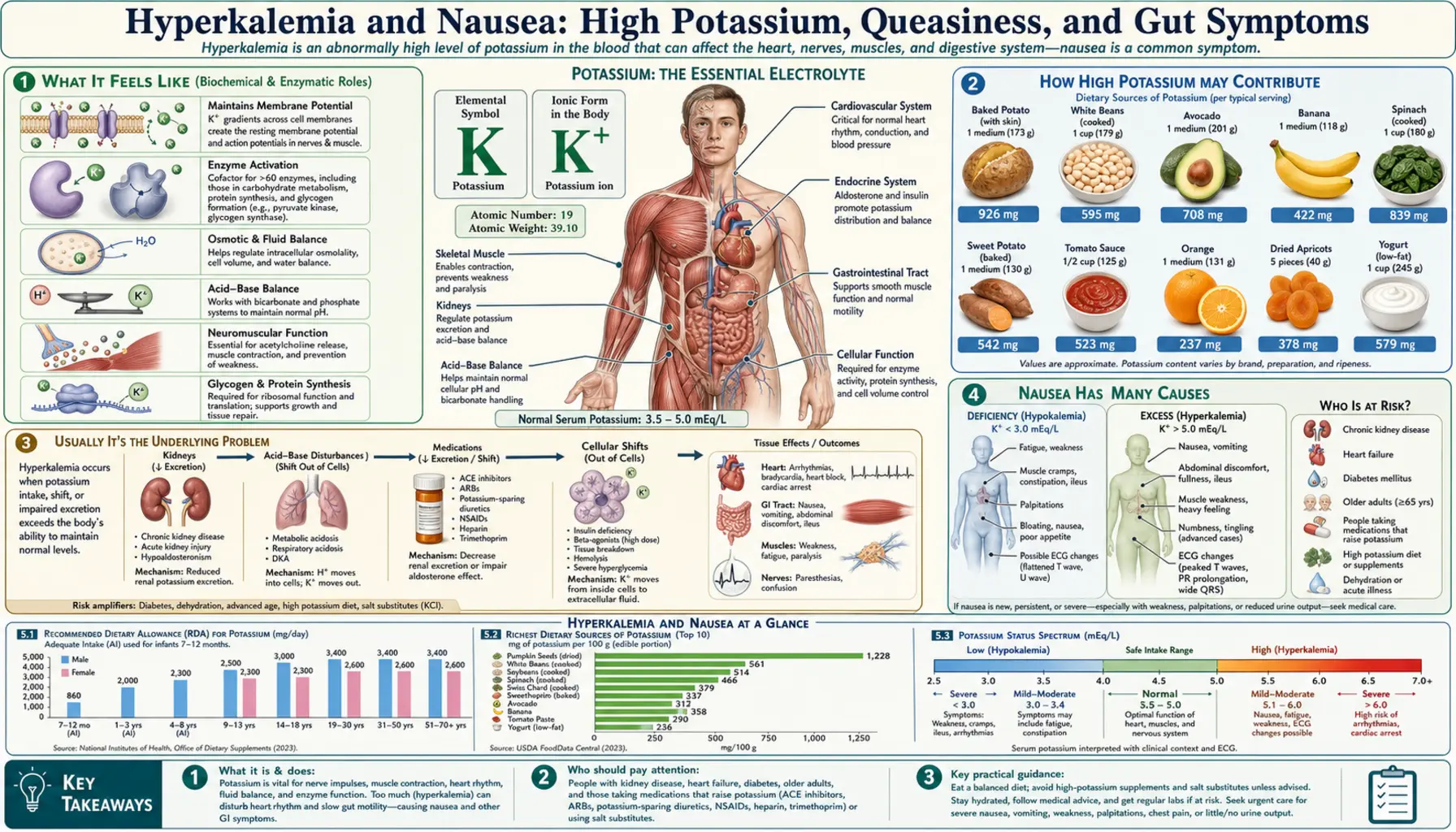
People sometimes ask whether feeling queasy, off their food, or occasionally throwing up could mean their potassium is too high. It is a fair question — but the honest answer is that nausea is one of the least reliable clues to high potassium (hyperkalemia). High potassium is usually silent, discovered only on a blood test, and when it does cause trouble the real danger is to the heart's rhythm, not the stomach. When nausea does turn up alongside high potassium, it is very often a symptom of the underlying problem — failing kidneys, a buildup of acid in the blood, or an adrenal disorder — rather than of the potassium itself. This page explains what the queasiness feels like, why high potassium might play a small role, why nausea has so many ordinary causes, and the specific situations in which it is worth connecting your nausea to potassium and getting a blood test.
Interactive Visualization The Sodium–Potassium Pump — why you have a voltage Run the pump that gives every cell its charge — three sodium out, two potassium in, on Mg-ATP — then drop the magnesium and see exactly why low potassium refuses to correct. Launch →
Table of Contents
- What It Feels Like
- How High Potassium May Contribute
- Usually It's the Underlying Problem
- Nausea Has Many Causes
- When to Connect It to Potassium
- Causes of the High Potassium
- How Nausea and Potassium Are Checked
- How It's Addressed
- Red Flags: Signs That Need Prompt Care
- Key Research Papers
- Connections
- Featured Videos
What It Feels Like
When nausea is described in the setting of high potassium, it is usually vague and low-grade rather than dramatic. People tend to report a cluster of mild gut complaints rather than one sharp symptom:
- Queasiness — a persistent “off” or unsettled feeling in the stomach, the sense that you might be sick without actually being sick. It often waxes and wanes through the day.
- Reduced appetite — food simply doesn't appeal. Meals get smaller, favorite foods lose their pull, and some people notice a faintly metallic or unpleasant taste that puts them off eating.
- Occasional vomiting — less common, and when it happens it is usually occasional rather than the repeated, forceful vomiting of a stomach bug or food poisoning.
- A general “unwell” feeling — the queasiness frequently travels with tiredness or a sense of being run-down, which is part of why it is so easy to attribute to something else.
Two honest points belong right at the front. First, these symptoms are completely non-specific — almost any illness can produce them, and most queasiness has nothing whatsoever to do with potassium. Second, and more importantly, high potassium is frequently asymptomatic: many people with a genuinely dangerous level feel nothing at all in their gut, which is exactly why hyperkalemia is so often caught only on a routine blood panel. Nausea is therefore not a warning system you can rely on. The absence of nausea tells you nothing reassuring, and its presence is rarely about potassium.
How High Potassium May Contribute
Potassium is the main electrically charged particle inside every cell, and it is central to how excitable tissues — nerve and muscle — fire and reset. The gut wall is lined with smooth muscle that contracts in coordinated waves (peristalsis) to move food along, and that movement is choreographed by the enteric nervous system (the gut's own network of nerves) together with autonomic signals from the brain. Because all of this machinery depends on potassium gradients across cell membranes, it is biologically plausible that a markedly high potassium level could disturb gut motility and contribute to nausea or a poor appetite.
It is important to be candid here: the evidence for this is much softer than the evidence for the cardiac effects. What is firmly established — and what makes hyperkalemia dangerous — is its effect on the heart. As potassium rises, it changes the resting voltage of heart-muscle cells and slows electrical conduction, producing the classic, well-documented electrocardiogram (ECG) changes: peaked T waves, a widening QRS complex, flattening P waves, and ultimately life-threatening rhythms or cardiac arrest. Those changes are measurable, reproducible, and the reason emergency departments treat high potassium urgently. The gut effects, by contrast, are far less consistent. Nausea and vomiting are sometimes listed among the possible symptoms of severe hyperkalemia, but they are neither a defining feature nor a dependable one, and clinical reviews emphasize that the symptoms of hyperkalemia in general are vague and non-specific.
So the most accurate framing is this: a very high potassium level might nudge the gut toward queasiness through its effects on smooth-muscle and autonomic signaling, but it is not a strong, predictable, or diagnostic cause of nausea. If your potassium is high and you feel queasy, the potassium is rarely the whole story — which leads to the next, more important point.
Usually It's the Underlying Problem
Here is the single most useful idea on this page: when nausea and high potassium appear together, they are very often two symptoms of the same underlying illness — and the nausea is usually being driven by the illness, not by the potassium. The conditions that most commonly raise potassium are also conditions that independently cause nausea. The potassium and the queasiness are siblings, both produced by the same parent problem.
- Advanced kidney disease and uremia. The kidneys are the body's main route for getting rid of potassium, so when kidney function falls far enough, potassium climbs. But failing kidneys also fail to clear other waste products, and that buildup — called uremia — is itself a classic, well-recognized cause of nausea, vomiting, a metallic taste, and loss of appetite. In someone with advanced chronic kidney disease, the nausea is far more likely to be uremia than the elevated potassium per se.
- Metabolic acidosis. When acid builds up in the blood (often alongside kidney failure, or in conditions like diabetic ketoacidosis), the body shifts potassium out of cells and into the bloodstream, raising the measured level. Acidosis itself reliably causes nausea, vomiting, and a sense of being unwell. Again, both symptoms trace back to the same disturbance.
- Adrenal insufficiency (Addison's disease). When the adrenal glands don't make enough of the hormone aldosterone, the kidneys can't excrete potassium properly, so it rises — and the same hormone deficiency causes prominent nausea, vomiting, poor appetite, fatigue, and weight loss. In Addison's disease, gastrointestinal complaints are among the most common presenting symptoms, and the low sodium / high potassium pattern on bloodwork is a recognized clue. Here the nausea is squarely a feature of the disease.
The practical message: in these conditions, queasiness is usually the disease itself rather than the potassium — the disease showing itself. That said, because these same illnesses raise potassium, new or worsening nausea in someone with kidney disease or an adrenal disorder is a reason doctors check promptly — not because the potassium is causing the nausea, but because both matter together.
Nausea Has Many Causes
Step back from potassium entirely and the picture becomes clear: nausea is one of the most common and least specific symptoms in all of medicine. The overwhelming majority of queasiness has an everyday explanation that has nothing to do with electrolytes. Before pinning nausea on potassium, it is worth remembering how long the ordinary list is:
- Infections — viral gastroenteritis (“stomach flu”), food poisoning, and many ordinary viral illnesses are the single most common cause of nausea and vomiting.
- Medications — a huge range of drugs cause nausea, including antibiotics, opioids and other painkillers, iron supplements, metformin and other diabetes drugs, chemotherapy, and many more. New nausea after starting a medication is a strong clue.
- Pregnancy — nausea, with or without vomiting, is extremely common in early pregnancy and is always on the list in anyone who could be pregnant.
- Gastrointestinal conditions — acid reflux (gastroesophageal reflux disease, GERD), gastritis, peptic ulcers, gallbladder disease, gastroparesis (slow stomach emptying, common in diabetes), constipation, and irritable bowel can all produce queasiness.
- Migraine and inner-ear problems — migraine famously causes nausea, and so do vertigo and motion-related inner-ear disturbances.
- Other causes — anxiety and stress, pain, low blood sugar, alcohol, and many systemic illnesses round out a very long list.
Against that backdrop, high potassium is an uncommon explanation for nausea, and a poor one to reach for first. When nausea is persistent, unexplained, or worsening, guessing at potassium settles nothing; a clinician's work-up sorts through the common causes and, where appropriate, includes a potassium level.
When to Connect It to Potassium
Although nausea on its own rarely points to high potassium, there are specific situations where it is reasonable — and sometimes important — to consider potassium as part of the picture. The pattern that matters is nausea plus context, not nausea alone:
- Nausea with palpitations. If queasiness comes alongside a racing, pounding, fluttering, or skipping heartbeat, that combination deserves attention, because the heart-rhythm effect is the dangerous face of hyperkalemia. See Hyperkalemia and Heart Palpitations & Arrhythmia and, more generally, heart palpitations and arrhythmia.
- Nausea with muscle weakness or numbness/tingling. When queasiness travels with new muscle weakness or with numbness and tingling, the cluster of symptoms is more suggestive of an electrolyte disturbance than nausea by itself.
- Known kidney disease. In anyone with reduced kidney function, new or worsening nausea is a reason doctors check potassium — both because the kidneys are the body's potassium regulator, and because uremia itself causes nausea (see the section above).
- On medications that block the renin-angiotensin-aldosterone system (RAAS), or other potassium-affecting medications. An angiotensin-converting enzyme inhibitor (ACE inhibitor), an angiotensin-receptor blocker, a potassium-sparing diuretic such as spironolactone, or potassium supplements make potassium more likely to drift up — so in people taking them, high potassium is one possible link to nausea.
- Profound fatigue with nausea. Overwhelming tiredness paired with queasiness, especially with low blood pressure or salt craving, can point toward an adrenal cause; see also Hyperkalemia and Fatigue.
In short: nausea earns a potassium check when it keeps the company of palpitations, weakness, numbness, kidney disease, or the relevant medications — not when it shows up alone.
Causes of the High Potassium
If a blood test does confirm that potassium is genuinely elevated, the next question is why. The common causes overlap heavily with the conditions that also cause nausea, which is why the two so often appear together. The major categories are:
- Reduced kidney function. This is the single most important cause. Because the kidneys excrete most of the body's potassium, chronic kidney disease and acute kidney injury are the leading reasons potassium accumulates.
- Medications. Drugs that block the renin-angiotensin-aldosterone system raise potassium: angiotensin-converting enzyme inhibitors (ACE inhibitors), angiotensin receptor blockers (ARBs), the potassium-sparing diuretics (spironolactone, eplerenone, amiloride), and certain others such as some pain relievers and trimethoprim. Potassium supplements taken without monitoring contribute too.
- Salt substitutes. Many “low-sodium” or “lite” salt products replace sodium chloride with potassium chloride. For most healthy people this is beneficial, but for someone with reduced kidney function or on a potassium-raising medication, generous use can push potassium into the danger zone. In the large salt-substitute trial cited below (Neal and colleagues, 2021), 20,995 people in rural Chinese villages who had had a stroke, or were 60 or older with high blood pressure, were followed for an average of 4.74 years. A substitute of 75% sodium chloride and 25% potassium chloride lowered the rates of stroke (rate ratio 0.86), major heart and blood-vessel events (0.87) and death (0.88) compared with regular salt, and serious events blamed on high potassium were not more common (3.35 versus 3.30 per 1,000 person-years). Those participants were older people with high blood pressure or a past stroke; the trial was not a study of people with advanced kidney disease.
- Tissue breakdown. Potassium lives mainly inside cells, so anything that damages large numbers of cells — severe injury or burns, muscle breakdown (rhabdomyolysis), or the rapid destruction of cells seen in some cancer treatments — releases a flood of potassium into the blood.
- Adrenal insufficiency (Addison's disease) and acidosis. Too little aldosterone (as in Addison's disease) impairs potassium excretion, and metabolic acidosis shifts potassium out of cells into the bloodstream — both raising the measured level, and both independently causing nausea.
A common, harmless mimic is worth knowing about: pseudohyperkalemia, a falsely high reading caused by red cells rupturing in the blood tube (often from a difficult draw or a clenched fist). If a high potassium result doesn't fit the clinical picture, clinicians frequently repeat the test to make sure the elevation is real before acting on it.
How Nausea and Potassium Are Checked
Sorting out nausea that might be linked to potassium is straightforward and inexpensive, and it usually proceeds on two tracks at once: confirm or exclude high potassium, and work up the many ordinary causes of nausea.
For the potassium question, the foundation is a simple blood draw. A Comprehensive Metabolic Panel (CMP) reports the serum potassium directly — the normal range is roughly 3.5–5.0 mEq/L — along with kidney function (creatinine, urea), sodium, and the bicarbonate level that signals acidosis. That single panel often reveals not just whether potassium is high but why. If potassium is elevated, an electrocardiogram (ECG) is the urgent next step, because the electrocardiogram — not the gut symptoms — reflects the real danger to the heart and guides how fast treatment must move. Because a falsely high reading is common, an unexpected result is often simply repeated.
For the nausea itself, a clinician will take the ordinary careful history — recent infections, every medication and supplement, the possibility of pregnancy, reflux or other gut symptoms, and the pattern and timing of the queasiness — and order further tests as the story dictates. Depending on the picture, that might include a pregnancy test, liver and pancreas labs, blood sugar, thyroid tests, or, where an adrenal cause is suspected, a morning cortisol and related hormone testing for Addison's disease. The point is that one cheap blood panel can settle the potassium question while the broader nausea work-up runs alongside it.
How It's Addressed
If high potassium is confirmed, treatment follows two parallel tracks: bring the potassium down and treat whatever caused it — and treating the cause is usually what resolves the nausea, since the nausea is so often the underlying disease talking.
- Urgency matched to the danger. Mild, stable elevations in a well person are managed calmly with dietary changes and medication review. Severe elevations, or any with electrocardiogram changes, are a medical emergency treated in hospital, often with intravenous calcium to protect the heart, insulin-with-glucose and inhaled albuterol to drive potassium back into cells, and measures (such as potassium-binding medications or dialysis) to remove potassium from the body. Albuterol's potassium-lowering effect, for example, is well documented in dialysis patients.
- Newer potassium-binding medicines. Two medicines bind potassium inside the gut so that it leaves the body in the stool. In a 2015 trial of people with chronic kidney disease taking RAAS-blocking drugs, patiromer lowered blood potassium by about 1 mmol per liter over 4 weeks (237 patients). When 107 of them were then randomly assigned to keep taking it or switch to placebo, high potassium came back in 60% of the placebo group versus 15% of those who stayed on patiromer; mild-to-moderate constipation was the most common side effect (11%). In a 2014 trial of 258 outpatients with high potassium, sodium zirconium cyclosilicate brought 84% to a normal potassium within 24 hours and 98% within 48 hours. In the 28-day phase that followed, swelling (edema) was more common at the 15 g daily dose (14%, versus 2% on placebo), and low potassium developed in 10–11% of people on the 10 g and 15 g doses.
- Medication review. Stopping or adjusting an angiotensin-converting enzyme inhibitor, angiotensin receptor blocker (ARB), potassium-sparing diuretic, nonsteroidal anti-inflammatory drug (NSAID), or potassium supplement is frequently the key correction. Salt substitutes containing potassium chloride are stopped.
- Diet adjustment when appropriate. In people with reduced kidney function, diet plans from a clinician or renal dietitian often moderate very high-potassium foods. This is individualized — potassium-rich whole foods are healthful for most people, and blanket restriction is not needed for someone with normal kidneys.
- Treating the root cause. Managing the kidney disease, correcting acidosis, or replacing the missing adrenal hormones in Addison's disease addresses both the potassium and the nausea at their source. In Addison's, hormone replacement typically resolves the gastrointestinal symptoms.
- Symptom relief for the nausea — with anti-nausea medication, small bland meals, and hydration — while the underlying problem is corrected, especially when uremia is the driver.
Red Flags: Signs That Need Prompt Care
Most queasiness is mild and self-limited and does not need urgent care. But because the genuine danger of high potassium is to the heart, certain combinations are treated as emergencies — handled through emergency services rather than a routine appointment:
- Nausea or vomiting with palpitations — a racing, pounding, fluttering, or skipping heartbeat alongside the queasiness.
- Severe muscle weakness, especially weakness that is spreading or making it hard to move, stand, or breathe.
- Confusion, fainting, or near-fainting.
- Very low or absent urine output — a sign the kidneys may be failing to clear potassium.
- Known kidney disease, Addison's disease, or potassium-raising medications together with new or worsening nausea — a combination doctors check promptly.
- Persistent vomiting, signs of dehydration, severe abdominal pain, blood in vomit, or nausea in pregnancy that prevents keeping fluids down — these are treated as needing timely medical care in their own right, whatever the potassium.
The dangerous pattern to remember is nausea or vomiting plus palpitations, severe weakness, confusion, or very little urine — particularly in someone with kidney disease. At that point the same high potassium that may be unsettling the gut can be destabilizing the heart, and confirming or excluding it takes one quick blood test and an electrocardiogram.
Key Research Papers
- Palmer BF (2015). Regulation of Potassium Homeostasis. Clinical Journal of the American Society of Nephrology;10(6):1050-1060. — DOI: 10.2215/CJN.08580813. — doi:10.2215/CJN.08580813
- Montford JR, Linas S (2017). How Dangerous Is Hyperkalemia? Journal of the American Society of Nephrology;28(11):3155-3165. — DOI: 10.1681/ASN.2016121344. — doi:10.1681/ASN.2016121344
- Lehnhardt A, Kemper MJ (2011). Pathogenesis, diagnosis and management of hyperkalemia. Pediatric Nephrology;26(3):377-384. — DOI: 10.1007/s00467-010-1699-3. — doi:10.1007/s00467-010-1699-3
- Weisberg LS (2008). Management of severe hyperkalemia. Critical Care Medicine;36(12):3246-3251. — DOI: 10.1097/CCM.0b013e31818f222b. — doi:10.1097/CCM.0b013e31818f222b
- Viera AJ, Wouk N (2015). Potassium Disorders: Hypokalemia and Hyperkalemia. American Family Physician;92(6):487-495. — PubMed PMID: 26371733
- Kardalas E, Paschou SA, Anagnostis P, et al. (2018). Hypokalemia: a clinical update. Endocrine Connections;7(4):R135-R146. — DOI: 10.1530/EC-18-0109. — doi:10.1530/EC-18-0109
- Charmandari E, Nicolaides NC, Chrousos GP (2014). Adrenal insufficiency. The Lancet;383(9935):2152-2167. — DOI: 10.1016/S0140-6736(13)61684-0. — doi:10.1016/S0140-6736(13)61684-0
- Chawla LS, Eggers PW, Star RA, Kimmel PL (2014). Acute Kidney Injury and Chronic Kidney Disease as Interconnected Syndromes. New England Journal of Medicine;371(1):58-66. — DOI: 10.1056/NEJMra1214243. — doi:10.1056/NEJMra1214243
- Neal B, Wu Y, Feng X, et al. (2021). Effect of Salt Substitution on Cardiovascular Events and Death. New England Journal of Medicine;385(12):1067-1077. — DOI: 10.1056/NEJMoa2105675. — doi:10.1056/NEJMoa2105675
- Weir MR, Bakris GL, Bushinsky DA, et al.; OPAL-HK Investigators (2015). Patiromer in patients with kidney disease and hyperkalemia receiving RAAS inhibitors. New England Journal of Medicine;372(3):211-221. — DOI: 10.1056/NEJMoa1410853. — PubMed PMID: 25415805
- Kosiborod M, Rasmussen HS, Lavin P, et al. (2014). Effect of sodium zirconium cyclosilicate on potassium lowering for 28 days among outpatients with hyperkalemia: the HARMONIZE randomized clinical trial. JAMA;312(21):2223-2233. — DOI: 10.1001/jama.2014.15688. — PubMed PMID: 25402495
- Allon M, Dunlay R, Copkney C (1989). Nebulized Albuterol for Acute Hyperkalemia in Patients on Hemodialysis. Annals of Internal Medicine;110(6):426-429. — DOI: 10.7326/0003-4819-110-6-426. — doi:10.7326/0003-4819-110-6-426
- Huang CL, Kuo E (2007). Mechanism of Hypokalemia in Magnesium Deficiency. Journal of the American Society of Nephrology;18(10):2649-2652. — DOI: 10.1681/ASN.2007070792. — doi:10.1681/ASN.2007070792
PubMed Topic Searches
- PubMed: Hyperkalemia symptoms and clinical manifestations
- PubMed: Uremia, nausea, and vomiting in chronic kidney disease
- PubMed: Adrenal insufficiency, GI symptoms, and hyperkalemia
- PubMed: Salt substitutes, potassium chloride, and hyperkalemia
- PubMed: Metabolic acidosis, potassium shift, and nausea
Connections
- All Minerals
- The Sodium–Potassium Pump — interactive animation
- Hyperkalemia Symptom Hub
- Hyperkalemia and Palpitations & Arrhythmia
- Hyperkalemia and Muscle Weakness
- Hyperkalemia and Numbness & Tingling
- Hyperkalemia and Fatigue
- Potassium Overview
- Hypokalemia (Low Potassium) Hub
- Potassium Benefits
- Potassium and Heart Rhythm
- Potassium and Muscle Function
- Magnesium
- Kidney Disease
- Addison's Disease
- Arrhythmia
- Heart Palpitations
- Comprehensive Metabolic Panel