⚠ Evidence warning: Clinical trials or other evidence do not support the claim that standardized potassium replacement protocols in cardiac intensive care units reduce atrial fibrillation and ventricular arrhythmias after surgery. This page keeps it as a report of what people, websites or other media say.
Potassium for Heart Rhythm
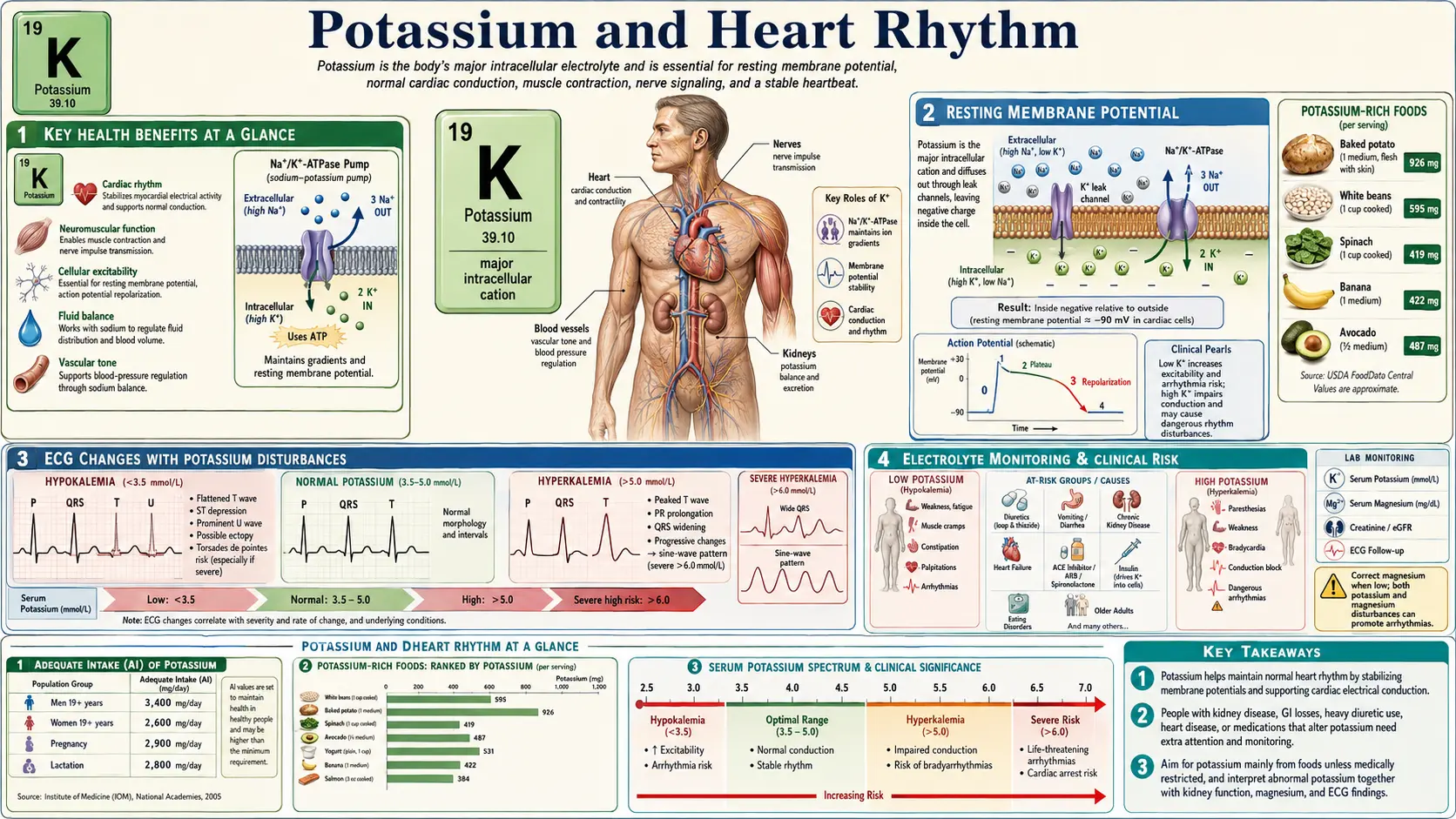
The heart is among the most electrically active organs in the body, generating and conducting electrical impulses with remarkable precision approximately 100,000 times per day. Potassium is the single most important ion governing cardiac electrical activity. The concentration of potassium in the extracellular fluid, normally maintained between 3.5 and 5.0 mEq/L, determines the resting membrane potential of cardiac myocytes and influences every phase of the cardiac action potential. Even modest deviations from the normal range can produce clinically significant disturbances in heart rhythm, ranging from benign premature beats to lethal ventricular fibrillation.
This page examines the molecular and cellular basis of potassium's effects on cardiac electrophysiology, the clinical syndromes of hypokalemia and hyperkalemia, the characteristic electrocardiogram (ECG) findings that accompany each, and the principles of potassium management in cardiac patients. Magnesium co-regulation, the evidence on tight potassium control in heart failure, after a heart attack and after cardiac surgery, and contemporary monitoring strategies are also reviewed.
Interactive Visualization The Sodium–Potassium Pump — why you have a voltage Run the pump that gives every cell its charge — three sodium out, two potassium in, on Mg-ATP — then drop the magnesium and see exactly why low potassium refuses to correct. Launch →
Table of Contents
Key Health Benefits at a Glance
Adequate potassium status is essential for normal cardiac electrical activity and rhythm stability. The following summarizes the evidence-backed rhythm benefits, each of which is detailed below with supporting research in the Key Research Papers section.
- Stabilizes cardiac resting membrane potential – Normal extracellular potassium (3.5–5.0 mEq/L) maintains the roughly −90 mV resting potential that keeps sodium channels available for reliable conduction.
- Reduces risk of torsades de pointes – Hypokalemia prolongs QT and provokes early afterdepolarizations; correcting low potassium is first-line therapy for prevention.
- Prevents ventricular ectopy – Adequate potassium suppresses spontaneous phase 4 depolarization in latent pacemaker cells, lowering the burden of premature ventricular contractions (PVCs, extra heartbeats from the lower chambers) and non-sustained ventricular tachycardia (VT, short runs of a fast rhythm from the lower chambers).
- Post-operative atrial fibrillation: the old target was tested – Cardiac-surgery intensive care unit (ICU) protocols have long kept potassium high-normal to prevent post-operative atrial fibrillation (AF). In the 2024 TIGHT K trial of 1,690 bypass-surgery patients, giving potassium only when it fell below 3.6 mEq/L was as good as keeping it at 4.5 mEq/L or more (new AF in 27.8% versus 26.2%), with no increase in other rhythm problems.
- Lowers sudden cardiac death risk – Prospective cohorts link low serum and dietary potassium to increased sudden cardiac death, particularly in patients on diuretics.
- Potentiates antiarrhythmic drugs – Potassium-dependent antiarrhythmics (Class III agents) depend on normokalemia for efficacy and safety.
- Prevents hyperkalemia-associated cardiac arrest – Avoiding severe hyperkalemia (>7.0 mEq/L) prevents the sinusoidal QRS pattern that heralds asystole.
- Supports pacemaker cell function – Normal potassium is essential for reproducible sinoatrial node automaticity and atrioventricular conduction.
- Potassium after a heart attack (myocardial infarction) – Clinical practice guidelines recommend keeping potassium at 4.0–5.0 mEq/L after a heart attack to reduce reperfusion arrhythmias. A 2012 study of 38,689 heart-attack patients (Goyal) notes that this target rests on small studies from before beta-blockers and reperfusion treatment; in that study, in-hospital death was lowest at 3.5 to under 4.5 mEq/L and about twice as high at 4.5 to under 5.0 mEq/L (10.0% versus 4.8%).
- Fewer serious rhythm events in people with implanted defibrillators – In the 2025 POTCAST trial, raising potassium to the high-normal range (4.5–5.0 mmol/L) in 1,200 people with an implantable cardioverter-defibrillator lowered the combined rate of dangerous ventricular rhythms or device shocks, unplanned hospital stays for arrhythmia or heart failure, and death (hazard ratio 0.76).
The Cardiac Action Potential
Understanding the role of potassium in cardiac rhythm requires familiarity with the cardiac action potential, which differs significantly from the action potential of neurons and skeletal muscle in both duration and ionic basis.
- Phase 0 – Rapid depolarization – The action potential begins with the rapid opening of voltage-gated sodium channels (Nav1.5), producing the steep upstroke of depolarization. Although sodium is the primary current in this phase, the resting membrane potential set by potassium determines the availability of sodium channels and therefore the velocity and amplitude of the upstroke.
- Phase 1 – Early repolarization – A transient outward potassium current (Ito) produces a brief partial repolarization, creating the characteristic "notch" in the action potential waveform. The Ito current is particularly prominent in epicardial and Purkinje fiber cells and contributes to the transmural dispersion of repolarization.
- Phase 2 – Plateau – The plateau phase, unique to cardiac muscle, results from a balance between inward calcium current (ICaL) through L-type calcium channels and outward potassium currents. The delayed rectifier potassium currents (IKr and IKs) gradually increase during this phase, eventually tilting the balance toward repolarization. The plateau phase is responsible for the long duration of the cardiac action potential (200–400 milliseconds) and the prolonged refractory period that prevents tetanic contraction of the heart.
- Phase 3 – Final repolarization – Rapid repolarization occurs as calcium channels inactivate and the delayed rectifier potassium currents (IKr and IKs) reach their peak. The inward rectifier potassium current (IK1) also contributes to terminal repolarization, driving the membrane potential back toward its resting value. Phase 3 is the most potassium-sensitive phase and the one most affected by abnormal serum potassium levels.
- Phase 4 – Resting membrane potential – In working atrial and ventricular myocytes, the resting membrane potential is maintained at approximately −85 to −90 mV by the strong inward rectifier potassium current (IK1). In pacemaker cells of the sinoatrial and atrioventricular nodes, phase 4 is characterized by spontaneous slow depolarization (the pacemaker potential), driven by the funny current (If), calcium currents, and declining potassium currents.
Resting Membrane Potential
The resting membrane potential of cardiac cells is determined primarily by the ratio of intracellular to extracellular potassium concentration, as described by the Nernst equation. Under normal conditions, the intracellular potassium concentration is approximately 140–150 mEq/L, while the extracellular concentration is 3.5–5.0 mEq/L, yielding a resting potential of approximately −90 mV.
- Hypokalemia and the resting potential – When extracellular potassium falls, the Nernst equation predicts membrane hyperpolarization (a more negative resting potential). However, in practice, hypokalemia also reduces the conductance of the IK1 channel, which paradoxically makes the resting potential less stable and more susceptible to ectopic depolarization. The net effect is an increase in cardiac excitability and automaticity.
- Hyperkalemia and the resting potential – Elevated extracellular potassium shifts the resting membrane potential toward less negative values (depolarization). Mild depolarization (resting potential of −80 to −75 mV) may initially increase excitability, but progressive depolarization (beyond −70 mV) inactivates sodium channels, slowing conduction velocity and eventually rendering cells inexcitable.
- Clinical threshold – The relationship between serum potassium and resting membrane potential is approximately linear within the physiological range. A decrease in serum potassium from 4.0 to 3.0 mEq/L hyperpolarizes the membrane by roughly 5–10 mV, while an increase from 4.0 to 6.0 mEq/L depolarizes it by approximately 10–15 mV.
Hypokalemia and Arrhythmias
Hypokalemia (serum potassium below 3.5 mEq/L) is one of the most common electrolyte abnormalities in clinical practice and is a well-established risk factor for cardiac arrhythmias.
- Prolonged repolarization – Hypokalemia reduces the conductance of the delayed rectifier potassium channels (particularly IKr), slowing phase 3 repolarization and prolonging the action potential duration. This manifests on the electrocardiogram as QT interval prolongation and increases the susceptibility to early afterdepolarizations (EADs), which are abnormal depolarizations that occur during the prolonged repolarization phase.
- Increased automaticity – Low extracellular potassium enhances the rate of spontaneous phase 4 depolarization in latent pacemaker cells (Purkinje fibers), promoting ectopic beat formation. This can manifest as premature ventricular complexes (PVCs), atrial premature beats, or accelerated junctional rhythms.
- Triggered activity – Early afterdepolarizations caused by hypokalemia can trigger sustained tachyarrhythmias. When an EAD reaches threshold, it initiates a new action potential, which may itself produce another EAD, creating a self-perpetuating cycle known as triggered activity. This mechanism underlies torsades de pointes, a polymorphic ventricular tachycardia that is the hallmark arrhythmia of hypokalemia.
- Re-entry circuits – Hypokalemia creates heterogeneity in repolarization across the myocardium because different regions and cell types (epicardial, endocardial, mid-myocardial) are affected to varying degrees. This dispersion of repolarization provides the substrate for re-entrant arrhythmias, in which electrical impulses circulate repeatedly through pathways of variable excitability and refractoriness.
- Digoxin interaction – Hypokalemia markedly increases the toxicity of cardiac glycosides (digoxin). Potassium and digoxin compete for the same binding site on the Na+/K+-ATPase. When extracellular potassium is low, digoxin binding increases, amplifying its inhibition of the pump and promoting intracellular calcium overload, delayed afterdepolarizations, and potentially fatal arrhythmias.
Hyperkalemia Risks
Hyperkalemia (serum potassium above 5.0 mEq/L) poses a different but equally dangerous set of risks to cardiac rhythm. The effects of hyperkalemia on the heart are progressive and dose-dependent.
- Mild hyperkalemia (5.5–6.0 mEq/L) – Initial effects include increased membrane excitability due to mild depolarization toward the threshold potential. Clinically, this may produce peaked, narrow-based T waves on the electrocardiogram, reflecting accelerated repolarization. Many patients at this level are asymptomatic.
- Moderate hyperkalemia (6.0–7.0 mEq/L) – Progressive sodium channel inactivation reduces conduction velocity throughout the heart. The PR interval prolongs as atrioventricular conduction slows, and the QRS complex widens as intraventricular conduction is impaired. P waves may diminish in amplitude or disappear altogether as atrial myocytes become inexcitable (sinoventricular rhythm).
- Severe hyperkalemia (above 7.0 mEq/L) – Profound depolarization renders large portions of the myocardium inexcitable. The widened QRS merges with the T wave to form a sinusoidal pattern, which is a pre-terminal rhythm that can degenerate into ventricular fibrillation or asystole. Without urgent treatment, cardiac arrest and death follow.
- Rate of change – The rapidity of potassium elevation is as important as the absolute level. Acute hyperkalemia is more dangerous than chronic hyperkalemia at the same serum concentration because the heart has less time to adapt through compensatory changes in channel expression and intracellular buffering.
- Modifying factors – Concurrent hypocalcemia, hyponatremia, and acidosis amplify the cardiac toxicity of hyperkalemia. Calcium stabilizes the cardiac membrane and raises the threshold potential, partially counteracting the depolarizing effect of potassium. This is the rationale for administering intravenous calcium gluconate as the first-line emergency treatment for severe hyperkalemia with electrocardiogram changes.
Electrocardiogram Changes
The electrocardiogram provides a non-invasive window into the effects of potassium on cardiac electrical activity. Characteristic electrocardiogram patterns are associated with both hypokalemia and hyperkalemia, though the correlation between serum potassium level and electrocardiogram findings is imperfect.
Electrocardiogram Changes in Hypokalemia
- ST-segment depression – Flattening or depression of the ST segment is one of the earliest electrocardiogram findings in hypokalemia, reflecting altered repolarization of ventricular myocytes.
- T-wave flattening or inversion – As potassium falls below 3.0 mEq/L, T waves become progressively flattened and may eventually invert, particularly in the precordial leads.
- U waves – The appearance of prominent U waves (small positive deflections following the T wave) is a hallmark of hypokalemia. U waves are thought to represent delayed repolarization of mid-myocardial M cells or Purkinje fibers. When U waves exceed T waves in amplitude, serum potassium is typically below 2.7 mEq/L.
- QT (QU) interval prolongation – The apparent QT interval lengthens in hypokalemia, often due to fusion of the T and U waves. This prolonged repolarization is the substrate for torsades de pointes.
- Arrhythmias – Severe hypokalemia may produce premature atrial and ventricular complexes, supraventricular tachycardia, ventricular tachycardia (including torsades de pointes), and ventricular fibrillation.
Electrocardiogram Changes in Hyperkalemia
- Peaked T waves – Tall, narrow, symmetrically peaked T waves are usually the first electrocardiogram manifestation of hyperkalemia, typically appearing when serum potassium exceeds 5.5 mEq/L. These reflect the accelerated phase 3 repolarization caused by increased potassium conductance.
- PR interval prolongation – Slowed atrial and atrioventricular nodal conduction produces progressive PR prolongation, which may progress to second- or third-degree heart block.
- P-wave flattening and loss – Depolarization of atrial myocytes reduces P-wave amplitude. Complete loss of P waves produces a "sinoventricular" rhythm in which the sinus impulse is conducted directly through specialized pathways to the ventricles without visible atrial depolarization.
- QRS widening – Slowed intraventricular conduction produces progressive QRS prolongation. The widened QRS may resemble bundle branch block or an intraventricular conduction delay pattern.
- Sine wave pattern – In severe hyperkalemia, the widened QRS merges with the peaked T wave to produce a smooth, undulating sine wave pattern. This is a medical emergency indicating imminent cardiac arrest.
Potassium in Cardiac Care
Maintaining potassium within a safe and optimal range is a cornerstone of cardiac care in both acute and chronic settings.
- Target range in cardiac patients – For patients with heart disease, particularly those with heart failure, acute myocardial infarction, or on antiarrhythmic therapy, the target serum potassium is typically maintained between 4.0 and 5.0 mEq/L. This range minimizes the risk of both hypokalemic and hyperkalemic arrhythmias. Some guidelines recommend a minimum of 4.0 mEq/L for patients with acute coronary syndromes. In a 2012 study of 38,689 heart-attack patients in 67 US hospitals (Goyal), in-hospital death followed a U-shaped curve: lowest between 3.5 and under 4.5 mEq/L (4.8% at 3.5 to under 4.0; 5.0% at 4.0 to under 4.5), about twice as high at 4.5 to under 5.0 mEq/L (10.0%), and higher again above that and below 3.5 mEq/L. Ventricular fibrillation or cardiac arrest was more common only below 3.0 mEq/L and at 5.0 mEq/L or above.
- Potassium replacement protocols – Intravenous potassium chloride is the standard treatment for symptomatic or severe hypokalemia (serum K+ below 2.5 mEq/L or with electrocardiogram changes). The maximum recommended infusion rate is generally 10–20 mEq/hour through a peripheral line or up to 40 mEq/hour through a central line under continuous cardiac monitoring. Oral potassium chloride (typically 40–80 mEq/day in divided doses) is preferred for less urgent replacement.
- Magnesium co-replacement – Hypomagnesemia frequently coexists with hypokalemia and renders potassium replacement ineffective. Magnesium is required for the normal function of the Na+/K+-ATPase and the ROMK potassium channel in the kidney. In refractory hypokalemia, serum magnesium is commonly measured and corrected, typically with intravenous magnesium sulfate (1–2 grams).
- Emergency treatment of hyperkalemia – The acute management of life-threatening hyperkalemia follows a stepwise approach: (1) intravenous calcium gluconate (10 mL of 10% solution) to stabilize the cardiac membrane; (2) insulin with glucose (10 units regular insulin with 25 grams dextrose) to shift potassium intracellularly; (3) sodium bicarbonate in cases of concurrent acidosis; (4) inhaled beta-agonists (albuterol) for additional transcellular shift; and (5) definitive potassium removal through sodium polystyrene sulfonate, patiromer, sodium zirconium cyclosilicate, or hemodialysis.
- Heart failure considerations – Patients with heart failure frequently receive medications that affect potassium balance in opposing directions: loop diuretics cause potassium wasting, while angiotensin-converting enzyme inhibitors (ACE inhibitors), angiotensin receptor blockers (ARBs), aldosterone antagonists (spironolactone, eplerenone), and sacubitril-valsartan promote potassium retention. Balancing these medications and frequent blood tests of serum potassium are how clinics guard against both hypokalemia and hyperkalemia in this vulnerable population.
- Post-cardiac surgery – After cardiac surgery, patients are at heightened risk for arrhythmias, and the widespread practice, as the TIGHT K authors describe it, has been to supplement potassium to keep it at or above 4.5 mEq/L. Standardized potassium replacement protocols in cardiac intensive care units have been shown to reduce the incidence of postoperative atrial fibrillation and ventricular arrhythmias. The TIGHT K randomized trial (JAMA 2024; 1,690 patients having bypass surgery at 23 centres in the United Kingdom and Germany) tested that practice: supplementing only when potassium fell below 3.6 mEq/L was non-inferior to supplementing below 4.5 mEq/L for preventing atrial fibrillation after surgery (27.8% versus 26.2%), with no difference in other rhythm problems, in-hospital deaths or length of stay, and about $112 less per patient in potassium costs. The authors describe high-normal supplementation as widespread but not evidence-based.
- High-risk patients with implanted defibrillators – The POTCAST trial (New England Journal of Medicine, 2025) enrolled 1,200 Danish patients with an implantable cardioverter-defibrillator and a blood potassium of 4.3 mmol/L or lower. Half were treated to raise potassium to 4.5–5.0 mmol/L with potassium supplements, a mineralocorticoid receptor antagonist (a spironolactone-type drug), or both, plus diet advice; half had standard care. Over a median of 39.6 months, the combined outcome of sustained ventricular tachycardia or a device shock, unplanned hospital stay for arrhythmia or heart failure, or death occurred in 22.7% versus 29.2% (hazard ratio 0.76). Hospital stays for high or low potassium were similar in the two groups.
Electrolyte Monitoring
Accurate and timely monitoring of serum potassium is essential for safe cardiac care and prevention of potassium-related arrhythmias.
- Frequency of monitoring – In hospital practice, serum potassium in cardiac patients is commonly measured at least daily. In critically ill patients, those receiving intravenous potassium replacement, or those with rapidly changing clinical status, it is commonly measured more often (every 4–6 hours). Outpatients on medications that affect potassium levels commonly have serum potassium checked within 1–2 weeks of starting or adjusting doses, and at least every 3–6 months thereafter.
- Sample handling – Pseudohyperkalemia, a falsely elevated potassium result caused by in vitro hemolysis or prolonged tourniquet application, is a common source of error. Proper blood-drawing technique, avoiding excessive fist clenching, and prompt processing of blood samples keep results accurate. When a potassium result is unexpectedly high, laboratories commonly repeat the sample before treatment is started.
- Concurrent electrolyte assessment – Potassium results are read alongside other tests. Serum sodium, magnesium, calcium, phosphate, bicarbonate, and renal function (creatinine, blood urea nitrogen, BUN) provide critical context. Hypomagnesemia and hypocalcemia amplify the cardiac effects of potassium abnormalities, which is why they are looked for and corrected at the same time.
- Point-of-care testing – Point-of-care blood gas analyzers can provide rapid potassium results within minutes, which is invaluable in emergency settings where treatment decisions for hyperkalemia or hypokalemia cannot wait for laboratory turnaround. These instruments measure potassium in whole blood using ion-selective electrodes and generally correlate well with laboratory serum values, though systematic differences of 0.1–0.4 mEq/L may exist.
- Continuous monitoring advances – Research is ongoing into wearable and implantable sensors capable of continuous or near-continuous potassium monitoring. Such technology could provide early warning of dangerous potassium shifts in high-risk patients, particularly those with end-stage renal disease, severe heart failure, or recurrent arrhythmias. Although not yet in routine clinical use, interstitial potassium sensors and potassium-selective micro-electrodes represent a promising frontier in electrolyte monitoring.
This content is provided for informational purposes only and does not constitute medical advice. Both low and high blood potassium can cause dangerous heart rhythms. Potassium supplements taken together with angiotensin-converting enzyme inhibitors, angiotensin receptor blockers, spironolactone or eplerenone, or by people with kidney disease, raise the risk of hyperkalemia; fainting, a racing or irregular heartbeat, and sudden muscle weakness are signs that hospitals treat as urgent.
Key Research Papers
The following are landmark and frequently cited research papers underpinning the claims on this page. Links resolve to the publisher DOI or PubMed record.
Potassium, Cardiovascular Outcomes, and Arrhythmia
- Aburto NJ, Hanson S, Gutierrez H, Hooper L, Elliott P, Cappuccio FP. Effect of increased potassium intake on cardiovascular risk factors and disease: systematic review and meta-analysis. BMJ. 2013;346:f1378. — doi:10.1136/bmj.f1378 · PubMed PMID: 23558164
- Neal B, Wu Y, Feng X, et al. Effect of salt substitution on cardiovascular events and death (SSaSS). New England Journal of Medicine. 2021;385(12):1067-1077. — doi:10.1056/NEJMoa2105675 · PubMed PMID: 34459569
- Franczyk B, Rysz J, Gluba-Sagr A. Impact of serum phosphate, potassium and other electrolyte levels on sudden cardiac death and cardiovascular mortality in haemodialysis and peritoneal dialysis: a systematic review and meta-analysis. Biomedicines. 2026;14(3):605. Dialysis patients only: across 35 cohorts, extreme potassium levels went with about twice the cardiovascular mortality, driven largely by peritoneal dialysis. — PubMed PMID: 41898252
- O’Brien B, Campbell NG, Allen E, et al.; TIGHT K investigators. Potassium supplementation and prevention of atrial fibrillation after cardiac surgery: the TIGHT K randomized clinical trial. JAMA. 2024;332(12):979-988. — doi:10.1001/jama.2024.17888 · PubMed PMID: 39215972
- Goyal A, Spertus JA, Gosch K, Venkitachalam L, Jones PG, Van den Berghe G, Kosiborod M. Serum potassium levels and mortality in acute myocardial infarction. JAMA. 2012;307(2):157-164. — doi:10.1001/jama.2011.1967 · PubMed PMID: 22235086
- Jøns C, Zheng C, Winsløw UCG, et al.; POTCAST Study Group. Increasing the potassium level in patients at high risk for ventricular arrhythmias. New England Journal of Medicine. 2025;393(20):1979-1989. — doi:10.1056/NEJMoa2509542 · PubMed PMID: 40879429
Cardiac Electrophysiology — Mechanisms
- PubMed: IKr / hERG potassium channel and long QT syndrome
- PubMed: IK1 inward rectifier and cardiac resting membrane potential
- PubMed: Torsades de pointes, hypokalemia, and early afterdepolarizations
Clinical Management — Hypokalemia and Hyperkalemia
- PubMed: Emergency management of hyperkalemia
- PubMed: Post-cardiac-surgery potassium targets and atrial fibrillation
- PubMed: Hypomagnesemia in refractory hypokalemia
- PubMed: Patiromer and sodium zirconium cyclosilicate for chronic hyperkalemia
External Authoritative Resources
Connections
- All Minerals
- The Sodium–Potassium Pump — interactive animation
- Potassium
- Potassium Benefits Hub
- Potassium and Blood Pressure
- Potassium and Muscle Function
- Potassium-Rich Foods
- Magnesium
- Calcium
- Arrhythmia
- Heart Failure
- Atrial Fibrillation
- Hypertension
- Bananas
- Avocado
- Kidney Disease
- Magnesium and Heart Health
- Magnesium Replenishment
- Heart Palpitations
- Celery Juice and Blood Pressure
- History
- Sources
- Deficiency
- Toxicity