St. John's Wort — Benefits Deep Dive
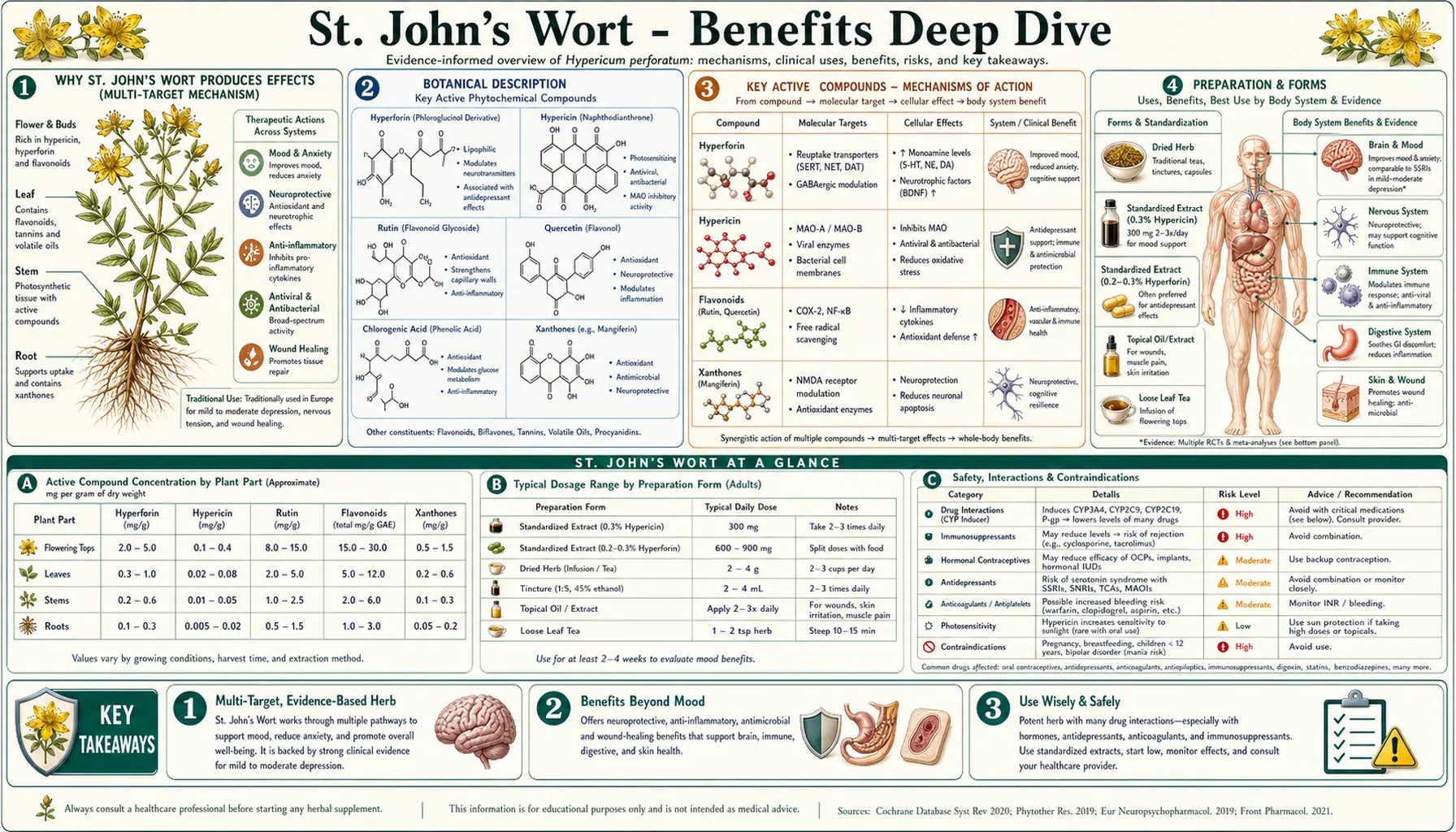
Hypericum perforatum — the bright-yellow European wildflower that blooms around the summer solstice — is the single most rigorously studied herbal antidepressant in modern medicine. Multiple Cochrane reviews (most recently Linde 2008, pooling 29 randomized trials and over 5,000 patients) have concluded that standardized hypericum extracts are statistically comparable to standard SSRI antidepressants for mild-to-moderate depression, with a substantially lower side-effect burden. The therapeutic profile depends on the synergy of three principal compound classes: hyperforin (multi-monoamine reuptake inhibition through TRPC6 channel activation), hypericin (photodynamic and MAO-modulating activity), and a rich flavonoid fraction (antioxidant and GABA-receptor binding). Four deep-dive pages below explore the major benefit domains — depression, mood and seasonal affective disorder, topical antiviral and wound-healing applications, and the most consequential and dangerous aspect of this herb's use: its potent induction of CYP450 enzymes and P-glycoprotein, which makes it the most-interacting herb in common clinical use.
⚠ CRITICAL SAFETY WARNING — Drug Interactions
St. John's Wort has the most extensive and clinically significant drug-interaction profile of any commonly used medicinal herb. Through induction of CYP3A4, CYP1A2, CYP2C9, and P-glycoprotein, it can reduce blood levels of more than 50% of all prescription drugs — including oral contraceptives (documented contraceptive failures and unintended pregnancies), warfarin, cyclosporine and tacrolimus (acute organ rejection has been reported), HIV protease inhibitors (treatment failure with viral resistance), digoxin, statins, anticoagulants, and chemotherapy agents. Combined with SSRIs, SNRIs, triptans, tramadol, or MAOIs, it can cause potentially fatal serotonin syndrome. The FDA, EMA, and Health Canada have all issued formal warnings. Disclose St. John's Wort use to every healthcare provider, pharmacist, and surgical team before starting any new medication or procedure. See the Critical Drug Interactions deep-dive for the comprehensive interaction table.
Deep-Dive Articles
Depression
The single most studied indication. Linde et al. 2008 Cochrane meta-analysis of 29 trials and 5,489 patients concluded standardized hypericum extracts are statistically comparable to standard SSRI and tricyclic antidepressants for mild-to-moderate major depression with significantly fewer adverse events. The HDS-1474 standardized extract, the Hypericum LI 160 trial, the pivotal mechanism of multi-monoamine reuptake inhibition via hyperforin's activation of TRPC6 ion channels, and the 4-6 week onset window that distinguishes botanical from pharmaceutical treatment.
Mood & Seasonal Depression
Wheatley's 1999 seasonal affective disorder (SAD) trial, the photoreceptor-mediated hypericin mood hypothesis, the curious paradox of an herb whose name and traditional harvest are tied to the summer solstice being clinically useful for winter depression, comparison to bright-light therapy (10,000 lux), combination protocols, and the mild-winter-depression and sub-syndromal sub-SAD applications that fall short of full DSM SAD criteria but still meaningfully impair quality of life.
Antiviral & Wound Healing
The ancient European wound oil (Oleum Hyperici, "St. John's Oil," "Red Oil") prepared by infusing fresh flowers in olive oil and sun-curing for weeks. Hypericin's photodynamic mechanism against enveloped viruses including HSV-1, HSV-2, and HPV. Hypericin topical photodynamic therapy (PDT) in dermatology. The herb's traditional use for nerve pain (trigeminal neuralgia, post-herpetic neuralgia, sciatica), bacterial skin infections including MRSA, and the burn and bruise applications that predated its antidepressant fame by centuries.
Critical Drug Interactions
The single most important page on this site for any patient considering St. John's Wort. A comprehensive table of CYP3A4, CYP1A2, CYP2C9, and P-glycoprotein-induced interactions affecting more than 50% of common prescription medications. Documented contraceptive failures, organ-rejection case series, HIV antiretroviral failure, warfarin INR collapse, the serotonin syndrome risk with SSRI/SNRI combination, the FDA, EMA, and Health Canada warning histories, and the 5-day pre-surgical discontinuation protocol.
Table of Contents
- Deep-Dive Articles
- Why St. John's Wort Produces Effects (Multi-Target Mechanism)
- Key Research Papers
- External Authoritative Resources
- Connections
- Featured Videos
Why St. John's Wort Produces Effects (Multi-Target Mechanism)
Conventional pharmaceutical antidepressants are designed as single-target drugs — an SSRI selectively inhibits the serotonin transporter, an SNRI inhibits serotonin and norepinephrine transporters, an MAO inhibitor blocks monoamine oxidase. The single-target design simplifies regulatory approval, dosing, and clinical trial interpretation, but it also limits efficacy in patients whose depression is driven by mechanisms other than the targeted neurotransmitter pathway. St. John's Wort is fundamentally different: it is a whole-plant extract whose therapeutic effect emerges from the synergistic interaction of dozens of bioactive compounds acting on multiple molecular targets simultaneously.
Three principal compound classes account for most of the documented activity:
- Hyperforin — the multi-monoamine reuptake inhibitor. Hyperforin is a phloroglucinol derivative discovered to be the most pharmacologically significant hypericum constituent (overturning the earlier assumption that hypericin was the active principle). Unlike pharmaceutical antidepressants that bind to neurotransmitter transporters at the substrate site, hyperforin works through an unusual mechanism: it activates the TRPC6 (Transient Receptor Potential Cation Channel C6) ion channel, raising intracellular sodium concentration, which then dissipates the sodium gradient that powers presynaptic reuptake of serotonin, norepinephrine, dopamine, GABA, and L-glutamate. This is effectively a non-selective reuptake inhibition of five neurotransmitters from a single molecular interaction — explaining why hypericum's antidepressant effect resembles the broadest-spectrum monoamine reuptake inhibitors while also producing GABAergic anxiolytic effects that pure SSRIs do not. Hyperforin is also a potent inducer of the CYP3A4 enzyme and P-glycoprotein transporter via activation of the pregnane X receptor (PXR), which is the molecular root of the herb's drug-interaction profile.
- Hypericin — the photodynamic and MAO-modulating naphthodianthrone. Hypericin is the red-pigmented compound that gives the traditional infused oil its dark crimson color and is the primary marker used to standardize commercial extracts (typically standardized to 0.3% hypericin). It is a photosensitizer: when activated by visible light, hypericin generates singlet oxygen and other reactive oxygen species that can damage enveloped viral particles, bacterial membranes, and dysplastic cells. This photodynamic mechanism underlies the topical antiviral and PDT applications against HSV, HPV, and certain skin cancers. Hypericin also weakly inhibits monoamine oxidase (MAO-A) in vitro, though the clinical relevance of this effect at oral therapeutic doses is debated. Hypericin is the source of the photosensitivity warning — some patients on high-dose hypericum develop sunburn-like rashes after sun exposure.
- Flavonoids and biflavonoids — antioxidant and GABAergic. Hypericum extracts contain a rich array of flavonoids (quercetin, rutin, hyperoside, isoquercitrin) and biflavonoids (amentoflavone, biapigenin). Amentoflavone in particular binds to the benzodiazepine binding site on the GABA-A receptor and contributes to the herb's anxiolytic effects without the sedation or dependence liability of benzodiazepines. The flavonoids also provide direct antioxidant activity and contribute to anti-inflammatory effects via NF-kB inhibition. Importantly, the flavonoids appear to enhance the bioavailability and CNS penetration of hyperforin and hypericin, which is why whole-plant extracts consistently outperform purified isolates in clinical trials.
The multi-target mechanism explains both the therapeutic breadth of the herb (effects observed in depression, anxiety, SAD, menopausal mood symptoms, neuropathic pain) and the clinical observation that hypericum is often well tolerated by patients who could not tolerate individual SSRI or tricyclic medications. It also explains the worst feature of the herb — the same pregnane X receptor activation that drives hyperforin's mood effects also induces CYP3A4 and P-glycoprotein system-wide, producing the most extensive drug-interaction profile of any commonly used herbal product. There is no way to separate the therapeutic mechanism from the interaction mechanism; they are different consequences of the same molecular event. The fourth deep-dive page is therefore not optional reading for any patient considering this herb — it is mandatory.
Key Research Papers
- Linde K et al. (2008). St John's wort for major depression. Cochrane Database of Systematic Reviews, Issue 4. CD000448. The definitive meta-analysis pooling 29 trials and 5,489 patients — concluded hypericum extracts comparable to standard antidepressants for mild-to-moderate depression with fewer side effects. — PubMed: Linde 2008 Cochrane
- Müller WE (2003). Current St John's wort research from mode of action to clinical efficacy. Pharmacological Research, 47(2):101-9. The seminal review elucidating hyperforin as the principal antidepressant compound and the TRPC6 channel mechanism of multi-monoamine reuptake inhibition. — PubMed: Müller 2003
- Schäfer-Korting M et al. (2007). Pharmacology of CYP3A4 induction by St. John's wort and clinical implications. The molecular mechanism (pregnane X receptor activation by hyperforin) driving the herb's extensive drug-interaction profile. — PubMed: PXR / CYP3A4 mechanism
- Wheatley D (1999). Hypericum in seasonal affective disorder (SAD). Current Medical Research and Opinion, 15(1):33-7. The pivotal trial establishing efficacy in winter seasonal depression and the rationale for the hypericin photoreceptor hypothesis. — PubMed: Wheatley SAD 1999
- Klemow KM, Bartlow A, Crawford J, Kocher N, Shah J, Ritsick M (2011). Medical Attributes of St. John's Wort (Hypericum perforatum). In Herbal Medicine: Biomolecular and Clinical Aspects, 2nd edition. The comprehensive monograph covering the botany, traditional use, active compounds (hyperforin, hypericin, flavonoids), pharmacology, clinical trials, and safety profile in one authoritative chapter. — PubMed: Klemow monograph
External Authoritative Resources
- NCCIH (National Center for Complementary and Integrative Health) — St. John's Wort — the U.S. federal government's primary consumer-facing summary, including drug-interaction warnings
- NIH Office of Dietary Supplements — St. John's Wort Fact Sheet (Health Professionals)
- FDA — Risk of Drug Interactions with St. John's Wort (formal regulatory warning)
- EMA (European Medicines Agency) — Hyperici herba (St. John's Wort) monograph
- MedlinePlus — St. John's Wort
- PubMed — All research on Hypericum perforatum (~6,000+ papers)
Connections
- All Herbs
- St. John's Wort (Main Page)
- St. John's Wort for Depression
- Mood & Seasonal Depression
- Antiviral & Wound Healing
- Critical Drug Interactions
- Depression
- Anxiety
- Bipolar Disorder
- OCD
- ADHD
- Lemon Balm
- Lavender
- Passionflower
- Rhodiola Rosea
- Ashwagandha
- Black Cohosh
- Stress Management
- Shingles (HSV)
- Fatigue