Licorice (Glycyrrhiza glabra) — Benefits Deep Dive
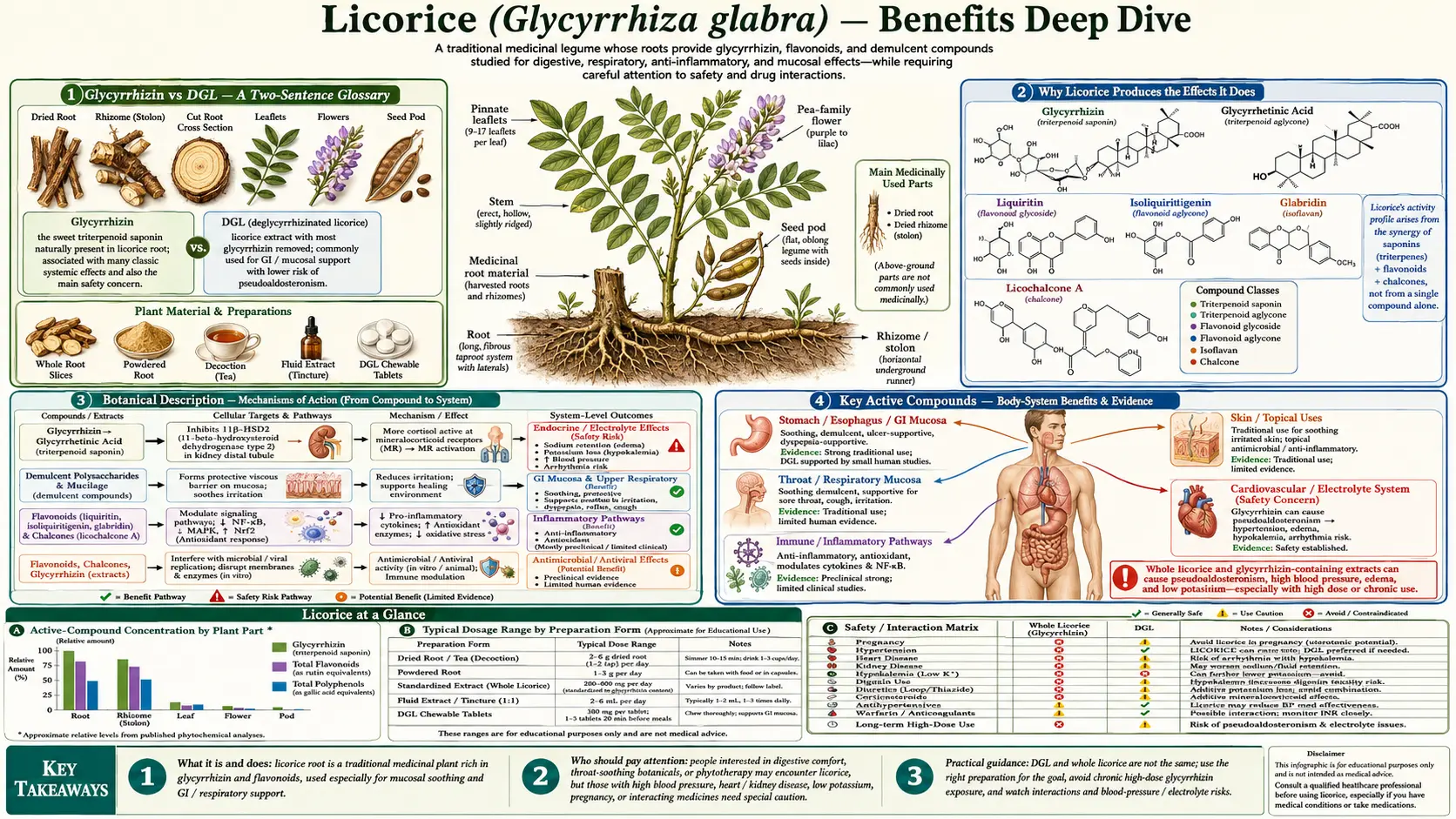
Glycyrrhiza glabra (literally "sweet root" in Greek) is one of the most-used herbs in both Chinese and Western herbal traditions — included as a "harmonizer" in roughly half of all classical Chinese herbal formulas (as gan cao) and continuously used in European pharmacy since at least Theophrastus in the 4th century BCE. Its dominant glycoside, glycyrrhizin (glycyrrhizic acid), is approximately 50 times sweeter than sucrose and is responsible for both the herb's most powerful clinical effects (antiviral activity, cortisol prolongation, anti-inflammatory action) and its most consequential adverse-effect syndrome (pseudoaldosteronism, hypokalemia, and hypertension). The deglycyrrhizinated form (DGL) removes glycyrrhizin entirely and has a fundamentally different safety profile — it retains the gastric mucus-stimulating flavonoid fraction without the cortisol or blood-pressure effects. The four deep-dive pages below explore the four most important clinical-effect domains and the single most important safety warning that anyone using whole licorice for more than a few days must understand.
CRITICAL SAFETY WARNING — PSEUDOALDOSTERONISM
Whole licorice and glycyrrhizin-containing preparations inhibit the enzyme 11-beta-HSD2 in the kidney, causing cortisol to act on the mineralocorticoid receptor as if it were aldosterone. The result is sodium and water retention, potassium loss (hypokalemia), hypertension, edema, and in severe cases life-threatening cardiac arrhythmias from low potassium. The FDA has issued a public-health warning that consuming as little as 2 ounces of black licorice candy per day for two weeks can trigger arrhythmias and hospitalization in adults over 40. The European Union upper limit for glycyrrhizin from food sources is 100 mg per day. Deglycyrrhizinated licorice (DGL) does not carry this risk because the glycyrrhizin has been removed. Anyone with hypertension, heart failure, kidney disease, or who takes diuretics, digoxin, or corticosteroids should use DGL only or avoid licorice entirely. See the dedicated Cortisol-and-Hypertension Warning page for the full mechanism, case literature, and contraindications.
Glycyrrhizin vs DGL — A Two-Sentence Glossary
Because most of the literature on licorice (and most of the patient confusion) hinges on this single distinction, it is worth defining it once at the top of every conversation:
- Whole licorice / glycyrrhizin-containing licorice — root, tea, tincture, standardized whole-root extract, and traditional candy. Contains glycyrrhizin (typically 2-12% by weight of the dried root). Produces the cortisol-prolonging, antiviral, and anti-inflammatory effects. Also produces the pseudoaldosteronism risk. Therapeutic dose ceiling is approximately 75-150 mg of glycyrrhizin per day, time-limited to 4-12 weeks, with blood pressure and potassium monitoring.
- DGL (deglycyrrhizinated licorice) — whole-root extract from which glycyrrhizin has been removed (residual glycyrrhizin typically < 3 mg per tablet, well below any pharmacologic threshold). Retains the flavonoid fraction responsible for gastric mucus stimulation, gastric epithelial restitution, and direct activity against Helicobacter pylori. Does not produce cortisol effects, blood-pressure effects, or potassium loss. Safe for indefinite daily use; the form of choice for peptic ulcer, gastritis, reflux, and any patient with cardiovascular or renal contraindications.
Deep-Dive Articles
Adrenal Support & Cortisol
Glycyrrhizin inhibits 11-beta-HSD2 in peripheral tissues, prolonging the half-life of endogenous cortisol — the rationale for using licorice in "adrenal fatigue" and HPA-axis depletion protocols. Covers the Shintani 1992 chronic fatigue trial, the pop-nutrition "adrenal cocktail," dosing for hypocortisolism, and an honest framing of why "adrenal fatigue" itself remains a controversial diagnostic label in conventional endocrinology.
GI Health & Ulcers (DGL)
The Morgan 1985 trial comparing DGL to cimetidine for peptic ulcer, the gastric-mucus and epithelial-restitution mechanism, DGL as adjunct in H. pylori eradication, the chewable-vs-capsule formulation question, and the carbenoxolone derivative line. Includes oral aphthous-ulcer (canker sore) trial data and the practical dosing convention of 380-760 mg chewed before meals.
Antiviral Activity
Glycyrrhizin's in-vitro and in-vivo antiviral profile against herpesviruses (HSV-1, EBV, CMV), the Crance 2003 hepatitis C work, the historically notable Cinatl 2003 Lancet paper showing glycyrrhizin inhibited the original SARS coronavirus replication, the Stronger Neo-Minophagen C intravenous protocol used for decades in Japan for chronic hepatitis, topical applications for cold sores, and a HIV adjunct pilot signal.
Cortisol & Hypertension Warning
The most-important safety page on the site for any herb. Walks through the 11-beta-HSD2 inhibition mechanism, why cortisol at high concentration acts on the mineralocorticoid receptor, the case reports of life-threatening hypokalemic arrhythmia from black licorice candy, the FDA 2 g/day candy warning, the European 100 mg/day glycyrrhizin upper limit, every absolute and relative contraindication, and why DGL bypasses the entire risk profile.
Table of Contents
- Glycyrrhizin vs DGL Glossary
- Deep-Dive Articles
- Why Licorice Produces the Effects It Does
- Research Papers: Adrenal & Cortisol
- Research Papers: GI & Ulcers (DGL)
- Research Papers: Antiviral
- Research Papers: Safety & Pseudoaldosteronism
- Research Papers: Cross-Cutting (Mechanism, Pharmacology, Reviews)
- External Authoritative Resources
- Connections
- Featured Videos
Why Licorice Produces the Effects It Does
Licorice is unusual among medicinal herbs in producing a wide range of clinical effects from a small number of well-characterized mechanisms, all traceable to three constituent classes:
- Glycyrrhizin (glycyrrhizic acid) and its active metabolite glycyrrhetinic acid — the dominant triterpenoid saponin and the constituent responsible for both the desired clinical effects of whole licorice and its dose-limiting toxicity. Three distinct molecular targets are well-mapped: (a) direct inhibition of 11-beta-hydroxysteroid dehydrogenase type 2 (11-beta-HSD2), the renal-tubular enzyme that normally inactivates cortisol — this is the mechanism behind both the adrenal-support effect and the pseudoaldosteronism toxicity; (b) direct binding to and partial agonism of the glucocorticoid receptor (GR) and mineralocorticoid receptor (MR), independent of any cortisol effect; and (c) direct antiviral activity against multiple enveloped DNA and RNA viruses through mechanisms that include inhibition of viral protein synthesis, modification of host signaling pathways, and inhibition of the viral fusion step — the mechanism behind the antiviral applications.
- The flavonoid fraction (liquiritin, liquiritigenin, isoliquiritigenin, glabridin, glabrene) — principally responsible for the gastric-protective and anti-inflammatory effects that survive the deglycyrrhization process and define DGL pharmacology. Flavonoids stimulate gastric mucus secretion (Muc5AC, Muc6), accelerate epithelial restitution after injury, inhibit pro-inflammatory transcription factors (NF-kappa-B, AP-1), and exhibit weak phytoestrogenic activity via beta-isoflavone-type structures.
- Polysaccharide and minor saponin fractions — less well-characterized but include demulcent action that coats and soothes mucous membranes (the basis of traditional use for cough, sore throat, and esophageal irritation) and expectorant action that helps mobilize respiratory mucus.
The therapeutic complication is that the same molecule (glycyrrhizin) that drives the most clinically powerful effects also drives the most consequential adverse effect. Unlike most herbs, where toxicity is a function of dose alone, with whole licorice the toxicity scales with the very same exposure that produces the desired effect, and individual sensitivity varies sharply because 11-beta-HSD2 expression varies among individuals. Some people develop hypertension after a single week of moderate intake; others tolerate higher doses for months. This is why blood pressure and serum potassium monitoring is non-negotiable for anyone using whole licorice therapeutically, and why the safety page is required reading before any clinical use.
A final pharmacology note: licorice is a substantial CYP450 modulator, with multiple isoforms affected. Notably, glycyrrhizin and glycyrrhetinic acid inhibit CYP3A4 and induce CYP2C9 and CYP2C19, producing a wide range of potential drug interactions including with warfarin, oral contraceptives, statins, methadone, tacrolimus, and many other commonly prescribed agents. Any patient on multiple prescription medications should consult a pharmacist before adding therapeutic-dose whole licorice.
Research Papers: Adrenal & Cortisol
- Glycyrrhizin and 11-beta-HSD2 inhibition mechanism — PubMed: 11-beta-HSD2 inhibition
- Shintani 1992 chronic fatigue and licorice glycyrrhizin pilot trial — PubMed: Shintani CFS trial
- Glycyrrhetinic acid and apparent mineralocorticoid excess syndrome — PubMed: Glycyrrhetinic AME
- Licorice and salivary cortisol prolongation — PubMed: Salivary cortisol
- HPA-axis depletion and adrenal fatigue: scientific status of the concept — PubMed: Adrenal fatigue systematic review
- Addison's disease and licorice as adjunct in hydrocortisone titration — PubMed: Addison's adjunct
- Glycyrrhizin and orthostatic hypotension management — PubMed: Orthostatic hypotension
- Licorice and DHEA-cortisol ratio in chronic fatigue patients — PubMed: DHEA-cortisol ratio
- Licorice glucocorticoid receptor and mineralocorticoid receptor direct binding — PubMed: GR/MR binding
- Glycyrrhizin pharmacokinetics in healthy volunteers (Ploeger 2001) — PubMed: Ploeger PK
Research Papers: GI & Ulcers (DGL)
- Morgan AG et al. (1985). DGL vs cimetidine for chronic duodenal ulcer healing — PubMed: Morgan 1985 trial
- DGL gastric mucus stimulation mechanism — PubMed: DGL mucus mechanism
- Licorice flavonoid GutGard standardized extract for functional dyspepsia — PubMed: GutGard dyspepsia trial
- Licorice activity against Helicobacter pylori — PubMed: H. pylori
- Carbenoxolone (synthetic glycyrrhetinic acid derivative) for peptic ulcer — PubMed: Carbenoxolone
- DGL for aphthous ulcer (canker sore) topical — PubMed: Aphthous ulcer DGL
- Licorice for GERD and reflux esophagitis — PubMed: Licorice and reflux
- NSAID-induced gastric mucosal injury prevention with licorice — PubMed: NSAID gastroprotection
- Isoliquiritigenin and gastric epithelial cell restitution — PubMed: Isoliquiritigenin
- Glabridin and H. pylori antimicrobial activity — PubMed: Glabridin H. pylori
Research Papers: Antiviral
- Cinatl J et al. (2003). Glycyrrhizin, an active component of liquorice roots, and replication of SARS-associated coronavirus. Lancet. — PubMed: Cinatl SARS Lancet 2003
- Crance JM et al. (2003). Interferon, ribavirin, 6-azauridine and glycyrrhizin against hepatitis viruses — PubMed: Crance HCV 2003
- Stronger Neo-Minophagen C intravenous glycyrrhizin for chronic hepatitis — PubMed: SNMC Japan
- Glycyrrhizin and herpes simplex virus type 1 inhibition — PubMed: HSV-1 inhibition
- Glycyrrhizin and Epstein-Barr virus (EBV) reactivation — PubMed: EBV
- Topical glycyrrhetinic acid for recurrent labial herpes — PubMed: Topical cold sore
- Glycyrrhizin and cytomegalovirus (CMV) replication — PubMed: CMV
- Glycyrrhizin pilot data in HIV infection — PubMed: HIV pilot
- Hepatocellular carcinoma risk reduction with chronic glycyrrhizin in chronic hepatitis C — PubMed: HCC risk reduction
- Glycyrrhizin antiviral mechanism review — PubMed: Antiviral mechanism review
Research Papers: Safety & Pseudoaldosteronism
- Licorice-induced pseudoaldosteronism case reports (collected) — PubMed: Pseudoaldosteronism cases
- Stewart PM et al. (1987). Mineralocorticoid activity of liquorice: 11-beta-hydroxysteroid dehydrogenase deficiency comes of age. Lancet. — PubMed: Stewart Lancet 1987
- FDA public health warning: black licorice and cardiac arrhythmia — PubMed: FDA black licorice
- European Scientific Committee on Food — glycyrrhizin upper limit 100 mg/day — PubMed: EU upper limit
- Licorice-induced hypokalemic paralysis case series — PubMed: Hypokalemic paralysis
- Licorice and rhabdomyolysis from severe hypokalemia — PubMed: Rhabdomyolysis
- Licorice in pregnancy and preterm birth association — PubMed: Pregnancy and preterm
- Licorice in pregnancy and offspring cognitive/HPA outcomes (Finnish cohort) — PubMed: Finnish cohort
- DGL safety profile in chronic use — PubMed: DGL safety
- Licorice and severe hypertension reversibility on discontinuation — PubMed: Reversibility
Research Papers: Cross-Cutting (Mechanism, Pharmacology, Reviews)
- Comprehensive Glycyrrhiza pharmacology review (Asl & Hosseinzadeh 2008) — PubMed: Asl 2008 review
- Glycyrrhizin and CYP450 drug interactions — PubMed: CYP interactions
- Licorice and warfarin / anticoagulant interaction — PubMed: Warfarin interaction
- Isoliquiritigenin anti-inflammatory and NF-kappa-B inhibition — PubMed: Isoliquiritigenin NF-kB
- Glabridin and tyrosinase inhibition for skin pigmentation — PubMed: Glabridin skin
- Glycyrrhizin and respiratory mucus expectorant activity — PubMed: Expectorant action
- Glycyrrhiza uralensis vs glabra chemical comparison — PubMed: Species comparison
- Licorice as harmonizer in classical Chinese formulas (gan cao) — PubMed: Gan cao in formulas
- Glycyrrhizin in cosmetic and dermatologic formulations — PubMed: Cosmetic glycyrrhizin
- Licorice as adjunct to corticosteroid taper (potential effect) — PubMed: Corticosteroid taper
External Authoritative Resources
- NCCIH — Licorice Root Fact Sheet — the National Center for Complementary and Integrative Health summary, including safety warnings
- FDA — Black Licorice: Trick or Treat? — the FDA public health communication on glycyrrhizin and cardiac arrhythmia from candy consumption
- MedlinePlus — Licorice (Glycyrrhiza glabra)
- NIH Office of Dietary Supplements — Botanical Fact Sheets
- PubMed — All research on Glycyrrhiza glabra (12,000+ papers)
- PubMed — All research on Glycyrrhiza uralensis (the Chinese species)
Connections
- All Herbs
- Licorice (Main Page)
- Licorice for Adrenal Support & Cortisol
- Licorice for GI Health & Ulcers
- Licorice Antiviral Activity
- Cortisol & Hypertension Warning
- Ashwagandha
- Holy Basil
- Rhodiola Rosea
- Marshmallow
- Slippery Elm
- Cortisol Test
- Adrenal Support
- Adrenal Fatigue
- Hypertension
- Peptic Ulcer Disease
- Gastroenterology
- Hepatitis
- Potassium
- Gut Healing