Licorice: History and Traditional Use
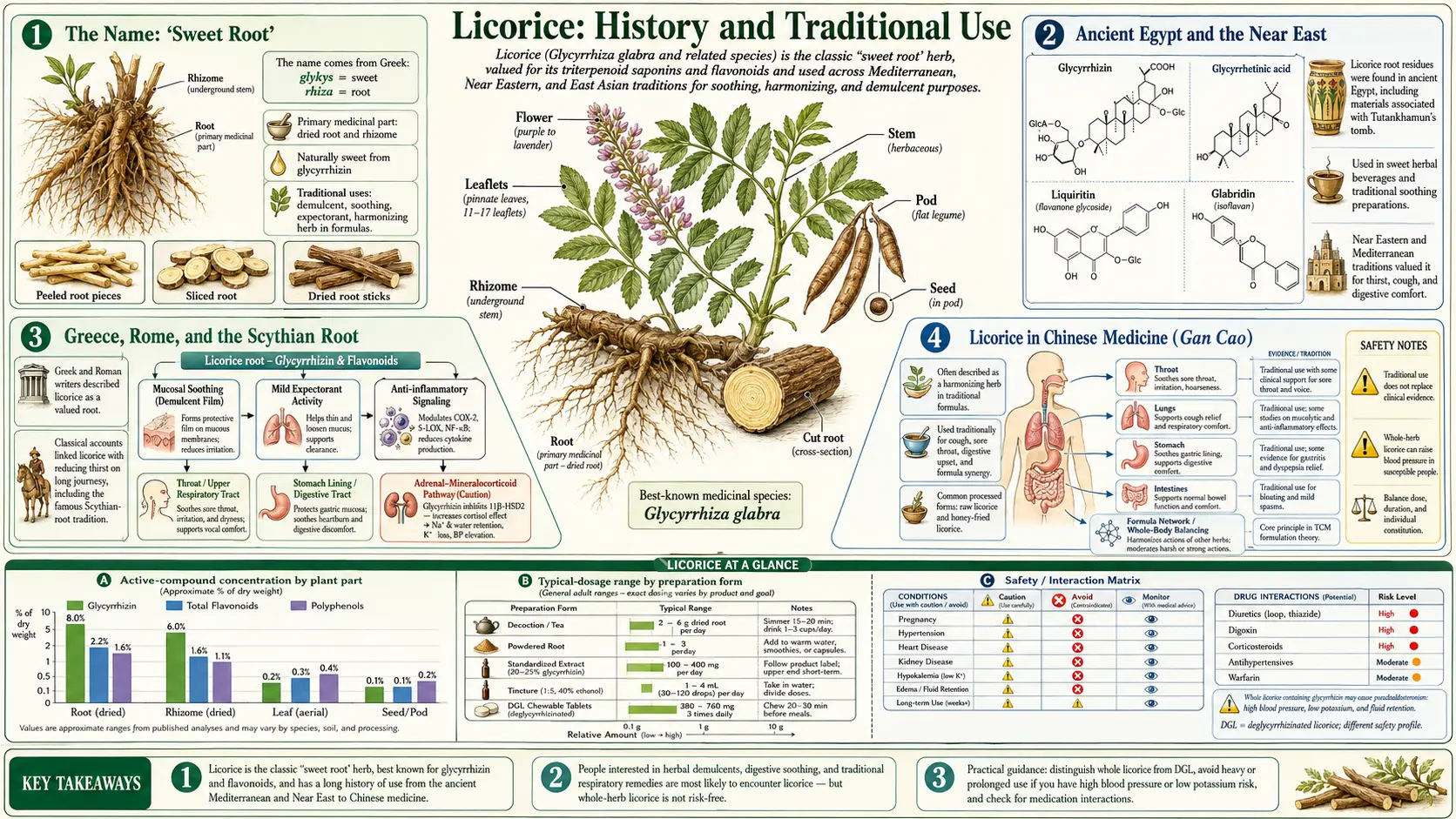
Licorice — the sweet root of Glycyrrhiza glabra and its close relatives — is one of the oldest and most widely travelled medicinal plants on record. Its very name tells its story: the Greek glykyrrhiza means simply “sweet root,” and the modern words licorice and liquorice are worn-down forms of it. This article follows the documented thread of that history — from the physicians of the ancient Mediterranean and the “Scythian root” that thirsty soldiers were said to chew, through licorice’s central place in Chinese medicine, its arrival in England and the sweet-shops of Pontefract, and into the modern laboratory where its compounds were finally named. Throughout, claims that rest on tradition or folklore are described as such; only firmly recorded history is stated as fact.
Table of Contents
- The Name: “Sweet Root”
- Ancient Egypt and the Near East
- Greece, Rome, and the Scythian Root
- Licorice in Chinese Medicine
- Ayurveda and Other Eastern Traditions
- Medieval Europe, England, and Pontefract
- From Medicine to Confectionery
- Naming the Plant and Its Compounds
- From Tradition to Modern Research
- References
- Connections
- Featured Videos
The Name: “Sweet Root”
Few plants are so honestly named. The botanical genus Glycyrrhiza comes straight from two Greek words — glykys, “sweet,” and rhiza, “root” — so the scientific name literally means “sweet root.” The everyday English words licorice (American spelling) and liquorice (British spelling) are simply that same Greek word, glykyrrhiza, gradually reshaped as it passed through Latin and Old French into English. When you say the name, you are repeating a description that classical Greek physicians wrote down more than two thousand years ago.
That sweetness is not ordinary sugar. It comes mainly from a compound called glycyrrhizin (also written glycyrrhizic or glycyrrhizinic acid), which is commonly described as roughly fifty times sweeter than table sugar. This single fact — an intensely sweet root that also seemed to soothe coughs and settle the stomach — is what made licorice so prized across so many cultures, and it runs through every chapter of the plant’s long history.
The plant itself is a hardy, deep-rooted perennial of the pea and bean family (Fabaceae), native to a broad band stretching from southern Europe through the Mediterranean and the Near East into western and central Asia. It is the thick, woody root and underground runners — not the leaves or the pale violet flowers — that hold the sweetness and have been gathered, dried, chewed, boiled, and traded for thousands of years.
Ancient Egypt and the Near East
Licorice belongs to the small handful of plants whose medicinal use reaches back to the very beginnings of the written record. Historians of medicine generally place its origins in the ancient Near East and the lands around Mesopotamia — indeed, a modern historical review by the clinical pharmacologist Michael R. Lee is subtitled “the journey of the sweet root from Mesopotamia to England,” tracing the plant from those early Eastern roots all the way to the British Isles.
In ancient Egypt, licorice appears among the plant remedies of the Ebers Papyrus, one of the most important surviving Egyptian medical texts, which is dated to roughly 1550 BCE. There it is listed as a sweet root used in herbal preparations — broadly as a gentle remedy for the chest, the digestion, and other minor complaints, consistent with the soothing, sweetening role licorice has played ever since. (A frequently repeated popular story holds that large quantities of licorice root were found among the treasures of Tutankhamun’s tomb; this colourful detail is best treated as tradition rather than firmly documented fact.)
Across the broader ancient Near East — Assyrian, Babylonian, and later Arab and Persian medicine all drew on the same sweet root — licorice was valued chiefly for coughs and chest complaints, for soothing the stomach, and as a general restorative. What is certain is that by the time the Greek and Roman writers began to describe it, licorice was already an old and well-established medicine inherited from the East.
Greece, Rome, and the Scythian Root
The plant enters the Western written tradition with the physicians and naturalists of classical Greece. The first mention in the Mediterranean medical literature is generally attributed to the Hippocratic writings: the treatise Diseases of Women, associated with the school of Hippocrates (5th–4th century BCE), refers to the sweet root, traditionally given mixed with honey. Whether or not Hippocrates himself wrote those words, the reference shows licorice was already part of Greek practice early on.
A clearer picture comes from Theophrastus (c. 371–287 BCE), the pupil of Aristotle often called the father of botany. He described a sweet plant he called the Scythian root or Scythian plant, growing in the region of Lake Maeotis (the Sea of Azov, north of the Black Sea). The famous — and often-repeated — tradition attached to this is that the nomadic Scythian peoples chewed the root, together with a cheese made from mare’s milk, to stave off thirst on long marches, reputedly going many days without water. This story should be read as the ancient account it is; it nicely captures why a sweet, moisture-holding root that quiets a dry mouth would be carried by people on the move.
In the first century CE the Greek army physician Dioscorides, whose De Materia Medica became the foundational drug reference of the Western world for the next fifteen centuries, gave licorice a detailed entry under names including glykyrrhiza, the “Scythian” root, the “Pontic” root, and adipson (roughly, “thirst-quenching”). He recommended decoctions of the root for a dry, irritated throat and cough, for heartburn and stomach complaints, and applied to wounds, and noted that the best licorice came from Cappadocia and Pontus in Asia Minor. His Roman contemporary Pliny the Elder likewise catalogued the sweet root in his Natural History, remarking that the finest came from Cilicia (in what is now southern Turkey) and repeating its use for the voice, the throat, and thirst. These classical entries — cough, throat, stomach, thirst — are the headwaters of essentially the entire later European tradition. They are named here as historical primary sources rather than as modern citations.
Licorice in Chinese Medicine
While Mediterranean physicians were writing licorice into their pharmacopoeias, an independent and equally deep tradition was growing in East Asia. In Traditional Chinese Medicine the root — usually from the related species Glycyrrhiza uralensis as well as G. glabra — is called gan cao (甘草), literally “sweet grass” or “sweet herb,” and it is among the most frequently used herbs in the entire system. It is recorded in the foundational Chinese herbal classic, the Shennong Bencao Jing (the Divine Farmer’s Materia Medica, compiled around the first to second centuries CE), where it is placed in the highest, “superior” class of herbs — those regarded as safe for long-term use. By the early centuries CE Chinese physicians were using it, among other purposes, to strengthen what the tradition calls the qi (vital energy) of the heart and the spleen.
Licorice earned an almost proverbial status in Chinese herbalism. It is traditionally nicknamed the “Great Harmonizer” (and, in some accounts, given honorifics such as the “Elder Statesman” of the herbs), because its classic role is to be added to a multi-herb formula to harmonize and moderate the other ingredients — smoothing harsh herbs, blending their actions, and protecting the digestion. A well-known saying in Chinese medicine holds that “nine out of ten formulas contain licorice,” and modern reviews describe it as a uniquely important “guide drug” for exactly this combining role. As with all traditional frameworks, these concepts (qi, harmonizing, the categories of herbs) are described here as the historical theory of that system, not as established physiology or medical advice.
Ayurveda and Other Eastern Traditions
Licorice also has a long place in the traditional medicine of the Indian subcontinent. In Ayurveda it is known by Sanskrit names including yashtimadhu (often translated as “sweet stick”) and mulethi, and it has been used traditionally as a soothing, demulcent herb — for the throat and cough, for the digestion, and as a general restorative or rejuvenating (rasayana) tonic. Its sweetness and its reputation for soothing irritated tissues gave it a role broadly parallel to the one it played in the Mediterranean and Chinese systems, a striking convergence among traditions that developed largely on their own.
From these heartlands licorice spread along the great trade routes. It was carried through Arab and Persian medicine — where physicians of the medieval Islamic world prescribed the sweet root for the chest, the stomach, and the kidneys — and it travelled both east and west as a valued article of commerce. By the close of the ancient and medieval periods, licorice was one of the relatively few medicinal plants genuinely known and used right across Eurasia, from China and India to the Atlantic coast of Europe.
Medieval Europe, England, and Pontefract
Licorice reached Europe as both a medicine and a luxury, and according to Lee’s historical account it was probably carried into Europe by the Cluniac order of monks, who cultivated medicinal plants in their monastery gardens. From the medieval period onward the dried root was a standard item in the European apothecary and a popular remedy for coughs, hoarseness, and chest and stomach complaints — the same uses the classical authors had recorded.
The most famous chapter of licorice in the West unfolded in England. Lee records that, “almost by accident,” licorice became established as a crop in West Yorkshire at Pontefract in the wake of the dissolution of the monasteries in the 1530s, when monastic lands and their plantings passed into other hands. The deep, well-drained soils around Pontefract suited the long-rooted plant, and the town became so closely identified with it that the small round licorice sweets stamped with the town’s castle became known as Pontefract cakes (or Pomfret cakes). For generations Pontefract was the centre of English licorice growing and the heart of a thriving licorice-sweet industry.
From Medicine to Confectionery
One of the most distinctive things about licorice is how thoroughly it crossed from the medicine chest into the sweet-shop — a journey driven entirely by that natural sweetness. Because the root is so sweet on its own, it was a natural base for lozenges and pastilles meant to soothe the throat, and those medicinal lozenges shaded gradually into pure confectionery. The Pontefract cake began life in this way, and over time licorice became the foundation of a whole family of candies and the familiar dark, anise-like flavour of licorice sweets, drinks, and liqueurs.
Licorice extract also became a widely used flavouring and sweetener in its own right — in confectionery, in some tobacco products, and in beverages — valued both for its sweetness and for its ability to mask bitterness. A practical word of caution that grows out of this history: not everything sold as “licorice” candy actually contains the root. Much black “licorice-flavoured” confectionery is flavoured chiefly with anise oil, which has a similar taste but is botanically unrelated, so genuine Glycyrrhiza content varies widely from product to product. This distinction matters, because the real root’s sweet compound, glycyrrhizin, can raise blood pressure and disturb the body’s salt and potassium balance when a lot is eaten over time — an effect documented in people who consumed large amounts of true licorice confectionery, and the reason modern guidance urges moderation. (Those safety issues are covered in detail on the main Licorice page and in the Benefits articles.)
Naming the Plant and Its Compounds
The transition from folk plant to scientific subject can be dated with some precision. The plant received its formal botanical name when the Swedish naturalist Carl Linnaeus published Glycyrrhiza glabra in his landmark Species Plantarum in 1753 — the work that fixed the modern two-name (binomial) system of naming living things. The species epithet glabra means “smooth,” distinguishing it from licorice relatives with hairier or spinier seed pods. To this day the standard botanical name is written “Glycyrrhiza glabra L.,” the trailing “L.” marking Linnaeus as its author.
Over the following two centuries chemists set about explaining the root’s sweetness and its effects. They identified its principal sweet constituent, glycyrrhizin, a triterpene saponin that the body converts to an active form called glycyrrhetinic acid; alongside it they characterized the flavonoids (such as liquiritin and isoliquiritigenin) and the isoflavonoid glabridin. A landmark in licorice’s modern medical career came in Japan, where an intravenous glycyrrhizin preparation marketed as Stronger Neo-Minophagen C (SNMC) was introduced for liver disease; intravenous treatment of patients with chronic hepatitis began there in 1977, and long-term studies later reported reduced liver injury and a lower rate of cirrhosis and liver cancer in treated chronic hepatitis C patients. The detailed chemistry and pharmacology of these compounds — and what the clinical evidence does and does not support — are taken up on the main Licorice page and in the Licorice Benefits articles.
From Tradition to Modern Research
The striking feature of licorice’s history is how consistent it is. Independent cultures — Egyptian, Greek and Roman, Chinese, Indian, Arab and Persian, and finally European — reached for the same sweet root for a remarkably similar short list of purposes: soothing a dry, irritated cough and throat, calming the stomach, and serving as a gentle restorative and a sweet base for other remedies. That a plant native to the Near East and central Asia should be used in nearly the same ways from China to England is one of the clearer examples of how a genuinely useful medicinal plant travels and is rediscovered.
Modern phytochemistry has, in turn, given chemical names to the qualities those old physicians described — glycyrrhizin and its metabolite for the sweetness and the cortisol-related effects; the flavonoids for soothing and protecting the stomach lining; glabridin for the skin. The same research has also drawn the firm boundaries the traditional record could not: glycyrrhizin in quantity can raise blood pressure and deplete potassium, which is why the deglycyrrhizinated form (DGL) was developed for long-term stomach use and why whole licorice must be used in moderation and with care. Tradition, in other words, raised the questions; research is now supplying both the explanations and the cautions. The thread that runs from Dioscorides’ first-century decoction and a Chinese harmonizing formula to a Yorkshire sweet-shop and a modern hepatology ward is, remarkably, unbroken — which is what makes the history of this humble sweet root worth knowing.
References
The references below are peer-reviewed historical and review articles together with curated PubMed topic-search links into the historical and ethnobotanical literature on licorice (Glycyrrhiza glabra). Historical primary texts (the Ebers Papyrus, the Hippocratic Diseases of Women, Theophrastus’ botanical writings, Dioscorides’ De Materia Medica, Pliny’s Natural History, and the Shennong Bencao Jing) are named in the article as historical sources rather than as modern citations. Each external link opens in a new tab.
- Lee MR. Liquorice (Glycyrrhiza glabra): the journey of the sweet root from Mesopotamia to England. Journal of the Royal College of Physicians of Edinburgh. 2018;48(4):378-382. — doi:10.4997/JRCPE.2018.419
- Wahab S, Annadurai S, Abullais SS, et al. Glycyrrhiza glabra (Licorice): A Comprehensive Review on Its Phytochemistry, Biological Activities, Clinical Evidence and Toxicology. Plants (Basel). 2021;10(12):2751. — doi:10.3390/plants10122751
- Wang X, Zhang H, Chen L, et al. Liquorice, a unique “guide drug” of traditional Chinese medicine: a review of its role in drug interactions. Journal of Ethnopharmacology. 2013;150(3):781-790. — PMID: 24201019
- Kumada H. Long-term treatment of chronic hepatitis C with glycyrrhizin [Stronger Neo-Minophagen C (SNMC)] for preventing liver cirrhosis and hepatocellular carcinoma. Oncology. 2002;62(Suppl 1):94-100. — doi:10.1159/000048283
- Licorice history and traditional use — PubMed: Glycyrrhiza glabra history and traditional use
- Licorice ethnobotany and ethnopharmacology — PubMed: licorice ethnobotany and ethnopharmacology
External Authoritative Resources
- NCCIH — Licorice Root: Usefulness and Safety
- MedlinePlus — Herbs and Supplements
- PubMed — All research on Glycyrrhiza glabra