Licorice for GI Health and Peptic Ulcers (DGL)
Deglycyrrhizinated licorice (DGL) is the most-studied botanical intervention for peptic ulcer disease, gastritis, and reflux esophagitis. By removing glycyrrhizin from whole licorice, DGL eliminates the cortisol-prolonging side effect profile while preserving the flavonoid fraction that stimulates gastric mucus secretion, accelerates epithelial restitution after injury, and exhibits direct activity against Helicobacter pylori. The pivotal 1985 Morgan trial demonstrated equivalent duodenal ulcer healing rates between DGL and cimetidine (the proton-pump inhibitor predecessor) over 12 weeks of therapy. Half a century earlier, the synthetic glycyrrhetinic acid derivative carbenoxolone was used routinely in British hospitals for peptic ulcer and is the structural template that led to modern peptic-ulcer drug design. Today DGL retains a respected place in the natural pharmacopeia for ulcer prevention, dyspepsia management, NSAID gastroprotection, oral aphthous ulcer (canker sore) treatment, and as a supportive adjunct to standard H. pylori eradication. This page covers each application, the mechanism, the chewable-vs-capsule formulation question, dosing convention, and the (small) safety considerations that distinguish DGL from whole licorice.
Table of Contents
- DGL Defined — What "Deglycyrrhizinated" Means
- Why DGL and Not Whole Licorice for GI Use
- The Morgan 1985 DGL-vs-Cimetidine Trial
- Gastric Mucus Stimulation — The Primary Mechanism
- Epithelial Restitution — The Second Mechanism
- DGL and Helicobacter pylori — Adjunct Role
- Functional Dyspepsia (GutGard Trials)
- Reflux and Gastroesophageal Reflux Disease (GERD)
- NSAID Gastroprotection
- Oral Aphthous Ulcer (Canker Sore) Treatment
- The Carbenoxolone Story — The Synthetic Cousin
- Chewable vs Capsule Formulation
- Dosing and Practical Use
- Safety Profile of DGL
- Key Research Papers
- Connections
- Featured Videos
DGL Defined — What "Deglycyrrhizinated" Means
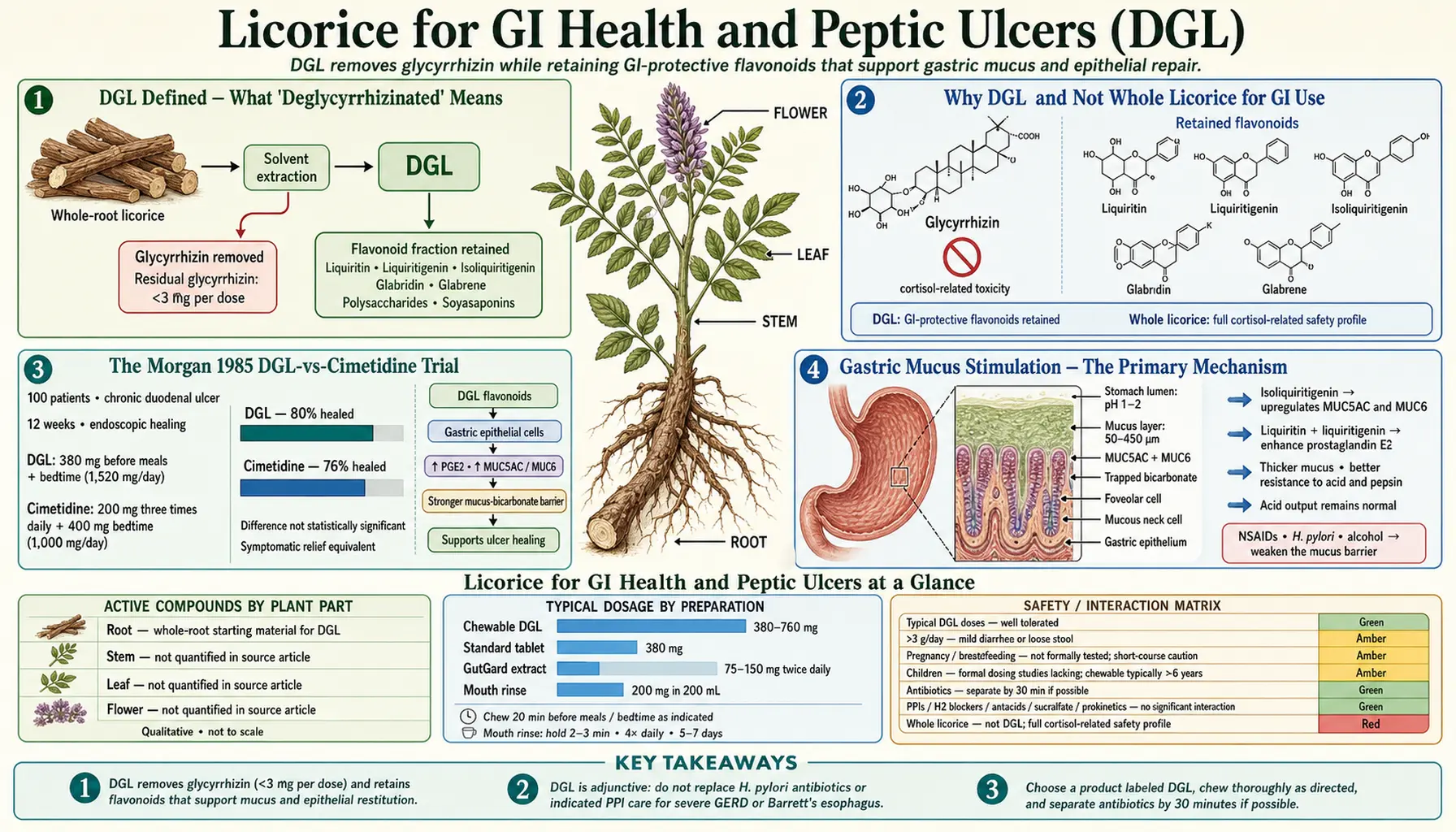
Deglycyrrhizinated licorice (DGL) is whole-root licorice from which the glycyrrhizin (glycyrrhizic acid) has been removed by solvent extraction. The standard preparation reduces glycyrrhizin content to less than 3 mg per dose, well below the threshold at which 11-beta-HSD2 inhibition produces detectable cortisol prolongation or mineralocorticoid effects. The European Pharmacopoeia and the United States Pharmacopeia both specify the deglycyrrhization process and the residual glycyrrhizin upper limit.
What remains after deglycyrrhization is the flavonoid fraction: liquiritin, liquiritigenin, isoliquiritigenin, glabridin, glabrene, and dozens of minor flavonoids, plus polysaccharides, soyasaponins (other than glycyrrhizin), and a small amount of essential-oil-soluble fraction. These constituents are responsible for the gastric-mucosal effects that make DGL clinically useful, and they are not the constituents responsible for the cortisol-prolongation problem.
From a labeling perspective: products marked "DGL" or "deglycyrrhizinated licorice" reliably meet this specification. Products marked simply "licorice extract" or "licorice root" do not — they are whole-licorice preparations and carry the full cortisol-related safety profile. The distinction matters: a patient on antihypertensive medication can safely chew DGL daily but should not consume daily whole licorice.
Why DGL and Not Whole Licorice for GI Use
The flavonoid fraction is the GI-protective fraction. Glycyrrhizin contributes nothing useful to ulcer healing or gastric mucus stimulation. Removing glycyrrhizin eliminates the cortisol-related toxicity without sacrificing any of the GI-protective benefit. From a benefit-risk perspective, there is essentially no clinical scenario in which whole licorice is preferable to DGL for peptic ulcer, gastritis, reflux, or dyspepsia — the same effect is available at lower risk.
This is unusual in herbal pharmacology. Most herbs cannot be cleanly fractionated into a "useful part" and a "toxic part"; the full constituent profile is needed to reproduce the traditional clinical effect. Licorice is the exception. The 1950s discovery that DGL retained ulcer activity without the mineralocorticoid effect was a small revolution in botanical pharmacology and led to the development of the synthetic carbenoxolone derivative (discussed below).
The historical exception was the use of whole licorice in classical Chinese formulas as a harmonizer (gan cao). In that context, licorice was rarely the dominant ingredient and was typically used at low doses (3-9 g of raw root in a daily decoction shared with 8-15 other herbs), and the formulas were prescribed for short courses. Even so, modern TCM practitioners increasingly substitute DGL for whole licorice in patients with hypertension or cardiovascular risk, with no apparent loss of efficacy for GI indications.
The Morgan 1985 DGL-vs-Cimetidine Trial
The pivotal modern trial of DGL in peptic ulcer disease was Morgan AG and colleagues, published in Gut in 1985 (though the work spanned several years earlier). 100 patients with endoscopically confirmed chronic duodenal ulcer were randomized to one of two arms:
- DGL arm — 380 mg of DGL chewed three times daily before meals and at bedtime (1,520 mg/day total)
- Cimetidine arm — 200 mg three times daily and 400 mg at bedtime (1,000 mg/day total, the standard ulcer dose)
After 12 weeks of treatment, endoscopic ulcer healing was assessed:
- DGL arm: 80% healed
- Cimetidine arm: 76% healed
- Difference: not statistically significant
Symptomatic relief was also equivalent between the two arms, and both arms tolerated treatment well. The Morgan trial established that DGL had genuine ulcer-healing activity comparable to the standard pharmaceutical of its day. Cimetidine has since been largely superseded by H2 blockers (ranitidine, famotidine) and then by proton-pump inhibitors (omeprazole, esomeprazole, pantoprazole), but DGL retains its position as a botanical option for patients who prefer not to use PPIs long-term, who have rebound symptoms on PPI withdrawal, or who use PPIs intermittently and want a daily maintenance option.
One limitation of the Morgan-era data is that it predates the recognition of Helicobacter pylori as the underlying cause of most duodenal ulcers (Marshall and Warren's 1983 paper). Modern duodenal ulcer management now starts with H. pylori eradication (triple or quadruple antibiotic therapy plus a PPI) rather than acid suppression alone. DGL in the modern era is used either as adjunct during H. pylori eradication, as maintenance therapy in the post-eradication phase, or as primary therapy for the subset of duodenal ulcers that are not H. pylori-positive (often NSAID-associated).
Gastric Mucus Stimulation — The Primary Mechanism
The gastric epithelium is protected from autodigestion by a layer of mucus 50-450 micrometers thick, composed of gel-forming mucins (principally MUC5AC and MUC6) secreted by foveolar and mucous neck cells. This mucus layer traps a thin layer of bicarbonate at its base, creating a neutralizing buffer at the cell surface even when luminal pH is 1-2. Disruption of this mucus barrier — by NSAIDs that inhibit prostaglandin-mediated mucus secretion, by H. pylori that secretes urease and proteases that thin the mucus, or by alcohol that solubilizes the gel structure — exposes the underlying epithelium to acid attack and is the proximate mechanism of most peptic ulcers.
The DGL flavonoid fraction stimulates gastric mucus secretion through several pathways. Isoliquiritigenin appears to upregulate MUC5AC and MUC6 expression at the transcriptional level. Liquiritin and liquiritigenin enhance prostaglandin E2 production in gastric epithelial cells (the same prostaglandin pathway that NSAIDs inhibit). The result is a thicker, more robust mucus layer that better resists acid penetration and pepsin digestion.
This mechanism explains why DGL works as both a treatment (helping existing ulcers heal by restoring mucosal defense) and a prevention (protecting against NSAID-induced injury when taken prophylactically). It also explains why DGL works without altering gastric acid output — unlike H2 blockers and PPIs, which reduce acid production, DGL leaves acid output normal and strengthens the mucosal defense that handles the acid. This is mechanistically appealing because chronic acid suppression has its own downstream consequences (small intestinal bacterial overgrowth, calcium and magnesium malabsorption, B12 malabsorption, increased infection risk).
Epithelial Restitution — The Second Mechanism
The gastric and duodenal mucosa is one of the body's most rapidly regenerating tissues — the entire epithelial surface is turned over every 3-7 days under normal conditions. When superficial injury occurs (a small erosion from NSAIDs, a stress-related lesion, the early-stage breakdown that precedes a frank ulcer), epithelial restitution is the rapid migration of viable cells from the wound margins to cover the denuded area, followed by full epithelial regeneration from the gastric pit stem cells. This process can resurface a small erosion within 30-60 minutes when the local environment is supportive.
DGL flavonoids appear to accelerate the restitution process by several mechanisms: increased local prostaglandin E2 production (cytoprotective), increased expression of cell-migration-related cytoskeletal proteins, antioxidant action that protects migrating cells from reactive oxygen species at the wound margin, and reduced local inflammation that would otherwise impede restitution. In cell-culture and animal models, DGL or its flavonoid components measurably accelerate epithelial wound closure compared to vehicle control.
For the patient, the practical translation is that DGL works better as a daily preventive than as an acute rescue medication. Taken before meals (when the gastric acid stimulus peaks) and at bedtime (when the next-morning acid peak follows hours of low intake), it supports the local environment that allows the natural restitution process to keep pace with the constant minor injury that any acid-secreting stomach inflicts on itself.
DGL and Helicobacter pylori — Adjunct Role
Helicobacter pylori is the gram-negative, microaerophilic, urease-producing bacterium implicated in roughly 70% of gastric ulcers and 90% of duodenal ulcers globally. Discovery of the organism by Marshall and Warren (Nobel Prize 2005) transformed peptic ulcer disease from a chronic relapsing condition managed by acid suppression into a curable infectious disease managed by short-course antibiotic therapy. The current standard for H. pylori eradication is one of several multi-drug regimens (clarithromycin triple therapy, bismuth quadruple therapy, levofloxacin-based salvage therapy) plus a proton-pump inhibitor, typically given for 10-14 days.
DGL has documented direct inhibitory activity against H. pylori in vitro. The mechanism is not fully characterized but appears to involve flavonoid-mediated disruption of bacterial cell membranes and inhibition of urease activity. The in vivo activity is much weaker than the in vitro activity, however — DGL alone is not a viable H. pylori eradication therapy and should not be used as a substitute for standard antibiotic regimens.
The adjunct role for DGL in H. pylori management is twofold: (a) taken during antibiotic eradication, DGL appears to reduce the gastric mucosal irritation that the antibiotics themselves cause and may improve patient tolerance of the multi-drug protocol; (b) taken in the post-eradication phase, DGL supports mucosal recovery in the gastric epithelium that was damaged by the chronic H. pylori infection. There is also some evidence that DGL may reduce the rate of reinfection or recolonization, though this is less well-established.
For patients in whom standard antibiotic eradication has failed (resistant H. pylori is increasingly common), DGL is sometimes used as part of an extended natural protocol that includes mastic gum (also active against H. pylori), broccoli sprouts (sulforaphane), Manuka honey, and probiotic strains shown to inhibit H. pylori. These approaches are not first-line and should not delay appropriate antibiotic therapy when it has a reasonable chance of success.
Functional Dyspepsia (GutGard Trials)
Functional dyspepsia is the technical term for chronic upper-abdominal discomfort (postprandial fullness, early satiety, epigastric pain, epigastric burning) in the absence of an identifiable organic cause — ulcers, erosions, and tumors have been ruled out by endoscopy. It is one of the most common GI complaints in primary care and is notoriously difficult to treat conventionally; PPIs, prokinetics, and tricyclic antidepressants all have modest effect sizes and significant side-effect burdens.
A specialized standardized licorice flavonoid extract marketed as GutGard (Natural Remedies, Bangalore) has been studied in functional dyspepsia in two randomized placebo-controlled trials. In one 30-day trial, 50 patients received GutGard 75 mg twice daily or placebo. The GutGard arm showed significantly greater reduction in the Nepean Dyspepsia Index symptom score compared to placebo (effect sustained at 30-day follow-up), with no significant difference in adverse events. A second trial replicated the symptom-reduction signal in a larger sample.
GutGard is essentially DGL with the flavonoid fraction further concentrated and standardized, so the mechanism is the same as DGL more broadly (mucus stimulation, anti-inflammatory action, accelerated epithelial restitution). The trial evidence supports its use as a low-risk option for the functional-dyspepsia patient who has already exhausted PPI trials, who experiences PPI rebound symptoms on attempted discontinuation, or who simply prefers a botanical option. Dosing is straightforward: 75-150 mg twice daily, taken 30 minutes before meals.
Reflux and Gastroesophageal Reflux Disease (GERD)
Gastroesophageal reflux disease (GERD) involves the regurgitation of gastric contents into the esophagus, causing the characteristic heartburn and acid taste. Chronic untreated GERD predisposes to Barrett's esophagus (intestinal metaplasia of the lower esophageal epithelium) and, rarely, to esophageal adenocarcinoma. Modern management is dominated by proton-pump inhibitors, which reduce gastric acid output by 90% or more and reliably relieve symptoms.
DGL is not a substitute for PPI therapy in moderate-to-severe GERD or in any patient with Barrett's esophagus, where the dominant goal is acid suppression and where the trial evidence overwhelmingly favors PPI. DGL has a place, however, in two specific scenarios:
- Mild intermittent reflux — the patient who has heartburn 1-2 times per week, typically diet- or stress-triggered, and prefers not to be on daily PPI. DGL chewed before the high-risk meal (large dinner, alcohol-containing meal, late-evening meal) provides demulcent coating and mucus stimulation that reduces symptom intensity. Often combined with marshmallow root, slippery elm, and dietary modification.
- PPI taper — the patient who has been on PPI long-term and wants to discontinue. PPI rebound (rebound acid hypersecretion after discontinuation) is a well-documented phenomenon that makes many patients feel worse for 2-6 weeks after stopping their PPI and concludes that they "still need it." DGL during the taper period helps with the rebound symptoms enough that many patients can successfully discontinue PPI, particularly when combined with H2 blocker bridging and dietary modification.
For severe GERD or Barrett's esophagus, DGL is at most a supportive adjunct and the patient should remain under gastroenterology care. For the more common mild reflux, DGL is a reasonable first-line botanical option.
NSAID Gastroprotection
Nonsteroidal anti-inflammatory drugs (NSAIDs) — aspirin, ibuprofen, naproxen, diclofenac, and dozens of others — cause gastric and small-intestinal injury through two mechanisms: (a) direct topical toxicity to the gastric epithelium, and (b) systemic inhibition of cyclooxygenase-1 (COX-1), reducing the prostaglandin signaling that normally stimulates gastric mucus and bicarbonate secretion. NSAID gastropathy is the leading cause of medication-related GI bleeding and is responsible for thousands of hospitalizations and deaths per year in the United States alone.
Standard gastroprotection for high-risk NSAID users (older patients, history of ulcer, concurrent anticoagulation, concurrent corticosteroid) is a proton-pump inhibitor or misoprostol (a synthetic prostaglandin E1 analog). DGL has been studied as an alternative or adjunct gastroprotective agent in animal models and small clinical trials, with positive but limited evidence. The mechanism is mechanistically appealing: DGL restores the gastric mucus-bicarbonate barrier that the NSAID has compromised, working with the body's defense system rather than suppressing acid production.
For low-dose aspirin users (cardioprotective daily aspirin 81 mg) at moderate risk, DGL 380-760 mg taken with the daily aspirin is a reasonable botanical gastroprotective strategy. For higher-dose NSAID users (full-strength ibuprofen for chronic pain, regular naproxen for arthritis), DGL is an adjunct rather than a substitute for proper gastroprotection. The patient on chronic high-dose NSAID should be on misoprostol or PPI per gastroenterology guidelines, with DGL as additional support.
Oral Aphthous Ulcer (Canker Sore) Treatment
Recurrent aphthous stomatitis (canker sores) afflicts approximately 20% of adults at some point. The lesions are painful round-to-oval ulcers in the non-keratinized oral mucosa, with a yellow-white fibrinous base and a red inflammatory halo. Most heal spontaneously in 7-14 days, but the recurrent nature of the problem motivates a search for symptom-shortening interventions.
DGL has been studied topically for aphthous ulcer in multiple small randomized trials. The typical protocol uses DGL dissolved in water (200 mg DGL in 200 mL warm water) as a mouth rinse held in the mouth for 2-3 minutes, four times daily for several days. Compared to placebo or to no treatment, DGL mouth rinse produces:
- Faster pain reduction (often within 1-2 days)
- Shorter overall ulcer duration (typically 4-6 days instead of 7-14)
- Reduced size of the active lesion
- No meaningful adverse effects
The mechanism is presumed to be the same flavonoid-mediated epithelial restitution and anti-inflammatory action that operates in the stomach, applied topically to the oral mucosa. The intervention is cheap, safe, and well-tolerated, and is a reasonable first-line option for a non-immunocompromised patient with recurrent canker sores.
For recurrent aphthous stomatitis that does not respond to topical interventions, the differential diagnosis includes nutritional deficiency (iron, B12, folate, zinc), gluten sensitivity, Behçet's disease, HIV, and inflammatory bowel disease. The persistent aphthous ulcer pattern deserves a clinical workup beyond topical symptomatic treatment.
The Carbenoxolone Story — The Synthetic Cousin
Carbenoxolone is a synthetic derivative of glycyrrhetinic acid (the active metabolite of glycyrrhizin), developed in the 1960s as an oral ulcer-healing drug. It was widely used in British hospitals through the 1970s with respectable healing rates for gastric and duodenal ulcers, until two developments changed prescribing patterns: (a) H2 blockers (cimetidine, ranitidine) arrived in the late 1970s with better efficacy and fewer side effects, and (b) the mineralocorticoid effects of carbenoxolone (the same 11-beta-HSD2 inhibition mechanism as glycyrrhizin) were better characterized and discouraged routine use, particularly in older patients.
Carbenoxolone remains historically important for two reasons. First, it was the first clinically used drug whose entire structural and pharmacological design derived from a botanical lead (licorice). The discovery pipeline ran: ancient herbal observation → identification of glycyrrhizin as the active → identification of glycyrrhetinic acid as the active metabolite → semisynthetic modification (carbenoxolone) to improve ulcer-healing potency at the cost of greater mineralocorticoid effect → clinical use → obsolescence by safer alternatives. This is one of the more transparent botanical-to-pharmaceutical pathways in 20th-century drug development.
Second, the carbenoxolone experience reinforced the case for DGL. If a more potent glycyrrhetinic acid derivative produced enough mineralocorticoid effect to limit its clinical use, then deglycyrrhizination of the natural plant material was clearly the smarter direction — preserve the flavonoid-mediated ulcer-healing fraction (the part that produces the gastric mucus and restitution effects), remove the glycyrrhizin entirely (eliminating the cortisol problem). The DGL approach has aged better than the carbenoxolone approach.
Chewable vs Capsule Formulation
DGL is commercially available in two main formulations: chewable tablets (the original Enzymatic Therapy / Integrative Therapeutics format) and swallowed capsules. The clinical experience and the small trial data both suggest that the chewable form is more effective for upper GI applications, for a specific physiological reason.
Chewing mechanically stimulates salivary secretion and triggers the cephalic phase of digestion, which includes a vagally mediated increase in gastric mucus secretion. When DGL is dissolved in saliva during chewing, it contacts the oral mucosa, esophageal mucosa, and gastric mucosa directly as it is swallowed. The flavonoids exert local effects on each surface they touch. For aphthous ulcer or for esophageal reflux symptoms, this local contact is essential and a swallowed capsule simply will not deliver the same effect.
For pure gastric or duodenal applications — preventing NSAID injury, supporting H. pylori eradication, managing functional dyspepsia — the capsule form may be acceptable but is generally still considered inferior to the chewable. Most experienced practitioners default to chewable DGL for all upper GI indications and reserve capsules for patients who genuinely cannot tolerate the slightly bitter chewable taste.
The standard dose unit is 380 mg per chewable tablet. The instruction is to chew thoroughly (30-60 seconds), allowing the dissolved tablet to coat the oral cavity and the upper esophagus before swallowing. Taking it with a small amount of water afterward is fine; rinsing the mouth out immediately after chewing partially defeats the purpose.
Dosing and Practical Use
- Peptic ulcer (active treatment) — 380-760 mg chewed 20 minutes before each meal and at bedtime (3-4 times daily), continued for 8-12 weeks alongside H. pylori eradication if positive
- Functional dyspepsia / chronic gastritis — 380 mg chewed 20 minutes before meals; titrate to symptom response; safe for indefinite use
- GERD / reflux symptom management — 380-760 mg chewed before the high-risk meal (typically the largest evening meal); on-demand use is appropriate
- PPI taper support — 380 mg chewed twice daily during the taper window and for 6-8 weeks after discontinuation
- NSAID gastroprotection (low-dose aspirin) — 380 mg chewed with the daily aspirin
- Oral aphthous ulcer (canker sore) — 200 mg DGL dissolved in 200 mL warm water as a mouth rinse, held for 2-3 minutes, 4 times daily for 5-7 days
- GutGard standardized flavonoid extract — 75-150 mg twice daily before meals; convenient for the patient who dislikes chewable taste
DGL can be taken concurrently with PPIs, H2 blockers, antacids, sucralfate, and prokinetics without significant interaction. The one practical caution is that chewing DGL immediately before an antibiotic dose may slightly delay antibiotic absorption due to the mucus-coating effect — separate by 30 minutes if possible.
Safety Profile of DGL
DGL has one of the cleanest safety profiles in the herbal medicine canon. Long-term use is well-tolerated, no significant drug interactions are clinically meaningful at typical doses, no contraindications apply to specific populations beyond standard pregnancy caution (precautionary; the studied DGL doses have not shown harm but no fetal-outcome trials exist), and no monitoring is required. The contrast with whole licorice could not be sharper.
The only commonly reported adverse effect is mild diarrhea or loose stool at high doses (>3 g/day), which resolves with dose reduction. Occasional patients report mild nausea or oral irritation from the chewable form; these are not class effects but appear to relate to specific commercial preparations and resolve on switching brands.
For pregnant or breastfeeding patients, DGL is not formally tested but is widely used in midwifery and integrative-OB practice for pregnancy-related reflux and indigestion. The deglycyrrhization process removes the constituent (glycyrrhizin) that drives the pregnancy concerns about whole licorice (preterm birth, altered fetal cortisol regulation), so the theoretical safety profile is favorable. Conservative practice would limit DGL during pregnancy to short-course symptomatic use rather than chronic high-dose therapy.
For pediatric use, DGL has been used in children with reflux and gastritis without reported safety concerns, though formal pediatric dosing studies are lacking. The chewable format is well-tolerated by children old enough to chew safely (typically >6 years).
Key Research Papers
- Morgan AG et al. (1985). Deglycyrrhinised liquorice in gastric ulcer: a follow-up study. Gut. — PubMed
- Tewari SN & Wilson AK (1973). Deglycyrrhizinated liquorice in duodenal ulcer. The Practitioner. — PubMed
- Raveendra KR et al. (2012). An extract of Glycyrrhiza glabra (GutGard) alleviates symptoms of functional dyspepsia: a randomized, double-blind, placebo-controlled study. Evidence-Based Complementary and Alternative Medicine. — PubMed
- Wittschier N et al. (2009). Aqueous extracts and polysaccharides from liquorice roots inhibit adhesion of Helicobacter pylori to gastric mucosa. Journal of Ethnopharmacology. — PubMed
- Das SK et al. (1989). Deglycyrrhizinated liquorice in aphthous ulcers. Journal of the Association of Physicians of India. — PubMed
- Martin MD et al. (2008). A controlled trial of a dissolving oral patch for the treatment of aphthous ulcers. General Dentistry. — PubMed
- Puram S et al. (2013). Effect of GutGard in the management of Helicobacter pylori: a randomized double blind placebo controlled study. Evidence-Based Complementary and Alternative Medicine. — PubMed
- Dehpour AR et al. (1994). Antiulcer activities of liquorice and its derivatives in experimental gastric lesion induced by ibuprofen in rats. International Journal of Pharmaceutics. — PubMed
- Wang Z & Nixon DW (2001). Licorice and cancer. Nutrition and Cancer. — PubMed
- Larkworthy W & Holgate PF (1975). Deglycyrrhizinized liquorice in the treatment of chronic duodenal ulcer. A retrospective endoscopic survey of 32 patients. The Practitioner. — PubMed
- Marshall BJ & Warren JR (1984). Unidentified curved bacilli in the stomach of patients with gastritis and peptic ulceration. The Lancet. — PubMed
- Bell AE et al. (1985). Properties of gastric and duodenal mucus: effect of proteolysis, disulfide reduction, bile, acid, ethanol, and hypertonicity on mucus gel structure. Gastroenterology. — PubMed
PubMed Topic Searches
- PubMed: DGL and peptic ulcer
- PubMed: Licorice and gastric mucus
- PubMed: GutGard and dyspepsia
- PubMed: Licorice and H. pylori
- PubMed: DGL and canker sores
Connections
- All Herbs
- Licorice Overview
- Licorice Benefits Hub
- Adrenal Support and Cortisol
- Antiviral Activity
- Cortisol and Hypertension Warning
- Marshmallow Root
- Slippery Elm
- Aloe Vera
- Ginger
- Peptic Ulcer Disease
- Gastritis
- GERD
- Reflux and Heartburn
- Functional Dyspepsia
- Helicobacter pylori
- Gut Healing
- Aspirin Side Effects
- Canker Sores