Lemongrass for Cholesterol and Metabolic Health
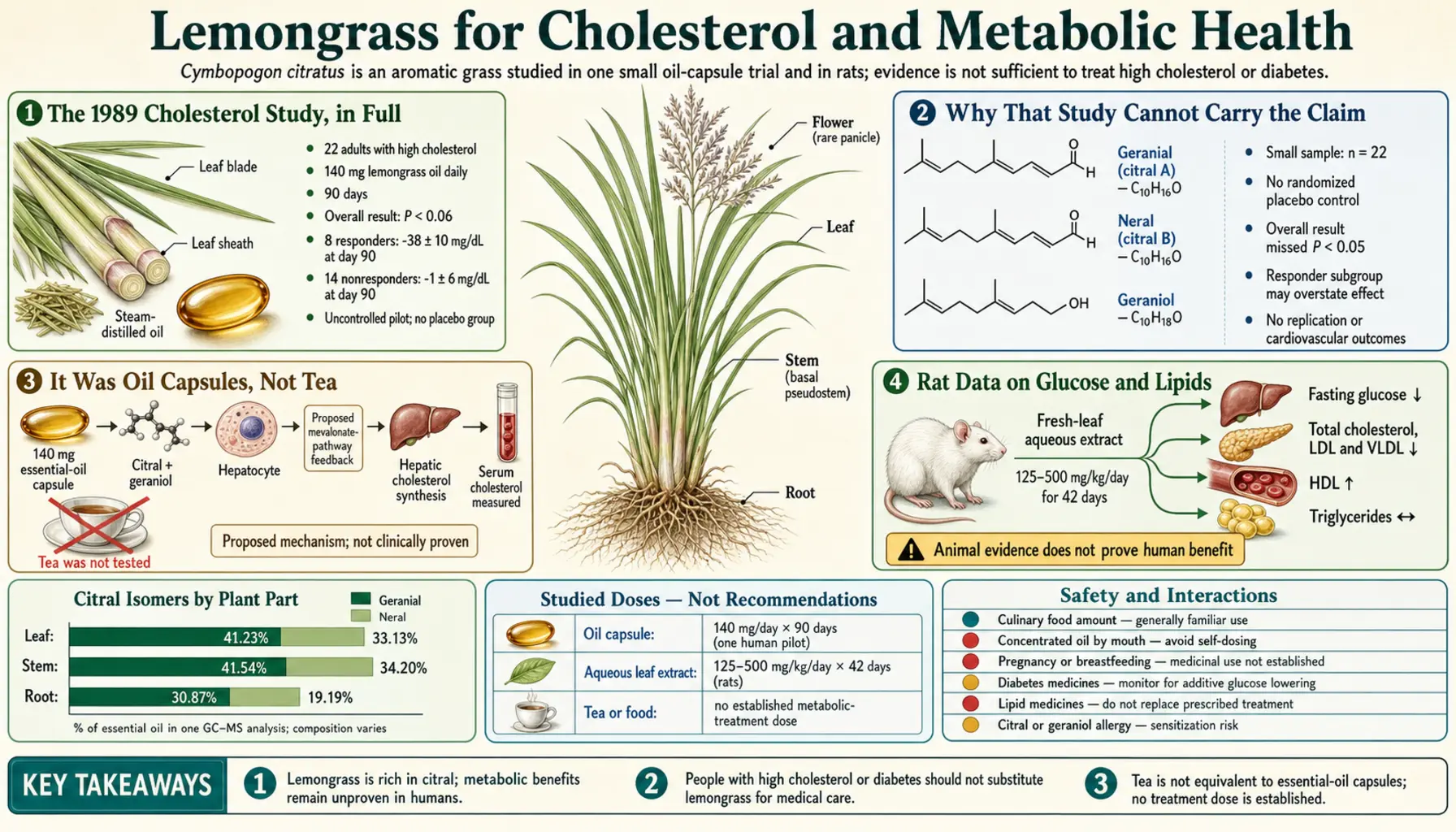
Search the internet for lemongrass and cholesterol and you will find confident statements that it lowers LDL, clears arteries and helps the heart. Follow those statements back through their sources and they converge on one paper: a small 1989 study in the journal Lipids, in which a group of volunteers took lemongrass oil capsules and had their serum cholesterol tracked. Some of them responded. Others did not respond at all. That study — small, uncontrolled by modern standards, thirty-six years old and never replicated at scale — is essentially the entire human evidence base for the most-repeated metabolic claim about this plant.
That is worth knowing before you spend money on a supplement. The rest of the metabolic story is animal work: rat studies in which a lemongrass leaf extract lowered blood glucose and blood lipids, isolated-tissue studies in which citral relaxed blood vessels, and the general antioxidant profile of the leaf's flavonoids. All of it is real research, none of it is a human outcome, and there is no trial showing that drinking lemongrass tea changes anyone's lipid panel, blood pressure, blood glucose or cardiovascular risk. This page lays out what was actually measured, why the original study is weaker than it is usually made to sound, and what genuinely moves these numbers.
Table of Contents
- The 1989 Cholesterol Study, in Full
- Why That Study Cannot Carry the Claim
- It Was Oil Capsules, Not Tea
- Rat Data on Glucose and Lipids
- The Blood Pressure Question
- Antioxidant Capacity and What It Predicts
- Kidney Markers and the Diuretic Tradition
- Weight Loss and Detox Claims
- What Actually Moves These Numbers
- A Sensible Role for Lemongrass
- Safety, Interactions and Cautions
- Key Research Papers
- Connections
The 1989 Cholesterol Study, in Full
Evidence tier: preliminary human. The paper is Impact of lemongrass oil, an essential oil, on serum cholesterol, by Elson, Underbakke, Hanson, Shrago, Wainberg and Qureshi, published in Lipids in 1989. It grew out of a research programme interested in whether dietary monoterpenes could inhibit cholesterol synthesis — a hypothesis with a genuine mechanistic basis, since certain isoprenoids can suppress HMG-CoA reductase, the same enzyme statins inhibit.
The design gave a small group of participants with elevated cholesterol lemongrass oil in capsule form daily and monitored serum cholesterol over a period of weeks. The headline result, and the reason the study is still cited: the response was heterogeneous. A subset of participants showed a meaningful fall in serum cholesterol. Others showed no change whatsoever. When the treatment stopped, values drifted back.
Two things are usually lost when this study is summarised online. First, the authors themselves described the finding as preliminary and the response as variable — the paper is not a triumphant demonstration, it is a hypothesis-generating observation. Second, the interesting scientific question it raised — why do some people respond to dietary monoterpenes and others not? — was never answered, because the work was not followed up with adequately powered controlled trials.
So the accurate statement is: in one small study from 1989, lemongrass oil capsules were associated with lower serum cholesterol in some participants and not others. Everything stronger than that sentence is embellishment.
Why That Study Cannot Carry the Claim
It helps to be specific about what is missing, because the same gaps recur across most botanical lipid claims.
- No adequate control group. Cholesterol drifts. It falls when people know they are being watched, when their diet changes because they are in a study, when the season changes, and simply through regression to the mean in anyone selected for a high starting value. Without randomisation to a placebo, none of that can be separated from a drug effect.
- Small sample. A handful of participants cannot support a population claim, and a "responder subgroup" identified after the fact is exactly the kind of result that most often fails to replicate.
- Short duration. Weeks. Cardiovascular benefit from lipid lowering accrues over years.
- Total cholesterol is a blunt endpoint. Modern lipid assessment cares about LDL cholesterol, non-HDL cholesterol and apolipoprotein B, because those are what track with risk. A change in total cholesterol tells you comparatively little.
- No outcome data at all. Nobody has ever measured whether lemongrass affects heart attacks, strokes or death. Surrogate markers are not outcomes — a lesson cardiology learned expensively with several drugs that improved a number and harmed patients.
- Never replicated. Thirty-six years is a long time for a positive finding to sit unreproduced. In a field with thousands of lipid trials, that absence is itself informative.
None of this means the observation was wrong. It means it was never confirmed, and an unconfirmed 1989 observation is not a basis for taking a supplement in place of treatment that has been confirmed many times over.
It Was Oil Capsules, Not Tea
This is the point at which the internet version of the claim quietly changes the product. The 1989 study used lemongrass essential oil in capsules — a concentrated, citral-rich preparation given at a defined daily amount under study conditions. The advice that circulates from it is almost always "drink lemongrass tea to lower your cholesterol."
Those are not the same intervention:
- A leaf infusion extracts water-soluble flavonoids and only a trace of citral, most of which escapes as aroma. The monoterpene exposure is a small fraction of a capsule dose.
- The proposed mechanism — monoterpene inhibition of cholesterol synthesis — is dose-dependent, and there is no reason to think tea-level exposure reaches it.
- No study has ever measured lipids in people drinking lemongrass tea.
And the obvious wrong turn should be named explicitly: the correct response to this is not to swallow lemongrass essential oil. Concentrated essential oils are not foods, there is no established safe oral dose, the 1989 capsule preparation was a research product rather than something you can improvise, and animal data on high-dose citral (see the safety section) give real reason for caution about chronic concentrated intake. If a lipid problem is worth treating, it is worth treating with something that works.
Rat Data on Glucose and Lipids
Evidence tier: preliminary (animal). The most-cited animal study is Hypoglycemic and hypolipidemic effects of fresh leaf aqueous extract of Cymbopogon citratus Stapf. in rats, by Adeneye and Agbaje, in the Journal of Ethnopharmacology in 2007. Using an aqueous leaf extract — closer to the drinkable form than an essential oil — the authors reported dose-dependent reductions in fasting blood glucose and in serum lipids in rats.
This is a reasonable-quality preclinical result and it is the strongest single reason to keep studying the plant metabolically. The reasons it cannot be carried across to a person are the standard ones and they are not trivial:
- Dose scaling. Rodent studies typically use doses per kilogram that, scaled to a human, correspond to far more plant material than anyone drinks. Body-surface-area conversion routinely turns an impressive rat dose into an impractical human one.
- Species differences in lipid handling. Rats and humans differ substantially in lipoprotein metabolism; rodents carry most of their cholesterol as HDL, which is one reason rodent lipid models translate poorly.
- Healthy or chemically diabetic animals are not people with type 2 diabetes. Induced-diabetes models respond to many things that do nothing in humans.
- Short duration and surrogate endpoints, again.
Related preclinical work covers antioxidant activity in the leaf and anti-inflammatory activity of the infusion in cell culture, which are plausible contributors to a metabolic effect but are several steps removed from a clinical one. If you have type 2 diabetes or insulin resistance, this literature is not a reason to change anything about your treatment.
The Blood Pressure Question
Evidence tier: preliminary (isolated tissue and animal); no clinical trial. The claim that lemongrass tea lowers blood pressure is widespread and its supporting evidence is thinner than the cholesterol claim.
The mechanistic work is real. Effect of Cymbopogon citratus and citral on vascular smooth muscle of the isolated thoracic rat aorta, by Devi, Sim and Ismail in Evidence-Based Complementary and Alternative Medicine in 2012, showed that citral and lemongrass extract relaxed pre-contracted vascular smooth muscle in an organ bath — vasorelaxation, the property that underlies most antihypertensive drug classes. Earlier animal pharmacology, including Carbajal and colleagues' 1989 screen of C. citratus leaves in the Journal of Ethnopharmacology, also examined cardiovascular and diuretic effects.
What does not exist: a randomized controlled trial of lemongrass tea or extract on blood pressure in people with hypertension. Not one with ambulatory monitoring, not one with a placebo arm, not one of adequate duration.
Blood pressure is a particularly treacherous endpoint for uncontrolled observation. It falls with repeated measurement (the white-coat effect fades), with rest, with weight loss, with reduced salt, with reduced alcohol, and with the simple act of sitting quietly for five minutes — which is, notably, what drinking a cup of tea involves. Anyone who checks their blood pressure before and after a relaxing hot drink will usually see a lower number, and none of that requires citral.
The practical warning matters more than the mechanism. Untreated or under-treated hypertension causes strokes, heart failure and kidney disease silently over years. If you take antihypertensive medication, lemongrass tea is a beverage, not a substitute, and you should not reduce a dose on the strength of a home reading. If you are on medication and drink it heavily as a medicinal tea, mention it to your clinician — a theoretical additive effect is worth knowing about even though no interaction has been documented.
Antioxidant Capacity and What It Predicts
Evidence tier: preliminary (in vitro). Lemongrass leaf tests well in antioxidant assays. Free radical scavengers and antioxidants from lemongrass (Cymbopogon citratus (DC.) Stapf.), by Cheel, Theoduloz, Rodríguez and Schmeda-Hirschmann in the Journal of Agricultural and Food Chemistry in 2005, identified the responsible constituents; Portuguese work characterised the infusion's flavonoids as luteolin and apigenin derivatives with caffeic-acid derivatives and tannins.
Antioxidant capacity measured in a tube deserves a specific caution, because it has been one of the most over-interpreted numbers in nutrition. A high radical-scavenging score in an assay tells you about the chemistry of an extract, not about what happens after digestion, absorption, extensive metabolism and distribution. The history here is instructive: high-antioxidant reasoning drove large trials of vitamin E and beta-carotene supplements that failed to prevent cardiovascular disease, and in the case of beta-carotene in smokers increased lung cancer incidence. The USDA withdrew its ORAC database of food antioxidant values in 2012 precisely because the values were being misused to imply health effects the data did not support.
So: lemongrass tea is a flavonoid-containing beverage, which is a pleasant thing to be, and its antioxidant assay results are not evidence of cardiovascular or metabolic benefit. Whole diets rich in plants are associated with better outcomes; single high-antioxidant extracts, as a class, have a poor record when tested properly.
Kidney Markers and the Diuretic Tradition
Evidence tier: traditional use, with limited preliminary human data. Lemongrass has a traditional reputation as a mild diuretic, and a small human study of daily lemongrass tea consumption examining kidney filtration markers — estimated glomerular filtration rate and creatinine clearance — was reported in the Journal of Renal Nutrition in 2015. Animal pharmacology, including the 1989 Carbajal screen, also examined diuretic effects.
Some perspective is needed here. Any substantial volume of fluid increases urine output; that is not a pharmacological diuretic effect, and it is the likeliest explanation for most of the folk reputation. Changes in estimated filtration measured over a short period in a small group are also easily influenced by hydration status alone, since both creatinine concentration and its clearance move with fluid intake.
The clinically important message runs the other way: if you have kidney disease, do not treat any herbal tea as beneficial for it without your nephrologist's input. Herbal products are a recognised cause of kidney injury in some cases, dosing is unstandardised, and people with reduced kidney function have narrower margins for everything. Lemongrass tea is not known to be harmful to kidneys, and it is also not a kidney treatment.
Weight Loss and Detox Claims
Evidence tier: none. Lemongrass tea appears constantly in "detox" and "slimming" tea blends and in social-media weight-loss content. There is no clinical evidence that lemongrass causes weight loss, reduces body fat, boosts metabolic rate or "detoxifies" anything.
Three specific points are worth making plainly:
- "Detox" is not a physiological category. Your liver and kidneys perform detoxification continuously; no tea improves that process, and the products marketed on this basis have never demonstrated removal of any named toxin.
- Any short-term weight change from a "detox tea" is fluid, particularly if the blend contains a laxative such as senna — which many commercial slimming teas do, and which can cause dependence, electrolyte disturbance and harm with prolonged use. Muscle cramps from potassium loss are one of the ways this shows up.
- Replacing sweetened drinks with unsweetened tea genuinely helps. If lemongrass tea displaces sugary beverages from your day, that is a real caloric change — and the benefit belongs to what you stopped drinking, not to the lemongrass.
See Obesity and Metabolic Syndrome for the interventions with actual evidence.
What Actually Moves These Numbers
It would be unhelpful to spend a page saying what lemongrass does not do without saying what does. For lipids, blood pressure and glucose, the evidence-based levers are well established and mostly unglamorous.
Lipids
- Statins reduce LDL cholesterol substantially and, unlike everything else on this page, have been shown in large randomized trials to reduce heart attacks and strokes. Ezetimibe and PCSK9 inhibitors add to that where needed.
- Dietary pattern. Replacing saturated fat with unsaturated fat lowers LDL; soluble fibre from oats, barley, beans and lentils, and from fruit and vegetables, lowers it further. See Mediterranean Diet.
- Weight loss and exercise, which move triglycerides and HDL more than LDL.
- Stopping smoking, which changes cardiovascular risk far more than any lipid number.
Blood pressure
- Reduced sodium and higher potassium intake from whole foods; weight loss; regular aerobic exercise; limiting alcohol; treating sleep apnoea; and antihypertensive medication when indicated.
Glucose
- Weight loss, physical activity (which improves insulin sensitivity for hours after a session), carbohydrate quality, sleep, and metformin or other agents where prescribed.
Against that list, a cup of herbal tea is a rounding error. That is not a reason to stop drinking it — it is a reason not to let it stand in for anything on the list.
A Sensible Role for Lemongrass
Here is the version of this page's message that survives scrutiny.
- As a beverage: caffeine-free, sugar-free, zero-calorie, pleasant hot or iced, and an easy swap for a sweetened drink. That swap has a real metabolic effect and it belongs entirely to the sugar you removed.
- As a flavour: lemongrass makes vegetables, fish, chicken and broths taste better without salt, sugar or fat. Anything that makes a whole-food dish more appealing is quietly useful to a metabolic diet, and this is probably lemongrass's largest honest contribution to cardiometabolic health.
- As a lipid or glucose therapy: no. There is no human evidence for the tea and one small, unreplicated, mixed-result study for oil capsules.
- As a reason to delay treatment: emphatically no. High LDL, high blood pressure and high blood glucose are silent for years and then are not. They are among the best-treated conditions in medicine, and the treatments work.
Safety, Interactions and Cautions
The tea. Good safety record. The 1986 human study by Leite and colleagues in the Journal of Ethnopharmacology looked specifically for toxicity from lemongrass tea and found none, alongside very wide culinary use. Ordinary household amounts are low-risk for most adults.
The essential oil, orally. Do not. There is no established safe oral dose of lemongrass essential oil. The 1989 study's capsules were a research preparation, not a template for self-dosing, and improvising with drops of oil risks mucosal injury. Concentrated essential oils are a recognised poisoning hazard, particularly in children.
High-dose citral. Animal work has reported that repeated high-dose citral exposure induces prostatic hyperplasia in rats, attributed to an estrogen-like action. That finding concerns concentrated citral at doses far above dietary exposure, and it is one more reason not to treat lemongrass oil as a daily supplement.
Theoretical medication interactions. None are documented in humans, but two are worth mentioning to a pharmacist if you use lemongrass heavily as a medicinal tea:
- Antihypertensives — on the basis of the vasorelaxation and diuretic animal data, an additive effect is theoretically possible.
- Glucose-lowering drugs — on the basis of the rat hypoglycaemic data. If you take insulin or a sulfonylurea and add any new daily herbal routine, monitoring is sensible.
Food and casual tea amounts are not a realistic concern for either.
Pregnancy and breastfeeding. Lemongrass is traditionally regarded as an emmenagogue, and the relevant preclinical work is the two-month rat dosing study with in-utero exposure (Souza Formigoni and colleagues, Journal of Ethnopharmacology, 1986). Culinary amounts are generally considered fine; concentrated preparations, the essential oil and strong daily medicinal teas are best avoided in pregnancy, and regular medicinal use should be discussed with your obstetric provider.
Liver and kidney disease. If you have significant liver or kidney impairment, discuss any regular herbal product with your specialist. Herbal preparations are unstandardised and the margins are narrower when clearance is reduced.
Disclaimer. This page is educational and is not medical advice. Lemongrass has not been shown in any adequately controlled human trial to lower cholesterol, blood pressure or blood glucose, and it has never been tested against cardiovascular outcomes. Do not use it in place of prescribed lipid-lowering, antihypertensive or glucose-lowering treatment, and do not change or stop any medication without your clinician. Never swallow lemongrass essential oil. If you are pregnant or breastfeeding, or manage a cardiovascular, metabolic, liver or kidney condition, speak with a qualified clinician before using any herb medicinally.
Key Research Papers
Citations resolve through PubMed topic searches rather than numeric identifiers, so each can be verified independently. Evidence tier is stated for each — note that nothing on this list is a randomized controlled trial of lemongrass for a metabolic endpoint, because none exists.
- Preliminary human (small, mixed result). Elson CE, Underbakke GL, Hanson P, Shrago E, Wainberg RH, Qureshi AA. Impact of lemongrass oil, an essential oil, on serum cholesterol. Lipids, 1989. Find on PubMed — the origin of the entire cholesterol claim.
- Preliminary (animal). Adeneye AA, Agbaje EO. Hypoglycemic and hypolipidemic effects of fresh leaf aqueous extract of Cymbopogon citratus Stapf. in rats. Journal of Ethnopharmacology, 2007. Find on PubMed
- Preliminary (isolated tissue). Devi RC, Sim SM, Ismail R. Effect of Cymbopogon citratus and citral on vascular smooth muscle of the isolated thoracic rat aorta. Evidence-Based Complementary and Alternative Medicine, 2012. Find on PubMed — the vasorelaxation behind the blood-pressure claim.
- Preliminary (animal). Carbajal D, Casaco A, Arruzazabala L, Gonzalez R, Tolon Z. Pharmacological study of Cymbopogon citratus leaves. Journal of Ethnopharmacology, 1989. Find on PubMed — includes cardiovascular and diuretic screening.
- Preliminary (in vitro). Cheel J, Theoduloz C, Rodríguez J, Schmeda-Hirschmann G. Free radical scavengers and antioxidants from lemongrass (Cymbopogon citratus (DC.) Stapf.). Journal of Agricultural and Food Chemistry, 2005. Find on PubMed
- Preliminary (cell culture). Figueirinha A, Cruz MT, Francisco V, Lopes MC, Batista MT. Anti-inflammatory activity of Cymbopogon citratus leaf infusion in lipopolysaccharide-stimulated dendritic cells. Journal of Medicinal Food, 2010. Find on PubMed
- Preliminary human (kidney markers). A small study of daily lemongrass tea consumption and estimated glomerular filtration rate and creatinine clearance, Journal of Renal Nutrition, 2015. PubMed topic search
- Preliminary human (safety). Leite JR, Seabra ML, Maluf E, et al. Pharmacology of lemongrass (Cymbopogon citratus Stapf). III. Assessment of eventual toxic, hypnotic and anxiolytic effects on humans. Journal of Ethnopharmacology, 1986. Find on PubMed — no toxicity from the infusion.
- Preliminary (animal, chronic dosing). Souza Formigoni ML, Lodder HM, Gianotti Filho O, Ferreira TM, Carlini EA. Pharmacology of lemongrass (Cymbopogon citratus Stapf). II. Effects of daily two-month administration in male and female rats and in offspring exposed in utero. Journal of Ethnopharmacology, 1986. Find on PubMed
- Preliminary (animal, high-dose citral safety). PubMed topic search: citral, estrogenic action and prostatic hyperplasia in rats
- Reviews. Shah G, Shri R, Panchal V, Sharma N, Singh B, Mann AS. Scientific basis for the therapeutic use of Cymbopogon citratus, Stapf (lemon grass). Journal of Advanced Pharmaceutical Technology & Research, 2011. Find on PubMed · Ekpenyong CE, Akpan E, Nyoh A. Ethnopharmacology, phytochemistry, and biological activities of Cymbopogon citratus (DC.) Stapf extracts. Chinese Journal of Natural Medicines, 2015. Find on PubMed
- Context — what does have outcome evidence. statin therapy and cardiovascular outcomes, randomized meta-analyses · soluble fibre and LDL cholesterol · antioxidant supplements and cardiovascular prevention — the cautionary literature
- Live topic searches. Cymbopogon citratus and cholesterol · C. citratus and blood pressure · C. citratus, diabetes and glucose — short lists, dominated by animal work.
Connections
- All Herbs
- Lemongrass Benefits Hub — all four deep dives and the themed research blocks.
- Lemongrass — botany, culinary use, compounds and overall safety.
- Cholesterol Management — what actually lowers LDL, and by how much.
- Atherosclerosis — the process lipid numbers are a proxy for.
- Hypertension — why a tea is not a substitute for treatment.
- Insulin Resistance — the context for the rat glucose data.
- Type 2 Diabetes — the condition that must not be self-treated with herbs.
- Metabolic Syndrome — the cluster these claims target.
- Obesity — where "detox tea" marketing does its damage.
- Mediterranean Diet — a dietary pattern with actual outcome trials.
- Exercise — the single most effective lever on insulin sensitivity.
- Potassium — the mineral that matters most for blood pressure alongside sodium.
- Berberine — a botanical that does have human metabolic trial data, for contrast.
- Cinnamon — another herb with mixed human glucose data and heavy marketing.
- Hibiscus — a tea with more blood-pressure trial data than lemongrass.
- Green Tea — a beverage with a larger cardiometabolic literature.
- Luteolin — a principal flavonoid of the lemongrass infusion.