Lemongrass for Anxiety, Sleep and Aromatherapy
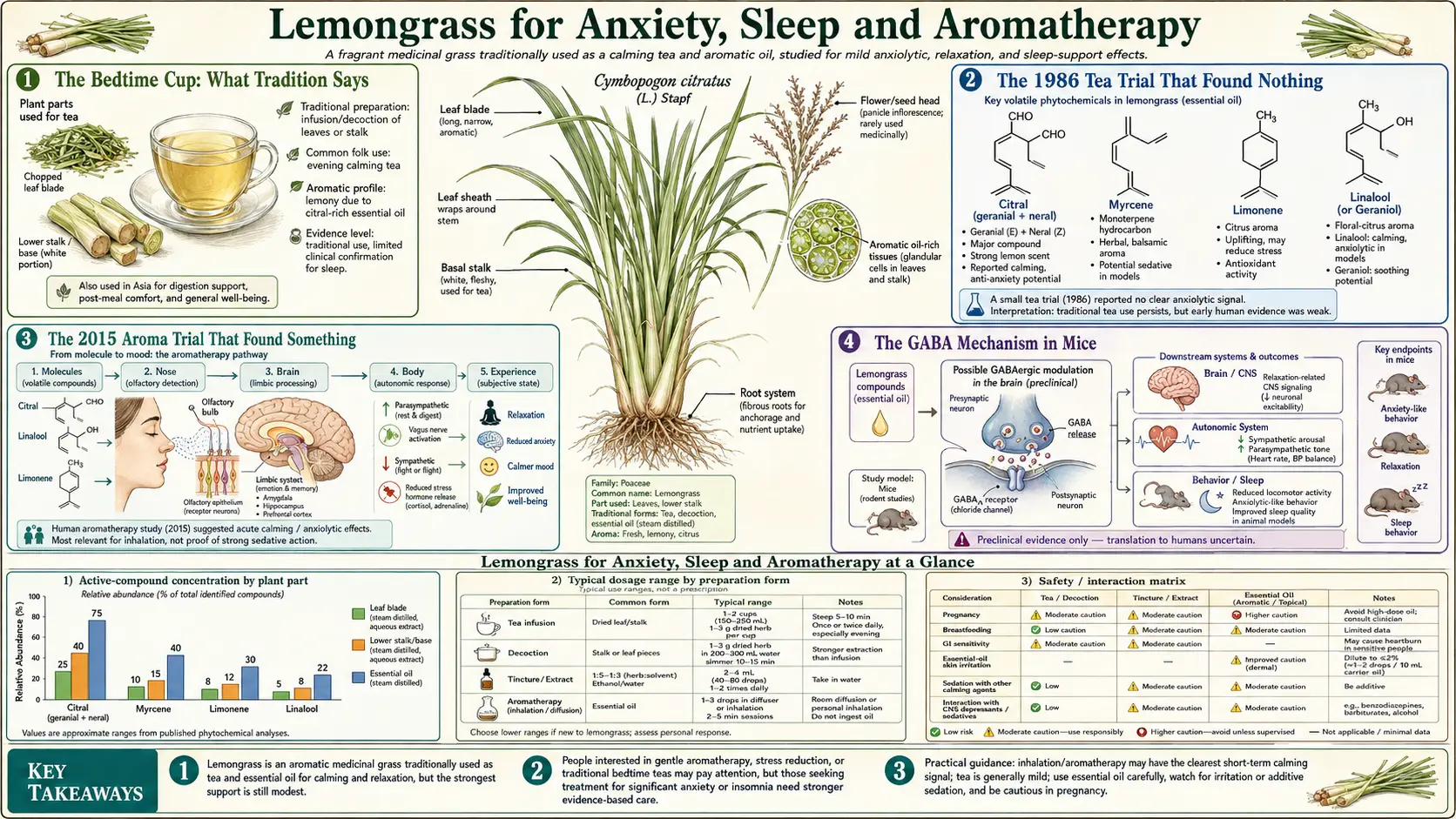
This is the most interesting evidence story lemongrass has, because the plant was tested twice in humans for essentially the same purpose and gave two different answers — and the difference between the two studies is the route. In 1986 a Brazilian group had volunteers drink lemongrass tea and looked for anxiolytic and hypnotic effects. They found none. In 2015 a different Brazilian group had volunteers smell lemongrass essential oil before an anxiety-provoking task, in a randomized design, and found a measurable reduction in anxiety. Drinking it did nothing detectable. Smelling it did something.
That pattern is worth sitting with, because it inverts the usual assumption that a concentrated internal dose is the "serious" version and the aroma is decoration. For lemongrass and the nervous system, the aroma is where the better human data are, and the tea — the form with the deepest folk reputation for calm, the Brazilian bedtime capim-santo — is the form that failed its one trial. This page walks through both studies, the mouse work that maps a plausible GABA mechanism, what aromatherapy research can and cannot establish, and how to use lemongrass for relaxation honestly: as a pleasant, very low-risk ritual with a modest experimental signal behind the smell, and no proven effect on clinical anxiety or insomnia.
Table of Contents
- The Bedtime Cup: What Tradition Says
- The 1986 Tea Trial That Found Nothing
- The 2015 Aroma Trial That Found Something
- The GABA Mechanism in Mice
- Why Drinking and Smelling Give Different Answers
- Sleep: What Is and Is Not Claimed
- What Aromatherapy Research Can Prove
- How It Compares With Lavender and Lemon Balm
- The Ritual Is Not a Trick
- How to Use It Safely
- What This Cannot Replace
- Safety and Cautions
- Key Research Papers
- Connections
The Bedtime Cup: What Tradition Says
Evidence tier: traditional use only. In Brazil, lemongrass is capim-santo or capim-cidreira, and it is one of the most commonly used medicinal plants in the country's household repertoire. Its two dominant folk indications are stomach complaints and nervousness — a cup taken to settle agitation, to calm a child, or to help someone get to sleep. The tea is sometimes called abafado, from the practice of covering the vessel while it steeps to hold in the aroma, which is a small but telling detail: the tradition itself treats the smell as part of the medicine.
Similar calming uses turn up in West African, Caribbean and Southeast Asian practice, usually alongside the digestive and fever indications. Ethnobotanical surveys record it consistently enough that the calming reputation cannot be dismissed as a modern wellness invention — it is old, geographically widespread and independently arrived at.
What tradition cannot tell you is whether the effect is pharmacological. A warm drink, a familiar smell, and five minutes of deliberately doing nothing are a potent combination in their own right, and the folk record has no way to separate those from citral. That separation is exactly what the two human studies below attempted.
The 1986 Tea Trial That Found Nothing
Evidence tier: preliminary human, negative for effect. The study is Pharmacology of lemongrass (Cymbopogon citratus Stapf). III. Assessment of eventual toxic, hypnotic and anxiolytic effects on humans, by Leite and colleagues, published in the Journal of Ethnopharmacology in 1986. It is the third in a series — the second paper dosed rats for two months, and the third took the question to people.
The design gave volunteers lemongrass tea and looked for two things: a hypnotic effect (does it help sleep?) and an anxiolytic effect (does it reduce anxiety?), while also monitoring for toxicity with clinical and laboratory measures. The result on both efficacy questions was negative — no measurable hypnotic effect, no measurable anxiolytic effect. The safety result was clean: no toxicity detected.
How much weight should that carry? It is a small, forty-year-old study, and a small negative trial cannot rule out a modest effect — the statistical power to detect a small change was limited, the instruments for measuring anxiety in 1986 were coarser than today's, and the dose and duration were what that group chose. What it does do is remove the strongest kind of support the tea could have had. Anyone claiming that lemongrass tea is a proven sedative is making a claim that has been tested and not confirmed, which is a different and weaker position than an untested claim.
It is worth noting what the study did establish firmly, because it is genuinely useful: the tea's safety. That null-plus-safe result is the reason lemongrass tea can be recommended as a low-risk habit even while its calming effect stays unproven.
The 2015 Aroma Trial That Found Something
Evidence tier: randomized clinical trial (small, experimental anxiety). The study is Effect of lemongrass aroma on experimental anxiety in humans, by Goes, Ursulino, Almeida-Souza, Alves and Teixeira-Silva, published in the Journal of Alternative and Complementary Medicine in 2015. This is the strongest single human result the plant has.
The design belongs to a well-established experimental-anxiety tradition. Rather than recruiting patients with an anxiety disorder and following them for months, healthy volunteers are put through a standardized stressor — in this line of work typically a simulated public-speaking task or an equivalent laboratory challenge — while anxiety is measured with validated self-report scales and physiological indicators. Participants are randomized to inhale the test aroma or a control, and the comparison is between groups under identical stress.
Inhaled lemongrass essential oil produced a reduction in the anxiety response relative to control. The same research group had previously used the identical model to study sweet-orange aroma, which is why the methodology was already validated when lemongrass was tested.
Now the caveats, which are important and do not cancel the result:
- Experimental anxiety is not clinical anxiety. Blunting a stress response in a healthy volunteer facing a laboratory task is not the same as treating generalized anxiety disorder, panic disorder or social anxiety disorder. The model is designed to detect acute anxiolytic-like activity efficiently, not to establish therapeutic benefit.
- Aroma studies are hard to blind. Lemongrass smells strongly and distinctively of lemon. A participant knows they are smelling something, and expectancy is a real contributor to any aroma result. Good designs use an active-smelling control to mitigate this; no design eliminates it.
- Small and single. One study, modest sample size, one laboratory. It has not been replicated at scale.
- It was the oil, inhaled. This result does not transfer to the tea, which was separately tested and failed.
Read charitably and accurately, the finding is: smelling lemongrass oil plausibly takes the edge off acute situational nervousness. That is a real, modest, useful thing, and it is not a treatment for an anxiety disorder.
The GABA Mechanism in Mice
Evidence tier: preliminary (animal). Mechanistically, the most cited paper is The GABAergic system contributes to the anxiolytic-like effect of essential oil from Cymbopogon citratus (lemongrass), by Costa, Kohn, de Lima, Gargano, Flório and Costa, in the Journal of Ethnopharmacology in 2011. An earlier paper from overlapping authors, Neurobehavioral effect of essential oil of Cymbopogon citratus in mice, appeared in Phytomedicine in 2009.
The mouse work used standard behavioral screens — the elevated maze and light/dark tests, in which a less anxious rodent spends more time in exposed or lit areas — and reported anxiolytic-like behavior from lemongrass essential oil. The 2011 paper went further and probed the mechanism using flumazenil, a drug that blocks the benzodiazepine binding site on the GABA-A receptor. When an agent's calming effect disappears in the presence of flumazenil, that implicates the same receptor system benzodiazepines act on. The authors concluded that the GABAergic system contributes to the effect.
GABA is the brain's principal inhibitory neurotransmitter, and GABA-A is the target of benzodiazepines, "Z-drug" hypnotics, barbiturates and alcohol. So a GABAergic mechanism is a plausible, well-trodden route to sedation — and that is precisely why it should be read carefully rather than triumphantly:
- The doses given to mice, by injection or gavage, are not the exposure a person gets from inhaling a diffuser or drinking a cup of tea.
- Rodent anxiety tests measure exploratory behavior, which is influenced by sedation, motor effects and novelty as well as by anxiety.
- A mechanism established in mice does not establish an effect in humans — and in this case the human tea trial had already come back negative.
The honest summary: there is a coherent candidate mechanism, demonstrated in rodents at doses well above ordinary human exposure, that has not been confirmed in people.
Why Drinking and Smelling Give Different Answers
The tea/oil divergence is not a contradiction in the data; it is what you would predict from basic pharmacokinetics.
- The dose of citral differs enormously. Citral is volatile and only sparingly water-soluble. Steeping leaves in hot water extracts flavonoids efficiently and citral poorly — and much of what is released escapes as steam, which is why the cup smells so good. A diffuser or an inhaler delivers citral vapour directly and continuously.
- The route bypasses the liver. Anything swallowed passes through the gut wall and then the liver before reaching the brain, and citral is readily metabolised. Inhaled volatiles cross the nasal and pulmonary epithelium into the circulation without that first-pass loss.
- Smell has a direct line to the limbic system. The olfactory pathway connects to the amygdala and hippocampus with unusual directness. An inhaled aroma can influence emotional state through this pathway at concentrations far too low to be pharmacologically active elsewhere in the body — which is also why the effect is fast, modest and short-lived.
- Expectation loads differently. Smelling a distinctive citrus oil while being told it is calming is a much stronger suggestion than drinking a mild tea. Some of the aroma effect is almost certainly expectancy, and that portion is real for the person experiencing it while not being a property of the plant.
So the accurate one-line summary of lemongrass and the nervous system is: the aroma has a small, randomized human signal; the tea does not.
Sleep: What Is and Is Not Claimed
Evidence tier: traditional use only, with one negative human trial. Lemongrass is widely marketed and traditionally used as a bedtime tea. The direct evidence is worse than for anxiety, not better: the 1986 study specifically tested a hypnotic effect and did not find one, and there is no subsequent trial of lemongrass tea or aroma on sleep latency, total sleep time, night-time waking or sleep quality in humans.
What can honestly be said about a lemongrass bedtime tea:
- It is caffeine-free. Substituting it for an evening coffee or black tea is a genuine, mechanistically obvious improvement in sleep hygiene — the benefit belongs to removing caffeine, not to adding lemongrass.
- It is a wind-down cue. A consistent pre-sleep routine is one of the better-supported behavioral interventions for insomnia. A nightly warm drink can serve as that cue; any warm drink can.
- It carries no hangover risk. Unlike alcohol as a sleep aid — which shortens sleep latency and then fragments the second half of the night — lemongrass tea has no rebound cost.
- Fluid volume cuts the other way. A large mug shortly before bed means a trip to the bathroom at 3 a.m. If night-time waking is your problem, drink it earlier and smaller.
For persistent insomnia, the intervention with the strongest evidence is not a herb at all — it is cognitive behavioral therapy for insomnia (CBT-I), which outperforms hypnotic medication for long-term outcomes and is the recommended first-line treatment. See Sleep Hygiene and Insomnia.
What Aromatherapy Research Can Prove
Aromatherapy trials have a structural problem, and knowing it makes you a much better reader of this literature. Aromas are, by definition, perceptible. That makes true blinding close to impossible: participants know they are smelling something, they frequently guess which arm they are in, and their expectations shape the self-reported outcomes that these studies mostly rely on.
The better designs mitigate this in specific ways — an active odour control rather than unscented air, objective outcomes alongside questionnaires (heart rate, blood pressure, salivary cortisol, actigraphy for sleep), blinded assessors, and pre-registered endpoints so the analysis is not chosen after the data arrive. Many published aromatherapy trials do none of these, which is why the meta-analytic literature in this field tends to report modest pooled benefits alongside high heterogeneity and serious risk-of-bias concerns. PubMed topic search: aromatherapy, anxiety and risk of bias.
Two practical implications for lemongrass. First, the 2015 aroma study deserves credit for using a validated experimental-anxiety model with a randomized design rather than an open-label satisfaction survey — it is a better-than-average study of its type. Second, one better-than-average small study is still one small study, and it would be wrong to describe lemongrass as an evidence-based anxiolytic on that basis. See Aromatherapy for the wider picture.
How It Compares With Lavender and Lemon Balm
Lemongrass is not the calming herb with the best evidence, and pretending otherwise does readers a disservice.
- Lavender is the most-studied aromatic in this space by a wide margin, with both inhalation studies and — more importantly — randomized placebo-controlled trials of a standardized oral lavender oil preparation in anxiety, including comparisons against active drugs. That is a tier of evidence lemongrass has never approached. PubMed topic search.
- Lemon balm (Melissa officinalis) has more human trial data than lemongrass for mood, stress and cognitive measures, and a plausible mechanism through GABA transaminase inhibition. PubMed topic search.
- Chamomile has been tested in randomized controlled trials of standardized extract for generalized anxiety disorder — small, but genuinely clinical. PubMed topic search.
- Valerian has been trialled repeatedly for insomnia with mixed and inconsistent results — a reminder that "more studies" does not automatically mean "better answer."
- Passionflower and L-theanine both have small human trial literatures for relaxation.
If your goal is the best-evidenced botanical option for anxiety or sleep, lemongrass is not it. If your goal is a pleasant, cheap, caffeine-free nightly ritual that carries essentially no risk and smells wonderful, lemongrass is an excellent choice and there is no need to oversell it.
The Ritual Is Not a Trick
One line in the main lemongrass page deserves expanding: the calming cup may owe as much to the ritual and the warm aroma as to pharmacology. That is often written as a debunking. It should not be.
The components of a bedtime tea ritual each have their own support. A consistent pre-sleep routine is part of standard behavioral sleep treatment. Slow, warm-drink-paced breathing shifts autonomic balance. Deliberately stopping stimulating activity for ten minutes reduces cognitive arousal, which is the specific problem in most sleep-onset insomnia. Warmth itself may assist the peripheral vasodilation and core-temperature drop that accompany sleep onset. None of those effects require citral, and none of them are fake.
What changes is the honest claim. Instead of "lemongrass tea has sedative compounds that calm your nervous system" — which the one relevant human trial did not support — the accurate version is: "a nightly lemongrass tea is a low-risk, caffeine-free wind-down ritual, and the ritual is doing most of the work." That is still worth doing. It just should not be sold as pharmacology.
How to Use It Safely
The tea, for a wind-down ritual
- One to two teaspoons of dried leaf, or one bruised fresh stalk cut into pieces, per cup.
- Just-boiled water, covered, steeped 5–10 minutes. Covering keeps the aromatics in the cup instead of the room.
- Drink 60–90 minutes before bed rather than immediately before, so fluid volume does not wake you.
- Blends well with chamomile, lemon balm or a little ginger.
The aroma, which is where the human signal is
- Diffuser: a few drops of lemongrass essential oil in a water diffuser, in a ventilated room, for a limited period rather than all night.
- Steam inhalation: one or two drops in a bowl of hot water, eyes closed, at a comfortable distance.
- Diluted topically: for scent on the skin, dilute in a carrier oil to roughly 1–2% and patch-test first. Lemongrass oil is a recognized contact allergen and skin irritant.
- Never swallow the oil. Not in tea, not in honey, not in water. The 2015 study was inhalation; the oral safety record on this page belongs to the infusion only.
- Keep it away from children, cats and dogs, and do not run a diffuser continuously in a closed room with pets or infants.
What This Cannot Replace
Anxiety and insomnia are common and treatable, and they are among the conditions where substituting a herbal ritual for real treatment does measurable harm. Lemongrass, in any form, is not a substitute for:
- Prescribed psychiatric medication. Never stop or reduce an antidepressant, anxiolytic or hypnotic on your own; some carry significant discontinuation effects.
- Psychological therapy. CBT for anxiety and CBT-I for insomnia have the strongest long-term evidence of anything in this space.
- Assessment of new or severe symptoms. Panic attacks, new-onset severe anxiety, anxiety with chest pain or breathlessness, and insomnia with daytime collapse all need evaluation — thyroid disease, sleep apnoea, anaemia, arrhythmia and medication effects all masquerade as anxiety.
- Urgent help. If you have thoughts of harming yourself, contact emergency services or a crisis line now. This is not a tea problem.
Safety and Cautions
The infusion has a good record, and the 1986 trial that found no calming effect also found no toxicity — a genuinely useful negative on the safety side. Ordinary household amounts are low-risk for most adults.
The essential oil is a different product. Do not swallow it. Dilute it for skin and patch-test: lemongrass oil is documented as a skin irritant and contact allergen in the dermatology literature (de Groot and Schmidt, Dermatitis, 2016). Photosensitivity is not a major concern for lemongrass as it is for expressed citrus peel oils, but irritation is.
Pregnancy and breastfeeding. Lemongrass is traditionally regarded as an emmenagogue, and the relevant animal work is the two-month rat dosing study with in-utero exposure (Souza Formigoni and colleagues, Journal of Ethnopharmacology, 1986). Culinary amounts are generally considered acceptable; concentrated or medicinal use, strong daily teas and the essential oil are best avoided in pregnancy, and any regular medicinal use should be raised with your obstetric provider. Do not use essential oils on or near infants.
Sedative interactions — theoretical but worth naming. Because the rodent mechanism implicates GABA-A, additive sedation with benzodiazepines, Z-drug hypnotics, alcohol, opioids or sedating antihistamines is theoretically possible. No human interaction has been documented, and the effect size in people appears to be at best small, but if you take sedating medication, treat lemongrass as you would any new relaxant and mention it to your pharmacist.
High-dose citral. Animal work has reported prostatic hyperplasia in rats after repeated high-dose citral exposure, attributed to an estrogen-like action — another reason to keep concentrated citral out of your mouth.
Disclaimer. This page is educational and is not medical advice. Lemongrass has not been shown to treat any anxiety disorder or any sleep disorder; the single randomized human study concerns inhaled aroma and short-term experimental anxiety in healthy volunteers, and the one human trial of the tea for anxiety and sleep was negative. Do not use lemongrass in place of prescribed treatment or professional assessment. If you are pregnant, breastfeeding, taking sedating medication, or managing a psychiatric or sleep disorder, speak with a qualified clinician first.
Key Research Papers
Citations resolve through PubMed topic searches rather than numeric identifiers, so each one can be verified independently. Evidence tier is stated for each.
- Randomized clinical trial (inhaled aroma, experimental anxiety). Goes TC, Ursulino FR, Almeida-Souza TH, Alves PB, Teixeira-Silva F. Effect of lemongrass aroma on experimental anxiety in humans. Journal of Alternative and Complementary Medicine, 2015. Find on PubMed — the strongest single human result for the plant.
- Preliminary human, negative. Leite JR, Seabra ML, Maluf E, et al. Pharmacology of lemongrass (Cymbopogon citratus Stapf). III. Assessment of eventual toxic, hypnotic and anxiolytic effects on humans. Journal of Ethnopharmacology, 1986. Find on PubMed — the tea showed no anxiolytic or hypnotic effect, and no toxicity.
- Preliminary (animal, mechanism). Costa CA, Kohn DO, de Lima VM, Gargano AC, Flório JC, Costa M. The GABAergic system contributes to the anxiolytic-like effect of essential oil from Cymbopogon citratus (lemongrass). Journal of Ethnopharmacology, 2011. Find on PubMed — flumazenil-sensitive effect in mice.
- Preliminary (animal). Blanco MM, Costa CA, Freire AO, Santos JG Jr, Costa M. Neurobehavioral effect of essential oil of Cymbopogon citratus in mice. Phytomedicine, 2009. Find on PubMed
- Preliminary (animal, reproductive/chronic dosing). Souza Formigoni ML, Lodder HM, Gianotti Filho O, Ferreira TM, Carlini EA. Pharmacology of lemongrass (Cymbopogon citratus Stapf). II. Effects of daily two-month administration in male and female rats and in offspring exposed in utero. Journal of Ethnopharmacology, 1986. Find on PubMed
- Preliminary (animal, early CNS work). Early Indian work examined the effect of Cymbopogon citratus essential oil on the central nervous system in animals. PubMed topic search: C. citratus essential oil and the central nervous system
- Review. Shah G, Shri R, Panchal V, Sharma N, Singh B, Mann AS. Scientific basis for the therapeutic use of Cymbopogon citratus, Stapf (lemon grass). Journal of Advanced Pharmaceutical Technology & Research, 2011. Find on PubMed
- Review. Ekpenyong CE, Akpan E, Nyoh A. Ethnopharmacology, phytochemistry, and biological activities of Cymbopogon citratus (DC.) Stapf extracts. Chinese Journal of Natural Medicines, 2015. Find on PubMed
- Review (skin safety of the oil). de Groot A, Schmidt E. Essential oils, part V: peppermint oil, lavender oil, and lemongrass oil. Dermatitis, 2016. Find on PubMed
- Context — methodology of the field. Aromatherapy and sleep quality: systematic reviews and meta-analyses · blinding and odour controls in aromatherapy trials
- Context — better-evidenced comparators. standardized lavender oil in anxiety, randomized double-blind trials · chamomile extract in generalized anxiety disorder · CBT for insomnia, meta-analyses
- Live topic search. Everything indexed on Cymbopogon citratus and anxiety — a short list, which is itself informative.
Connections
- All Herbs
- Lemongrass Benefits Hub — all four deep dives and the themed research blocks.
- Lemongrass — botany, culinary use, compounds and overall safety.
- Lavender Benefits — the calming oil with real randomized trial data.
- Lemon Balm Benefits — the other lemony calming herb, better tested.
- Chamomile Benefits — the archetypal bedtime tea, trialled in generalized anxiety.
- Valerian Benefits — the most-trialled sleep herb, with inconsistent results.
- Passionflower — another traditional calming botanical.
- L-Theanine — tea's own relaxing amino acid.
- Aromatherapy — how inhaled-aroma studies are designed and where they fail.
- Sleep Hygiene — the behavioral measures that actually move sleep.
- Meditation — a better-evidenced route to lowering arousal.
- Anxiety — the condition, its assessment and its real treatments.
- Social Anxiety Disorder — the closest clinical analogue to a public-speaking stressor.
- Insomnia — why CBT-I outranks every herbal option.
- Insomnia (Symptom) — the symptom view and its differential.
- Circadian Rhythm Sleep-Wake Disorders — when the problem is timing, not arousal.
- Apigenin — the flavonoid shared by lemongrass and chamomile, itself studied for GABA-A binding.