Luteolin: The Flavone for Brain Inflammation, Mast Cells, and Immune Balance
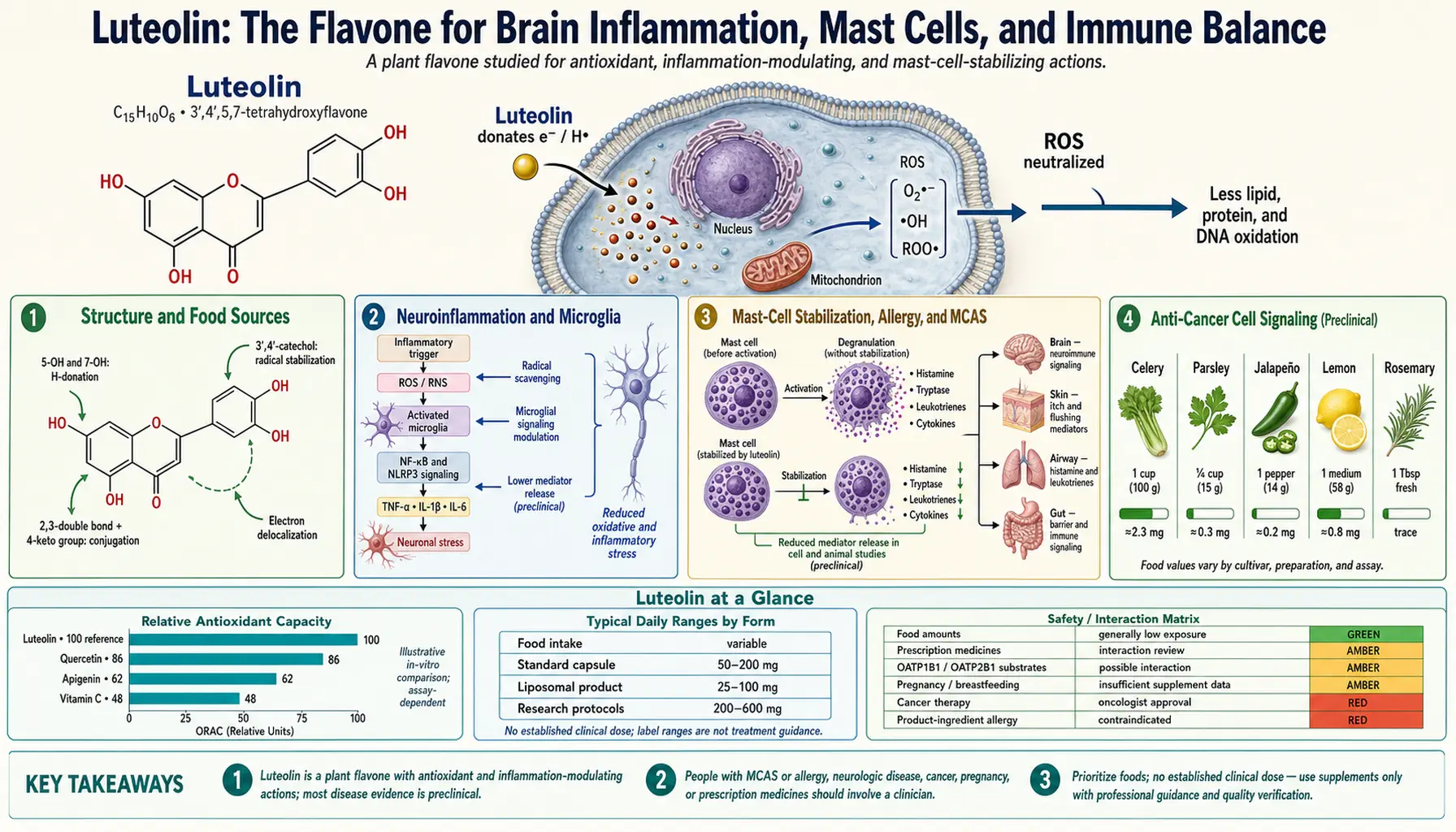
Luteolin is a dietary flavone — a yellow plant pigment found in everyday foods such as celery, parsley, oregano, thyme, peppermint, chamomile, artichoke, and green and yellow peppers. Chemically it is a close cousin of apigenin (the two share the same flavone backbone) and a more distant relative of the better-known flavonol quercetin. In the laboratory, luteolin is one of the more potent plant molecules at quieting two of the body's main inflammatory cell types — microglia (the immune cells of the brain) and mast cells (the cells that release histamine in allergy). That combination has made it a favorite molecule for researchers studying neuroinflammation, "brain fog," allergy, and mast-cell activation.
It is important to be clear about the evidence. Most of what is known about luteolin comes from cell-culture and animal studies, with only a handful of small human trials — most of those using multi-ingredient formulations rather than luteolin alone. Luteolin is not an approved treatment for any disease, and its poor water solubility means that much of what is swallowed is broken down before it reaches the bloodstream. This article walks through the food sources and chemistry, the best-studied research angles (neuroinflammation, mast cells, and cell-signaling in cancer models), the antioxidant and metabolic mechanisms, and the practical questions of forms, dosing, bioavailability, and safety — flagging at each step where the science is preclinical and where there is genuine human data.
Table of Contents
- Structure and Food Sources
- Neuroinflammation and Microglia
- Mast-Cell Stabilization, Allergy, and MCAS
- Anti-Cancer Cell Signaling (Preclinical)
- Antioxidant Activity and the Nrf2 Pathway
- Metabolic and Anti-Inflammatory Effects
- Forms, Dosing, and Bioavailability
- Safety and Interactions
- Research Papers
- Connections
- Featured Videos
Structure and Food Sources
Flavonoids are split into several subclasses. Luteolin belongs to the flavone subclass — the same family as apigenin. The two differ by a single hydroxyl group, and they tend to occur together in the same herbs and vegetables. This is different from quercetin and fisetin, which are flavonols (they carry an extra oxygen at one position). In plants, luteolin is usually stored attached to sugars as glycosides — most commonly luteolin-7-O-glucoside — which gut bacteria and intestinal enzymes have to clip off before the free "aglycone" form can be absorbed.
The richest everyday dietary sources include:
- Celery and celery seed — one of the most cited food sources
- Parsley — among the densest culinary herbs for luteolin and apigenin
- Oregano, thyme, peppermint, and rosemary — concentrated in dried Mediterranean herbs
- Chamomile — luteolin is one of the flavones in chamomile tea and extract
- Artichoke — a notable source, alongside its caffeoylquinic acids
- Green and yellow bell peppers and chili peppers
- Radicchio, broccoli, and carrots
Actual amounts in food are small — typically only a few milligrams per 100 grams in most herbs and vegetables — which is far below the doses used in research. Luteolin is reasonably heat-stable, so it survives normal cooking fairly well. A diet rich in herbs and colorful vegetables supplies a steady background intake, but reaching the gram-level amounts studied in animals is not realistic from food alone.
Neuroinflammation and Microglia
The best-known research angle for luteolin is neuroinflammation. Microglia are the brain's resident immune cells. When they are persistently switched into an inflammatory state, they release signaling molecules — interleukin-6 (IL-6), tumor necrosis factor (TNF), interleukin-1β, nitric oxide, and others — that can damage nearby neurons. This kind of low-grade, chronic brain inflammation is one of the suspected contributors to age-related cognitive decline and the everyday complaint of "brain fog."
In laboratory and animal studies, luteolin consistently calms inflamed microglia. It suppresses IL-6 production in part by blocking the JNK / AP-1 signaling route, dampens the TLR4 / NF-κB pathway, and nudges microglia away from the pro-inflammatory "M1" state toward a more reparative profile. In aged mice, a luteolin-supplemented diet reduced inflammatory microglia in the hippocampus and was associated with better performance on a spatial-memory task — one of the cleaner pieces of animal evidence linking luteolin's microglial effects to actual cognition.
What this does not mean: there is no good evidence that luteolin treats or prevents Alzheimer's disease, dementia, or any other neurological condition in people. The human data are limited and indirect — for example, small studies of luteolin-containing formulations in autism and in "brain fog" associated with mast-cell conditions (covered next). The honest summary is that luteolin is a promising, mechanistically well-characterized preclinical candidate for neuroinflammation, with early human interest but not yet the controlled trials needed to call it effective.
Mast-Cell Stabilization, Allergy, and MCAS
Luteolin's second major research theme is mast-cell stabilization. Mast cells sit in tissues throughout the body and, when triggered, release histamine and a cascade of other mediators that drive allergic and inflammatory symptoms — itching, flushing, congestion, hives, and gut and brain symptoms in some people. The drug cromolyn (sodium cromoglicate) works by stabilizing mast cells, and it was the structural similarity between cromolyn and certain flavonoids that first drew researchers to luteolin in this area.
In cultured human mast cells, luteolin reduces the release of histamine, TNF, IL-6, and other mediators — and in head-to-head laboratory comparisons it has been reported to be more potent than cromolyn at inhibiting mediator release. Because luteolin also calms microglia, it has been proposed as a single molecule that targets both of the immune cell types most involved in the overlap between allergy and brain inflammation. This is the rationale behind its interest for Mast Cell Activation Syndrome (MCAS) and the "brain fog" that many people with mast-cell and chronic-fatigue conditions describe.
The human evidence here is the strongest luteolin has — but it is still modest and mostly tied to combination products, not pure luteolin. Small open-label and case-series studies of luteolin-containing formulations in children with autism spectrum disorder reported behavioral improvements and, in one study, reduced blood levels of TNF and IL-6. These were uncontrolled studies (no placebo group), so they cannot prove the effect was due to luteolin rather than expectation or natural variation. Luteolin is a reasonable, well-tolerated option that some clinicians use as an adjunct in mast-cell conditions, but it should not replace prescribed mast-cell or allergy treatment, and people with MCAS should work with a knowledgeable clinician.
Anti-Cancer Cell Signaling (Preclinical)
Luteolin has a large laboratory literature in cancer biology — and this is exactly the area where it is most important to be careful with language. Luteolin is not a cancer treatment. What follows describes how the molecule behaves in cell cultures and in mice; none of it has been shown to treat cancer in humans.
In preclinical models across breast, lung, colon, prostate, and liver cancer cell lines, luteolin has been reported to push cancer cells toward programmed cell death (apoptosis), stall the cell cycle, and interfere with the new blood-vessel growth (angiogenesis) that tumors depend on. Mechanistically, it tends to down-regulate pro-survival signaling — reducing activity of the PI3K/Akt pathway, STAT3, and anti-death proteins such as Bcl-2 — while up-regulating pro-death factors including BAX, caspase-3, p21, and the transcription factor FOXO3a. In some models luteolin also appears to make cancer cells more sensitive to standard chemotherapy.
These findings explain why luteolin is studied as a potential lead compound and as a possible adjunct worth formal testing — not why anyone should use it to treat disease. Cell-culture concentrations and the doses given to mice are typically far higher than what a person could reach by eating luteolin-rich foods or taking a supplement, and luteolin's poor absorption (below) makes the gap larger. Anyone with cancer should rely on their oncology team; supplements can interact with chemotherapy and should only be used with that team's knowledge.
Antioxidant Activity and the Nrf2 Pathway
Like most flavonoids, luteolin has direct antioxidant chemistry — its hydroxyl groups can neutralize reactive oxygen species and chelate metal ions that would otherwise drive oxidative damage. But its more biologically meaningful antioxidant role is indirect: luteolin can activate the cell's master defense switch, the Nrf2 pathway.
Nrf2 is a transcription factor normally held in check by a partner protein called Keap1. Under stress — or in response to certain plant compounds — Nrf2 is released, moves into the nucleus, and turns on a battery of protective genes including heme oxygenase-1 (HO-1), NAD(P)H:quinone oxidoreductase-1 (NQO1), glutathione-related enzymes, and other "phase II" detoxification systems. By raising the cell's own antioxidant and detox capacity, an Nrf2 activator can blunt oxidative stress more durably than a molecule that simply mops up free radicals one at a time. In one notable study, luteolin even activated Nrf2 epigenetically — by reducing methylation of the Nrf2 gene's control region, increasing how much Nrf2 the cell makes.
This Nrf2 mechanism is shared, to varying degrees, with other studied plant compounds such as sulforaphane and curcumin, and it ties together many of luteolin's anti-inflammatory and protective effects in animal models. As with the rest of luteolin's biology, the Nrf2 evidence is largely preclinical, and how reliably ordinary oral doses raise Nrf2 activity in humans is not well established.
Metabolic and Anti-Inflammatory Effects
Chronic low-grade inflammation — especially inflammation originating in fat tissue — is closely tied to insulin resistance, type 2 diabetes, and cardiovascular risk. Luteolin's core action is to interrupt the master inflammatory switch NF-κB (along with the related MAPK signaling routes), which reduces the output of inflammatory messengers such as TNF and IL-6. In fat-cell (adipocyte) studies, luteolin dampens this adipocyte-driven inflammatory response.
In animal models of obesity, luteolin has improved insulin sensitivity — in one study by activating the cellular energy sensor AMPK in the immune cells (macrophages) that infiltrate fat tissue, which in turn reduced inflammation and improved how the body handled glucose. Other rodent work points to effects on PPARγ signaling and on endothelial (blood-vessel-lining) function. Together these mechanisms suggest luteolin could be relevant to metabolic syndrome and diabetes.
Once again, the caveat is the same: these are animal and cell studies. There are no large human trials showing that luteolin supplements lower blood sugar, improve insulin sensitivity, or reduce cardiovascular events in people. Luteolin-rich foods fit comfortably into the kind of vegetable-and-herb-forward diet that supports metabolic health, but the supplement itself should not be treated as a metabolic therapy.
Forms, Dosing, and Bioavailability
The central practical problem with luteolin is poor bioavailability. It is only slightly water-soluble, and after it is swallowed it undergoes heavy first-pass metabolism in the gut wall and liver — so only a small fraction of an oral dose reaches the bloodstream as intact luteolin (animal data put oral bioavailability in the low single-digit percentages). Most circulating luteolin appears as conjugated metabolites rather than the free molecule.
Common forms and strategies include:
- Luteolin combined with rutin — many commercial "luteolin" formulations pair it with the flavonoid rutin (and sometimes other ingredients); this is the basis of the multi-ingredient products used in the mast-cell and autism studies.
- Liposomal and nanoparticle preparations — experimental delivery systems intended to improve absorption.
- Plain luteolin (aglycone) powder/capsules — widely sold but poorly absorbed; taking it with a fat-containing meal is generally advised, since luteolin is fat-soluble.
Because pure luteolin has not been formally dose-optimized in controlled human trials, there is no established standard dose. Supplement labels commonly suggest roughly 100–300 mg/day, often as part of a blend, but this reflects market convention rather than trial-validated dosing. Higher numbers seen in laboratory and animal studies do not translate directly to humans.
Safety and Interactions
- Generally well tolerated. In the small human studies available, luteolin and luteolin-containing formulations were well tolerated, with mild and infrequent side effects (occasional digestive upset).
- Limited human safety data. There are no large or long-term safety trials of pure luteolin, so the full safety profile — especially at higher doses or with prolonged use — is not well characterized.
- Pregnancy and breastfeeding: there is not enough data to consider supplemental luteolin safe; avoid supplemental doses. Normal dietary amounts from food are not a concern.
- Anticoagulant and antiplatelet medicines: like several flavonoids, luteolin may have mild blood-thinning effects, so use caution if you take warfarin, other anticoagulants, or antiplatelet drugs, and discuss it with your clinician.
- Chemotherapy and drug metabolism: luteolin can affect drug-metabolizing enzymes and may interact with chemotherapy or other narrow-therapeutic-window medications; people in cancer treatment should only use it with their oncology team's knowledge.
- Not a substitute for treatment. Luteolin is a supplement, not an approved therapy; it should complement, not replace, care for any diagnosed condition.
Research Papers
Selected peer-reviewed papers on luteolin spanning neuroinflammation, mast cells, cancer cell-signaling, antioxidant (Nrf2), and metabolic research. Most are preclinical (cell-culture or animal) studies; the human studies noted below are small and used multi-ingredient formulations rather than pure luteolin. Each linked year/volume opens the article via its DOI.
- Burton MD, Rytych JL, Amin R, Johnson RW. Dietary Luteolin Reduces Proinflammatory Microglia in the Brain of Senescent Mice. Rejuvenation Research. 2016;19(4):286–292.
- Theoharides TC, Asadi S, Panagiotidou S. A Case Series of a Luteolin Formulation (Neuroprotek®) in Children with Autism Spectrum Disorders. International Journal of Immunopathology and Pharmacology. 2012;25(2):317–323.
- Tsilioni I, Taliou A, Francis K, Theoharides TC. Children with autism spectrum disorders, who improved with a luteolin-containing dietary formulation, show reduced serum levels of TNF and IL-6. Translational Psychiatry. 2015;5(9):e647.
- Tsilioni I, Theoharides TC. Luteolin Is More Potent than Cromolyn in Their Ability to Inhibit Mediator Release from Cultured Human Mast Cells. International Archives of Allergy and Immunology. 2024;185(8):803–809.
- Rauf A, Wilairatana P, Joshi PB, et al. Revisiting luteolin: An updated review on its anticancer potential. Heliyon. 2024;10(5):e26701.
- Prasher P, Sharma M, Singh SK, et al. Luteolin: a flavonoid with a multifaceted anticancer potential. Cancer Cell International. 2022;22(1):386.
- Zuo Q, Wu R, Xiao X, et al. The dietary flavone luteolin epigenetically activates the Nrf2 pathway and blocks cell transformation in human colorectal cancer HCT116 cells. Journal of Cellular Biochemistry. 2018;119(11):9573–9582.
- Zhang L, Han Y, Zhang X, et al. Luteolin reduces obesity-associated insulin resistance in mice by activating AMPKα1 signalling in adipose tissue macrophages. Diabetologia. 2016;59(10):2219–2228.
Live PubMed Searches
- Luteolin, microglia, and neuroinflammation
- Luteolin and mast-cell stabilization
- Luteolin and autism spectrum disorder
- Luteolin, cancer, and apoptosis signaling
- Luteolin and the Nrf2 antioxidant pathway
- Luteolin and NF-κB inflammation
- Luteolin, insulin resistance, and metabolism
- Luteolin bioavailability and pharmacokinetics
Connections
- Apigenin
- Quercetin
- Fisetin
- Rutin
- Hesperidin
- Anthocyanins
- Curcumin
- Sulforaphane
- Chamomile
- Rosemary
- MCAS
- Oxidative Stress
- Immune Boosting
- Cancer
- Diabetes
- Antioxidants