Mediterranean Diet
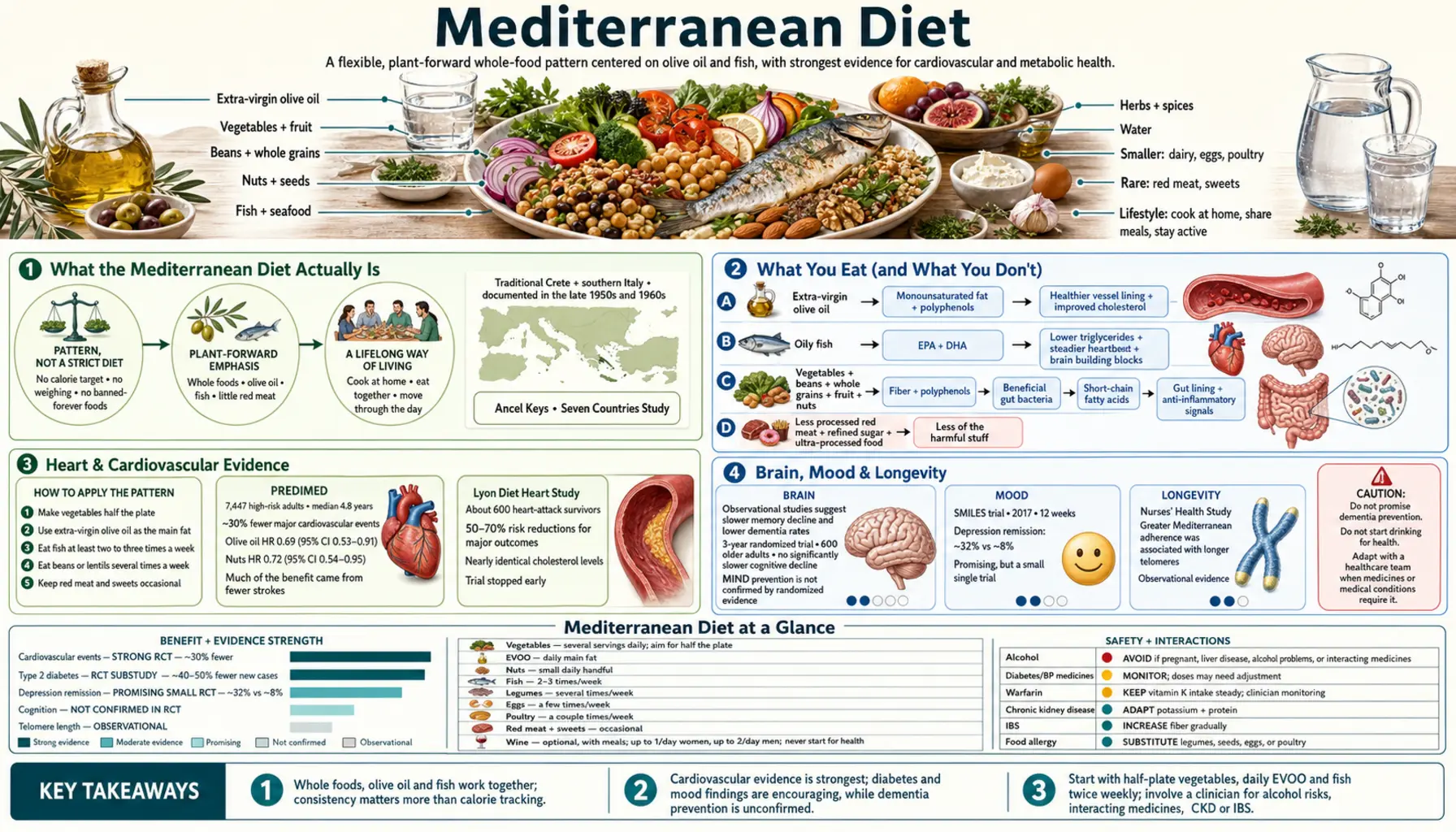
The Mediterranean diet isn't a fad or a 30-day plan with a finish line — it's the traditional way of eating that people in places like Crete and southern Italy followed for generations, and it is the single most studied and most strongly evidence-backed eating pattern in the world. It's built around real, whole foods you probably already like: olive oil, vegetables, fruit, beans and lentils, whole grains, nuts, fish, and herbs, with smaller amounts of dairy, eggs, and poultry, very little red meat or sugar, and — for those who already drink — a little wine with meals. Across large, rigorous trials it has been shown to lower heart attacks and strokes, protect the brain, ease depression, and reduce the risk of type 2 diabetes. The best part: it's flexible, affordable, deeply satisfying, and you can start this week.
Table of Contents
- What the Mediterranean Diet Actually Is
- What You Eat (and What You Don't)
- Heart & Cardiovascular Evidence
- Brain, Mood & Longevity
- Diabetes, Weight & Metabolic Health
- Why It Works (Mechanisms)
- How to Start This Week
- Cautions & Who Should Take Care
- Key Research Papers
- Connections
- Featured Videos
What the Mediterranean Diet Actually Is
The "Mediterranean diet" doesn't refer to everything eaten today around the Mediterranean Sea — modern Spain and Italy eat plenty of pizza, soda, and processed food like everyone else. It refers to a specific traditional pattern that researchers documented in the late 1950s and 1960s, especially on the Greek island of Crete and in southern Italy, where rates of heart disease were strikingly low and people often lived long, healthy lives.
This caught the attention of American physiologist Ancel Keys, whose Seven Countries Study compared diet and heart disease across regions and found that the Mediterranean populations — eating mostly plants, olive oil, and fish, with little red meat — had far less heart disease than countries eating a richer, meatier, more processed diet. That observation launched more than half a century of research.
The most important thing to understand is this: the Mediterranean diet is a pattern, not a strict diet. There is no calorie target you must hit, no single "approved" food list, no banned-forever ingredients, and no weighing or tracking. It's a way of eating defined by emphasis — what's on your plate most of the time — rather than by rigid rules. Two people can both eat a Mediterranean diet and have very different meals. That flexibility is exactly why it works in the real world: people can actually stick with it for life, which is something crash diets almost never achieve.
It's also a lifestyle, not just a food list. The traditional pattern came bundled with things that are hard to put in a clinical trial but clearly matter: cooking at home, eating with family and friends, being physically active through the day, and slowing down at the table. You don't have to move to Greece to benefit — but it helps to think of this as a relaxed, sustainable way of living, not a diet you're "on."
What You Eat (and What You Don't)
The simplest way to picture it: a plate that's mostly vegetables, whole grains, and beans, with olive oil as the main fat, fish a few times a week, and meat and sweets as the exception rather than the rule. Here's the traditional pattern broken down by how often foods appear.
Eat every day (the foundation)
- Extra-virgin olive oil — the primary fat for cooking, dressing, and finishing dishes. This replaces butter and processed seed-oil blends. Use it generously; it's where much of the benefit comes from.
- Vegetables — aim for several servings, in many colors: leafy greens, tomatoes, peppers, eggplant, zucchini, onions, garlic, artichokes. Often the centerpiece of the meal, not a side.
- Fruit — fresh, whole fruit is the default dessert: figs, grapes, oranges, melon, berries, apples, pomegranate.
- Whole grains — whole-grain bread, pasta, bulgur, farro, barley, oats, brown rice. Whole and minimally refined, not white flour.
- Nuts and seeds — a small daily handful of almonds, walnuts, hazelnuts, pistachios; sesame (often as tahini).
- Herbs and spices — oregano, basil, rosemary, thyme, mint, parsley, garlic. These flavor food so you need far less salt, and they add their own beneficial plant compounds.
- Water — the main drink.
Eat most weeks (several times)
- Legumes — lentils, chickpeas, white beans, fava beans. A cornerstone protein, eaten several times a week in soups, stews, and salads.
- Fish and seafood — at least two to three times a week, especially oily fish like sardines, anchovies, mackerel, and salmon that are rich in omega-3 fats; also shellfish.
- Eggs — a few times a week.
- Dairy in moderate amounts — mostly traditional cheese and plain yogurt, in modest portions, rather than large glasses of milk.
- Poultry — chicken and other birds a couple of times a week, in modest portions.
Eat occasionally (small amounts)
- Red meat — beef, lamb, and pork appear infrequently and in small portions, more as a flavoring or special-occasion food than a daily main course.
- Sweets and sugary foods — pastries, candy, and sugar-sweetened drinks are treats, not staples. Honey is the traditional sweetener, used sparingly. Fresh fruit handles most of the "dessert" job.
Wine — optional, and only with food
In the traditional pattern, wine (usually red) was consumed in moderate amounts with meals — roughly up to one glass a day for women and up to two for men. This is genuinely optional. As the cautions section explains, the evidence on alcohol has shifted, and no one should start drinking for their health. If you don't drink, skip it entirely — every other part of the diet stands on its own.
The big picture
Notice what defines the pattern: it's overwhelmingly plant-forward and built on whole foods, with olive oil as the everyday fat and fish as the main animal protein. You don't need special "diet" products, low-fat versions of things, or meal-replacement shakes. You eat ordinary food, cooked simply, with real olive oil and real flavor.
Heart & Cardiovascular Evidence
This is where the Mediterranean diet has its strongest and most famous evidence — and unlike most diet claims, it comes from randomized controlled trials, the same gold-standard design used to test medications, not just from observational studies that can be confounded.
PREDIMED: the landmark trial
The PREDIMED trial (PREvención con DIeta MEDiterránea), run in Spain, enrolled about 7,447 people at high cardiovascular risk — older adults with diabetes or multiple risk factors — who had not yet had a heart attack or stroke. They were randomly assigned to one of three diets: a Mediterranean diet with extra free extra-virgin olive oil, a Mediterranean diet with extra mixed nuts, or a control "low-fat" advice group. Crucially, the two Mediterranean groups were not told to cut calories or to exercise more — the only major difference was how they ate.
Over a median of about 4.8 years, both Mediterranean groups had roughly 30% fewer major cardiovascular events (a combined measure of heart attack, stroke, and death from cardiovascular causes) than the control group. The olive-oil group had a hazard ratio of about 0.69 (95% CI 0.53–0.91) and the nut group about 0.72 (95% CI 0.54–0.95) — both statistically significant. Much of that benefit came from a clear drop in strokes.
An honest footnote, because accuracy matters here: in 2018 the original 2013 PREDIMED paper was retracted and republished after the authors discovered that some participants in a few of the study sites hadn't been randomized individually as intended (some households and a clinic were assigned as groups). The team reanalyzed all the data correctly, dropping or reassigning the affected participants — and the results held up almost unchanged, still showing the ~30% reduction. The corrected, current version is the Estruch 2018 paper cited below. So the headline finding survived rigorous scrutiny; it just had a bumpy road getting there.
The Lyon Diet Heart Study
Earlier, the Lyon Diet Heart Study in France tested the pattern in people who had already survived a heart attack (this is called secondary prevention). About 600 patients were randomized to either a Mediterranean-style diet rich in alpha-linolenic acid (a plant omega-3, from sources like canola/rapeseed-based margarine and walnuts) or a typical prudent post-heart-attack Western diet.
The results were dramatic enough that the trial was stopped early on ethical grounds. Over the follow-up, the Mediterranean group had a large reduction in cardiac death and recurrent heart attacks — the final report described risk reductions in the range of roughly 50–70% for major outcomes, despite the two groups having nearly identical cholesterol levels. That last detail was important historically: it showed the diet protects the heart through more than just lowering cholesterol.
How to read these numbers: a "30% reduction" is a relative reduction. If your baseline risk is moderate, that translates to a meaningful but not miraculous drop in your absolute chance of an event — yet it's achieved with food alone, with no side effects, while improving many other things at the same time. Few single interventions in all of medicine do that.
Brain, Mood & Longevity
What's good for your heart's blood vessels tends to be good for your brain's blood vessels too — and the Mediterranean diet's effects appear to reach well beyond the heart.
Memory and dementia
Many large observational studies link closer adherence to a Mediterranean-style diet with slower age-related memory decline and lower rates of dementia. This inspired the MIND diet — a hybrid of the Mediterranean diet and the blood-pressure-lowering DASH diet, specifically emphasizing brain-protective foods like leafy greens and berries. In a well-known observational study of older adults, those who followed the MIND diet most closely had a substantially lower rate of developing Alzheimer's disease, with effects suggesting their brains functioned years "younger."
Here it's important to be straight with you: when the MIND diet was finally put to the test in a rigorous 3-year randomized controlled trial (NEJM, 2023) in 600 older adults, the diet group did not show significantly slower cognitive decline than the comparison group — both groups, who also mildly cut calories, improved similarly. So the strong observational signal for brain protection has not yet been confirmed by a randomized trial. The diet is still excellent for your overall health and almost certainly good for your brain's blood supply, but anyone promising it will prevent dementia is going beyond what the best evidence currently shows.
Depression and mood
The connection between food and mood was long dismissed, until the SMILES trial (Jacka and colleagues, 2017) tested it directly. Adults with moderate-to-severe major depression were randomly assigned to either dietary support toward a modified Mediterranean diet, or to a social-support control, alongside their usual treatment. After 12 weeks, the diet group improved dramatically more: about 32% achieved remission of their depression, versus only about 8% in the control group — a large effect for a depression treatment. It was a small, single trial, so it's a beginning rather than the last word, but it was the first randomized evidence that improving diet can directly help treat depression, and later trials have pointed the same direction.
Living longer
On longevity, one intriguing line of research looked at telomeres — the protective caps on the ends of your chromosomes that shorten as cells age, like the plastic tips on shoelaces fraying. In a large study within the Nurses' Health Study, women who ate a more Mediterranean-style diet had longer telomeres, a biological marker associated with healthier aging. Combined with the heart and metabolic benefits, it's easy to see why Mediterranean-style eating consistently shows up in the diets of the world's longest-lived populations.
Diabetes, Weight & Metabolic Health
The Mediterranean diet is one of the best-supported eating patterns for blood sugar and metabolic health — which surprises people who assume a "healthy" diet has to be low in fat. It isn't; it's rich in olive oil and nuts, and it still helps.
Preventing type 2 diabetes
Within the PREDIMED program, a substudy in Reus, Spain (Salas-Salvadó and colleagues, 2011) followed people without diabetes and found that those assigned to a Mediterranean diet — without any calorie restriction or weight-loss goal — developed type 2 diabetes far less often. The reduction in new diabetes cases was about 40–50% compared with the low-fat control group. That's a striking result for a change in eating pattern alone, with no medication and no mandated weight loss.
Metabolic syndrome
"Metabolic syndrome" is the dangerous cluster of belly fat, high blood pressure, high blood sugar, high triglycerides, and low "good" HDL cholesterol that drives heart disease and diabetes. A large meta-analysis of 50 studies covering more than half a million people (Kastorini and colleagues, 2011) found that following a Mediterranean diet was associated with a lower risk of metabolic syndrome and with improvements in nearly every one of its components — waist circumference, blood pressure, blood sugar, triglycerides, and HDL all moved in the healthy direction.
Weight
On weight, the picture is reassuring and realistic. Because it's relatively high in fat (from olive oil and nuts), people once feared the Mediterranean diet would be fattening — but trials show the opposite: it does not cause weight gain, and in many studies it leads to modest weight loss or a smaller waistline, often comparable to or better than low-fat diets, partly because the fat, fiber, and protein keep you genuinely full. It's not primarily a weight-loss diet, but it tends to improve your body composition and metabolic numbers even when the scale barely moves — which is arguably what matters more for health.
Why It Works (Mechanisms)
The Mediterranean diet isn't a single magic nutrient — its power comes from many beneficial components working together, in real food, in combination. Here's what's happening under the hood, in plain terms.
- Healthy fats instead of bad ones. Extra-virgin olive oil is rich in monounsaturated fat, which improves cholesterol and is gentle on blood vessels, especially when it replaces saturated fat from heavy red meat and the fats in ultra-processed foods. You're not eating "low fat" — you're eating better fat.
- Omega-3 fats from fish. Oily fish supply long-chain omega-3 fatty acids (EPA and DHA) that reduce inflammation, lower triglycerides, help keep the heartbeat steady, and are building blocks for the brain.
- Polyphenols and antioxidants. Extra-virgin olive oil, colorful vegetables, fruit, herbs, nuts, and red wine are loaded with plant compounds (polyphenols) that act as antioxidants and protect the lining of your blood vessels. This is one reason extra-virgin olive oil — which keeps these compounds — matters more than refined oil.
- Fiber, and lots of it. Vegetables, beans, whole grains, fruit, and nuts deliver plenty of fiber, which steadies blood sugar, lowers cholesterol, keeps you full, and feeds your gut bacteria.
- A calmer, less inflammatory body. Chronic low-grade inflammation underlies heart disease, diabetes, and possibly depression and dementia. The combined effect of all the above is a measurable reduction in markers of inflammation — the diet essentially turns down a fire that quietly damages the body over decades.
- A healthier gut microbiome. The high fiber and polyphenol content feeds beneficial gut bacteria, which ferment fiber into short-chain fatty acids that nourish the gut lining and send anti-inflammatory signals throughout the body — increasingly thought to be one of the diet's most important pathways, including the emerging gut-brain connection behind its mood benefits.
- Less of the harmful stuff. Just as importantly, the pattern crowds out the things that drive disease: excess processed red meat, refined sugar, and ultra-processed foods. Some of the benefit is simply what you're not eating.
How to Start This Week
You don't need to overhaul your whole kitchen overnight. The Mediterranean diet rewards small, permanent changes far more than a dramatic short-lived effort. Pick a few of these and build from there.
Easy swaps to make first
- Cook with extra-virgin olive oil instead of butter or processed seed-oil blends, and drizzle it on vegetables, bread, and salads.
- Make vegetables the biggest thing on your plate — aim for half — and treat meat as a side or a flavoring.
- Have fish twice a week. Canned sardines, mackerel, or salmon are inexpensive, shelf-stable, and excellent on toast or in a salad.
- Eat beans or lentils a few times a week — in soup, chili, salads, or stirred into pasta. Canned is perfectly fine; just rinse them.
- Swap white bread, rice, and pasta for whole-grain versions.
- Keep a bowl of fruit out and a small jar of nuts handy as your default snacks instead of chips or candy.
- Make fruit your usual dessert, with sweets reserved for genuine treats.
- Flavor with herbs, garlic, and lemon instead of reaching for the salt.
A sample day
- Breakfast: Plain yogurt with berries, walnuts, and a drizzle of honey — or whole-grain toast with olive oil and sliced tomato.
- Lunch: A big salad of greens, chickpeas, cucumber, tomato, olives, and feta, dressed with olive oil and lemon, plus a piece of whole-grain bread.
- Snack: A handful of almonds and a piece of fruit.
- Dinner: Baked or pan-seared fish with a large side of roasted vegetables and a small portion of farro or brown rice; fresh fruit for dessert. A small glass of wine with the meal is optional.
Eating this way on a budget
This pattern is naturally economical because its staples are some of the cheapest, most nutritious foods there are.
- Beans, lentils, and whole grains bought dried (or canned) are extremely cheap sources of protein and fiber.
- Canned and frozen count fully. Frozen vegetables and canned tomatoes, beans, and fish are affordable, last a long time, and are just as nutritious as fresh.
- Buy produce in season and use whatever is cheapest that week — the diet is flexible by design.
- A big bottle of store-brand extra-virgin olive oil is an affordable everyday staple; you don't need a boutique brand.
- Eggs are an inexpensive, high-quality protein for several meals a week.
- Cooking at home — itself part of the tradition — is where most of the savings (and most of the control over what you eat) come from.
Cautions & Who Should Take Care
The Mediterranean diet is one of the safest dietary patterns there is — it's whole-food-based, balanced, and recommended by major health organizations for the general public. There's no "detox" phase, nothing extreme, and no need to eliminate entire food groups. For most people it can simply be adopted. A few sensible notes:
- Alcohol — do not start drinking for your health. The traditional pattern includes a little wine with meals, but the science on alcohol has shifted: more recent evidence suggests that even moderate drinking carries some risks (including for certain cancers), and the older idea that wine is actively protective is now seriously questioned. If you already drink moderately and enjoy it, keeping it modest and with food fits the pattern — but if you don't drink, there is no health reason to start. Every benefit of this diet holds without any alcohol at all. Anyone who is pregnant, has liver disease, a history of alcohol problems, or takes medications that interact with alcohol should not drink.
- If you take medications, check with your clinician. Because this diet genuinely improves blood sugar, blood pressure, and cholesterol, your need for some medications may change. If you take drugs for diabetes (especially insulin or sulfonylureas) or blood pressure, your numbers may drop and your doses may need adjusting — a good problem to have, but one to manage with your doctor, not on your own. If you take blood thinners like warfarin, leafy greens are high in vitamin K, so keep your intake steady and tell your clinician you're changing your diet so they can monitor it.
- Allergies and individual needs. Nuts, fish, and shellfish are central to the pattern; if you're allergic, simply substitute other components (legumes, seeds, eggs, poultry) — the diet is flexible enough to work around any one food.
- Specific medical conditions. People with chronic kidney disease may need to watch the high potassium and protein in beans, nuts, and greens; people with certain digestive conditions (such as IBS) may need to increase fiber gradually to avoid bloating, and adjust which high-fiber foods they choose. If you have a condition that requires a special diet, adapt this pattern with your healthcare team rather than assuming one-size-fits-all.
- Use real food, not supplements. The benefits come from the whole pattern of foods eaten together over time — not from olive-oil pills or omega-3 capsules taken alongside an otherwise poor diet. The trials tested food, so eat the food.
The bottom line: this is a pattern almost anyone can adopt safely and enjoyably. The only real "rule" is consistency over time — and because the food is so good, that turns out to be the easy part.
Key Research Papers
- Estruch R, Ros E, Salas-Salvadó J, et al. (2018). Primary Prevention of Cardiovascular Disease with a Mediterranean Diet Supplemented with Extra-Virgin Olive Oil or Nuts. New England Journal of Medicine, 378(25):e34. — The landmark PREDIMED trial (corrected, republished version): a Mediterranean diet with olive oil or nuts cut major heart attacks, strokes, and cardiovascular deaths by about 30% in high-risk adults. (PMID: 29897866)
- de Lorgeril M, Salen P, Martin JL, Monjaud I, Delaye J, Mamelle N. (1999). Mediterranean Diet, Traditional Risk Factors, and the Rate of Cardiovascular Complications After Myocardial Infarction: Final Report of the Lyon Diet Heart Study. Circulation, 99(6):779–785. — In heart-attack survivors, a Mediterranean diet sharply reduced recurrent heart attacks and cardiac death, even though cholesterol levels barely changed. (PMID: 9989963)
- Salas-Salvadó J, Bulló M, Babio N, et al. (2011). Reduction in the Incidence of Type 2 Diabetes with the Mediterranean Diet: Results of the PREDIMED-Reus Nutrition Intervention Randomized Trial. Diabetes Care, 34(1):14–19. — Following a Mediterranean diet, without cutting calories, lowered the rate of new type 2 diabetes by roughly half. (PMID: 20929998)
- Kastorini CM, Milionis HJ, Esposito K, Giugliano D, Goudevenos JA, Panagiotakos DB. (2011). The Effect of Mediterranean Diet on Metabolic Syndrome and Its Components: A Meta-Analysis of 50 Studies and 534,906 Individuals. Journal of the American College of Cardiology, 57(11):1299–1313. — Pooling half a million people, the diet was linked to lower metabolic syndrome and improvements in waist size, blood pressure, blood sugar, triglycerides, and HDL. (PMID: 21392646)
- Jacka FN, O'Neil A, Opie R, et al. (2017). A Randomised Controlled Trial of Dietary Improvement for Adults with Major Depression (the 'SMILES' Trial). BMC Medicine, 15:23. — The first randomized trial showing that switching to a Mediterranean-style diet substantially improved major depression, with about 32% achieving remission versus 8% in the control group. (PMID: 28137247)
- Morris MC, Tangney CC, Wang Y, Sacks FM, Bennett DA, Aggarwal NT. (2015). MIND Diet Associated with Reduced Incidence of Alzheimer's Disease. Alzheimer's & Dementia, 11(9):1007–1014. — In this observational study, older adults who closely followed the Mediterranean-DASH (MIND) diet had a markedly lower rate of developing Alzheimer's disease. (PMID: 25681666)
- Barnes LL, Dhana K, Liu X, et al. (2023). Trial of the MIND Diet for Prevention of Cognitive Decline in Older Persons. New England Journal of Medicine, 389(7):602–611. — Included for honesty: a 3-year randomized trial found the MIND diet did not slow cognitive decline more than the comparison diet, showing the brain-protection idea is not yet confirmed by a controlled trial. (PMID: 37466280)
- Crous-Bou M, Fung TT, Prescott J, et al. (2014). Mediterranean Diet and Telomere Length in Nurses' Health Study: Population Based Cohort Study. BMJ, 349:g6674. — Women eating a more Mediterranean diet had longer telomeres, a cellular marker of slower biological aging. (PMID: 25467028)