Elderberry — Preparation and Safety
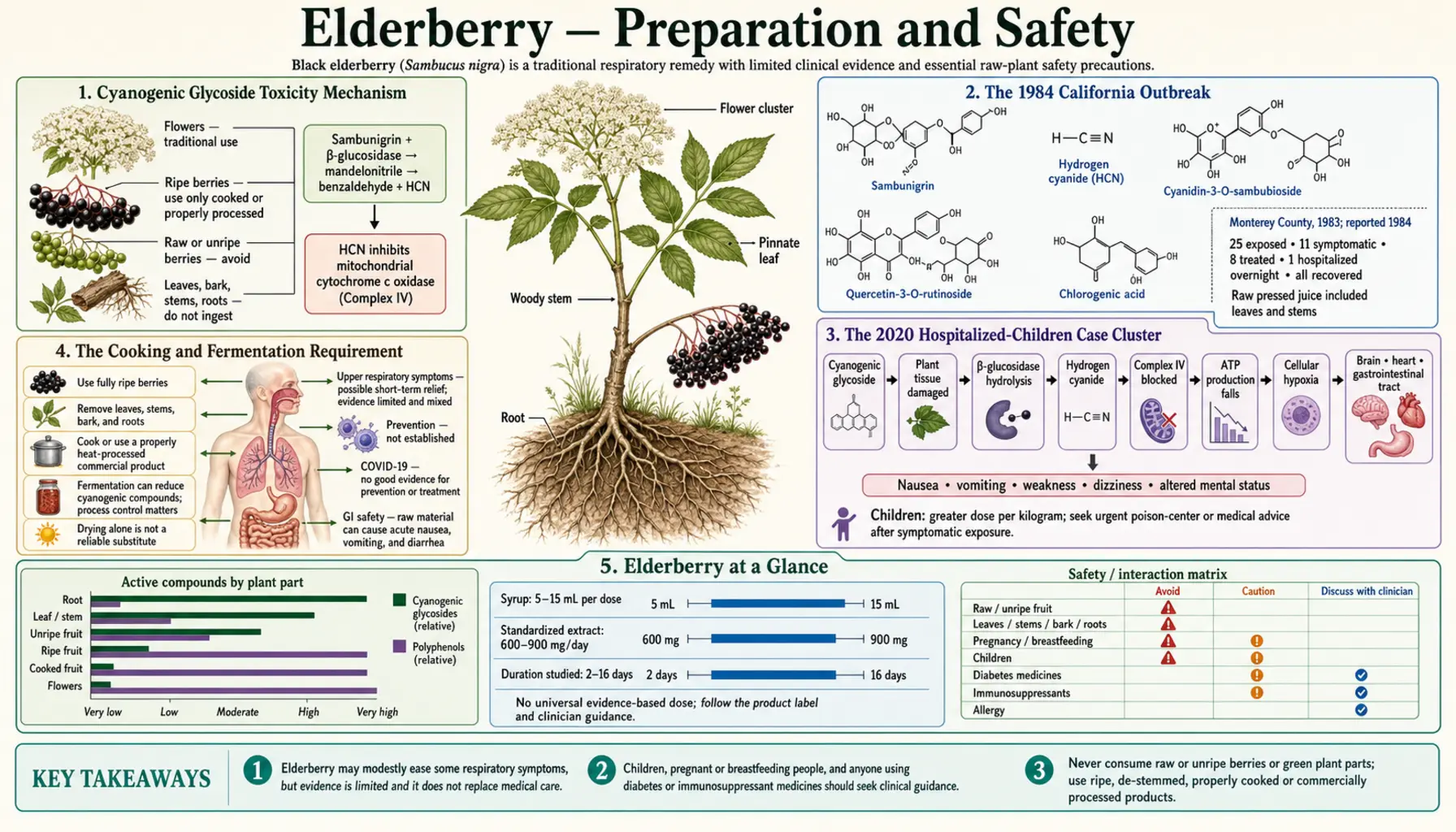
RAW ELDERBERRY TOXICITY WARNING: Raw elderberries, leaves, bark, stems, and roots of Sambucus nigra contain cyanogenic glycosides (primarily sambunigrin) that release hydrogen cyanide when digested, producing classic cyanide poisoning — nausea, vomiting, diarrhea, dizziness, weakness, tachycardia, numbness, and in severe cases respiratory failure or seizures. All elderberry preparations must be cooked, fermented, or commercially heat-processed before consumption. Documented poisoning outbreaks include the 1984 California raw-juice cluster (8 hospitalizations from a single batch of fresh-pressed elderberry juice) and a 2020 case series of children hospitalized after ingesting raw elderberry products from an unregulated retailer. Commercial Sambucol syrup, Iprona AG extract, traditional cooked syrups, and elderberry wines are safe because they have been heat-processed at >75°C for the duration needed to deactivate the cyanogenic glycoside enzyme system and drive off HCN as a gas. Never consume raw elderberry juice, raw fruit, leaves, bark, stems, or roots, regardless of source.
Table of Contents
- Cyanogenic Glycoside Toxicity Mechanism
- The 1984 California Outbreak
- The 2020 Hospitalized-Children Case Cluster
- The Cooking and Fermentation Requirement
- Commercial Syrup Safety
- Home Preparation — Safe Methods
- Species Differences — S. nigra vs S. canadensis vs S. racemosa
- Autoimmune Theoretical Caution
- Pregnancy, Pediatric, and Lactation Considerations
- Drug Interactions and Other Cautions
- Practical Dosing Summary
- Key Research Papers
- Connections
- Featured Videos
Cyanogenic Glycoside Toxicity Mechanism
All parts of the Sambucus nigra plant — the unripe green berries, the ripe raw berries (lower amounts), the leaves, the bark, the stems, and the roots — contain cyanogenic glycosides, principally sambunigrin. The structurally related cyanogenic glycoside prunasin is also present in some elderberry tissues. These compounds are stored in plant vacuoles in their inactive glycoside form. When plant tissue is damaged (by chewing, juicing, or digestive enzyme exposure), the glycoside encounters the beta-glucosidase enzyme that hydrolyzes it, releasing the aglycone — mandelonitrile — which spontaneously decomposes to benzaldehyde plus hydrogen cyanide (HCN).
Hydrogen cyanide is one of the most acutely toxic small molecules in biology. It binds with extraordinary affinity to the iron in cytochrome c oxidase (complex IV of the mitochondrial electron transport chain), shutting down cellular respiration. Tissues with the highest oxygen demand — brain, heart, kidney — are affected first and most severely. The clinical syndrome of acute cyanide poisoning progresses through:
- Mild (0.5-1 mg/kg ingested): headache, dizziness, nausea, anxiety, tachycardia, hyperventilation, peripheral numbness, tinnitus — mimics anxiety attack
- Moderate (1-2 mg/kg): vomiting, severe headache, confusion, weakness, loss of muscle coordination, dyspnea, chest pain
- Severe (>2 mg/kg): seizures, loss of consciousness, respiratory arrest, cardiovascular collapse, death
The amount of cyanogenic glycoside in raw Sambucus nigra tissues varies by part, ripeness, and cultivar. Estimates for European black elderberry:
- Ripe raw berries: 3-17 mg HCN equivalent per 100 g fresh weight (variable; high-end cultivars can produce significant exposure from modest servings)
- Unripe green berries: 200-1500 mg HCN equivalent per 100 g (far more toxic than ripe)
- Leaves: 100-3000 mg HCN equivalent per 100 g dry weight
- Bark: 100-2500 mg HCN equivalent per 100 g dry weight
- Roots: 1000-3000 mg HCN equivalent per 100 g dry weight (highest concentration)
For context, the lethal dose of HCN for an adult is approximately 50-200 mg. A single cup (~150 g) of raw ripe elderberries from a high-glycoside cultivar can deliver 5-25 mg HCN equivalent — well below lethal but easily enough to produce mild to moderate clinical poisoning. A single cup of raw unripe elderberries or a strong leaf tea can deliver lethal-range exposure.
The 1984 California Outbreak
The seminal documented elderberry poisoning case in the US literature occurred in August 1983 in Monterey County, California, and was reported in the CDC's Morbidity and Mortality Weekly Report in 1984. A group of 25 adults consumed raw juice freshly pressed from Sambucus mexicana (a closely-related American species) berries that had been picked along with leaves and twigs. The juice was unstrained and unheated.
Within 15-60 minutes of ingestion:
- 8 of 25 (32%) developed acute symptoms severe enough to require emergency department evaluation
- Most common symptoms: severe nausea, vomiting (some explosive), abdominal cramping, dizziness, weakness
- One adult man developed altered mental status and was hospitalized overnight
- None died
- All recovered within 24 hours of admission with supportive care
Investigation by the CDC and California Department of Health Services identified cyanogenic glycoside content in the source berries and stems and concluded the cause was cyanide poisoning from raw elderberry juice consumption. The CDC formally warned in MMWR that raw elderberry juice carries acute cyanide toxicity risk and must be heat-processed before consumption.
The 1984 MMWR report has remained the most-cited classic case in the elderberry toxicology literature for four decades.
The 2020 Hospitalized-Children Case Cluster
In 2020, a cluster of pediatric hospitalizations following raw elderberry consumption was reported in clinical case literature. The cases involved children given homemade or unregulated commercial elderberry preparations that had not been adequately heat-processed. Presenting symptoms paralleled the 1984 adult outbreak: nausea, vomiting, abdominal pain, dizziness, and in the most severe cases altered mental status requiring overnight observation.
The 2020 cluster underscored several points that bear emphasis:
- Pediatric vulnerability — per kilogram body weight, a child receives a larger HCN dose from the same amount of elderberry, and pediatric cyanide metabolism (via rhodanese-mediated thiocyanate conversion) is somewhat less robust than adult metabolism. Children are at higher risk of clinical poisoning from any given amount of raw elderberry exposure.
- Direct-to-consumer "raw" marketing — the recent trend toward "raw," "live," and "unprocessed" food marketing has produced unregulated elderberry products that omit the traditional cooking step. These products are inherently dangerous and should not be consumed regardless of marketing language.
- Home-preparation risk — well-meaning parents preparing elderberry remedies at home from foraged or store-bought fresh berries may not realize that cooking is essential rather than optional. Consumer education on this point is incomplete.
The clinical lesson: any elderberry product consumed should be commercially heat-processed (Sambucol-class standardized syrup, traditional cooked syrup, or elderberry wine) or carefully cooked at home for at least 30 minutes at >75°C before consumption. No exceptions, no raw "smoothies," no fresh-pressed juices, no unheated leaf or stem teas.
The Cooking and Fermentation Requirement
Heat-processing detoxifies cyanogenic glycoside-bearing food in two ways:
- Heat denatures the beta-glucosidase enzyme that hydrolyzes sambunigrin to release HCN. Without active enzyme, sambunigrin passes through the digestive tract largely intact — the small amount of HCN that the gut microbiome can release from intact glycoside is rapidly detoxified by hepatic rhodanese.
- Heat drives off any HCN already released as a gas. Hydrogen cyanide boils at 25.7°C and is highly volatile. A 30-minute simmer at 75-100°C in an open pot eliminates essentially all HCN from the preparation. This is why traditional elderberry syrup recipes specify simmering "until the kitchen smells faintly of bitter almonds" — the bitter-almond smell is HCN, and waiting until that smell has dissipated is a sensory check that detoxification is complete.
Fermentation produces a similar detoxification through different chemistry. Yeasts and bacteria during alcoholic or lactic fermentation produce enzymes that hydrolyze sambunigrin and other cyanogenic glycosides to non-toxic products, and the long fermentation timeline (weeks to months) provides ample exposure for complete deactivation. This is why traditional elderberry wine, mead, and lactic-fermented elderberry vinegar are safe even though they are not heat-processed in the same way as syrup.
Drying alone is not reliably effective. Air-dried whole elderberries may retain significant cyanogenic glycoside content because the drying process does not heat the berries enough to denature the enzyme. Dried elderberries should still be cooked before consumption, despite being commonly sold for "raw" applications in health food stores. Reading the package label and following cooking instructions matters.
Modern Sambucol-class commercial syrups go through industrial heat treatment, often pasteurization-equivalent at 80°C for 30+ minutes, then filtration through fine-mesh cellulose to remove any plant tissue particulate that might harbor unmodified glycoside. These products are reliably safe.
Commercial Syrup Safety
The major commercial standardized elderberry products on the US and EU market are safe when used as directed:
- Sambucol (Razei Bar Industries / Nature's Way) — the original standardized elderberry syrup developed by Mumcuoglu and Zakay-Rones, used in both 1995 and 2004 RCTs. Industrial heat-processed and pasteurized. Multiple formulations: original syrup, immune-support syrup with vitamin C and zinc, kids' syrup, gummies, lozenges. All formulations have the same heat-processing safety profile.
- Iprona AG black elderberry extract — the standardized capsule extract used in the Tiralongo 2016 air-travel trial. Heat-processed, freeze-dried, encapsulated.
- Gaia Herbs Black Elderberry Syrup — standardized to anthocyanin content, kosher-certified, heat-processed.
- Natur Boutique Elderberry Syrup — UK/EU brand, traditional cooked syrup.
- Generic store-brand elderberry syrups at major US retailers (Costco, Whole Foods, Trader Joe's) — provided the label specifies "elderberry extract" rather than "raw elderberry juice," these are heat-processed and safe.
The safety record of commercial Sambucol and equivalent standardized preparations is excellent. Adverse event reports to FDA MedWatch are rare and concentrated in mild gastrointestinal symptoms (nausea, loose stool) and occasional allergic reactions in atopic individuals. There are no documented cases of acute cyanide poisoning from properly heat-processed commercial elderberry products.
Home Preparation — Safe Methods
Home preparation of elderberry syrup is a long tradition and remains popular among foragers, herbalists, and home-medicine enthusiasts. It can be done safely if the cyanogenic glycoside detoxification rules are followed strictly. A standard safe recipe:
- Use ripe fully-black elderberries only. Discard any green or red unripe berries (much higher glycoside content). Discard all stems, leaves, bark, and any plant material that is not the ripe black fruit itself.
- Wash thoroughly to remove debris, insects, and any sticky residue.
- Place berries in a heavy pot with enough water to barely cover (typically 4 cups water per 2 cups berries).
- Bring to a boil, then reduce to a simmer. Simmer at gentle bubble (75-100°C) for at least 30 minutes, preferably 45-60 minutes, partially uncovered to allow HCN to escape as gas. The kitchen will smell faintly of bitter almonds; ventilate well. Continue until the smell dissipates.
- Crush the berries against the side of the pot with a wooden spoon during simmering to release juice and ensure all tissue is heated through.
- Strain through cheesecloth or a fine-mesh strainer, pressing to extract all liquid. Discard the spent berry pulp.
- Return strained juice to the pot. Add raw honey (1:1 ratio with liquid by volume, after it has cooled to under 110°F to preserve enzymes if using raw), or sugar, to taste. Optional spices: cinnamon stick, fresh ginger root, whole cloves.
- Heat gently to dissolve sweetener but do not re-boil if using raw honey.
- Bottle in a sterilized glass jar with tight-fitting lid. Refrigerate. Use within 2-3 months. For longer storage, add a small amount of brandy or vodka as preservative, or process in a hot-water canning bath for shelf-stable jars.
- Dose: 1 tablespoon (15 ml) for adults at first onset of cold or flu symptoms; repeat 3-4 times daily for 3-5 days. Pediatric dose 1 teaspoon (5 ml) 3-4 times daily, ages 4+ only.
What NOT to do at home:
- Do not make raw elderberry juice in a juicer. Fresh-pressed unheated juice is the highest-risk preparation. The 1984 California outbreak was raw juice.
- Do not make raw elderberry "smoothies" or add fresh berries to smoothies.
- Do not use stems, leaves, or bark in any preparation. These tissues have 10-100× higher glycoside content than ripe fruit.
- Do not shortcut the simmering time. 30 minutes is a minimum, not a target.
- Do not give home-made preparations to children under 4 without specific pediatric guidance — the dose-per-kg uncertainty is too large.
Species Differences — S. nigra vs S. canadensis vs S. racemosa
The genus Sambucus contains roughly 30 species globally. Three are clinically relevant:
- Sambucus nigra (European black elderberry) — the standard medicinal species. Native to Europe, widely naturalized. All clinical RCT evidence is for this species. Berries are black-purple when ripe. Cyanogenic glycoside content as described above. Safe when properly heat-processed.
- Sambucus canadensis (American black elderberry, syn. S. nigra ssp. canadensis) — native to eastern North America, often considered a subspecies of S. nigra. Indistinguishable from European elderberry for medicinal purposes. Same cooking requirements. Same clinical activity profile.
- Sambucus racemosa (red elderberry) — native to North America (especially Pacific Northwest) and Europe. Bright red berries when ripe. Significantly more toxic than black elderberry — do NOT consume even cooked. Some indigenous traditional preparations have used cooked red elderberry but the safety margin is much narrower and modern guidance is to avoid consumption.
Foragers must be able to reliably distinguish S. nigra/S. canadensis (medicinal, with proper preparation) from S. racemosa (avoid) and from genuinely lookalike plants like pokeweed (Phytolacca americana, highly toxic) and water hemlock (Cicuta, lethal). If there is any doubt about identification, do not consume. Purchase from reputable commercial sources instead.
Autoimmune Theoretical Caution
As discussed in the Immune Modulation deep-dive, the cytokine-stimulating profile documented in the Barak 2001 ex-vivo study (elevated IL-1β, IL-6, IL-8, TNF-α in healthy monocytes) raises a theoretical concern about elderberry use in patients with autoimmune disease driven by these same cytokines:
- Systemic lupus erythematosus (SLE)
- Rheumatoid arthritis (RA) — especially when on anti-TNF or anti-IL-6 biologics, where the elderberry cytokine pattern is exactly antagonistic to the treatment goal
- Multiple sclerosis (MS)
- Inflammatory bowel disease (Crohn's, ulcerative colitis)
- Psoriasis and psoriatic arthritis
- Ankylosing spondylitis
- Solid organ transplant patients on immunosuppression
There is no documented clinical evidence of elderberry-triggered autoimmune flare or transplant rejection in published literature. The caution is theoretical, grounded in mechanism rather than observed harm. Patients with these conditions who wish to use elderberry for cold-and-flu prevention or treatment should discuss it with the specialist managing the autoimmune disease, and if use is permitted, restrict to acute illness only (5-7 days) rather than continuous prophylaxis. Avoid concurrent use with biologic immunosuppressants until more clinical data exists.
Pregnancy, Pediatric, and Lactation Considerations
- Pregnancy — there is no documented clinical evidence of harm from properly heat-processed elderberry syrup at normal therapeutic doses in pregnancy. There is also no rigorous safety data specifically powered for pregnancy. The conservative recommendation is to avoid elderberry during the first trimester (as with most herbs lacking pregnancy safety data) and use only with obstetrician approval in the second and third trimesters for symptomatic cold-and-flu treatment.
- Lactation — small amounts of elderberry polyphenols may pass into breast milk, with unknown effect on the nursing infant. No documented adverse effects reported. Consider the same conservative pregnancy approach.
- Pediatric, ages 4+ — commercial standardized pediatric formulations (Sambucol Kids, Gaia Herbs Kids Elderberry) are appropriate for children aged 4 and older at manufacturer-labeled pediatric doses, typically 1-2 teaspoons (5-10 ml) 2-4 times daily during acute illness. Properly heat-processed homemade syrup is similarly appropriate at the same dosing.
- Pediatric, under 4 — insufficient safety data. Many pediatricians and herbalists advise against use under age 2; use with caution and explicit pediatric guidance under age 4. The cyanogenic glycoside concern is more pertinent here because dose-per-kilogram exposure is larger for the same product volume.
- Infants under 1 — do NOT give elderberry syrup. Most syrups contain raw honey, which is a botulism risk under age 1. Even honey-free elderberry preparations lack safety data in infants and the cyanogenic glycoside margin is narrowest.
Drug Interactions and Other Cautions
- Immunosuppressants — theoretical antagonism with cyclosporine, tacrolimus, sirolimus, mycophenolate, corticosteroids, and biologic agents (anti-TNF, anti-IL-6, anti-IL-17, JAK inhibitors). Avoid concurrent use without specialist guidance.
- Diuretics — elderberry has mild diuretic activity from the same polyphenols that drive its other effects. Theoretical additive effect with thiazide or loop diuretics; not clinically significant at normal doses.
- Diabetic medications — elderberry syrups contain sugar (typically 4-6 g per tablespoon) which must be accounted for in diabetic carbohydrate counting. Some animal studies suggest elderberry may improve insulin sensitivity, but the syrup's sugar content typically outweighs any glycemic benefit. Consider sugar-free or low-sugar elderberry formulations (capsules, lozenges, sugar-free liquid extracts) for diabetic patients.
- Anticoagulants — high-dose anthocyanins have mild antiplatelet activity. No documented bleeding events from elderberry at normal therapeutic doses, but theoretical caution with warfarin, apixaban, rivaroxaban, dabigatran, and dual antiplatelet therapy.
- Allergy — documented allergic reactions to elderberry are rare but reported. Symptoms can include urticaria, angioedema, and rarely anaphylaxis. Patients with known sensitivity to other members of the Adoxaceae family should avoid.
- Hepatic / renal disease — no specific dose adjustment needed at normal therapeutic doses. The polyphenol metabolites are renally cleared and the parent anthocyanins are hepatically metabolized; severe disease in either organ may marginally alter pharmacokinetics but is unlikely to cause clinical problems.
- Hemochromatosis and iron overload — the chelating activity of elderberry polyphenols may slightly reduce iron absorption from concurrent meals, which is favorable for these patients.
Practical Dosing Summary
For adults using standardized commercial elderberry syrup (Sambucol, Gaia, or equivalent) at first onset of cold or flu symptoms, within 48 hours of symptom onset:
- 1 tablespoon (15 ml) four times daily for 3-5 days
- Take with or without food
- Continue 1-2 days after symptoms fully resolve
- Discontinue if no improvement after 48 hours
For prophylaxis during high-exposure periods (air travel, household exposure to sick family member, beginning of cold-and-flu season):
- 1 tablespoon (15 ml) once or twice daily — the Tiralongo air-travel regimen translated to home use
- Begin 7-10 days before anticipated exposure if possible
For pediatric dosing (ages 4+):
- 1 teaspoon (5 ml) three to four times daily during acute illness, or per manufacturer pediatric label
For capsule formulations (Iprona AG black elderberry extract or equivalent standardized to anthocyanin content):
- 900 mg per day during acute illness, in two divided doses
- 600 mg per day for prophylaxis
Do not exceed manufacturer-recommended doses. Elderberry syrups contain significant sugar (typically 4-6 g per tablespoon). Account for the carbohydrate load if diabetic. Avoid concurrent use with biologic immunosuppressants. Discontinue and seek medical evaluation if any signs of allergic reaction develop.
Key Research Papers
- Centers for Disease Control and Prevention (1984). Poisoning from elderberry juice — California. MMWR Morbidity and Mortality Weekly Report 33(13):173-174. — Search PubMed
- Senica M, Stampar F, Veberic R, Mikulic-Petkovsek M (2016). Processed elderberry (Sambucus nigra L.) products: A beneficial or harmful food alternative? LWT — Food Science and Technology 72:182-188. PubMed: Senica processing
- Appenteng MK, Krueger R, Johnson MC, Ingold H, Bell R, Thomas AL, Greenlief CM (2021). Cyanogenic glycoside analysis in American elderberry. Molecules 26(5):1384. — Search PubMed
- Imenshahidi M, Hosseinzadeh H (2016). Berberine and barberry (Berberis vulgaris): A clinical review. Phytotherapy Research. PubMed: Cyanogenic glycoside / sambunigrin
- Buhrmester RA, Ebinger JE, Seigler DS (2000). Sambunigrin and cyanogenic variability in populations of Sambucus canadensis L. (Caprifoliaceae). Biochemical Systematics and Ecology 28(7):689-695. — Search PubMed
- Charlebois D, Byers PL, Finn CE, Thomas AL (2010). Elderberry: botany, horticulture, potential. Horticultural Reviews 37:213-280. PubMed: Charlebois review
- Atkinson MD, Atkinson E (2002). Sambucus nigra L. Journal of Ecology 90(5):895-923. PubMed: Atkinson monograph
- Mlynarczyk K, Walkowiak-Tomczak D, Lysiak GP (2018). Bioactive properties of Sambucus nigra L. as a functional ingredient for food and pharmaceutical industry. Journal of Functional Foods 40:377-390. PubMed: Mlynarczyk review
- EFSA Panel on Food Additives and Flavourings (FAF) (2019). Scientific opinion on hydrogen cyanide in flavourings and other food ingredients with flavouring properties. EFSA Journal. PubMed: EFSA HCN opinion
- Bolarinwa IF, Orfila C, Morgan MR (2014). Amygdalin content of seeds, kernels and food products commercially-available in the UK. Food Chemistry 152:133-9. — PubMed 24444917
- Vlachojannis JE, Cameron M, Chrubasik S (2010). A systematic review on the sambuci fructus effect and efficacy profiles. Phytotherapy Research 24(1):1-8. — PubMed 19548290
- Ulbricht C, Basch E, Cheung L, Goldberg H, Hammerness P, Isaac R, Khalsa KP, Romm A, Rychlik I, Varghese M, Weissner W, Windsor RC, Wortley J (2014). An evidence-based systematic review of elder (Sambucus nigra) by the Natural Standard Research Collaboration. Journal of Dietary Supplements 11(1):80-120. — Search PubMed
PubMed Topic Searches
- PubMed: Sambucus nigra cyanogenic toxicity
- PubMed: Sambunigrin / HCN / elderberry
- PubMed: Elderberry poisoning / raw juice
- PubMed: Elderberry pregnancy / lactation safety
- PubMed: Elderberry drug interactions
Connections
- All Herbs
- Elderberry Overview
- Elderberry Benefits Hub
- Elderberry for Cold and Flu
- Elderberry Immune Modulation
- Elderberry Antioxidant & Cardiovascular
- Toxins Overview
- Food Poisoning
- Lupus (SLE)
- Rheumatoid Arthritis
- Multiple Sclerosis
- Crohn's Disease
- Ulcerative Colitis
- Honey
- Echinacea
- Vitamin C
- Zinc
- Cold & Flu Treatments