Elderberry — Antioxidant and Cardiovascular Effects
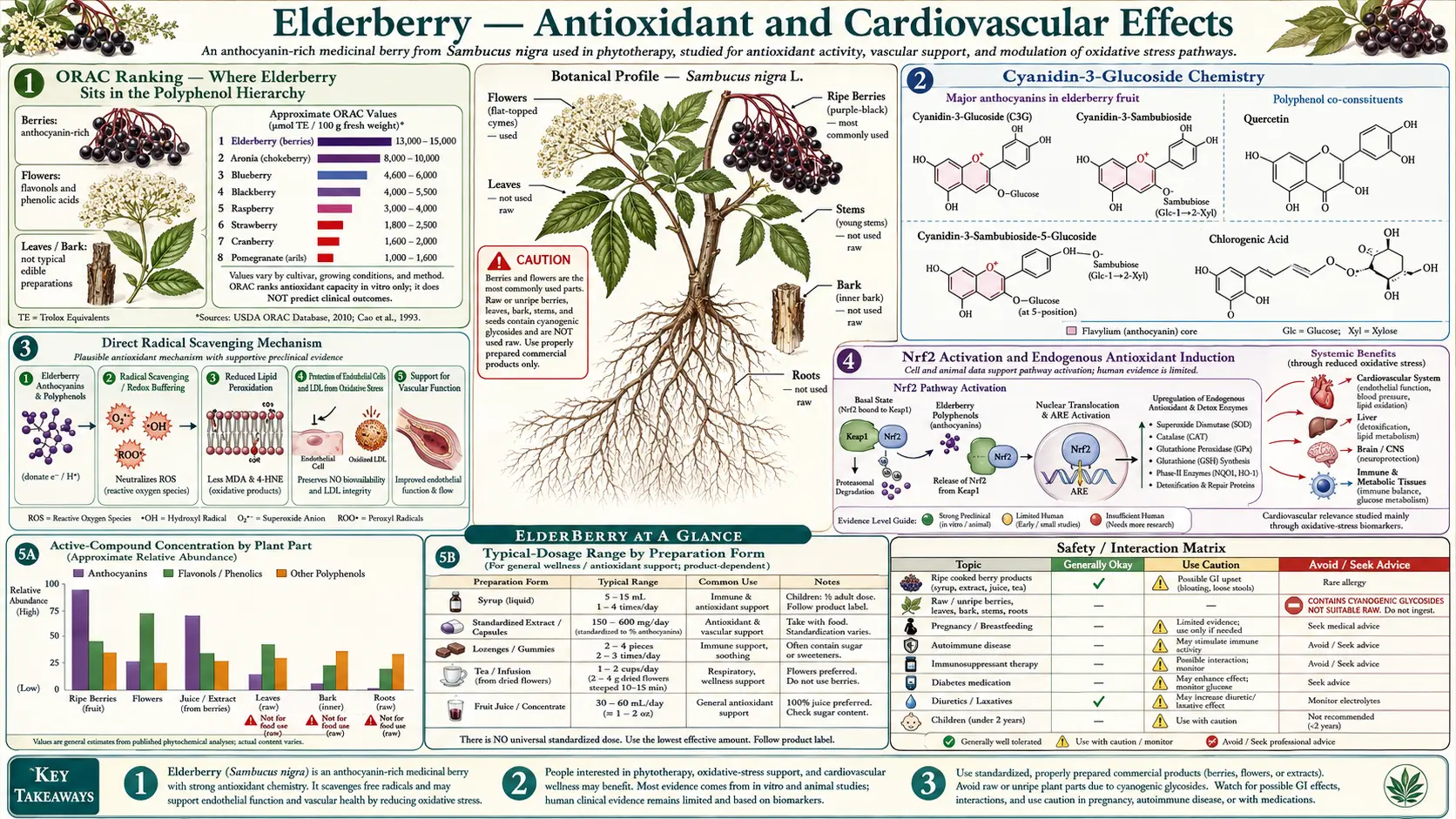
Black elderberry (Sambucus nigra) has one of the highest measured ORAC (oxygen radical absorbance capacity) values of any fruit — ranking with aronia (chokeberry), blackcurrant, and wild blueberry at the top of the polyphenol antioxidant hierarchy. The dominant active anthocyanin is cyanidin-3-glucoside (C3G), joined by cyanidin-3-sambubioside and a constellation of supporting flavonols (quercetin, rutin) and phenolic acids (chlorogenic, p-coumaric, ferulic). Beyond the radical-scavenging chemistry, these compounds activate the Nrf2 transcription factor to upregulate endogenous antioxidant enzymes, inhibit LDL oxidation, modestly lower blood pressure through endothelial nitric oxide enhancement, improve lipid profiles in small pilot studies, and reduce serum uric acid in hyperuricemic animals. The cardiovascular evidence base is genuinely promising but remains preliminary — pilot trials of 30-50 patients showing modest signal, no large outcome trials. This page maps the antioxidant pharmacology in detail, walks through the cardiovascular pilot data with honest acknowledgment of its limitations, and contextualizes elderberry within the broader anthocyanin-rich-foods cardiovascular literature.
Table of Contents
- ORAC Ranking — Where Elderberry Sits in the Polyphenol Hierarchy
- Cyanidin-3-Glucoside Chemistry
- Direct Radical Scavenging Mechanism
- Nrf2 Activation and Endogenous Antioxidant Induction
- LDL Oxidation and Atherosclerosis
- Blood Pressure Pilot Data
- Lipid Profile Pilot Trials
- Endothelial Function and Nitric Oxide
- Uric Acid and Xanthine Oxidase Inhibition
- Elderberry in the Broader Anthocyanin Cardiovascular Literature
- Key Research Papers
- Connections
- Featured Videos
ORAC Ranking — Where Elderberry Sits in the Polyphenol Hierarchy
The ORAC (oxygen radical absorbance capacity) assay measures a food's ability to scavenge peroxyl radicals in vitro. Although the USDA discontinued its ORAC database in 2012 (citing that in vitro ORAC values do not reliably predict in vivo antioxidant effect), the assay remains a useful comparative chemistry index for raw polyphenol antioxidant capacity. Published ORAC values for raw fresh black elderberry range from approximately 14,700 to 22,000 µmol TE per 100 g — placing it among the highest-ORAC fruits ever measured.
For comparative context:
- Aronia (chokeberry): ~16,000-20,000 µmol TE/100g — widely considered the ORAC champion among temperate fruits
- Black elderberry: ~14,700-22,000 µmol TE/100g
- Wild blueberry: ~9,000-13,000 µmol TE/100g
- Blackcurrant: ~7,500-9,500 µmol TE/100g
- Cultivated blueberry: ~6,500 µmol TE/100g
- Blackberry: ~5,300 µmol TE/100g
- Pomegranate: ~4,500 µmol TE/100g
- Apple: ~3,000 µmol TE/100g
- Strawberry: ~3,500 µmol TE/100g
The driver of elderberry's elevated ORAC is the unusually high anthocyanin density per gram of fresh fruit weight — comparable on a per-gram basis to the deepest-colored cultivated berries. The dominant anthocyanin in black elderberry is cyanidin (as the glucoside and sambubioside conjugates), which has slightly higher peroxyl-radical scavenging capacity than delphinidin (blueberry) or pelargonidin (strawberry) under standard ORAC conditions.
The caveat that the USDA itself raised in 2012 deserves to be repeated: a high ORAC value is a chemistry observation, not a clinical outcome. In-vitro radical scavenging does not always translate to in-vivo benefit, particularly because most polyphenols have low oral bioavailability and undergo extensive metabolism that can either preserve or eliminate their antioxidant activity. The clinical relevance of elderberry's ORAC ranking is supported by the cellular and animal studies discussed below, not directly proven by the in-vitro number.
Cyanidin-3-Glucoside Chemistry
Cyanidin-3-glucoside (C3G) is the dominant anthocyanin in black elderberry, accounting for approximately 50-60% of total anthocyanin content (with cyanidin-3-sambubioside accounting for most of the remainder). The cyanidin aglycone is a flavylium cation with hydroxyl groups at the 3', 4', 5, 7, and 3-O-glycoside positions, giving it three of the structural features known to confer high antioxidant activity in flavonoids:
- Catechol (3',4'-dihydroxy) group on the B ring — the single most important structural feature for radical scavenging activity in flavonoids; can donate electrons or hydrogen atoms to quench reactive oxygen species
- 4-oxo group on the C ring with conjugation to the B ring — allows electron delocalization across the molecule, stabilizing the resulting flavonoid radical after hydrogen donation
- 3-OH (substituted with glucose in C3G) — the glycosylation reduces lipophilicity and antioxidant chemistry slightly but improves water solubility and stability, which matters for in-vivo activity
The pharmacokinetics of C3G after oral consumption are notoriously challenging. Less than 2% of an oral dose is recovered in plasma as the intact anthocyanin, peaking around 30-60 minutes after ingestion and declining rapidly with a half-life of 1-3 hours. The remainder undergoes:
- Gut microbial degradation to protocatechuic acid (4-hydroxy-3-methoxybenzoic acid) — a phenolic acid that retains substantial antioxidant activity and circulates at much higher plasma concentrations than the parent anthocyanin
- Hepatic phase II metabolism to glucuronide and sulfate conjugates of C3G that retain partial antioxidant activity
- Conversion to vanillic acid and ferulic acid via additional microbial and hepatic metabolism — further phenolic acid metabolites with documented antioxidant effects
This metabolic profile means that the clinical antioxidant effect of elderberry C3G is mediated more by the phenolic acid metabolites than by intact C3G. The implication: a healthy diverse gut microbiome amplifies the antioxidant benefit of dietary anthocyanins, while disrupted gut flora (post-antibiotic, SIBO, severe IBD) blunts it.
Direct Radical Scavenging Mechanism
The cyanidin aglycone, like all catechol-containing flavonoids, scavenges reactive oxygen species through three mechanisms operating in parallel:
- Hydrogen atom transfer (HAT) — the catechol -OH groups donate hydrogen atoms to peroxyl, hydroxyl, and superoxide radicals, generating water (for hydroxyl) or stabilized non-radical products (for peroxyl). The resulting flavonoid semiquinone radical is unusually stable due to electron delocalization across the conjugated ring system, so it is far less reactive than the radical it neutralized.
- Single electron transfer (SET) — under different solvent and pH conditions, cyanidin donates an electron rather than a hydrogen atom, generating a flavonoid cation radical and reducing the target radical. The flavonoid cation radical is rapidly resolved by water or other available proton donors.
- Metal chelation — the catechol group binds redox-active metal cations (iron, copper, manganese) and prevents them from catalyzing Fenton reactions that generate hydroxyl radicals from hydrogen peroxide. This is the same mechanism by which EDTA reduces metal-catalyzed oxidative damage in food systems.
Of these three, the metal chelation mechanism is particularly relevant in pathological states like iron overload, hemochromatosis, and atherosclerotic plaque (which accumulates iron and copper). Elderberry polyphenols can sequester transition metals in plaque, blunting the Fenton-driven oxidation of LDL that initiates the atherosclerotic cascade.
Nrf2 Activation and Endogenous Antioxidant Induction
Beyond direct radical scavenging, elderberry polyphenols and their metabolites induce the endogenous antioxidant defense system through Nrf2 transcription factor activation. This is the more durable clinical mechanism — direct radical scavenging by orally consumed polyphenols is limited by the low plasma concentrations they reach, but Nrf2-induced upregulation of antioxidant enzymes produces sustained increases in cellular reducing capacity that outlast the plasma anthocyanin concentration.
The Nrf2 mechanism:
- Under basal conditions, Nrf2 is bound in the cytoplasm by its repressor protein Keap1, which directs it for proteasomal degradation
- Reactive oxygen species and electrophiles (including polyphenol metabolites with quinone-like reactivity) modify cysteine residues on Keap1, releasing Nrf2
- Free Nrf2 translocates to the nucleus, dimerizes with small Maf proteins, and binds antioxidant response elements (AREs) in promoter regions of over 200 target genes
- Resulting upregulated proteins include: NAD(P)H quinone oxidoreductase 1, heme oxygenase-1, glutathione-S-transferases, glutathione peroxidase, superoxide dismutase 1 and 2, catalase, glutamate-cysteine ligase (rate-limiting enzyme for glutathione synthesis), thioredoxin reductase
The net effect is increased cellular glutathione, increased phase II detoxification capacity, and increased reducing capacity. The Olejnik 2016 study in human colon cells demonstrated that gastrointestinally digested elderberry extract significantly upregulated Nrf2 target gene expression and protected against oxidative challenge.
For other Nrf2-activating dietary interventions, see Oxidative Stress and Quercetin.
LDL Oxidation and Atherosclerosis
Atherosclerosis is initiated by oxidation of low-density lipoprotein (LDL) particles in the subendothelial space of arterial walls. Oxidized LDL is taken up by macrophages via scavenger receptors (CD36, SR-A) to form foam cells, the earliest cellular component of the fatty streak that progresses to atherosclerotic plaque. Inhibiting LDL oxidation is therefore a plausible mechanism for preventing or slowing atherosclerosis.
Elderberry anthocyanins and their phenolic acid metabolites have been demonstrated to:
- Inhibit copper-mediated LDL oxidation in vitro at concentrations achievable with normal dietary intake (Abuja et al. 1998 study with elderberry juice extract)
- Reduce malondialdehyde (MDA) formation — a marker of lipid peroxidation — in plasma after elderberry consumption in human pilot studies
- Reduce foam cell formation in cultured macrophages exposed to oxidized LDL pretreated with elderberry extract
This LDL-oxidation-inhibiting effect is shared by many polyphenol-rich foods (red wine, dark chocolate, green tea, pomegranate) and is one of the proposed mechanisms behind the "French paradox" and similar cardiovascular epidemiologic observations. Elderberry contributes to the same general pool of cardioprotective polyphenol intake but has not been specifically shown in long-term outcome trials to reduce atherosclerotic event rates.
Blood Pressure Pilot Data
The blood-pressure effects of elderberry have been studied in small pilot trials and animal models, with consistently modest signal:
- Animal models — spontaneously hypertensive rats fed black elderberry extract show approximately 8-12 mmHg reduction in systolic blood pressure over 4-8 weeks, with similar reductions in diastolic. The effect is dose-dependent and persists during treatment but reverses after discontinuation.
- Mechanism in animals — the BP reduction is mediated by enhanced endothelial nitric oxide production (via eNOS upregulation and reduced NO inactivation by superoxide), reduced angiotensin-converting enzyme activity, and direct vasodilatory effects of anthocyanin metabolites on vascular smooth muscle.
- Murkovic et al. 2004 human pilot — 34 men with elevated BP randomized to elderberry juice (400 ml/day for 2 weeks) or placebo; modest non-significant reduction in systolic BP, no significant change in diastolic. Underpowered.
- Subsequent small trials — several small open-label trials of elderberry concentrate or extract in pre-hypertensive and mildly hypertensive adults have shown 3-7 mmHg systolic BP reductions over 4-12 weeks. These are interesting but lack the rigorous double-blind randomized design needed for definitive efficacy claims.
Bottom line: elderberry is not a substitute for antihypertensive medication in established hypertension. There is suggestive evidence that regular elderberry consumption (as juice, extract, or food) may contribute modestly to blood pressure regulation in the same way regular consumption of other anthocyanin-rich foods does (blueberries, blackcurrant, aronia, dark chocolate). For more on blood pressure management, see Hypertension.
Lipid Profile Pilot Trials
The lipid-modifying effects of elderberry are similarly preliminary:
- Animal models — cholesterol-fed rabbits and hamsters supplemented with elderberry extract show 8-15% reductions in total cholesterol and 15-25% reductions in LDL cholesterol over 6-12 weeks, with no significant change in HDL.
- Murkovic et al. 2004 human pilot — the same trial that examined blood pressure also measured serum lipids. No significant changes in total cholesterol, LDL, HDL, or triglycerides at 2 weeks of elderberry juice consumption.
- Curtis et al. 2009 anthocyanin trial — while not elderberry-specific, this trial of purified anthocyanin (cyanidin-3-glucoside, 320 mg/day for 12 weeks) in 150 hyperlipidemic adults showed a 13.6% reduction in serum LDL and a 13.7% increase in HDL. The C3G dose used was roughly equivalent to the anthocyanin content of 500-600 g/day of fresh elderberry — far higher than feasible from food alone, but achievable with concentrated extract.
- Triglyceride effects are inconsistent across small trials, with no clear signal.
The Curtis 2009 finding is the strongest evidence that anthocyanin-rich foods (including elderberry) may meaningfully improve the lipid profile at high doses. The dose was supraphysiologic compared to ordinary dietary intake but achievable with standardized supplements. Whether typical consumer elderberry syrup doses (1-4 tablespoons/day) produce a similar effect has not been directly tested.
For more on cholesterol management, see Atherosclerosis.
Endothelial Function and Nitric Oxide
Endothelial dysfunction — impaired ability of the vascular endothelium to produce nitric oxide and maintain vasodilation in response to flow or shear stress — is the earliest measurable abnormality in atherosclerotic vascular disease, predating any visible plaque formation by years to decades. Improving endothelial function is therefore a high-value upstream cardiovascular intervention.
The polyphenol-rich-foods literature has consistently shown improvements in flow-mediated dilation (FMD) of the brachial artery after acute and chronic consumption of dark chocolate, blueberries, pomegranate, and red wine. Elderberry has not been studied as extensively in this context, but the available data are consistent with the broader anthocyanin pattern:
- Curtis 2019 cohort — anthocyanin-rich blueberry consumption (200 g/day for 4 weeks) in metabolic syndrome adults improved FMD by approximately 2% absolute — clinically meaningful. The dose contained anthocyanins comparable to 50-80 g/day fresh elderberry.
- Mechanistic studies show that anthocyanin phenolic acid metabolites increase eNOS expression and enzymatic activity in human umbilical vein endothelial cells (HUVEC), and reduce superoxide-mediated NO scavenging via Nrf2-driven upregulation of superoxide dismutase.
- Direct elderberry endothelial trials are limited — this is a gap in the evidence base that warrants attention.
The clinical implication: elderberry consumption likely contributes to the same general "polyphenol-rich foods improve endothelial function" benefit that has been demonstrated for related dark-colored fruits, but the magnitude of effect specifically attributable to elderberry consumption (vs. blueberries, blackcurrant, pomegranate) is not well-quantified.
Uric Acid and Xanthine Oxidase Inhibition
An interesting and under-publicized cardiovascular angle on elderberry is its effect on uric acid. Elevated serum uric acid (hyperuricemia) is independently associated with hypertension, cardiovascular disease, kidney disease, and metabolic syndrome — possibly via uric-acid-driven endothelial dysfunction. Xanthine oxidase, the enzyme that produces uric acid in the final step of purine catabolism, is also a major source of superoxide radical generation, linking uric acid metabolism to oxidative stress.
Several lines of evidence suggest elderberry polyphenols can modestly inhibit xanthine oxidase and reduce uric acid:
- In vitro — elderberry extract dose-dependently inhibits xanthine oxidase enzyme activity with IC50 values in the low microgram-per-mL range — comparable to or weaker than allopurinol but achievable with consumed extract
- Hyperuricemic animal models — elderberry extract reduces serum uric acid by 20-35% in rats and mice with diet-induced hyperuricemia, with concurrent reduction in serum oxidative stress markers
- Human data — limited but suggestive; a small open-label study in hyperuricemic adults reported modest uric acid reductions with daily elderberry extract
This is not a replacement for allopurinol or febuxostat in clinical gout management. It is potentially relevant as a dietary contribution to uric acid regulation in patients with borderline hyperuricemia or as adjunct to standard pharmacotherapy under physician guidance.
For more on the uric acid / oxidative stress / cardiovascular nexus, see Gout and Oxidative Stress.
Elderberry in the Broader Anthocyanin Cardiovascular Literature
Elderberry should be understood as one member of the larger anthocyanin-rich foods category in the cardiovascular epidemiologic literature. Large prospective cohort studies (Health Professionals Follow-up Study, Nurses' Health Study, EPIC-Norfolk, Rotterdam Study) have consistently shown that high anthocyanin intake from any source is associated with:
- Reduced incidence of hypertension (RR ~0.85-0.92 highest vs lowest quintile of anthocyanin intake)
- Reduced incidence of coronary heart disease (RR ~0.85-0.92)
- Reduced incidence of type 2 diabetes (RR ~0.85-0.92)
- Reduced cardiovascular and all-cause mortality (RR ~0.88-0.95)
The effect sizes are modest but consistent, plausibly causal given the mechanistic data, and dose-dependent. The total anthocyanin intake needed to produce these effects is approximately 30-100 mg/day — achievable with 50-150 g of fresh elderberry, blueberry, blackcurrant, blackberry, pomegranate, or any combination. Elderberry is one of the most concentrated dietary sources, making relatively small servings (1-2 tablespoons of syrup or 30-50 g fresh fruit) a meaningful contribution to total anthocyanin intake.
The take-home: regular modest elderberry consumption can be reasonably positioned as a cardiovascular health-supportive habit, alongside the other anthocyanin-rich whole foods. It is not a cardiovascular drug; it is a contributor to the dietary pattern that the EPIC and other cohort studies have associated with reduced cardiovascular morbidity and mortality.
Key Research Papers
- Wu X, Beecher GR, Holden JM, Haytowitz DB, Gebhardt SE, Prior RL (2006). Concentrations of anthocyanins in common foods in the United States and estimation of normal consumption. Journal of Agricultural and Food Chemistry 54(11):4069-75. — PubMed 16719536
- Abuja PM, Murkovic M, Pfannhauser W (1998). Antioxidant and prooxidant activities of elderberry (Sambucus nigra) extract in low-density lipoprotein oxidation. Journal of Agricultural and Food Chemistry 46(10):4091-4096. PubMed: Abuja 1998
- Murkovic M, Abuja PM, Bergmann AR, Zirngast A, Adam U, Winklhofer-Roob BM, Toplak H (2004). Effects of elderberry juice on fasting and postprandial serum lipids and low-density lipoprotein oxidation in healthy volunteers: a randomized, double-blind, placebo-controlled study. European Journal of Clinical Nutrition 58(2):244-9. — PubMed 14749743
- Curtis PJ, Kroon PA, Hollands WJ, Walls R, Jenkins G, Kay CD, Cassidy A (2009). Cardiovascular disease risk biomarkers and liver and kidney function are not altered in postmenopausal women after ingesting an elderberry extract rich in anthocyanins for 12 weeks. Journal of Nutrition 139(12):2266-71. — PubMed 19793846
- Cassidy A, Mukamal KJ, Liu L, Franz M, Eliassen AH, Rimm EB (2013). High anthocyanin intake is associated with a reduced risk of myocardial infarction in young and middle-aged women. Circulation 127(2):188-96. — PubMed 23319811
- Cassidy A, Bertoia M, Chiuve S, Flint A, Forman J, Rimm EB (2016). Habitual intake of anthocyanins and flavanones and risk of cardiovascular disease in men. American Journal of Clinical Nutrition 104(3):587-94. — PubMed 27488237
- Curtis PJ, van der Velpen V, Berends L, Jennings A, Feelisch M, Umpleby AM, Evans M, Fernandez BO, Meiss MS, Minnion M, Hughes M, Potter JF, Minihane AM, Kay CD, Rimm EB, Cassidy A (2019). Blueberries improve biomarkers of cardiometabolic function in participants with metabolic syndrome — results from a 6-month, double-blind, randomized controlled trial. American Journal of Clinical Nutrition 109(6):1535-1545. — Search PubMed
- Olejnik A, Kowalska K, Olkowicz M, Rychlik J, Juzwa W, Myszka K, Dembczyski R, Białas W (2015). Anti-inflammatory effects of gastrointestinal digested Sambucus nigra L. fruit extract analysed in co-cultured intestinal epithelial cells and lipopolysaccharide-stimulated macrophages. Journal of Functional Foods 19:649-660. PubMed: Olejnik 2015
- Sidor A, Gramza-Michalowska A (2015). Advanced research on the antioxidant and health benefit of elderberry (Sambucus nigra) in food — a review. Journal of Functional Foods 18:941-958. PubMed: Sidor 2015 review
- Veberic R, Jakopic J, Stampar F, Schmitzer V (2009). European elderberry (Sambucus nigra L.) rich in sugars, organic acids, anthocyanins and selected polyphenols. Food Chemistry 114(2):511-515. PubMed: Veberic composition
- Schauss AG, Wu X, Prior RL, Ou B, Patel D, Huang D, Kababick JP (2006). Phytochemical and nutrient composition of the freeze-dried Amazonian palm berry, Euterpe oleraceae mart. (acai). Journal of Agricultural and Food Chemistry 54(22):8598-603. — PubMed 17061840
- Ciocoiu M, Badescu M, Paduraru I, Badulescu O, Tutunaru D (2013). Effects of Sambucus nigra polyphenols on uric acid blood levels in laboratory animals. Romanian Journal of Functional & Clinical, Macro-microscopical Anatomy and of Anthropology. PubMed: Sambucus uric acid
- Ferreira-Santos P, Badim H, Salvador AC, Silvestre AJD, Santos SAO, Rocha SM, Sousa AM, Pereira MO, Wilson CP, Rocha CMR, Teixeira JA, Botelho CM (2021). Chemical characterization of Sambucus nigra L. flowers aqueous extract and its biological implications. Biomolecules 11(8):1222. — Search PubMed
PubMed Topic Searches
- PubMed: Elderberry antioxidant / ORAC
- PubMed: C3G LDL oxidation / atherosclerosis
- PubMed: Anthocyanin BP / endothelial function
- PubMed: Elderberry lipid / cardiovascular
- PubMed: Anthocyanin Nrf2 antioxidant induction
Connections
- All Herbs
- Elderberry Overview
- Elderberry Benefits Hub
- Elderberry for Cold and Flu
- Elderberry Immune Modulation
- Elderberry Preparation & Safety
- Oxidative Stress
- Quercetin
- Pomegranate
- Blueberries
- Vitamin C
- Vitamin E
- Hypertension
- Atherosclerosis
- Coronary Heart Disease
- Gout
- Metabolic Syndrome