Coriander Seeds Antimicrobial Activity (Food Safety, Dodecenal, Linalool)
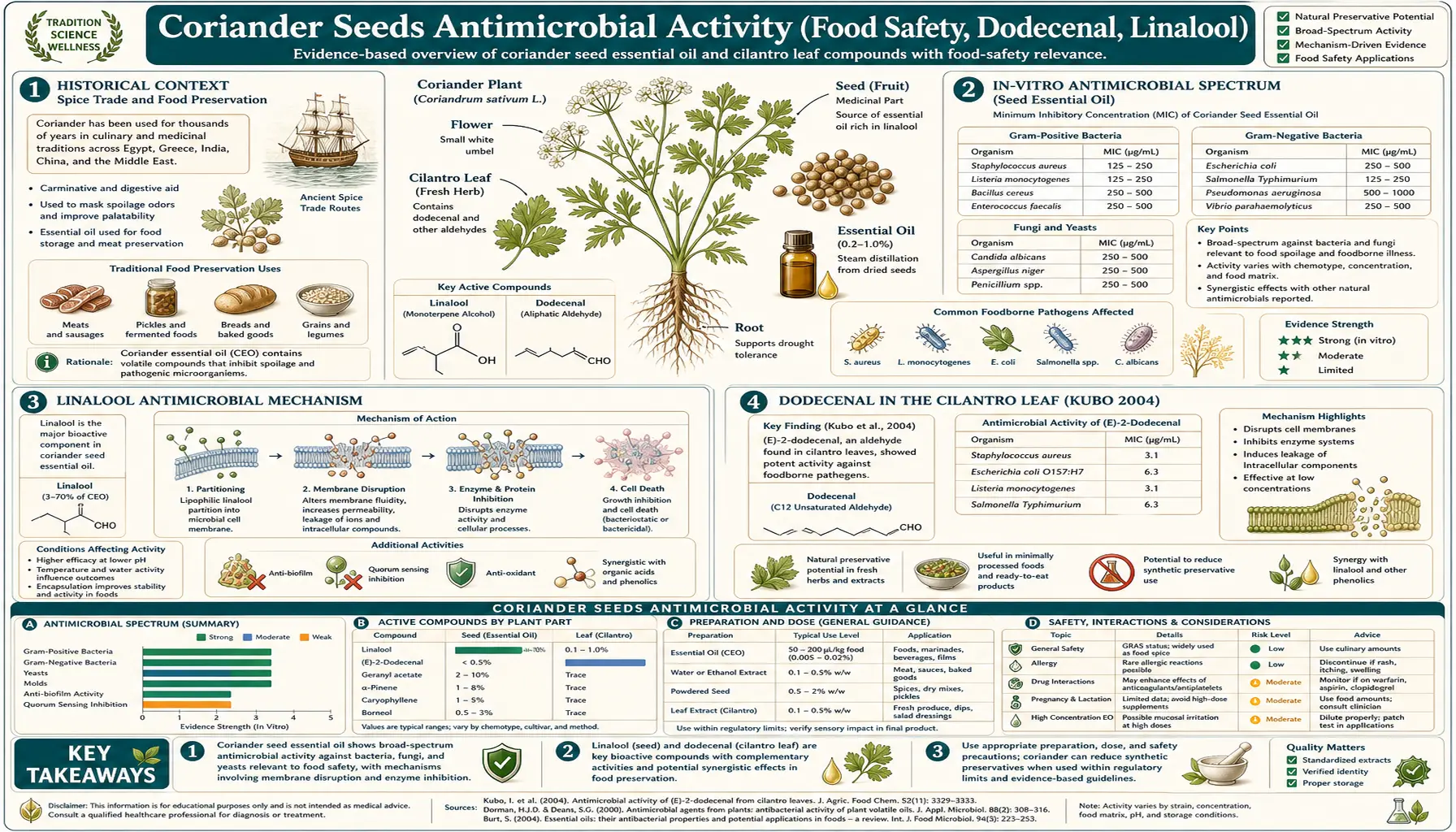
Coriander has a long-documented broad-spectrum antimicrobial profile that has been one of the chemical bases for the spice's preservation role in human food storage for thousands of years. The seed essential oil — dominated by linalool — inhibits a wide range of food-borne and clinically relevant bacteria including Salmonella species, Escherichia coli O157:H7, Listeria monocytogenes, Staphylococcus aureus, Bacillus cereus, and several Candida yeasts in standard in-vitro disk-diffusion and minimum-inhibitory-concentration (MIC) assays. The cilantro leaf, by contrast, contains the long-chain aldehyde (E)-2-dodecenal, which Kubo and colleagues showed in 2004 was twice as potent against Salmonella choleraesuis as the prescription aminoglycoside antibiotic gentamicin — making dodecenal one of the most potent naturally occurring antibacterial compounds yet characterized. This deep-dive walks through the in-vitro spectrum, the historical food-preservation role, the modern food-safety applications, the gap between in-vitro MIC and clinical infection treatment, and the careful framing required when discussing coriander as an "antimicrobial herb" with patients.
Table of Contents
- Historical Context (Spice Trade and Food Preservation)
- In-Vitro Antimicrobial Spectrum (Seed Essential Oil)
- Linalool Antimicrobial Mechanism
- Dodecenal in the Cilantro Leaf (Kubo 2004)
- Modern Food-Safety Applications
- Antifungal Activity (Candida and Aspergillus)
- Oral, Skin, and Topical Applications
- Gut Microbiome Effects (Selective vs Broad)
- The In-Vitro to Clinical Translation Gap
- Cautions, Resistance, and Realistic Framing
- Key Research Papers
- Connections
- Featured Videos
Historical Context (Spice Trade and Food Preservation)
Coriander is among the oldest spices in continuous human use. Carbonized coriander seeds recovered from the Nahal Hemar cave in Israel have been radiocarbon-dated to approximately 8,000 years before present, making coriander one of the earliest archaeologically documented domesticated plants. Coriander seeds were found in the tomb of Tutankhamun (circa 1325 BCE) and feature in the medical papyri of pharaonic Egypt. The Hebrew Bible (Exodus 16:31) likens manna to coriander seed. The Roman cookbook of Apicius, written in the late 4th or early 5th century, lists coriander in numerous recipes. Coriander spread along the early spice trade routes from the Mediterranean basin into Persia, India, China, sub-Saharan Africa, and eventually the Americas with European colonization.
The reason for coriander's persistent prominence across this immense geographic and temporal range is partly culinary (the warm citrus-pine flavor of the seed pairs with an extraordinary range of cuisines) but also functional. The spice trade was always partly a food-preservation trade. In a world without refrigeration, dried meat, fish, and grain preparations had limited shelf life. Spices that suppressed microbial spoilage extended that shelf life materially. Coriander, alongside cloves, cinnamon, black pepper, cardamom, and turmeric, was prized partly because it kept food edible for longer.
The modern food-microbiology literature has retroactively validated this traditional knowledge. The "antimicrobial hypothesis of spice use" was advanced most prominently by Sherman and Billing in their 1999 paper "Darwinian gastronomy: why we use spices — spices taste good because they are good for us." They observed that traditional spice-use intensity across world cuisines correlates with average temperature (more spices in hotter climates where food spoilage is faster), and that the spices that became culturally entrenched are disproportionately those with the strongest in-vitro antimicrobial activity. Coriander fits this pattern.
In-Vitro Antimicrobial Spectrum (Seed Essential Oil)
Coriander seed essential oil has been tested against a broad panel of bacteria and fungi in standardized disk-diffusion and broth-microdilution MIC assays. The general profile is:
- Gram-positive bacteria — consistently susceptible. Staphylococcus aureus (including some MRSA isolates), Bacillus cereus, Listeria monocytogenes, Enterococcus faecalis, Streptococcus mutans, Streptococcus pyogenes. MIC values typically in the range 0.1-2 mg/mL.
- Gram-negative bacteria — moderately susceptible, generally requiring somewhat higher concentrations than gram-positives due to the outer-membrane permeability barrier. Salmonella enterica serovars (Typhimurium, Enteritidis, Typhi), Escherichia coli (including pathogenic O157:H7), Shigella, Klebsiella pneumoniae, Pseudomonas aeruginosa (more resistant), Proteus mirabilis, Vibrio cholerae.
- Yeasts — consistently susceptible. Candida albicans, Candida glabrata, Candida krusei, Saccharomyces cerevisiae.
- Molds — variably susceptible. Aspergillus niger, Aspergillus flavus (relevant to aflatoxin prevention), Penicillium species.
- Mycobacteria — limited data, but some activity against Mycobacterium smegmatis in screening studies.
The MIC values are higher (less potent) than the prescription antibiotics for direct clinical-infection treatment, but well within the range achievable in food preservation applications and consistent with the traditional culinary use.
The Begnami 2010 study published in Food Chemistry tested coriander essential oil against 26 clinically relevant bacterial isolates and reported inhibition zones consistent with moderate-to-strong activity against most gram-positive species and many gram-negative species. The activity correlates closely with linalool content of the oil, supporting linalool as the principal antimicrobial constituent of the seed fraction.
Linalool Antimicrobial Mechanism
Linalool, the dominant monoterpene alcohol of coriander seed essential oil, has a well-characterized antimicrobial mechanism that explains its broad spectrum:
- Membrane disruption — the small, lipophilic monoterpene partitions into the bacterial cell membrane, increases membrane fluidity, and disrupts the proton-motive force that drives ATP synthesis. At higher concentrations, membrane integrity fails entirely and intracellular contents leak out. This mechanism is non-specific (which is why it works against both gram-positive and gram-negative species, fungi, and even some enveloped viruses) but also relatively slow to drive resistance — bacteria cannot easily evolve away from membrane chemistry the way they can mutate a specific protein target.
- Enzyme inhibition — linalool inhibits several bacterial enzymes including those involved in cell-wall synthesis and energy metabolism.
- Biofilm disruption — linalool reduces biofilm formation in S. aureus, P. aeruginosa, and Candida species at sub-MIC concentrations. This is important because biofilms are the dominant mode of bacterial growth in nature and on medical devices, and biofilm-resident bacteria are typically 100- to 1000-fold more resistant to conventional antibiotics than planktonic cells.
- Quorum-sensing interference — linalool and several other monoterpenes interfere with bacterial cell-to-cell communication systems (acyl-homoserine lactone signaling in gram-negatives, autoinducer peptides in gram-positives), reducing coordinated virulence factor expression.
Alpha-pinene, gamma-terpinene, and other minor monoterpenes contribute additively. The whole essential oil is generally more potent than any single isolated component at equimolar concentration, suggesting some synergy among the components.
Dodecenal in the Cilantro Leaf (Kubo 2004)
The most dramatic antimicrobial finding in the coriander literature involves not the seed but the leaf. Kubo and colleagues published in the Journal of Agricultural and Food Chemistry (2004) a study isolating and characterizing the antibacterial compounds of cilantro leaf (the fresh herb of Coriandrum sativum). They identified (E)-2-dodecenal as the most potent single compound and reported that its MIC against Salmonella choleraesuis ATCC 35640 was 6.25 µg/mL — approximately twice as potent as the aminoglycoside antibiotic gentamicin in the same assay.
(E)-2-dodecenal is a 12-carbon unsaturated aldehyde with the conjugated alpha,beta-unsaturated carbonyl functional group that defines the alpha,beta-unsaturated aldehyde chemical class. The reactive aldehyde group can form Schiff bases (covalent adducts) with primary amines on bacterial cell-surface proteins, disrupting function. The conjugated double bond makes the carbonyl more electrophilic and more reactive than a saturated aldehyde of similar size.
Key points about the dodecenal finding:
- It is a leaf compound, not a seed compound. Dried coriander seed essential oil contains negligible dodecenal.
- The MIC of pure dodecenal is impressive, but the concentration of dodecenal in fresh cilantro leaf is modest — you would need to eat very large quantities of fresh cilantro to reach a systemically active dose.
- The activity is most relevant to topical and food-safety applications where the local concentration can be controlled.
- Dodecenal also occurs in other plants and in some animal-source aromatic compounds; it is not unique to cilantro.
- The Kubo study explicitly used S. choleraesuis, a swine-associated Salmonella serovar. Cross-spectrum activity against other clinically relevant Salmonella serovars (Typhimurium, Enteritidis, Typhi) has been reported but with somewhat variable potency.
For the cilantro-leaf antimicrobial application specifically, the practical use cases that follow from the dodecenal evidence are food-safety washes for raw produce, surface decontamination of food-preparation areas, and traditional culinary inclusion in dishes containing raw or marginally cooked animal protein (ceviche, salsa, larb, raw beef tartare-style dishes).
Modern Food-Safety Applications
Coriander essential oil has been studied as a natural food preservative in multiple commercial food-safety applications:
- Meat preservation — coriander essential oil added at 0.01-0.1% w/w to ground beef and pork extends shelf life by suppressing L. monocytogenes, E. coli O157:H7, and aerobic mesophiles. The flavor impact is modest at the concentrations needed for preservation and is typically compatible with savory meat applications.
- Seafood preservation — coriander oil has been tested in fish marinades and ready-to-eat seafood with similar shelf-life extension.
- Cheese rind treatment — topical application of coriander oil to cheese rinds suppresses mold and yeast contamination.
- Edible film and coating — coriander oil incorporated into chitosan- or alginate-based edible films and coatings for fresh fruits, vegetables, and prepared foods.
- Aflatoxin prevention in stored grain — coriander seed essential oil suppresses Aspergillus flavus growth and reduces aflatoxin B1 production in stored maize and groundnut.
- Disinfection of fresh produce — coriander oil wash for leafy greens reduces post-harvest microbial load. Less effective than chlorine-based wash but appealing in organic and clean-label contexts.
- Beverage preservation — minor application in apple juice and other fruit juices.
The European Food Safety Authority and the US FDA have approved coriander oil as Generally Recognized as Safe (GRAS) for food use at appropriate concentrations. The major limit on commercial application is the sensory impact — coriander oil at preservation concentrations imparts a noticeable flavor that suits some food matrices and not others.
Antifungal Activity (Candida and Aspergillus)
Coriander essential oil has clinically relevant antifungal activity, particularly against Candida species. Multiple in-vitro studies have reported MIC values for coriander oil against C. albicans in the range 0.05-0.5 mg/mL, comparable to fluconazole for some isolates and superior to fluconazole for some fluconazole-resistant strains.
The Silva 2011 study published in the Journal of Medical Microbiology tested coriander oil against 35 clinical Candida isolates and reported broadly fungicidal activity, with the mechanism appearing to involve plasma membrane damage and disruption of ergosterol biosynthesis — similar to the azole antifungal drug class. The clinical translation has been limited primarily by the difficulty of delivering essential oil to systemic sites at antifungal concentrations, but topical and oral applications are plausible.
Specific antifungal applications include:
- Oral thrush in immunocompromised patients — coriander oil mouthwash or topical paste as adjunct to fluconazole, particularly when resistant Candida is suspected
- Vulvovaginal candidiasis — some traditional practitioners use coriander oil in carrier oil for topical application, though clinical evidence is limited
- Onychomycosis (toenail fungus) — topical coriander oil as part of a broader essential-oil regimen (often with tea tree, oregano, thyme oils)
- Athlete's foot and tinea infections — topical application of diluted essential oil
- Aspergillosis prevention in stored crops — agricultural-scale application
As with the antibacterial applications, the systemic clinical infection-treatment role of coriander oil is limited. Topical and food-safety applications are where the evidence base is strongest.
Oral, Skin, and Topical Applications
Coriander essential oil has been incorporated into multiple commercial and traditional topical formulations:
- Oral hygiene products — coriander oil is included in some natural toothpaste, mouthwash, and breath-freshener products for its activity against S. mutans (the primary cariogenic streptococcus) and oral anaerobes implicated in periodontitis and halitosis.
- Acne formulations — coriander oil has activity against Propionibacterium acnes (now reclassified as Cutibacterium acnes) in in-vitro assays and is included in some natural acne products. Effect size is modest compared with benzoyl peroxide or topical retinoids but the safety profile is favorable.
- Wound care — traditional uses include topical poultices of crushed seed and oil for minor wounds, particularly in folk medicine traditions of South Asia, the Middle East, and North Africa. The activity against S. aureus provides plausible mechanistic support.
- Mild dermatitis and inflammation — the Reuter 2008 paper showed coriander oil in a lipolotion vehicle reduced UV-induced erythema in human volunteers, suggesting genuine topical anti-inflammatory activity in addition to antimicrobial effect.
- Aromatherapy — coriander oil is widely used in aromatherapy preparations, both for its pleasant warm-citrus aroma and for the linalool / alpha-pinene anxiolytic effect.
Standard topical-formulation guidance applies: essential oil should be diluted in carrier oil to 1-2% for general skin application, lower (0.5-1%) for sensitive-skin or facial application. Undiluted application risks contact dermatitis.
Gut Microbiome Effects (Selective vs Broad)
An important question for any "antimicrobial herb" used internally is whether it produces meaningful disruption of the beneficial gut microbiota or whether its activity is more selective. The available data for coriander suggests:
- At culinary doses (1-5 g/day of seed), coriander does not appear to meaningfully disrupt the major beneficial gut genera (Bifidobacterium, Lactobacillus, Faecalibacterium prausnitzii, Akkermansia muciniphila).
- The lipophilic essential oil fraction is largely absorbed in the upper small intestine and has limited bioavailability to the colon, where most microbial diversity resides.
- The flavonoid fraction (quercetin, kaempferol, rutin) reaches the colon and is actually a substrate for beneficial microbial metabolism — bacterial cleavage of rutin releases quercetin, which has prebiotic-like effects on certain beneficial taxa.
- High-dose extract use (multi-gram-per-day equivalents) has not been carefully studied for microbiome effects, but extrapolation from related Apiaceae monoterpene profiles suggests modest selective inhibition of overgrowth species like E. coli and certain Clostridium while sparing the major beneficial commensals.
For patients pursuing SIBO-targeted herbal antimicrobial protocols (typically rotating berberine, oregano oil, neem, allicin), coriander seed is sometimes added either for additional Apiaceae monoterpene activity or for its motility-supporting role in the prokinetic phase that follows kill-phase antimicrobials. The evidence base for this specific use is largely traditional rather than RCT-grounded.
The In-Vitro to Clinical Translation Gap
It is important to be precise about what the in-vitro antimicrobial data does and does not imply. The gap between MIC values in a clean broth assay and clinical infection treatment is large for several reasons:
- Pharmacokinetic limits — oral ingestion of coriander essential oil produces serum linalool concentrations far below the MIC values measured in vitro. The essential oil is rapidly metabolized, conjugated, and excreted. Achieving systemically meaningful antimicrobial concentrations in deep tissue is essentially impossible at safe oral doses.
- Biofilm and tissue penetration — clinical infections are typically biofilm-embedded and tissue-deep, requiring 10-1000x higher drug concentrations than planktonic in-vitro assays suggest.
- Inoculum size — in-vitro assays use standardized inocula (~10^5 CFU/mL); clinical infections often have higher inoculum density.
- Host environment — protein binding, pH, electrolyte composition, and host immune function all modulate antimicrobial activity in vivo.
- Subtherapeutic exposure risk — chronic low-level exposure to any antimicrobial can drive resistance development. Casually using coriander as a "natural antibiotic" for systemic infection risks both treatment failure and contribution to broader antibiotic resistance pressure.
The honest framing: coriander's antimicrobial activity is most relevant where the concentration can be controlled and the application is local — food preservation, topical skin, oral hygiene. Treating systemic bacterial or fungal infection with culinary coriander is not effective and is not recommended.
The exception that proves the rule is severe untreated infection in low-resource settings — where traditional spice-rich diets and topical herbal poultices were genuinely the only options available, the antimicrobial contribution of dietary coriander was meaningful at the population level. In modern medical settings with access to evidence-based antimicrobial pharmacotherapy, coriander's role is complementary and food-safety-oriented rather than therapeutic.
Cautions, Resistance, and Realistic Framing
- Do not substitute for medical antimicrobial therapy — the most important caveat. Patients with serious infections (sepsis, pneumonia, urinary tract infection with systemic signs, skin and soft tissue infection with systemic signs) require evidence-based prescription antibiotics. Coriander is not a substitute.
- Apiaceae allergy — routine caveat, with cross-reactivity to fennel, cumin, anise, parsley, carrot, celery.
- Contact dermatitis — undiluted essential oil applied topically can cause irritation; always dilute to 1-2% in carrier oil.
- Phototoxicity — minor concern; coriander has low furanocoumarin content compared with fennel or bergamot, but high-dose topical application followed by intense UV exposure could theoretically cause phytophotodermatitis.
- Resistance pressure — widespread casual use of any antimicrobial agent, including herbal essential oils, generates selective pressure for resistance. Reserve essential-oil applications for situations where they add genuine value rather than reflexively adding them to every product.
- Food matrix dilution — in food-safety applications, the antimicrobial concentration needed depends on the food matrix (fat content, protein content, pH). Lipid-rich foods can sequester essential oil and reduce effective bactericidal concentration.
- Pregnancy — topical and culinary use is safe; high-dose essential oil internal use should be avoided due to limited safety data.
- Pediatric use — culinary use is safe; essential oil use (internal or topical) should be supervised by clinicians experienced in pediatric herbal medicine. Essential oils are generally not recommended for infants and very young children.
- Quality of essential oil products — varies dramatically. Adulterated or oxidized coriander essential oil loses antimicrobial activity. Look for GC-MS analysis on the product certificate of analysis, with linalool content of 60-75% for genuine coriander seed oil.
Key Research Papers
- Kubo I, Fujita K, Kubo A, Nihei K, Ogura T (2004). Antibacterial activity of coriander volatile compounds against Salmonella choleraesuis. Journal of Agricultural and Food Chemistry. — PubMed
- Begnami AF, Duarte MC, Furletti V, Rehder VL (2010). Antimicrobial potential of Coriandrum sativum L. essential oil against clinically relevant bacteria. Food Chemistry. — PubMed
- Silva F, Ferreira S, Queiroz JA, Domingues FC (2011). Coriander (Coriandrum sativum L.) essential oil: its antibacterial activity and mode of action evaluated by flow cytometry. Journal of Medical Microbiology. — PubMed
- Silva F, Ferreira S, Duarte A, Mendonca DI, Domingues FC (2011). Antifungal activity of Coriandrum sativum essential oil, its mode of action against Candida species and potential synergism with amphotericin B. Phytomedicine. — PubMed
- Sherman PW, Billing J (1999). Darwinian gastronomy: why we use spices — spices taste good because they are good for us. BioScience. — PubMed
- Reuter J, Huyke C, Casetti F, Theek C, Frank U, Augustin M, Schempp C (2008). Anti-inflammatory potential of a lipolotion containing coriander oil in the ultraviolet erythema test. Journal der Deutschen Dermatologischen Gesellschaft. — PubMed
- Delaquis PJ, Stanich K, Girard B, Mazza G (2002). Antimicrobial activity of individual and mixed fractions of dill, cilantro, coriander and eucalyptus essential oils. International Journal of Food Microbiology. — PubMed
- Dorman HJ, Deans SG (2000). Antimicrobial agents from plants: antibacterial activity of plant volatile oils. Journal of Applied Microbiology. — PubMed
- Burt S (2004). Essential oils: their antibacterial properties and potential applications in foods — a review. International Journal of Food Microbiology. — PubMed
- Casetti F, Bartelke S, Biehler K, Augustin M, Schempp CM, Frank U (2012). Antimicrobial activity against bacteria with dermatological relevance and skin tolerance of the essential oil from Coriandrum sativum L. fruits. Phytotherapy Research. — PubMed
- Lo Cantore P, Iacobellis NS, De Marco A, Capasso F, Senatore F (2004). Antibacterial activity of Coriandrum sativum L. and Foeniculum vulgare Miller var. vulgare (Miller) essential oils. Journal of Agricultural and Food Chemistry. — PubMed
- Duarte A, Ferreira S, Silva F, Domingues FC (2012). Synergistic activity of coriander oil and conventional antibiotics against Acinetobacter baumannii. Phytomedicine. — PubMed
- Singh G, Maurya S, de Lampasona MP, Catalan CA (2006). Studies on essential oils, part 41: chemical composition, antifungal, antioxidant and sprout suppressant activities of coriander (Coriandrum sativum) essential oil and its oleoresin. Flavour and Fragrance Journal. — PubMed
- Matasyoh JC, Maiyo ZC, Ngure RM, Chepkorir R (2009). Chemical composition and antimicrobial activity of the essential oil of Coriandrum sativum. Food Chemistry. — PubMed
PubMed Topic Searches
- PubMed: Coriander essential oil antimicrobial
- PubMed: Dodecenal cilantro antibacterial
- PubMed: Linalool antimicrobial mechanism
- PubMed: Essential oils food preservation
- PubMed: Coriander Candida antifungal
Connections
- All Herbs
- Coriander Seeds Overview
- Coriander Benefits Hub
- Coriander for Digestive Aid
- Coriander for Heavy Metal Chelation
- Coriander for Blood Sugar
- Antibacterial Herbs
- Oregano
- Thyme
- Tea Tree
- Garlic (Allicin)
- SIBO
- Bacteria
- Acne
- Gut Healing
- Probiotics