Coriander Seeds for Digestive Aid (Carminative, IBS)
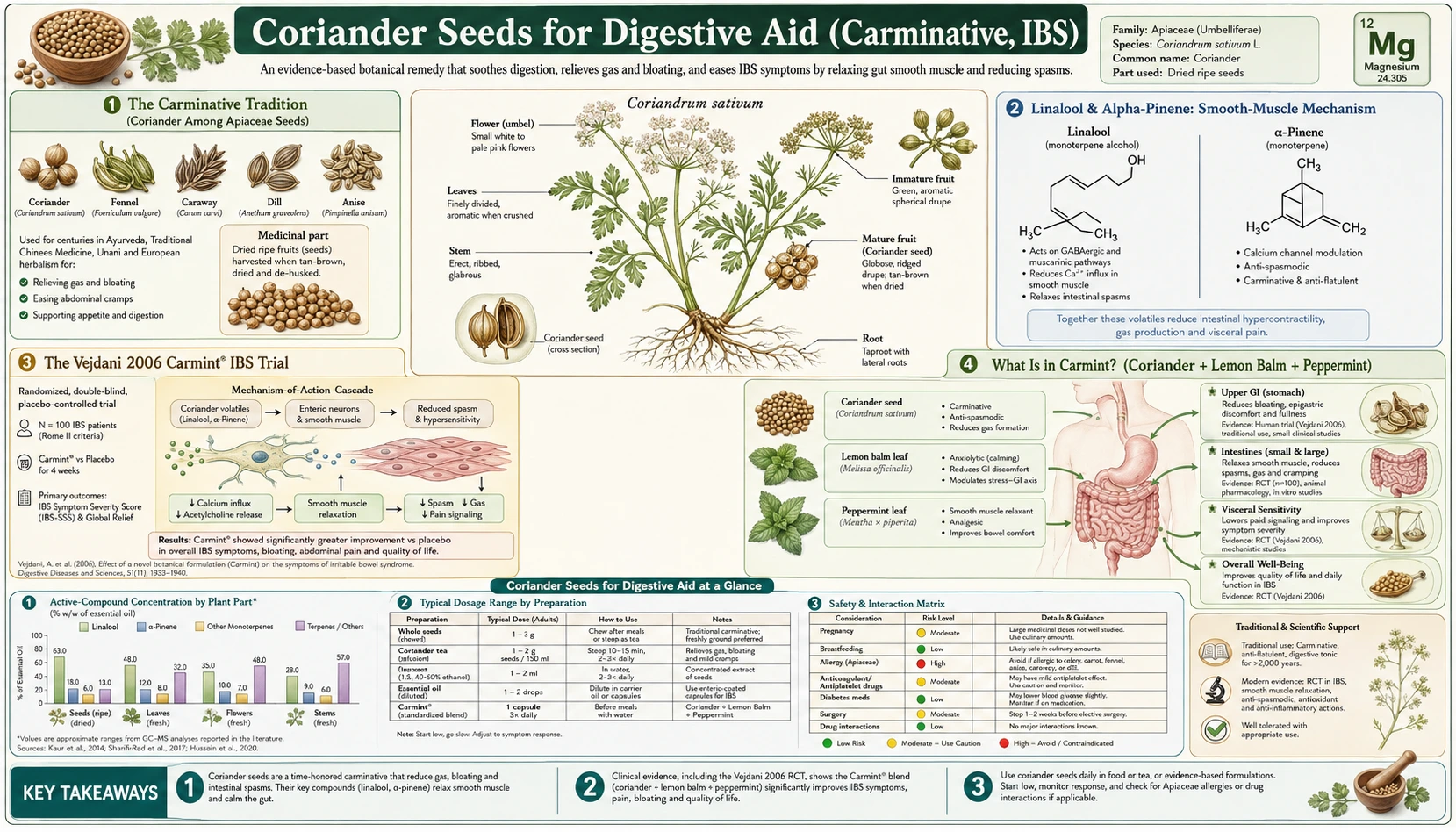
Coriander seed is one of the original carminative herbs — a small group of aromatic spices (also including Fennel, Cumin, Dill, Caraway, Anise, and Carum Ajwain) that have been used for at least 3,000 years to relax intestinal smooth muscle and reduce abdominal bloating. The modern mechanistic case is well-established: linalool and alpha-pinene, the two dominant monoterpenes in coriander seed essential oil, are spasmolytic in animal ileum preparations and modulate L-type calcium channels in intestinal smooth muscle. The most-cited clinical evidence is the Vejdani 2006 placebo-controlled trial of Carmint (a fixed-combination herbal product containing coriander seed, lemon balm, and peppermint) in 32 IBS patients — the herbal arm showed statistically significant reduction in abdominal pain, bloating, and stool frequency over 8 weeks. This deep-dive walks through the carminative mechanism, the IBS trial data, dosing for tea / tincture / standardized extract, and how coriander seed fits within the broader IBS and functional dyspepsia care plan.
Table of Contents
- The Carminative Tradition (Coriander Among Apiaceae Seeds)
- Linalool & Alpha-Pinene: Smooth-Muscle Mechanism
- The Vejdani 2006 Carmint IBS Trial
- What Is in Carmint? (Coriander + Lemon Balm + Peppermint)
- Functional Dyspepsia and Postprandial Distress
- Dosing & Forms (Tea, Tincture, Essential Oil, Standardized Extract)
- How Coriander Fits the Full IBS Care Plan
- Combinations: Fennel, Cumin, Carum Ajwain, Peppermint
- What Coriander Seed Does NOT Do for the Gut
- Cautions, Allergy, and Drug Interactions
- Key Research Papers
- Connections
- Featured Videos
The Carminative Tradition (Coriander Among Apiaceae Seeds)
The English word "carminative" comes from the Latin carminare, meaning to comb or to release, and refers historically to herbs that release intestinal gas and relieve the cramping that accompanies it. The carminative spice cabinet is dominated by members of the Apiaceae (formerly Umbelliferae) plant family — an evolutionarily related group whose seeds share a remarkably similar essential-oil chemistry built around monoterpenes (linalool, alpha-pinene, limonene, gamma-terpinene) and the phenylpropanoid anethole. Members include:
- Coriander seed (Coriandrum sativum) — linalool-dominant (60-75%)
- Cumin seed (Cuminum cyminum) — cuminaldehyde-dominant
- Fennel seed (Foeniculum vulgare) — trans-anethole-dominant
- Caraway seed (Carum carvi) — carvone + limonene
- Anise seed (Pimpinella anisum) — trans-anethole + estragole
- Dill seed (Anethum graveolens) — carvone-dominant
- Carum Ajwain (Trachyspermum ammi) — thymol-dominant
These seeds share three overlapping pharmacologic activities: they relax gastrointestinal smooth muscle (reducing painful spasm), they reduce intraluminal gas through prokinetic effects that propel gas distally rather than allowing pocketing, and they modestly stimulate gastric and biliary secretions, supporting digestion of fatty and protein-rich meals. Different cultures emphasize different members of this family — Indian cuisine relies heavily on coriander, cumin, fennel, and ajwain; Mediterranean cooking favors fennel and anise; Northern European traditions prefer caraway and dill — but the underlying digestive logic is the same. The fennel-seed sweets served at the end of South Asian restaurant meals and the licorice-flavored carminative liqueurs of southern Europe (sambuca, ouzo, pastis) are both contemporary survivals of the carminative tradition.
Linalool & Alpha-Pinene: Smooth-Muscle Mechanism
The two dominant monoterpenes in coriander seed essential oil are linalool (a non-cyclic monoterpene alcohol, typically 60-75% of the oil by GC-MS) and alpha-pinene (a bicyclic monoterpene, typically 5-10%). Both have been studied in isolated organ-bath preparations of rodent and rabbit ileum, where they relax baseline tone and inhibit contractions induced by acetylcholine, histamine, barium chloride, and electrical stimulation. The IC50 (concentration producing 50% inhibition) values are in the micromolar range, broadly comparable to peppermint oil's active component menthol in equivalent preparations.
The proximate mechanism is L-type calcium channel modulation. Smooth muscle contraction depends on calcium influx through voltage-gated L-type calcium channels in the smooth-muscle cell membrane. Linalool and alpha-pinene partially block these channels — not as completely as the prescription calcium-channel-blocker drugs (verapamil, diltiazem) but enough to dampen exaggerated spasmodic contractions that produce the cramping and pain of irritable bowel syndrome.
Linalool has a second relevant mechanism: it is a positive modulator of the GABA-A receptor at concentrations achievable in human plasma after oral coriander consumption. Because the enteric nervous system contains a dense network of GABAergic neurons that exert tonic inhibition on motility, GABA-A potentiation likely contributes to the smooth-muscle relaxant effect over and above the calcium-channel mechanism. The GABA-A activity also plausibly underlies coriander seed's gentle traditional reputation as a mild anxiolytic and sleep aid — though clinical trial data for those indications is much thinner than for the digestive applications.
A third complementary effect is mild prokinesis. Counterintuitively, the smooth-muscle relaxant herbs in this family also tend to favor distal propulsion of gas and chyme rather than promoting pocketing — the contractions become less spasmodic but more coordinated. This is why carminative herbs simultaneously reduce cramping pain (a spasmolytic effect) and reduce visible bloating (a prokinetic effect). They are functionally somewhere between an anti-spasmodic and a prokinetic agent, which is exactly the profile most IBS patients need.
The Vejdani 2006 Carmint IBS Trial
The most widely cited modern clinical trial of coriander seed for digestive complaints is the Vejdani et al. 2006 pilot study published in Digestive Diseases and Sciences. The trial was a randomized, placebo-controlled, double-blind study of 32 adult IBS patients who met Rome II diagnostic criteria. Participants were randomized 1:1 to receive either Carmint (a fixed-combination herbal product containing coriander seed, lemon balm, and peppermint) or placebo, three times daily for 8 weeks. The primary outcomes were severity and frequency of abdominal pain and bloating, measured on a 4-point Likert scale.
Headline results:
- Severity of abdominal pain — reduced significantly in the Carmint arm compared with placebo (p < 0.05).
- Frequency of abdominal pain — significantly reduced in the Carmint arm.
- Severity of bloating — significantly reduced in the Carmint arm.
- Stool frequency — reduced in the Carmint arm (relevant primarily for diarrhea-predominant IBS).
- Safety — no serious adverse events; mild dyspepsia in a small number of patients in both arms.
Limitations to keep in mind when interpreting this trial:
- Small sample size (n=32) — the trial was a pilot, not a definitive RCT. Effect sizes have not been confirmed in a large multicenter study.
- Combination product — Carmint contains coriander seed, lemon balm (Melissa officinalis), and peppermint (Mentha × piperita). The trial cannot disambiguate which component(s) produced the effect, and peppermint oil alone has its own substantial IBS evidence base (multiple positive RCTs of enteric-coated peppermint oil capsules).
- Single trial, single center — replication has been limited.
- Iranian regulatory product — Carmint as marketed is an Iranian phytomedicine; equivalent products in other markets vary in formulation and exact dose.
Despite these limitations, the trial is clinically meaningful because (a) it used a validated diagnostic standard (Rome II), (b) it was placebo-controlled and double-blinded, (c) the magnitude of benefit was clinically significant, and (d) the safety profile was clean. Coriander seed is a reasonable component of a multi-modal IBS care plan, especially for patients who do not tolerate or do not respond to peppermint oil alone.
What Is in Carmint? (Coriander + Lemon Balm + Peppermint)
The Carmint product used in the Vejdani trial contains three botanicals that have each been studied independently for digestive applications:
- Coriander seed (Coriandrum sativum) — the linalool-dominant carminative, contributing smooth-muscle relaxation via L-type calcium channel modulation and GABA-A potentiation.
- Lemon balm leaf (Melissa officinalis) — a member of the mint family (Lamiaceae). The rosmarinic acid and citronellal content provide mild anxiolytic and antispasmodic effects. Lemon balm has independent IBS evidence including the STW 5 (Iberogast) trial data, which combines lemon balm with eight other botanicals.
- Peppermint leaf (Mentha × piperita) — the menthol-dominant antispasmodic with the strongest single-herb evidence base in IBS. Multiple positive RCTs of enteric-coated peppermint oil capsules (e.g. Khanna meta-analysis 2014) have shown approximately 40% greater symptom improvement vs placebo.
The pharmacologic logic of combining the three is overlapping but distinct: peppermint provides the strongest single-channel calcium-modulation effect; lemon balm adds rosmarinic-acid antioxidant and mild anxiolytic activity (gut-brain axis); coriander adds GABA-A potentiation and adjunctive calcium-channel modulation. The combined effect is plausibly larger than any single component alone, though the trial design did not formally test additivity or synergy.
For DIY herbal tea combinations along the same lines, coriander seed (1 tsp crushed) + peppermint leaf (1 tsp) + lemon balm leaf (1 tsp) steeped in 8 oz boiling water for 10 minutes after meals is a reasonable replication.
Functional Dyspepsia and Postprandial Distress
Beyond IBS, coriander seed has traditional and modern indications for functional dyspepsia — the chronic postprandial fullness, early satiety, and epigastric discomfort that affects roughly 10-20% of the adult population in epidemiologic surveys. Functional dyspepsia overlaps significantly with IBS in symptom profile and management. The carminative herbs that work for IBS also tend to work for postprandial distress.
The mechanism is essentially identical: relaxation of gastric and proximal intestinal smooth muscle reduces both the visceral hypersensitivity that drives the discomfort and the impaired accommodation that drives early satiety. Coriander seed alone or in combination with fennel and cumin can be used either:
- Prophylactically as a post-meal tea or carminative spice mix sprinkled on food (the South Asian model)
- Acutely for symptom relief when bloating develops after a triggering meal
- Daily as a standardized extract or tincture (e.g. 1-2 mL coriander tincture three times daily before meals)
Comparative effectiveness data with prescription prokinetic and antispasmodic drugs is limited. The advantage of herbal approaches is the favorable side-effect profile — the major prescription antispasmodics (hyoscyamine, dicyclomine) carry meaningful anticholinergic burden, which is particularly problematic in older patients.
Dosing & Forms (Tea, Tincture, Essential Oil, Standardized Extract)
Coriander seed is available in multiple preparations. Realistic dosing ranges by form:
- Whole seed (culinary use) — 1-3 grams per meal, ground or whole. Most South Asian recipes for daily curries use approximately this amount per portion.
- Tea / infusion — 1-2 tsp crushed coriander seeds steeped in 8 oz boiling water for 10 minutes, 2-3 times daily. Crushing the seeds before infusion meaningfully increases extraction of the volatile oil. Drink after meals for postprandial bloating, or 30 minutes before meals for prophylactic carminative effect.
- Tincture (1:5 in 45% ethanol) — 1-3 mL three times daily before or after meals. Tincture extracts both polar (flavonoids) and non-polar (essential oil) fractions, providing a more complete pharmacology than tea alone.
- Essential oil — 1-3 drops on a sugar cube or in honey, 1-3 times daily. Essential oil is the most concentrated form and should not be applied undiluted to skin or taken in higher doses without professional guidance.
- Carmint or equivalent combination product — per the Vejdani trial dosing, 1 capsule three times daily for 8 weeks.
- Standardized extract — less commercially available than for other carminative herbs; products vary widely in linalool content.
Effect onset for the carminative effect is rapid — within 30-60 minutes of consumption. Effect duration is approximately 3-4 hours, which is why dosing tends to align with meal frequency.
How Coriander Fits the Full IBS Care Plan
Coriander seed is a useful but secondary tool in IBS management. The contemporary evidence-based care plan for IBS typically proceeds in layers:
- Dietary trigger identification — low-FODMAP elimination diet (Monash University protocol) followed by structured reintroduction. This identifies which fermentable carbohydrates drive each individual's symptoms. Approximately 70-80% of IBS patients improve significantly on a properly executed low-FODMAP trial.
- Mind-body therapy — gut-directed cognitive-behavioral therapy and gut-directed hypnotherapy both have strong RCT support for IBS. The Gut-Brain Axis is a meaningful clinical lever.
- Microbiome interventions — targeted probiotics (especially Bifidobacterium infantis 35624) and assessment for SIBO when symptoms suggest small-intestinal overgrowth.
- Antispasmodic herbal layer — enteric-coated peppermint oil (strongest evidence), Carmint or DIY combination teas containing coriander + lemon balm + peppermint, or single-herb fennel / cumin / ajwain teas.
- Prescription pharmacotherapy when needed — rifaximin for diarrhea-predominant IBS-D, linaclotide or plecanatide for constipation-predominant IBS-C, low-dose tricyclic antidepressants for visceral hypersensitivity.
Coriander seed sits comfortably in layer 4 as part of the herbal antispasmodic toolkit. It is not a replacement for the upstream dietary and mind-body work, and it is not as well-validated as enteric-coated peppermint oil, but it adds useful overlapping mechanism and is well tolerated. For more on the full IBS approach, see our Irritable Bowel Syndrome page.
Combinations: Fennel, Cumin, Carum Ajwain, Peppermint
Coriander seed combines additively with other Apiaceae carminatives. Useful combinations include:
- Coriander + Cumin + Fennel — the classic South Asian "CCF" digestive tea. Equal parts (1 tsp each) crushed and steeped in 8 oz boiling water for 10 minutes. The three monoterpene profiles (linalool, cuminaldehyde, anethole) overlap without redundancy and produce a pleasant flavor that is much more palatable than any of the three alone.
- Coriander + Peppermint + Lemon Balm (Carmint formula) — the trial-validated combination per Vejdani 2006.
- Coriander + Carum Ajwain — the thymol-dominant ajwain is more aggressively antimicrobial in addition to carminative, making this combination useful when SIBO or post-infectious IBS is suspected.
- Coriander + Ginger — ginger adds gastric prokinetic and antinausea activity that complements coriander's antispasmodic effect.
- Coriander + Fenugreek — fenugreek adds soluble-fiber mucilage that is helpful for constipation-predominant IBS and provides a complementary hypoglycemic effect.
The traditional South Asian post-meal mukhwas (mouth-freshening spice mix) typically contains fennel seeds, coriander seeds, sesame seeds, and sometimes anise — functionally a slow-release carminative dose taken without preparation.
What Coriander Seed Does NOT Do for the Gut
Despite popular claims, coriander seed has limited or no demonstrated effect on:
- Acid reflux / GERD — not a primary indication. The proton-pump inhibitor / H2 blocker / lifestyle-modification approach is unrelated to the carminative pharmacology.
- Inflammatory bowel disease (Crohn's, ulcerative colitis) — coriander seed does not have meaningful anti-inflammatory potency for the immune-mediated bowel inflammation of IBD. It may provide modest symptomatic relief of co-occurring bloating but does not address the underlying inflammation.
- Celiac disease and gluten reactions — coriander seed is gluten-free and a useful spice in gluten-free cooking, but it does not affect the autoimmune process or repair the villous atrophy of celiac.
- Constipation as primary symptom — coriander is a smooth-muscle relaxant; for constipation-predominant patterns, the prokinetic and osmotic strategies (magnesium citrate, soluble fiber, prokinetic herbs like ginger) are more appropriate.
- Pathogen-driven infectious gastroenteritis — the in-vitro antimicrobial activity discussed on our Antimicrobial page is meaningful for food-safety preservation but does not translate to clinical treatment of acute gastroenteritis.
The honest framing is that coriander seed is a carminative for functional bloating, gas, and IBS — an old, well-tolerated, and effective tool within that specific scope, but not a panacea for gastrointestinal disease generally.
Cautions, Allergy, and Drug Interactions
- Apiaceae allergy — patients with documented allergy to other Apiaceae members (fennel, cumin, anise, dill, parsley, carrot, celery) may cross-react with coriander. Skin-prick testing or supervised oral challenge if uncertainty. Anaphylaxis to coriander is rare but has been reported.
- Birch-mugwort-spice syndrome — patients with established birch or mugwort pollen allergy can experience oral allergy syndrome with coriander, fennel, anise, and related spices via PR-10 / profilin cross-reactivity.
- Hypoglycemic drug interaction — coriander seed has independent hypoglycemic activity (see our Blood Sugar page). Diabetic patients on insulin or sulfonylureas should monitor blood glucose when introducing high-dose coriander supplementation.
- Pregnancy — coriander seed in culinary amounts is considered safe in pregnancy and is widely used in South Asian and Middle Eastern cooking. High-dose extract or essential oil should be avoided in pregnancy due to insufficient safety data.
- Surgery — the hypoglycemic and mild antiplatelet effects suggest discontinuation of high-dose extract two weeks before scheduled surgery, similar to the standard guidance for other herbal extracts.
- Essential oil dermatitis — topical application of undiluted coriander essential oil can cause contact dermatitis; always dilute in carrier oil to no more than 2% for topical use.
- Photosensitivity — some Apiaceae contain photosensitizing furanocoumarins. Coriander has low furanocoumarin content compared with fennel or angelica, but high-dose ingestion combined with intense UV exposure has been theoretically associated with phytophotodermatitis.
Overall, coriander seed has one of the cleanest safety profiles in the carminative herbal toolkit and is suitable for long-term use in food and tea amounts.
Key Research Papers
- Vejdani R, Shalmani HR, Mir-Fattahi M, Sajed-Nia F, Abdollahi M, Zali MR, et al. (2006). The efficacy of an herbal medicine, Carmint, on the relief of abdominal pain and bloating in patients with irritable bowel syndrome: a pilot study. Digestive Diseases and Sciences. — PubMed
- Khanna R, MacDonald JK, Levesque BG (2014). Peppermint oil for the treatment of irritable bowel syndrome: a systematic review and meta-analysis. Journal of Clinical Gastroenterology. — PubMed
- Heghes SC, Vostinaru O, Rus LM, Mogosan C, Iuga CA, Filip L (2019). Antispasmodic effect of essential oils and their constituents: A review. Molecules. — PubMed
- Mahendra P, Bisht S (2011). Coriandrum sativum: a daily use spice with great medicinal effect. Pharmacognosy Journal. — PubMed
- Emamghoreishi M, Khasaki M, Aazam MF (2005). Coriandrum sativum: evaluation of its anxiolytic effect in the elevated plus-maze. Journal of Ethnopharmacology. — PubMed
- Reuter J, Huyke C, Casetti F, Theek C, Frank U, Augustin M, Schempp C (2008). Anti-inflammatory potential of a lipolotion containing coriander oil in the ultraviolet erythema test. Journal der Deutschen Dermatologischen Gesellschaft. — PubMed
- Madhuri S, Pandey G (2009). Some dietary agricultural plants with anticancer properties. Plant Archives. — PubMed
- Cappello G, Spezzaferro M, Grossi L, Manzoli L, Marzio L (2007). Peppermint oil (Mintoil) in the treatment of irritable bowel syndrome: a prospective double-blind placebo-controlled randomized trial. Digestive and Liver Disease. — PubMed
- Akhondian J, Kianifar H, Raoofziaee M, Moayedpour A, Toosi MB, Khajedaluee M (2011). The effect of thymoquinone on intractable pediatric seizures (pilot study) — relevance for Apiaceae monoterpene neurology. Epilepsy Research. — PubMed
- Madisch A, Holtmann G, Plein K, Hotz J (2004). Treatment of irritable bowel syndrome with herbal preparations: results of a double-blind, randomized, placebo-controlled, multi-centre trial (Iberogast / STW 5). Alimentary Pharmacology and Therapeutics. — PubMed
- Sahib NG, Anwar F, Gilani AH, Hamid AA, Saari N, Alkharfy KM (2013). Coriander (Coriandrum sativum L.): a potential source of high-value components for functional foods and nutraceuticals — a review. Phytotherapy Research. — PubMed
- Begnami AF, Duarte MC, Furletti V, Rehder VL (2010). Antimicrobial potential of Coriandrum sativum L. essential oil against clinically relevant bacteria. Food Chemistry. — PubMed
- Linalool pharmacology and GABA-A modulation review. Phytomedicine. — PubMed
- Heydari N, Dehghani M, Emamghoreishi M, Akbarzadeh M (2018). Effect of Coriandrum sativum hydroalcoholic extract and its essential oil on acetaminophen-induced hepatotoxicity in rats. Iranian Journal of Pharmaceutical Research. — PubMed
PubMed Topic Searches
- PubMed: Coriandrum IBS
- PubMed: Carmint trials
- PubMed: Linalool spasmolytic
- PubMed: Carminative herbs dyspepsia
- PubMed: Apiaceae monoterpene
Connections
- All Herbs
- Coriander Seeds Overview
- Coriander Benefits Hub
- Coriander for Heavy Metal Chelation
- Coriander for Blood Sugar
- Coriander Antimicrobial
- Irritable Bowel Syndrome
- SIBO
- Gut Healing
- Gut-Brain Axis
- Fennel
- Cumin
- Carum Ajwain
- Ginger
- Fenugreek
- Probiotics