Coriander Seeds: History and Traditional Use
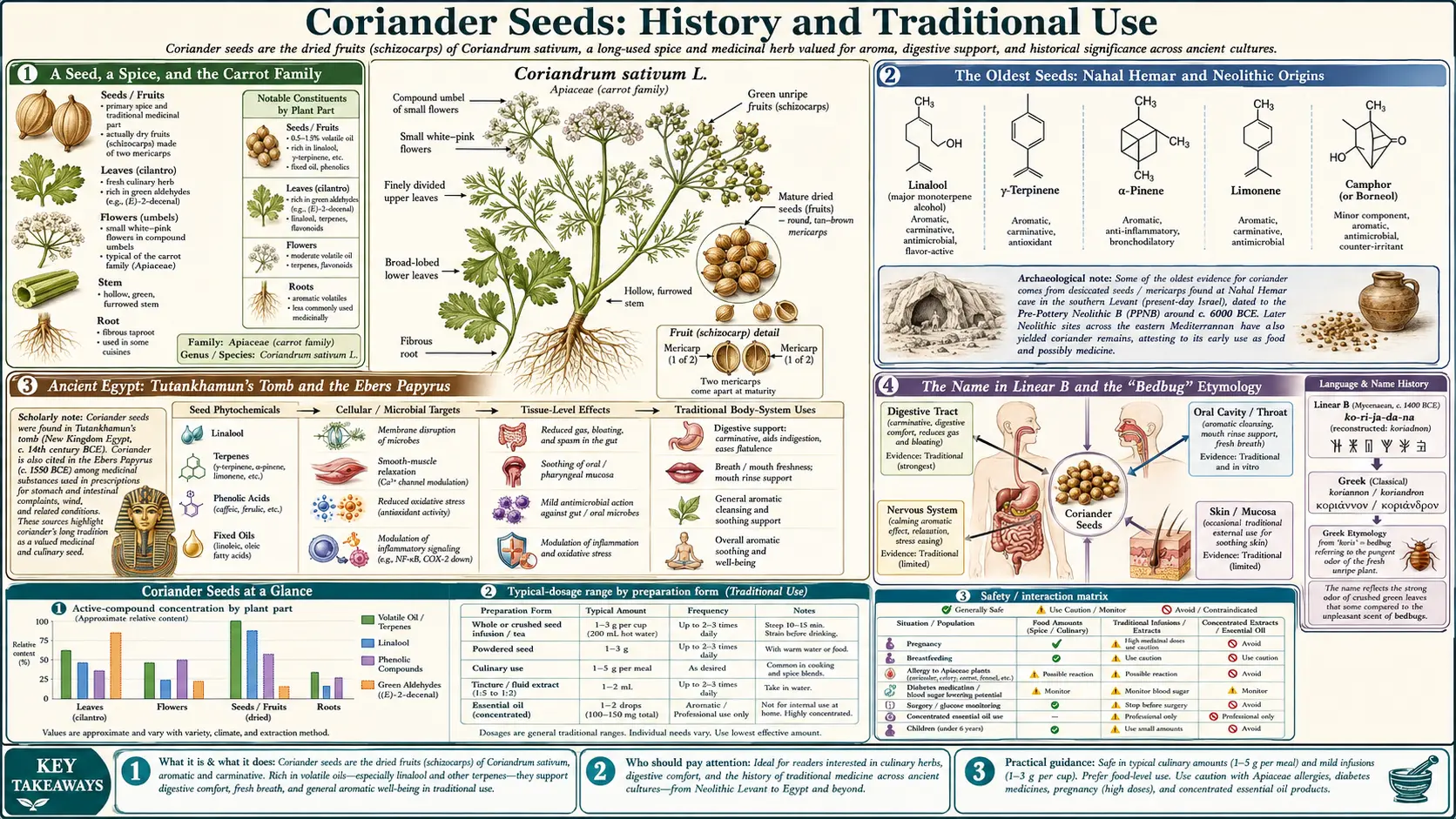
Coriander is one of the oldest spices in continuous human use, with a history that runs back almost to the dawn of farming itself. Desiccated coriander seeds have been recovered from a Neolithic cave in the Judean Desert dated to roughly 6,000 to 8,000 years ago, the plant's name appears on Bronze Age clay tablets written in the earliest form of Greek, and about half a litre of its seeds was packed into the tomb of the pharaoh Tutankhamun. From the kitchens of ancient Egypt to the gardens of Roman Britain, the cooling remedies of Ayurveda, and the spice routes that carried it across Asia, the small round "seed" of Coriandrum sativum has been valued as food, medicine, perfume, and the very yardstick by which the Bible measured the taste of manna. This page traces that documented history and marks tradition honestly as tradition.
Table of Contents
- A Seed, a Spice, and the Carrot Family
- The Oldest Seeds: Nahal Hemar and Neolithic Origins
- Ancient Egypt: Tutankhamun's Tomb and the Ebers Papyrus
- The Name in Linear B and the "Bedbug" Etymology
- Coriander in the Bible: The Taste of Manna
- Greece, Rome, and the Spread Across Europe
- Coriander in Ayurveda: Dhanyaka, the Cooling Seed
- A Journey East: China, Japan, and the Spice Routes
- Folklore, the "Spice of Happiness," and Love Charms
- From Ancient Kitchen to Modern Research
- References
- Connections
- Featured Videos
A Seed, a Spice, and the Carrot Family
Coriander is the common English name for Coriandrum sativum L., an annual herb of the family Apiaceae (also called Umbelliferae) — the same botanical family as carrots, celery, parsley, dill, fennel, cumin, and ajwain. It is one plant with two culinary identities that confuse a great many cooks: the fresh leaves and stems are what Americans call cilantro, while the dried, ripe fruits are what most of the world calls coriander seed. Although they come from a single plant, they taste almost nothing alike, because their aromatic chemistry is quite different — the leaf is dominated by pungent aldehydes (the source of the "soapy" flavor some people detect), while the seed is dominated by the sweet, citrusy monoterpene alcohol linalool. This page is concerned chiefly with the history of the seed, though in practice the ancient record often does not distinguish the two, and many old uses drew on the whole plant.
Botanically, what we call the "seed" is really the plant's dried fruit: a small, round, ribbed schizocarp that splits into two halves called mericarps. This detail matters to the archaeologist, because it is precisely these hard, durable, distinctly shaped mericarps that survive for thousands of years in dry caves and tombs, allowing coriander's antiquity to be documented far more securely than that of most leafy herbs. The plant is generally thought to be native to a broad region spanning the eastern Mediterranean, the Near East, and southwestern Asia, from which it spread by trade and cultivation across Europe, Africa, and Asia, and eventually to the Americas. Its unusually long association with humans, and the durability of its seed, together make coriander one of the best-attested spices in the entire archaeological and written record.
The Oldest Seeds: Nahal Hemar and Neolithic Origins
The single most striking fact in coriander's history is how astonishingly old it is. At Nahal Hemar, a cave in the Judean Desert near the Dead Sea in modern Israel, archaeologists recovered about fifteen desiccated coriander mericarps from a layer dated to the Pre-Pottery Neolithic B period — that is, roughly 6,000 to 8,000 years ago. This is generally cited as the oldest archaeological find of coriander anywhere in the world, predating writing, the wheel, and most of recorded civilization. A second early find of coriander mericarps comes from the submerged Neolithic village of Atlit-Yam off the coast of Israel, also dated to many thousands of years ago.
An important note of scholarly honesty belongs here: because coriander grows readily as a weed of disturbed and cultivated ground, archaeologists cannot always be certain whether the very earliest finds represent a deliberately cultivated crop, a gathered wild plant, or a traded commodity. What the Nahal Hemar seeds prove beyond doubt is that people were collecting, using, and valuing coriander at the very beginning of the Neolithic — the dawn of farming — which is why coriander is so often described as one of the first spices, and possibly one of the first cultivated crops, in human history. Whatever its precise status eight millennia ago, the plant was clearly already part of human life.
Ancient Egypt: Tutankhamun's Tomb and the Ebers Papyrus
Coriander is firmly documented in ancient Egypt. The most famous single piece of evidence is that roughly half a litre (about 500 millilitres) of coriander mericarps was recovered from the tomb of the pharaoh Tutankhamun, who was buried in the 14th century BCE. The detail that makes this find so historically valuable is a simple botanical one: coriander does not grow wild in Egypt. For the Egyptians to have had that much seed to bury with a king, they must have been deliberately cultivating the plant — so the tomb offering is taken by scholars as direct evidence of organized Egyptian coriander agriculture more than three thousand years ago.
Coriander also appears in the Egyptian medical tradition. The Ebers Papyrus, one of the most important surviving ancient Egyptian medical texts, dated to around 1550 BCE, references coriander among its remedies. Beyond the documented record, Egyptian tradition is sometimes said to have prized coriander as a "spice of happiness" and an aphrodisiac; that reputation is best treated as folklore rather than established fact, and is discussed further below. What is not in doubt is that coriander was a familiar and cultivated plant in the Nile Valley, valued enough to send into the afterlife with a pharaoh.
The Name in Linear B and the "Bedbug" Etymology
One of the reasons we can trace coriander so far back is that its name is among the oldest plant names recorded in Europe. The earliest attested form of the word is the Mycenaean Greek ko-ri-ja-da-na, written in the Linear B syllabic script on clay tablets from the Bronze Age palace centers of Pylos and Knossos, dating to roughly the second millennium BCE. Remarkably, one of the Linear B tablets from Pylos records coriander as being cultivated for the manufacture of perfumes — a reminder that the plant was prized for its aroma, not only as a food. This Mycenaean word evolved through later Greek koriannon and Latin coriandrum, and through Old French coriandre, into the modern English "coriander" (the Spanish branch of the same root gives "cilantro").
The etymology carries a memorable twist. The Greek koriannon is widely held to be related to koris, the Greek word for a bedbug — an allusion to the sharp, somewhat fetid smell of the unripe fruit and bruised foliage, which some people find buggy or unpleasant. This "bedbug" derivation is repeated across many classical and modern sources; it is the traditional and most commonly cited explanation, though, as with many ancient etymologies, it cannot be proven with certainty. Either way, the link is a charming detail: the same plant whose ripe, dried seed smells sweetly of citrus was named, it seems, for the off-putting odor of its green parts.
Coriander in the Bible: The Taste of Manna
Coriander earns a small but vivid place in the Hebrew Bible, where it is used not as a medicine but as a familiar point of comparison. In the Book of Exodus (16:31), the miraculous food manna that fed the Israelites in the wilderness is described as being "like coriander seed, white," and again in the Book of Numbers (11:7) manna is likened to coriander seed in appearance. The very fact that the biblical writers reached for coriander seed as a yardstick — expecting their readers to know exactly what a coriander seed looked like — tells us how ordinary and well-known the spice already was in the ancient Near East.
These scriptural references are valuable to historians precisely because they are incidental. No one was making a claim about coriander; it was simply the everyday object closest to hand when the authors needed to describe the size, shape, and pale color of manna. That casual familiarity, echoing across the Egyptian, Mycenaean, and Israelite worlds at roughly the same era, confirms that by the second millennium BCE coriander was a common feature of daily life throughout the eastern Mediterranean. The biblical texts are named here as historical primary sources rather than as modern citations.
Greece, Rome, and the Spread Across Europe
Coriander passes from the Bronze Age into the classical written record through the Greek physicians and naturalists. It was mentioned by Hippocrates (around 400 BCE), the father of Greek medicine, and later described by the Greek physician and pharmacologist Dioscorides, whose first-century De Materia Medica (around 65 CE) is the foundational text of the entire Western tradition of medicinal plants. The Roman naturalist Pliny the Elder also discussed coriander, and according to him the finest coriander of the Roman world was imported from Egypt — a neat confirmation of the Egyptian cultivation that the Tutankhamun find implies. These ancient authors are named here as historical primary sources.
It was the Romans who carried coriander across Europe and into the far northwest of their empire. Coriander is one of a large group of new food plants — alongside dill, fennel, and many others — that the Romans introduced to Britain, where the archaeological evidence is unusually clear. Charred and waterlogged coriander remains have been recovered from Roman-period sites in Britain, including dramatically from buildings in Roman Colchester that burned during the revolt of Queen Boudica in AD 60–61, where the fire preserved coriander together with figs, dates, and other imported foods; coriander remains have also been found at Roman London and at Staines. After the decline of Roman power in Britain in the early fifth century, several of these introduced herbs, coriander among them, fell out of fashion for a time. The Romans valued coriander both as a kitchen seasoning — it features in the recipes of the famous Roman cookery collection attributed to Apicius — and, traditionally, as an aid to preserving meat, a use commonly attributed to the antimicrobial quality of its volatile oil.
Coriander in Ayurveda: Dhanyaka, the Cooling Seed
In the Indian subcontinent, coriander has been a cornerstone of both the kitchen and the traditional medicine of Ayurveda for well over two thousand years. It is known in Sanskrit as dhanyaka (and in everyday Hindi as dhania), and it is referenced in the classical Ayurvedic compendia — the seed is treated in texts in the tradition of the Charaka Samhita and Sushruta Samhita as a digestive carminative, a remedy classed among the substances used to kindle digestion and relieve gas and bloating. Coriander water and coriander-seed decoctions remain common household digestive remedies across South Asia to this day.
What most distinguishes coriander in the Ayurvedic system is its reputation as a cooling herb. In Ayurvedic terms it is regarded as pitta-pacifying — that is, soothing to the body's "fire" principle — and is valued for kindling the digestive fire (agni) without aggravating acidity, which is why it is traditionally favored for digestive complaints accompanied by heat or inflammation. This cooling, calming character is the thread that connects coriander's Eastern reputation to the descriptive nickname recorded on the main Coriander Seeds page ("the holy herb that cools the destructive inner fire"). Readers should note that these are descriptions of a traditional medical system, valuable as cultural and historical record, and are not the same thing as modern clinical proof; the contemporary evidence is taken up on the Coriander Seeds Benefits pages.
A Journey East: China, Japan, and the Spice Routes
From its Mediterranean and Near Eastern heartland, coriander travelled steadily eastward along the great trade and spice routes, becoming naturalized into the cuisines and folk medicines of Persia, India, China, and Southeast Asia. In China the fresh herb became a familiar pot-herb and garnish, and Chinese tradition is often said to have associated it with longevity — a piece of folklore rather than a documented medical claim, but one that reflects how thoroughly the plant was adopted across Asia. Across this vast region the same dual pattern recurs that we see in the West: the seed prized as a warm, sweet kitchen spice, and both seed and leaf used as gentle home remedies for the stomach.
The plant's reception was not always smooth, and one well-documented episode shows that coriander's polarizing aroma is nothing new. A historical account of coriander in Japan records that the herb was known there as a food as early as the tenth century, but fell out of use — reportedly because of its disagreeable smell — and was only reintroduced much later, in the eighteenth century, by Portuguese traders, under a name borrowed from the European word (rendered roughly as ko-en-do-ro). That a culture could adopt, abandon, and then re-adopt the same plant over the course of eight hundred years, with its "buggy" green-leaf smell at the center of the story, is a vivid reminder that the love-it-or-hate-it response to coriander is a genuine constant of its long human history.
Folklore, the "Spice of Happiness," and Love Charms
Like every plant that has lived alongside people for thousands of years, coriander accumulated a thick layer of folklore that should be enjoyed as cultural history rather than mistaken for medicine. The most persistent strand is amorous: coriander was widely reputed across the ancient and medieval world to be an aphrodisiac and a love charm. The ancient Egyptians are traditionally said to have regarded it as a "spice of happiness" for this reason, and coriander's reputation as an ingredient in love potions and fertility charms recurs in European folk magic and in Eastern story traditions. These are folk beliefs; they are part of coriander's genuine cultural record, but no aphrodisiac power has been demonstrated.
Coriander's long association with the dead is also notable: as the Tutankhamun burial shows, the seed was placed in tombs as a grave offering, a practice consistent with its value as a precious, cultivated, and aromatic commodity. Elsewhere in folk tradition the seed was carried or used as a protective and fertility charm, and the plant featured in herb-lore as a kitchen-garden staple believed to bring good fortune to the household. What unites these scattered beliefs — love, fertility, happiness, protection, and the honoring of the dead — is exactly what we would expect of a plant familiar and treasured enough to be woven into the symbolic life of many cultures across many centuries.
From Ancient Kitchen to Modern Research
The arc of coriander's history is, in the end, less dramatic and more humane than that of the great "wonder" herbs: there is no single founder, no isolated miracle cure, and no one moment of discovery. Instead there is something rarer — a plant so genuinely useful and so pleasant that it has stayed in continuous human use for the better part of eight thousand years, recognized across cultures that never met one another. The Neolithic forager at Nahal Hemar, the Egyptian who measured out seed for a pharaoh's tomb, the Mycenaean scribe pressing ko-ri-ja-da-na into wet clay, the Ayurvedic physician prescribing a cooling seed for a hot stomach, and the Roman soldier carrying coriander to Britain were all, in their own way, reaching for the same small fragrant fruit for much the same reasons.
Modern phytochemistry has begun to put a chemical address to that long reputation. Researchers have identified the seed's major constituents — above all linalool, the dominant component of its essential oil, along with other monoterpenes, flavonoids, and phenolic compounds — and have studied coriander for digestive, antimicrobial, antioxidant, blood-sugar, and blood-pressure effects, much as tradition long suggested. Comprehensive modern reviews, such as the Sahib and colleagues review in Phytotherapy Research (2013) and the Sobhani and colleagues review in the Journal of Food Science (2022), survey this growing body of work and connect the ancient ethnobotanical record to contemporary laboratory and clinical findings. The detailed evidence behind each modern use — digestion, antimicrobial action, blood sugar, and the contested heavy-metal-chelation claim — is covered on the Coriander Seeds Benefits pages and the main Coriander Seeds page. Tradition raised the questions across eight millennia; modern research is now, gently, testing the answers.
References
Coriander's documented history rests on archaeobotanical finds, ancient texts, and the ethnobotanical record. The peer-reviewed reviews below are the best modern entry points and survey both the traditional uses and the supporting science; primary historical sources (the Bible's manna passages in Exodus 16:31 and Numbers 11:7, the Linear B Pylos and Knossos tablets, the Egyptian Ebers Papyrus, and the classical authors Hippocrates, Dioscorides, and Pliny the Elder) are named in the article as historical sources rather than as modern citations. Author names, titles, and journals are given as plain text; only stable identifiers (DOI / PMID / PubMed) are linked, and each opens in a new tab.
- Sahib NG, Anwar F, Gilani AH, Hamid AA, Saari N, Alkharfy KM. Coriander (Coriandrum sativum L.): a potential source of high-value components for functional foods and nutraceuticals — a review. Phytotherapy Research. 2013;27(10):1439–1456. — doi:10.1002/ptr.4897 (PMID: 23281145)
- Sobhani Z, Mohtashami L, Amiri MS, Ramezani M, Emami SA, Simal-Gandara J. Ethnobotanical and phytochemical aspects of the edible herb Coriandrum sativum L. Journal of Food Science. 2022;87(4):1386–1422. — doi:10.1111/1750-3841.16085 (PMID: 35279837)
- Mahleyuddin NN, Moshawih S, Ming LC, Zulkifly HH, Kifli N, Loy MJ, Sarker MMR, Al-Worafi YM, Goh BH, Thuraisingam S, Goh HP. Coriandrum sativum L.: a review on ethnopharmacology, phytochemistry, and cardiovascular benefits. Molecules. 2021;27(1):209. — doi:10.3390/molecules27010209
- Uchibayashi M. [The coriander story.] Yakushigaku Zasshi (The Journal of the Japanese Society for the History of Pharmacy). 2001;36(1):56–57 (in Japanese; English abstract) — a historical account of coriander's name and use, including its reception in Japan. — PMID: 11776997
- Primary historical sources: the Hebrew Bible, Exodus 16:31 and Numbers 11:7 (manna compared to coriander seed); Mycenaean Linear B tablets from Pylos and Knossos (the name ko-ri-ja-da-na); the Egyptian Ebers Papyrus, c. 1550 BCE; and the classical authors Hippocrates, Dioscorides (De Materia Medica), and Pliny the Elder (Natural History).
- Coriandrum sativum ethnobotany, history, and traditional use — PubMed: Coriandrum sativum ethnobotany and traditional use
- Coriandrum sativum phytochemistry and pharmacology reviews — PubMed: Coriandrum sativum phytochemistry and pharmacology
External Authoritative Resources
- NCCIH — Herbs at a Glance
- MedlinePlus — Herbs and Supplements
- PubMed — All research on Coriandrum sativum
Connections
- All Herbs
- Coriander Seeds (Main Page)
- Coriander Seeds Benefits
- Cumin
- Fennel
- Carum Ajwain
- Fenugreek
- Turmeric