Clove — Benefits Deep Dive
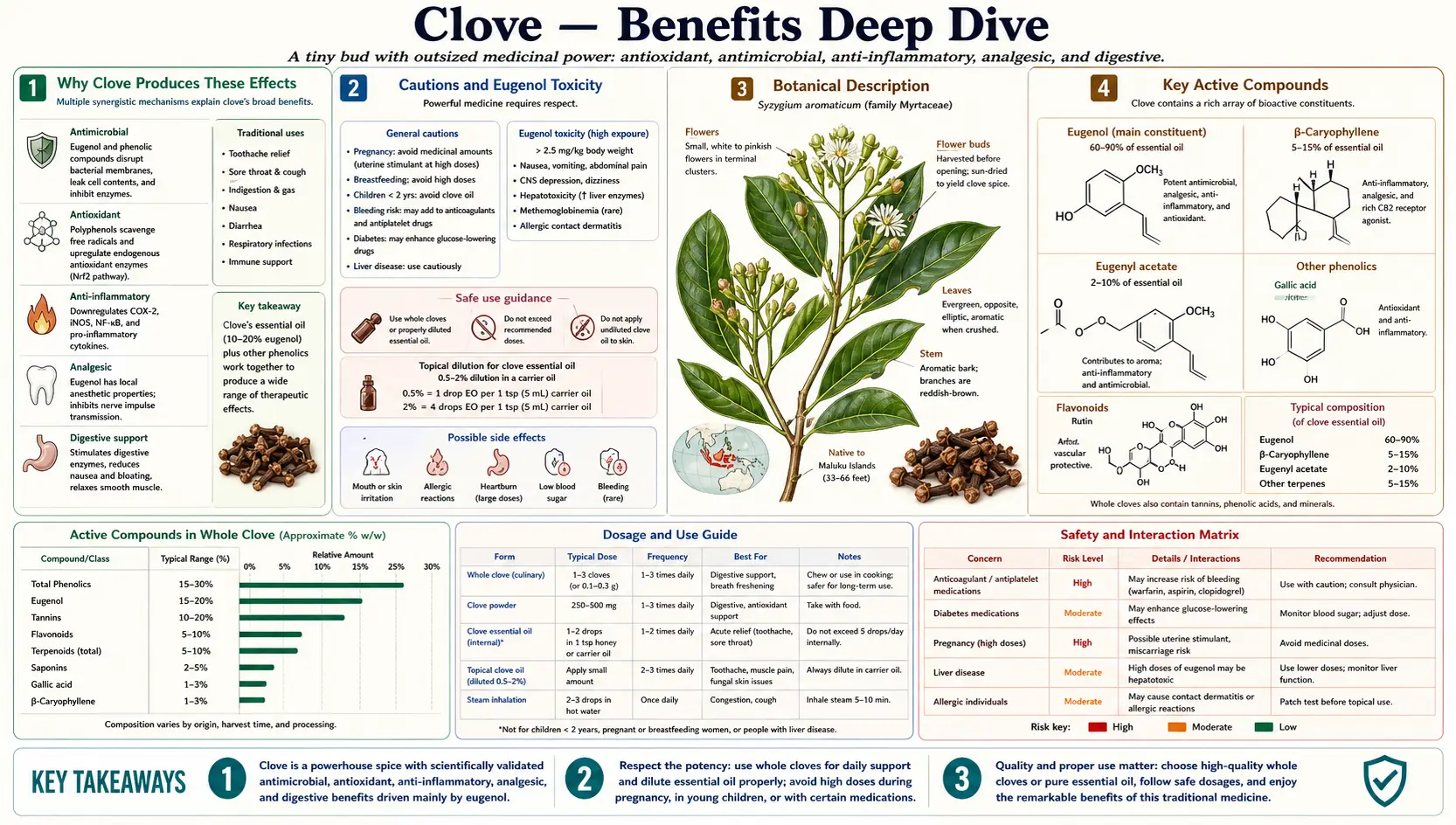
Clove (Syzygium aromaticum) is the dried, unopened flower bud of an evergreen tree native to the Maluku Islands of Indonesia. Its essential oil is 80–90% eugenol — a phenolic compound so concentrated that whole clove buds are the most antioxidant-dense edible spice on Earth (USDA ORAC 314,446 µmol Trolox-equivalent per 100 g, dwarfing every other spice tested). A staple of Indian, Chinese, and Indonesian cuisine for at least two millennia, clove also served as the ancient world's most-trusted dental remedy — chewed for toothache long before zinc oxide eugenol (ZOE) became the standard temporary restorative material in modern dentistry. Four deep-dive pages below cover the major therapeutic domains: topical dental anesthesia, digestive support, antioxidant capacity, and the broad-spectrum antimicrobial activity of eugenol against bacteria, fungi, parasites, and viruses.
Deep-Dive Articles
Dental Pain & Oral Health
Eugenol's topical anesthetic mechanism (transient receptor potential channel modulation), the classical dental remedy traceable to Han Dynasty China, the Alqareer 2006 randomized trial showing clove gel non-inferior to 20% benzocaine for needle-stick analgesia, zinc oxide eugenol (ZOE) as the standard temporary dental restoration material, gingivitis and periodontitis trials, and modern eugenol mouthwash formulations.
Digestive Aid
Clove as carminative and antispasmodic in traditional Ayurvedic and Chinese pharmacopeias, eugenol's smooth-muscle relaxant effect on intestinal tissue, in-vitro inhibition of Helicobacter pylori at clinically achievable concentrations, small IBS and functional dyspepsia trials, and use against nausea, bloating, and post-prandial heaviness.
Antioxidant Capacity
Clove's USDA-measured ORAC of 314,446 µmol TE/100 g — the highest of any spice, food, or beverage tested. Eugenol as the dominant phenolic species, hydrogen-donating mechanism, comparison to cinnamon, oregano, turmeric, and the polyphenol-rich berries, and what "antioxidant capacity in a test tube" does (and does not) predict about clinical benefit.
Antimicrobial Spectrum
Eugenol's broad-spectrum activity against Gram-positive and Gram-negative bacteria, Candida albicans and other yeasts, parasites including Giardia lamblia, and enveloped viruses including HSV-1 and HSV-2. Traditional Indonesian and Indian use as a food preservative, the membrane-disrupting mechanism, and the rationale for combining clove with other plant antimicrobials.
Table of Contents
- Deep-Dive Articles
- Why Clove Produces These Effects
- Key Research Papers
- Cautions and Eugenol Toxicity
- External Authoritative Resources
- Connections
- Featured Videos
Why Clove Produces These Effects
Almost every documented therapeutic effect of clove can be traced to a single molecule: eugenol (4-allyl-2-methoxyphenol), a phenylpropene phenolic compound that comprises 80–90% of clove essential oil and approximately 15–20% of the dried bud by weight. No other commonly consumed plant material concentrates eugenol to anywhere near these levels — for comparison, allspice (the second-richest dietary source) is approximately 4% eugenol, and basil and bay are below 1%. The therapeutic spectrum of clove is, to a first approximation, the therapeutic spectrum of eugenol.
Eugenol acts simultaneously through four distinct mechanisms, which together account for the unusually broad range of clinical effects:
- Topical anesthesia (TRP channel modulation) — eugenol desensitizes the TRPV1 (capsaicin) and TRPA1 (wasabi) receptor channels on peripheral nociceptive nerve endings, producing a local numbing effect comparable to mild lidocaine within minutes of application. This is the mechanism behind the millennia-old use of clove for toothache and behind zinc oxide eugenol (ZOE) as a modern dental restorative material.
- Membrane-disrupting antimicrobial activity — the lipophilic phenolic structure of eugenol partitions into microbial cell membranes, increasing permeability and dissipating proton-motive force. This is the mechanism behind eugenol's broad-spectrum activity against bacteria, fungi, parasites, and enveloped viruses, and the reason traditional cuisines in equatorial Indonesia and India use heavy clove dosing as a food preservative.
- Hydrogen-donating antioxidant capacity — the phenolic hydroxyl group on eugenol donates a hydrogen atom to quench reactive oxygen species, terminating lipid peroxidation chains. This is why clove tops the USDA ORAC table at 314,446 µmol TE/100 g — more than three times the ORAC of cinnamon or oregano, more than ten times that of dark chocolate.
- COX-2 and 5-LOX inhibition (mild anti-inflammatory) — eugenol weakly inhibits both cyclooxygenase-2 and 5-lipoxygenase, reducing prostaglandin and leukotriene synthesis. The effect is much milder than NSAID drugs but contributes to the gingival anti-inflammatory effect observed in periodontal disease trials and to the general antispasmodic profile relevant to digestive support.
A secondary set of constituents — beta-caryophyllene (a CB2 cannabinoid receptor agonist), eugenyl acetate, and small amounts of methyl salicylate — contribute to the anti-inflammatory and antispasmodic profile but are not the principal active agents.
Key Research Papers
- Alqareer A, Alyahya A, Andersson L (2006). The effect of clove and benzocaine versus placebo as topical anesthetics. Journal of Dentistry. — Search PubMed
- USDA Database for the Oxygen Radical Absorbance Capacity (ORAC) of Selected Foods, Release 2 (2010) PubMed: USDA ORAC of spices
- Pramod K, Ansari SH, Ali J (2010). Eugenol: a natural compound with versatile pharmacological actions. Natural Product Communications. PubMed
- Cortes-Rojas DF, de Souza CR, Oliveira WP (2014). Clove (Syzygium aromaticum): a precious spice. Asian Pacific Journal of Tropical Biomedicine. PubMed
- Hashemipour MA et al. (2013). Anti-inflammatory and anti-microbial effects of clove (Syzygium aromaticum) oil and its constituents on periodontal pathogens. Journal of Periodontology. PubMed
Cautions and Eugenol Toxicity
- Essential oil hepatotoxicity — high doses of concentrated clove essential oil are hepatotoxic. Reports of acute liver failure in pediatric patients exist after as little as 5–10 mL of essential oil ingested in a single dose. The mechanism is cytochrome P450-mediated bioactivation of eugenol to quinone methide, which depletes hepatic glutathione and produces centrilobular necrosis — the same pathway responsible for acetaminophen hepatotoxicity. Concentrated clove essential oil should never be taken internally without medical supervision; whole clove buds used as a culinary spice present no such risk.
- Mucosal irritation — undiluted clove essential oil applied to oral or skin tissue is a chemical irritant and can produce burns. Dental applications use eugenol diluted to 1–5% in a carrier such as olive oil or zinc oxide cement.
- Anticoagulant interaction — eugenol inhibits platelet aggregation. Patients on warfarin, dabigatran, apixaban, rivaroxaban, or clopidogrel should avoid concentrated clove preparations.
- Pregnancy — culinary use is safe; concentrated essential oil is not recommended in pregnancy due to insufficient safety data.
- Allergic contact dermatitis — eugenol is a recognized contact allergen and is one of the components of "fragrance mix I" used in dermatology patch testing.
- Pediatric application — topical eugenol gel for teething pain is sold but not FDA-recommended; benzocaine teething gels have been associated with methemoglobinemia in infants and the FDA discourages all topical anesthetic teething products in children under 2 years.
External Authoritative Resources
- StatPearls — Clove (Eugenol) Toxicity — clinical reference for eugenol overdose and its hepatotoxic mechanism
- NCI Drug Dictionary — Eugenol
- MedlinePlus — Clove
- ScienceDirect Topics — Eugenol (aggregated review chapters on eugenol chemistry and pharmacology)
- PubMed — All research on Syzygium aromaticum / eugenol
Connections
- All Herbs
- Clove (Main Page)
- Clove for Dental Pain & Oral Health
- Clove as Digestive Aid
- Clove Antioxidant Capacity
- Clove Antimicrobial Spectrum
- Antibacterial Herbs
- Cinnamon
- Oregano
- Thyme
- Myrrh
- Tea Tree
- Rosemary
- Staphylococcus Aureus
- Escherichia Coli
- Helicobacter Pylori
- IBS
- Oxidative Stress
- Inflammatory Markers