Clove Antioxidant Capacity
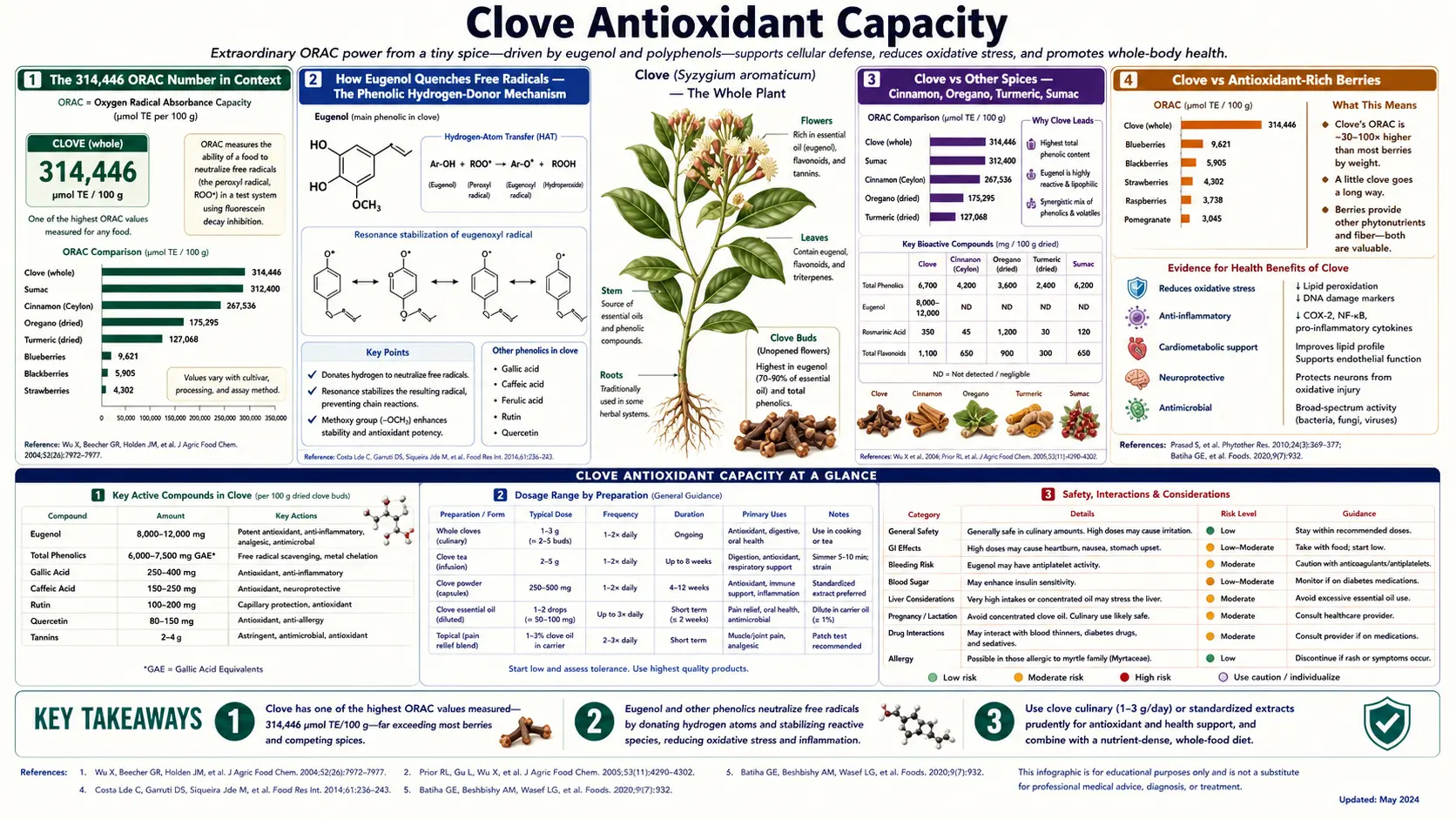
When the USDA published its database of Oxygen Radical Absorbance Capacity (ORAC) values for foods in 2010, one entry was so far above the rest that it appeared to be a typographical error. Ground cloves: 314,446 µmol Trolox-equivalent per 100 grams. The next-highest spices — sumac, cinnamon, sorghum bran, oregano — clustered between 90,000 and 175,000. Common high-antioxidant berries (blueberries, blackberries, raspberries) sit around 6,000–9,000. Dark chocolate, often cited as exceptionally antioxidant-dense, registers around 21,000. By this single most-widely-cited measure of antioxidant capacity, no other consumed plant material comes close to dried clove buds. The dominant contributor is eugenol, the same phenolic compound that explains clove's anesthetic and antimicrobial effects. This deep-dive examines what the 314,446 number really means, the mechanism by which eugenol quenches free radicals, the gap between in-vitro antioxidant capacity and in-vivo clinical effect, and where clove fits in a broader antioxidant-rich diet.
Table of Contents
- The 314,446 ORAC Number in Context
- How Eugenol Quenches Free Radicals — The Phenolic Hydrogen-Donor Mechanism
- Clove vs Other Spices — Cinnamon, Oregano, Turmeric, Sumac
- Clove vs Antioxidant-Rich Berries
- Why the USDA Withdrew the ORAC Database
- Lipid Peroxidation — Where Eugenol Actually Acts
- Systemic Antioxidant Effects in Human Trials
- Stacking Clove With a Broader Antioxidant Diet
- Effects of Cooking, Storage, and Bioavailability
- Cautions — Why Antioxidants Are Not a Drug
- Key Research Papers
- Connections
- Featured Videos
The 314,446 ORAC Number in Context
The ORAC (Oxygen Radical Absorbance Capacity) assay was developed by Cao, Alessio, and Cutler in the 1990s as a unified measure of a substance's ability to quench peroxyl radicals in a controlled in-vitro reaction. The reaction uses a fluorescent probe (typically fluorescein) that is degraded by peroxyl radicals generated from a free-radical initiator (AAPH). An added antioxidant slows the rate of fluorescence loss; the area under the curve, normalized to a Trolox standard (a water-soluble Vitamin E analog), gives the ORAC value in µmol Trolox-equivalent per gram of test material.
The 2010 USDA database for selected foods is the most-cited compilation of ORAC values. The top of the spice section reads:
- Cloves, ground — 314,446 µmol TE / 100 g
- Sumac bran — 312,400
- Cinnamon, ground — 267,536
- Sorghum bran, hi-tannin — 240,000
- Oregano, dried — 175,295
- Turmeric, ground — 159,277
- Acai berry, powder — 102,700
- Sage, ground — 119,929
- Cocoa powder, unsweetened — 80,933
- Cumin seed — 76,800
- Dark chocolate (60-69%) — ~21,000
- Blueberries (wild) — ~9,621
- Pomegranates — ~4,479
- Red wine — ~3,873
- Green tea, brewed — ~1,253
The asymmetry has to be interpreted carefully. ORAC is reported per 100 grams of test material; you can drink 100 grams of green tea easily but a 100-gram dose of ground clove would be inedibly extreme — a typical culinary use is 1–2 grams of clove, contributing ~3,000–6,000 ORAC units to a meal. A cup of blueberries (~150 g) contributes ~14,000 ORAC units. So in terms of "ORAC actually delivered per typical serving," clove is high but not orders of magnitude beyond a serving of berries. The 314,446 figure tells you that on a gram-for-gram basis, no commonly consumed plant material is more antioxidant-dense; it does not tell you that 1 gram of clove is therapeutically equivalent to 50 grams of blueberries.
How Eugenol Quenches Free Radicals — The Phenolic Hydrogen-Donor Mechanism
The chemistry of how eugenol neutralizes a free radical is shared with all phenolic antioxidants — the same mechanism by which Vitamin E (alpha-tocopherol), polyphenols in tea, anthocyanins in berries, and resveratrol in wine all operate. The shared feature is a hydroxyl group (-OH) bonded to a phenolic (benzene) ring.
When a free radical (R·) encounters the phenolic hydroxyl, it abstracts the hydrogen atom, generating a relatively stable phenoxyl radical and an inert R-H product:
R· + PhOH → R-H + PhO·
The reaction is favorable because the phenoxyl radical (PhO·) is stabilized by resonance with the aromatic ring — the unpaired electron can be delocalized into multiple positions on the ring, lowering the radical's energy and reactivity. Where the original R· was an aggressive oxidant ready to propagate damage to adjacent molecules, the resulting PhO· is a stable terminus that either reacts with a second radical (terminating the chain) or is reduced back to PhOH by another antioxidant such as ascorbate (Vitamin C) or glutathione.
Eugenol's specific structure (4-allyl-2-methoxyphenol) places its phenolic hydroxyl in an electron-rich environment — the adjacent methoxy group donates electron density to the ring, which weakens the O-H bond and makes hydrogen abstraction by free radicals more thermodynamically favorable. This electron-rich phenolic structure is shared by other potent antioxidant phenolics including ferulic acid, sinapic acid, and many of the flavonoids. The eugenol O-H bond dissociation energy is around 79 kcal/mol — comparable to alpha-tocopherol (~77 kcal/mol), the gold-standard lipid-phase chain-breaking antioxidant.
In addition to direct radical scavenging, eugenol modestly upregulates the Nrf2-mediated antioxidant response — the transcription factor pathway that increases expression of glutathione peroxidase, superoxide dismutase, catalase, and heme oxygenase-1 in cells exposed to oxidative stress. This indirect mechanism may be more relevant to in-vivo benefit than the direct radical scavenging activity, because endogenous antioxidant enzymes operate at much higher concentrations and turnover rates than dietary phenolic antioxidants in the bloodstream.
Clove vs Other Spices — Cinnamon, Oregano, Turmeric, Sumac
Clove's ORAC value is approximately:
- 1.0× sumac — effectively tied (sumac 312,400 vs clove 314,446)
- 1.2× cinnamon
- 1.8× oregano
- 2.0× turmeric
- 2.6× sage
- 4.1× cocoa powder
- 32× wild blueberries (per 100 g, but adjusted for typical serving sizes the gap closes substantially)
The composition of the antioxidant activity differs across spices in ways that matter functionally:
- Clove — eugenol is the dominant phenolic, accounting for an estimated 80–90% of the antioxidant activity in standard extracts. The activity is concentrated in a single lipophilic compound that distributes well into membranes.
- Cinnamon — the dominant antioxidant is cinnamaldehyde (a different aromatic compound) plus polyphenols including procyanidins. Some cinnamons (Cassia variety) also contain coumarin, which has its own pharmacological profile including anticoagulant activity.
- Oregano — carvacrol and thymol are the dominant antioxidant phenolics; rosmarinic acid contributes substantially.
- Turmeric — curcumin is the principal antioxidant, with the well-known bioavailability problem (poor absorption, rapid metabolism). Pepperine co-administration or lipid formulation is typically needed for systemic effect.
- Sumac — mixed tannins, gallotannins, and gallic acid esters provide the antioxidant capacity. Used heavily in Middle Eastern cuisine.
The practical implication is that no single spice covers the full spectrum of dietary phenolic chemistry. A varied, spice-rich diet draws on multiple compound classes (eugenol, cinnamaldehyde, carvacrol, curcumin, gallic acid esters, rosmarinic acid, etc.) that distribute to different body compartments and target different oxidation pathways. Clove is one of the most potent contributors per gram, but it complements rather than replaces other antioxidant-rich spices and foods.
Clove vs Antioxidant-Rich Berries
Berries are typically described as the highest-antioxidant fruit category, with wild blueberries, blackberries, elderberries, and acai topping the list at 4,000–10,000 ORAC per 100 g. Clove's 314,446 ORAC is roughly 30–80 times higher on a per-gram basis. But the realistic consumption math closes that gap:
- Typical clove serving — 1 g of clove in a meal contributes ~3,144 ORAC units
- Typical berry serving — 100 g (~3/4 cup) of blueberries contributes ~6,500 ORAC units
- Typical generous berry serving — 250 g (~2 cups) of blackberries contributes ~14,000 ORAC units
On per-serving terms, a good serving of berries actually delivers somewhat more ORAC than a typical clove use in a meal. The categories complement each other:
- Berries — deliver larger total ORAC per serving, in compounds (anthocyanins, ellagic acid) that distribute to water-soluble compartments and modulate the gut microbiome favorably.
- Clove and other phenolic spices — deliver concentrated, lipophilic antioxidant activity per gram, distributing well into membranes and tissues. The eugenol from a few clove buds reaches blood and tissue concentrations sufficient for measurable antioxidant effect even at low intake.
A diet that includes both spice and berry sources of polyphenols provides broader antioxidant coverage than either alone. See our Blueberries page and the Antioxidants overview for the broader picture.
Why the USDA Withdrew the ORAC Database
The USDA withdrew its ORAC database in 2012, after maintaining it from 2007 through 2010. The withdrawal note stated that ORAC values had been "mistakenly used by food and dietary supplement manufacturing companies to promote their products" and that there was "no evidence that the beneficial effects of polyphenol-rich foods can be attributed to their antioxidant capacity." This was a hard pivot from the database's earlier promotion as a tool for nutritional research.
Several legitimate criticisms drove the withdrawal:
- In-vitro vs in-vivo gap — the ORAC reaction occurs in a buffered aqueous system at controlled pH and oxygen tension; the human body has many compartments (membranes, plasma, intracellular), different oxidizing species (peroxyl, hydroxyl, superoxide, peroxynitrite), and an extensive endogenous antioxidant system (glutathione, superoxide dismutase, catalase, peroxidase enzymes). In-vitro radical-scavenging capacity does not necessarily predict the effect of dietary antioxidant intake on cellular oxidative stress markers in vivo.
- Bioavailability variation — an antioxidant compound's ORAC value tells you nothing about whether the compound is absorbed from the gut, metabolized to active vs inactive metabolites, transported into relevant tissues, or excreted before exerting any effect. Curcumin has high in-vitro ORAC but very poor systemic bioavailability; vitamin E has high ORAC and good systemic distribution; eugenol falls somewhere in between.
- Antioxidant supplements failing in clinical trials — the largest randomized trials of high-dose antioxidant supplements (vitamin E, beta-carotene) in cardiovascular disease and cancer have shown null or even harmful effects (ATBC, CARET, HOPE trials). This suggested that simply elevating in-vivo antioxidant capacity is not necessarily beneficial — that some basal level of reactive oxygen species is required for normal signaling (mitohormesis), and that whole-food sources of polyphenols may produce benefits through mechanisms (microbiome interaction, gene expression effects via Nrf2, anti-inflammatory effects) that ORAC does not capture.
- Marketing misuse — food and supplement companies were citing ORAC values as if they were a clinical endpoint, with no link to actual health outcomes.
The reasonable interpretation today is that ORAC remains a useful relative measure of the phenolic content of foods — cloves really do contain extraordinary amounts of eugenol per gram — while not being a clinical endpoint. The 314,446 number says clove is rich in phenolic compounds, which is true and useful; it does not say that eating clove will produce a quantifiable health benefit proportional to the number.
Lipid Peroxidation — Where Eugenol Actually Acts
Where eugenol's antioxidant chemistry probably matters most physiologically is in the membrane lipid environment. Polyunsaturated fatty acids in cell membranes and circulating lipoproteins are particularly susceptible to free-radical attack — the unsaturated bonds allow propagation of radical chain reactions through the membrane, producing toxic lipid peroxides and aldehyde byproducts (malondialdehyde, 4-hydroxynonenal) that further damage proteins and DNA.
Eugenol's lipophilic phenolic structure allows it to partition into membrane lipid bilayers, where it can intercept lipid radicals at the site of damage. In this respect, eugenol behaves analogously to alpha-tocopherol (Vitamin E), the body's endogenous membrane-resident chain-breaking antioxidant. Several studies show eugenol can substitute for or augment tocopherol activity in protecting membrane lipids in animal and cell culture models.
This membrane-protective activity may be the molecular basis for several documented eugenol effects:
- Cardioprotection in animal models — eugenol pre-treatment reduces myocardial infarct size in rat ischemia-reperfusion models, with reduced lipid peroxidation in the cardiac tissue.
- Hepatoprotection in low to moderate doses — paradoxically, given the hepatotoxicity of high-dose eugenol, lower doses protect the liver against ethanol and CCl4 induced damage in rat models, again with reduced lipid peroxidation.
- Anti-aging effects in skin — topical eugenol formulations show reduced UV-induced lipid peroxidation in skin biopsies after UV exposure.
The clinical translation in humans is much less developed than the animal data would suggest. No large randomized trials have tested clove or eugenol for cardiovascular outcomes, hepatic protection, or skin aging. The animal data and the mechanistic plausibility justify ongoing research but not strong clinical recommendations.
Systemic Antioxidant Effects in Human Trials
The most rigorous evidence for systemic antioxidant effect from clove in humans comes from a 2010 Indian study that randomized 30 healthy male volunteers to either daily clove (250 mg or 750 mg per day for 30 days) or placebo. The endpoints were blood markers of oxidative stress and antioxidant status. Results:
- Plasma total antioxidant capacity — significantly higher in the clove groups vs placebo, dose-dependent
- Plasma malondialdehyde (MDA) — a marker of lipid peroxidation — significantly lower in the clove groups
- Erythrocyte glutathione peroxidase activity — significantly higher (consistent with Nrf2-mediated induction)
- Glucose, lipid panel, liver enzymes, kidney function — no significant changes (consistent with safety at these doses)
The trial was small and short, but it represents one of the cleanest demonstrations that culinary-dose clove produces measurable systemic antioxidant effects in healthy adults. Subsequent smaller studies have shown similar findings in diabetics (improvement in plasma antioxidant markers without major effect on glycemic control) and in patients with metabolic syndrome.
The clinical relevance of moderate improvements in plasma antioxidant markers is uncertain. The relationship between such markers and hard clinical endpoints (cardiovascular events, cancer incidence, cognitive decline) is not established with the strength that would justify a strong dietary recommendation. The pragmatic position is that incorporating clove into a varied antioxidant-rich diet is reasonable, inexpensive, and low-risk, with mechanistic plausibility for benefit but without rigorous outcome trial evidence.
Stacking Clove With a Broader Antioxidant Diet
Clove fits into the broader strategy of an antioxidant-rich whole-food diet, complementing rather than replacing the other major contributors:
- Berries (blueberries, blackberries, raspberries, elderberries, acai) — the anthocyanin-rich water-soluble polyphenol contribution. See our Blueberries page.
- Dark leafy greens (kale, spinach, collards, Swiss chard) — carotenoids, lutein, zeaxanthin, and chlorophyll-derived antioxidants. See our Kale page.
- Tea (green and black) — EGCG and other catechins for sustained low-dose polyphenol exposure.
- Other phenolic spices (cinnamon, oregano, turmeric, rosemary, sage) — varied phenolic compound classes complementing eugenol.
- Cocoa and dark chocolate — epicatechin and other flavanols.
- Cold-water fatty fish, olive oil, nuts, seeds — vitamin E (alpha-tocopherol) for membrane lipid antioxidant cover.
- Citrus, peppers, kiwi, broccoli — vitamin C for plasma and tissue water-soluble antioxidant capacity, and for regenerating other antioxidants (vitamin E, glutathione) after they have quenched a radical.
The biochemical case for variety over single-source supplementation is concrete: a single antioxidant compound, even an excellent one, only addresses one class of radical species in one body compartment. The endogenous antioxidant system is integrated, with the regenerative cycles between vitamin E, vitamin C, and glutathione recycling spent antioxidants back to their active reduced forms. Dietary polyphenols feed into this system as supplements, not substitutes.
The failure of high-dose isolated antioxidant supplements (vitamin E alone, beta-carotene alone) in clinical trials reinforces this point — flooding the system with one species at supraphysiologic levels disrupts the integrated antioxidant network, sometimes producing harm. Whole-food polyphenols at culinary doses appear to support the system without disrupting it.
Effects of Cooking, Storage, and Bioavailability
Clove's antioxidant compounds — eugenol foremost — are reasonably heat-stable but volatile, with several practical implications:
- Whole cloves vs ground — whole cloves retain their volatile oils much better than pre-ground powder. Ground clove loses 30–50% of its eugenol content over 12 months of storage, even in a sealed container. Whole cloves stored cool and dark retain most of their potency for 2–3 years. For maximum potency, grind cloves immediately before use.
- Long simmering vs short additions — eugenol is somewhat volatile and prolonged simmering (over 30–45 minutes) reduces the eugenol content of the dish. Indian and Indonesian recipes typically add whole cloves early in the cook for sustained low-dose extraction, while finishing additions of ground clove preserve more of the volatile activity.
- Light and air exposure — eugenol is mildly photoreactive and oxidizes on prolonged air exposure to eugenol-quinone, which has reduced antioxidant activity but actually greater electrophilic reactivity (more relevant to cellular signaling effects). Store cloves in opaque, sealed containers.
- Oral bioavailability — eugenol from whole clove preparations is absorbed in the small intestine, undergoes first-pass conjugation in the liver (glucuronidation, sulfation), and circulates as both free eugenol and conjugated forms. Plasma half-life of free eugenol is approximately 14 hours after oral dose. Peak plasma concentrations after a culinary clove serving are in the low micromolar range — sufficient for measurable antioxidant effect in plasma but well below the concentrations used in many in-vitro studies.
- Combination with black pepper — piperine from black pepper inhibits some of the conjugation enzymes that clear eugenol, modestly extending its plasma half-life and circulating concentration. This is the empirical basis for the traditional Indian use of clove and black pepper together in masala blends.
Cautions — Why Antioxidants Are Not a Drug
- ORAC marketing claims are not clinical endpoints — the 314,446 number tells you clove is phenolic-rich. It does not tell you that eating clove will reduce cancer risk, cardiovascular events, or aging by any quantifiable amount.
- Antioxidant supplements have failed in clinical trials — the ATBC, CARET, HOPE, and SELECT trials of isolated high-dose antioxidant supplements showed null to harmful effects on cardiovascular events and cancer incidence. Whole-food polyphenols at dietary doses appear safer than isolated supplements, but the same humility about clinical effect size is warranted.
- Mitohormesis — the body actually requires some basal level of reactive oxygen species for normal cellular signaling, including the adaptive response to exercise. Over-suppression of oxidative tone with high-dose antioxidant supplementation can blunt training adaptations and metabolic responses. Whole-food polyphenols at culinary doses do not appear to cause this problem; isolated megadose supplements can.
- High-dose clove essential oil hepatotoxicity — the irony is that the same eugenol that quenches free radicals at low doses produces hepatotoxic quinone-methide metabolites at high concentrations through cytochrome P450 bioactivation. Whole spice is safe; concentrated essential oil internally is not.
- Drug interactions — eugenol modestly affects CYP1A1, CYP1A2, and CYP3A4 metabolism. At culinary doses the interaction is minimal; at concentrated essential oil doses it can be clinically significant for narrow-therapeutic-index drugs.
- Anticoagulant interaction — as with the other Clove deep-dive pages, patients on warfarin or direct-acting oral anticoagulants should avoid concentrated clove preparations due to eugenol's antiplatelet effect.
Key Research Papers
- USDA Database for the Oxygen Radical Absorbance Capacity (ORAC) of Selected Foods, Release 2 (2010, withdrawn 2012). — PubMed: USDA ORAC database
- Cao G, Alessio HM, Cutler RG (1993). Oxygen-radical absorbance capacity assay for antioxidants. Free Radical Biology & Medicine. — PubMed
- Nagababu E, Rifkind JM, Boindala S, Nakka L (2010). Assessment of antioxidant activity of eugenol in vitro and in vivo. Methods in Molecular Biology. — PubMed
- Hussain A, Brahmbhatt K, Priyani A et al. (2011). Eugenol enhances the chemotherapeutic potential of gemcitabine and induces anticarcinogenic and anti-inflammatory activity in human cervical cancer cells. Cancer Biotherapy & Radiopharmaceuticals. — PubMed
- Carrasco-Pozo C et al. (2015). Differential protective effects of quercetin, resveratrol, rutin and epigallocatechin gallate against mitochondrial dysfunction. Food Chemistry. (context for polyphenol comparison). — PubMed
- Yashin A, Yashin Y, Xia X, Nemzer B (2017). Antioxidant activity of spices and their impact on human health: a review. Antioxidants (Basel). — PubMed
- Shan B, Cai YZ, Sun M, Corke H (2005). Antioxidant capacity of 26 spice extracts and characterization of their phenolic constituents. Journal of Agricultural and Food Chemistry. — PubMed
- Choi YJ et al. (2007). Eugenol inhibits TNF-alpha-induced expression of adhesion molecules. Journal of Inflammation. — PubMed
- Ogata M et al. (2000). Antioxidant activity of eugenol and related monomeric and dimeric compounds. Chemical & Pharmaceutical Bulletin. — PubMed
- Mishra A, Bhatti R, Singh A, Ishar MPS (2010). Ameliorative effect of the cinnamon oil from Cinnamomum zeylanicum upon early stage diabetic nephropathy. Planta Medica. (eugenol as component of cinnamon oil). — PubMed
- Bezerra DP, Militao GC, de Morais MC, de Sousa DP (2017). The dual antioxidant/prooxidant effect of eugenol and its action in cancer development and treatment. Nutrients. — PubMed
- Selmi S et al. (2015). Hepatoprotective effect of clove against acetaminophen-induced hepatotoxicity in mice. Journal of Food Biochemistry. — PubMed
PubMed Topic Searches
- PubMed: Clove eugenol antioxidant ORAC
- PubMed: Eugenol lipid peroxidation
- PubMed: Spice polyphenol oxidative stress trial
- PubMed: Eugenol Nrf2 glutathione
- PubMed: ORAC clinical outcomes meta-analysis
Connections
- All Herbs
- Clove Benefits Hub
- Clove Overview
- Clove for Dental Pain
- Clove as Digestive Aid
- Clove Antimicrobial Spectrum
- Antioxidants Overview
- Oxidative Stress
- Cinnamon
- Oregano
- Turmeric
- Rosemary
- Blueberries
- Kale
- Vitamin E (Lipid-Phase Antioxidant)
- Vitamin C
- Inflammatory Markers