Clove Antimicrobial Spectrum
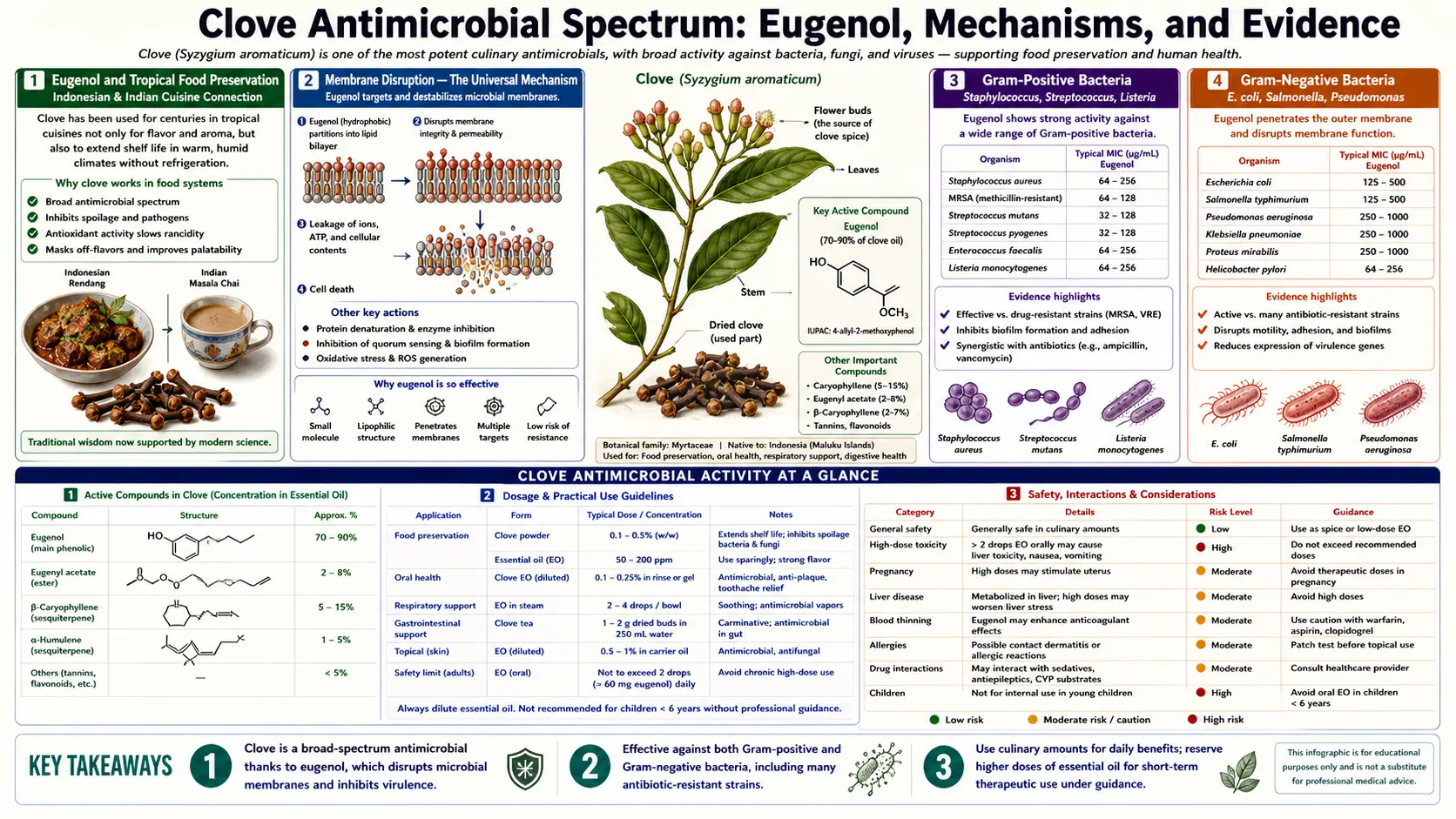
Eugenol's broad-spectrum antimicrobial activity is one of the most consistently replicated findings across the entire ethnopharmacology literature. Hundreds of in-vitro studies, spanning four decades and dozens of laboratories, have tested clove essential oil or purified eugenol against Gram-positive bacteria, Gram-negative bacteria, fungi (notably Candida species), parasites including the giardiasis pathogen Giardia lamblia, and enveloped viruses including herpes simplex types 1 and 2. The pattern is remarkably consistent: clinically significant inhibition at minimum inhibitory concentrations in the 0.1–5 mg/mL range — concentrations achievable in topical applications, oral rinses, food preservation matrices, and the upper gastrointestinal tract after oral dosing. The traditional use of clove as a heavy spice in equatorial cuisines (Indonesia, India, Southeast Asia, Sri Lanka) almost certainly evolved partly as a food preservation strategy in tropical climates where bacterial contamination is rapid. This deep-dive surveys the antimicrobial spectrum, the membrane-disruption mechanism, the traditional food-preservation use, and the rational basis for combining clove with other plant antimicrobials.
Table of Contents
- Eugenol and Tropical Food Preservation — The Indonesian/Indian Cuisine Connection
- Membrane Disruption — The Universal Mechanism
- Gram-Positive Bacteria — Staphylococcus, Streptococcus, Listeria
- Gram-Negative Bacteria — E. coli, Salmonella, Pseudomonas
- Anaerobic Pathogens — Clostridium, Bacteroides, Oral Anaerobes
- Candida and Other Fungi
- Parasites — Giardia, Entamoeba, and Other Protozoa
- Enveloped Viruses — HSV-1, HSV-2, Influenza, RSV
- Biofilm Disruption
- Food Preservation Applications
- Synergy with Other Antimicrobials
- Cautions and Practical Limits
- Key Research Papers
- Connections
- Featured Videos
Eugenol and Tropical Food Preservation — The Indonesian/Indian Cuisine Connection
The native range of Syzygium aromaticum is the Maluku Islands of eastern Indonesia, in the equatorial tropics where bacterial spoilage of food is rapid. Clove's history as a spice begins as a local food preservative, then spreads via the Maritime Silk Road to Indian, Persian, Arab, and eventually European cuisine. Heavily spiced Indonesian and Indian dishes — gulai, rendang, biryani, curries — combine clove with cinnamon, cardamom, black pepper, ginger, and other antimicrobially active spices in concentrations that produce meaningful eugenol exposure in the dish and meaningful antimicrobial activity against contaminating bacteria.
A 1998 study by Sherman and Billing in the journal BioScience formalized what cuisine anthropologists had observed for decades: the tropical-region cuisines of the world systematically use more spices, in higher quantities, and with greater preference for antimicrobially active spices, than the cuisines of cooler climates. The biological hypothesis is that spice use evolved partly as an antimicrobial defense strategy, with cultures that used antimicrobial spices having lower rates of foodborne illness and therefore higher reproductive success. Clove is consistently among the spices showing the strongest correlation with this pattern.
The modern food science literature confirms the practical antimicrobial effect of clove in food matrices. Clove essential oil at 0.1–1% concentration extends the shelf life of meat, fish, dairy, and baked goods by inhibiting the growth of spoilage and pathogenic bacteria. The principal limitation is sensory — at concentrations sufficient for full antimicrobial effect, the eugenol flavor dominates the dish. This is why traditional clove preservation tends to use it as a heavy seasoning of already-strongly-flavored dishes rather than as a neutral preservative.
Membrane Disruption — The Universal Mechanism
The broad spectrum of eugenol's antimicrobial activity is explained by a non-specific mechanism: direct disruption of microbial cell membranes. Eugenol's structure (a small phenolic molecule with a hydrophobic aromatic ring, a hydrogen-bonding hydroxyl, and a methoxy and allyl substituent) is ideal for partitioning into the lipid bilayer of cell membranes. Once embedded, eugenol:
- Increases membrane permeability — disrupting the tight packing of phospholipids and allowing leakage of small ions (K+, Na+) and metabolites (amino acids, nucleotides) out of the cell.
- Dissipates proton-motive force — the transmembrane electrochemical gradient that drives ATP synthesis. Without the proton gradient, the cell cannot generate the ATP needed for active transport, protein synthesis, or basic metabolism.
- Disrupts membrane-embedded enzyme function — including the electron transport chain components and the membrane ATPase.
- At higher concentrations, causes membrane lysis — complete cell death through loss of membrane integrity.
This mechanism is universal across bacteria (Gram-positive and Gram-negative), fungi, and enveloped viruses, all of which depend on intact phospholipid membranes for their structural integrity. It does not affect non-enveloped viruses (no membrane to disrupt) or, importantly, bacterial spores (the spore coat is not a standard membrane). It also has limited effect on intracellular pathogens once they are inside human cells, because eugenol distributes preferentially to lipid phases and may not reach intracellular pathogen concentrations sufficient for activity.
The non-specificity of the mechanism has two implications. The advantage: resistance is difficult to develop, because there is no single target to mutate; bacteria have not evolved meaningful eugenol resistance after thousands of years of human exposure, in contrast to the rapid resistance seen against most specific-target antibiotics. The disadvantage: at concentrations high enough to kill pathogens efficiently, eugenol also disrupts human cell membranes, producing the mucosal irritation and the cytotoxicity seen with high-dose essential oil application.
Gram-Positive Bacteria — Staphylococcus, Streptococcus, Listeria
Gram-positive bacteria have a thick peptidoglycan cell wall outside the cytoplasmic membrane. The peptidoglycan is permeable to eugenol, which reaches and disrupts the underlying membrane. Reported MIC values for eugenol against major Gram-positive pathogens:
- Staphylococcus aureus (including methicillin-resistant MRSA) — 0.25–1 mg/mL. Activity equivalent against MRSA and methicillin-susceptible strains, consistent with the membrane-disruption mechanism being independent of beta-lactam resistance.
- Streptococcus mutans (principal cariogenic oral bacterium) — 0.5–2 mg/mL. Activity demonstrated in toothpaste and mouthwash formulations against dental plaque.
- Streptococcus pyogenes (Group A Strep) — 0.5–1 mg/mL.
- Listeria monocytogenes — 0.5–1 mg/mL. Food-safety relevance for ready-to-eat foods and soft cheeses.
- Enterococcus faecalis (including vancomycin-resistant VRE) — 1–4 mg/mL. Higher MIC reflecting the intrinsic robustness of enterococci.
- Bacillus cereus — 0.5–2 mg/mL. Food poisoning relevance.
The MRSA activity is of particular interest. MRSA infection has been a leading hospital-acquired infection for the past two decades, with limited and increasingly toxic antibiotic options. Clove essential oil at sub-MIC concentrations also demonstrably reverses the methicillin resistance phenotype in some MRSA strains, restoring susceptibility to standard beta-lactams — though this is a research finding rather than a clinical protocol. See our Staphylococcus Aureus page for more on MRSA.
Gram-Negative Bacteria — E. coli, Salmonella, Pseudomonas
Gram-negative bacteria have an additional outer membrane outside the peptidoglycan layer, which acts as a permeability barrier to many antibiotics and hydrophobic compounds. Eugenol's activity against Gram-negative bacteria is generally somewhat lower than against Gram-positives but remains clinically meaningful. Reported MIC values:
- Escherichia coli (including pathogenic E. coli O157:H7) — 0.5–2 mg/mL. Activity demonstrated in food-preservation studies and in vitro against urinary tract isolates. See Escherichia Coli.
- Salmonella enterica (food poisoning) — 0.5–2 mg/mL.
- Pseudomonas aeruginosa (opportunistic hospital pathogen) — 1–5 mg/mL. Higher MIC reflecting the formidable outer membrane and efflux systems of pseudomonas.
- Helicobacter pylori — 0.25–1 mg/mL. Discussed in detail on the Digestive Aid page.
- Klebsiella pneumoniae — 0.5–2 mg/mL.
- Vibrio cholerae — 0.5–1 mg/mL. Food preservation relevance in regions with seasonal cholera transmission.
- Campylobacter jejuni — 0.5–1 mg/mL. Leading cause of bacterial gastroenteritis in industrialized countries.
The activity against pseudomonas is of particular interest because pseudomonas biofilms are notoriously antibiotic-tolerant in clinical settings (chronic cystic fibrosis lung infection, chronic wound infection, catheter-associated infection). Eugenol shows activity not only against planktonic pseudomonas but also against established biofilms, with biofilm-disruption mechanisms discussed below.
Anaerobic Pathogens — Clostridium, Bacteroides, Oral Anaerobes
Strict and facultative anaerobes are a significant clinical pathogen category, including oral anaerobes that cause periodontitis, gut anaerobes that cause intra-abdominal infections after bowel surgery or perforation, and Clostridium difficile, the leading cause of antibiotic-associated diarrhea. Eugenol shows generally good activity against this category:
- Porphyromonas gingivalis (periodontitis red complex) — 0.25–1 mg/mL. Discussed on the Dental Pain page.
- Fusobacterium nucleatum (periodontitis, also implicated in colorectal cancer microbiome) — 0.5–1 mg/mL.
- Bacteroides fragilis (anaerobic intra-abdominal infections) — 0.5–2 mg/mL.
- Clostridium difficile — 0.5–2 mg/mL. In vitro activity is well-demonstrated; clinical translation has not been studied in the context of CDI treatment.
- Clostridium perfringens (gas gangrene, food poisoning) — 0.5–1 mg/mL.
- Peptostreptococcus species (mixed anaerobic infections) — 1–4 mg/mL.
Spore forms of clostridial species are not affected by eugenol — this is the standard limitation of membrane-disruption mechanisms against spore-forming bacteria. Vegetative forms are killed but spores survive to germinate later. For clinical clostridium difficile management, see the C. difficile page for standard medical approach.
Candida and Other Fungi
Eugenol's activity against fungi is comparable in spectrum and potency to its activity against bacteria, because fungal cell membranes share the basic phospholipid architecture susceptible to eugenol disruption. The fungal cell wall (containing chitin and beta-glucans) is permeable to eugenol. Reported MIC values:
- Candida albicans — 0.5–2 mg/mL. The most studied fungal target for clove research. Activity against fluconazole-resistant strains is preserved, consistent with the non-specific membrane mechanism.
- Candida glabrata, C. krusei, C. parapsilosis — 0.5–2 mg/mL across non-albicans Candida species.
- Aspergillus fumigatus (invasive aspergillosis, allergic bronchopulmonary aspergillosis) — 1–4 mg/mL.
- Cryptococcus neoformans — 1–4 mg/mL.
- Dermatophytes (Trichophyton, Microsporum, Epidermophyton) — the agents of athlete's foot, jock itch, ringworm, and tinea capitis — 0.5–2 mg/mL. Topical clove oil preparations are used in some traditional remedies for these conditions.
- Storage and food spoilage molds (Aspergillus, Penicillium, Fusarium) — 0.5–2 mg/mL. Relevance for food preservation, particularly grain and bread storage.
The activity against Candida is the most clinically relevant, given the common burden of recurrent candidiasis in women (vaginal), in patients with diabetes (oral and skin), and in immunocompromised hosts (systemic). Clove oil mouthwash has been studied as an adjunct in oral candidiasis (thrush), particularly in HIV patients and in patients with denture stomatitis, with reasonable benefit reported in small trials. Topical clove preparations for cutaneous candidiasis carry the same caveat as for dental use: dilution to 0.5–2% in a carrier oil is required to avoid mucosal or skin irritation.
Parasites — Giardia, Entamoeba, and Other Protozoa
Eugenol's antiparasitic spectrum is narrower than its antibacterial or antifungal activity but includes several clinically important targets:
- Giardia lamblia (giardiasis, the most common waterborne intestinal protozoan in the developed world) — in vitro studies show eugenol disrupts Giardia trophozoites at concentrations achievable in the small intestinal lumen after oral dosing. Activity has been demonstrated against metronidazole-susceptible and metronidazole-resistant strains.
- Entamoeba histolytica (amebiasis) — in vitro activity demonstrated, mechanism involves membrane disruption of trophozoites.
- Leishmania species (cutaneous and visceral leishmaniasis) — activity in in vitro and animal model studies, with research interest in topical eugenol formulations for cutaneous leishmaniasis in resource-limited settings.
- Trypanosoma cruzi (Chagas disease) — in vitro activity against epimastigote and trypomastigote forms.
- Plasmodium falciparum (malaria) — modest in vitro activity, but the clinical anti-malarial potency is much lower than artemisinin-based therapies.
- Intestinal nematodes (helminth worms) — some folk-use evidence for clove as an anthelmintic; in vitro evidence is mixed and the clinical translation is unclear.
The Giardia activity is the most clinically suggestive, given the substantial global burden of giardiasis (estimated 200 million symptomatic cases per year worldwide) and the rising rates of metronidazole resistance in some regions. Clinical translation is limited; standard medical therapy for giardiasis remains nitroimidazole drugs (metronidazole, tinidazole) or nitazoxanide. Clove as adjunct or alternative is research-stage rather than clinical-standard.
Enveloped Viruses — HSV-1, HSV-2, Influenza, RSV
Eugenol's antiviral activity is limited to enveloped viruses — those with a host-derived lipid envelope susceptible to the same membrane-disruption mechanism that acts on bacterial and fungal membranes. Non-enveloped viruses (norovirus, rotavirus, polio, hepatitis A) lack the lipid envelope and are not affected. Documented in vitro activity:
- Herpes simplex virus type 1 (HSV-1, oral cold sores) — eugenol inhibits HSV-1 replication in cell culture at non-cytotoxic concentrations. The mechanism appears to involve direct virion envelope disruption pre-attachment plus inhibition of post-entry replication steps. Topical clove oil formulations are used in some traditional remedies for cold sore outbreaks.
- Herpes simplex virus type 2 (HSV-2, genital herpes) — similar in vitro activity. Clinical translation has not been formally tested.
- Influenza A virus — in vitro inhibition demonstrated against several influenza strains, with virion envelope disruption as the principal mechanism.
- Respiratory syncytial virus (RSV) — in vitro activity demonstrated.
- Hepatitis C virus (in vitro replicon systems) — modest activity against HCV replication in cell culture; clinical relevance unclear given the availability of highly effective direct-acting antiviral therapy for HCV.
The Astani 2011 study in Evidence-Based Complementary and Alternative Medicine compared the anti-HSV activity of various essential oils and isolated phenolic compounds; eugenol ranked among the more potent isolated compounds tested, comparable to carvacrol and stronger than menthol or thymol.
Biofilm Disruption
Biofilms — communities of bacteria embedded in a self-secreted polymer matrix — are responsible for many chronic and treatment-refractory infections including dental plaque, chronic wound infection, catheter-associated urinary tract infection, prosthetic joint infection, and chronic pseudomonas lung infection in cystic fibrosis. Biofilms are typically 10–1000-fold more resistant to standard antibiotics than the same bacterial species in planktonic (free-swimming) form, because the polymer matrix limits antibiotic penetration and the bacteria within shift to a slow-growth state that escapes most antibiotic mechanisms.
Eugenol shows several biofilm-relevant properties:
- Inhibition of biofilm formation — sub-MIC concentrations of eugenol applied during the early colonization phase reduce biofilm formation by S. aureus, P. aeruginosa, E. coli, and oral streptococci.
- Disruption of established biofilms — eugenol can penetrate established biofilms more effectively than many standard antibiotics, due to its small size and lipophilicity. In vitro studies show 24-hour exposure to eugenol concentrations 2–4 times the planktonic MIC produces measurable biofilm reduction.
- Quorum sensing interference — eugenol interferes with bacterial quorum sensing signaling molecules (acyl-homoserine lactones in gram-negatives, autoinducer peptides in gram-positives), reducing the coordinated gene expression that biofilm formation requires.
- Synergy with conventional antibiotics against biofilms — eugenol pre-treatment or co-treatment with antibiotics restores antibiotic susceptibility in biofilm-embedded bacteria, in vitro.
The clinical translation of biofilm-active antimicrobials is an active area of research with limited mainstream application so far. Dental use of eugenol-containing mouthwashes for plaque biofilm control is the most established clinical application; other applications (chronic wound care, urinary catheter coatings) are at the research-product stage.
Food Preservation Applications
Food preservation is the oldest and best-validated practical use of clove's antimicrobial activity. Beyond the historical use in tropical cuisines, modern food science has formalized several applications:
- Meat and fish preservation — clove essential oil at 0.05–0.5% concentration in marinades, brines, or surface treatments extends shelf life of refrigerated meat and fish by 3–7 days compared with untreated controls, primarily through inhibition of Pseudomonas, Salmonella, and Listeria.
- Dairy product extension — clove-containing herb mixes are used in some traditional cheese varieties (Dutch leyden, some Indian paneer preparations) both for flavor and for inhibition of spoilage molds.
- Bread and baked goods — small additions of clove powder (often combined with cinnamon and cardamom in spiced breads, fruit cakes, and panettone) inhibit mold growth and extend shelf life. Traditional Christmas mincemeat pies and gingerbread used clove specifically for the long shelf life needed for holiday-season production.
- Active packaging films — modern research on edible antimicrobial packaging films incorporating clove essential oil shows promising shelf-life extension for ready-to-eat foods, fresh fruits, and chilled meats. Several commercial active packaging products use clove-derived eugenol as the active ingredient.
- Beverages — traditional mulled wine and warm cider preparations include clove as both flavor and antimicrobial, contributing to the stability of these beverages at the warm serving temperatures that would otherwise promote bacterial growth.
- Pickles and ferments — clove is a traditional addition to pickling spice mixes, where it inhibits spoilage organisms while allowing the desired Lactobacillus fermentation to proceed (lactobacilli are relatively eugenol-tolerant).
The sensory ceiling is the main practical limit. At eugenol concentrations sufficient for full antimicrobial effect, the clove flavor becomes dominant. Most food applications use clove in combination with other antimicrobial herbs and spices (thyme, oregano, cinnamon, rosemary) so that no single flavor dominates and the combined antimicrobial effect is greater than any single component alone.
Synergy with Other Antimicrobials
One of the most consistent findings in the eugenol antimicrobial literature is synergy with other antimicrobial compounds — both plant-derived and pharmaceutical. The synergy is documented in vitro using the checkerboard method (calculating the fractional inhibitory concentration index, FICI) and via time-kill kinetics. Notable synergies:
- Eugenol + carvacrol (oregano) — strong synergy against S. aureus, E. coli, Salmonella. Combined oregano + clove essential oil formulations are widely used in food preservation and in herbal antimicrobial supplements.
- Eugenol + thymol (thyme) — strong synergy across a broad range of bacterial targets. Many commercial herbal antimicrobial products combine these three phenolics (eugenol + carvacrol + thymol).
- Eugenol + cinnamaldehyde (cinnamon) — synergy against E. coli and other Gram-negatives.
- Eugenol + allicin (garlic) — broad-spectrum synergy.
- Eugenol + standard antibiotics — documented synergy of eugenol with vancomycin (against VRE), with beta-lactams (against MRSA), with metronidazole (against H. pylori and giardia), and with several antifungal azoles (against fluconazole-resistant Candida). The clinical translation has not been pursued in standard antibiotic-stewardship programs but represents an interesting research direction.
The mechanistic basis for synergy is typically complementary — the second compound exploits the membrane permeabilization caused by eugenol to reach intracellular targets more effectively, or addresses a different mechanism (cell wall synthesis, protein synthesis, DNA replication) that compounds the membrane disruption.
Cautions and Practical Limits
- Cytotoxicity at high concentration — the same membrane disruption that kills microbes will damage human cells at sufficient exposure. Topical applications must dilute concentrated essential oil to 1–5% in a carrier; oral mucosal applications to 0.5–2%.
- Internal use of concentrated essential oil is hepatotoxic — the recurring warning across all four Clove deep-dive pages. Whole clove and culinary preparations are safe; concentrated essential oil internally requires medical supervision.
- Limited intracellular activity — eugenol distributes poorly into mammalian cell cytoplasm and is not a good option for treating intracellular pathogens (intracellular Listeria, Salmonella, Mycobacterium, Chlamydia, viruses in established infection).
- No effect on spores or non-enveloped viruses — clove does not eradicate C. difficile spores or norovirus or polio virus.
- Not a substitute for medical antibiotic therapy — for established systemic bacterial infection, fungal infection, parasitic infection, or viral infection requiring antiviral therapy, evidence-based pharmaceutical treatment is required. Clove may have adjunct or food-preservation roles but does not replace the standard of care.
- Antiseptic vs antibiotic distinction — clove's antimicrobial activity is closer to that of an antiseptic (high concentration, broad spectrum, surface application) than to that of a pharmaceutical antibiotic (lower concentration, narrower spectrum, systemic activity). Antiseptics and antibiotics have different clinical roles; clove's strongest applications are in topical, surface, and food-preservation contexts where antiseptic activity is what is needed.
- Allergic contact dermatitis — eugenol is a known contact allergen, particularly relevant for topical antimicrobial applications.
Key Research Papers
- Sherman PW, Billing J (1999). Darwinian gastronomy: why we use spices — spices taste good because they are good for us. BioScience. — PubMed
- Chaieb K, Hajlaoui H, Zmantar T et al. (2007). The chemical composition and biological activity of clove essential oil. Phytotherapy Research. — PubMed
- Burt S (2004). Essential oils: their antibacterial properties and potential applications in foods — a review. International Journal of Food Microbiology. — PubMed
- Astani A, Reichling J, Schnitzler P (2011). Screening for antiviral activities of isolated compounds from essential oils. Evidence-Based Complementary and Alternative Medicine. — PubMed
- Pinto E, Vale-Silva L, Cavaleiro C, Salgueiro L (2009). Antifungal activity of the clove essential oil from Syzygium aromaticum on Candida, Aspergillus and dermatophyte species. Journal of Medical Microbiology. — PubMed
- Devi KP, Nisha SA, Sakthivel R, Pandian SK (2010). Eugenol (an essential oil of clove) acts as an antibacterial agent against Salmonella typhi by disrupting the cellular membrane. Journal of Ethnopharmacology. — PubMed
- Kuete V (2017). Medicinal Spices and Vegetables from Africa: Therapeutic Potential against Metabolic, Inflammatory, Infectious and Systemic Diseases. (Eugenol chapter). — PubMed
- Marchese A, Barbieri R, Coppo E et al. (2017). Antimicrobial activity of eugenol and essential oils containing eugenol: a mechanistic viewpoint. Critical Reviews in Microbiology. — PubMed
- Hemaiswarya S, Doble M (2009). Synergistic interaction of eugenol with antibiotics against Gram-negative bacteria. Phytomedicine. — PubMed
- Friedman M, Henika PR, Mandrell RE (2002). Bactericidal activities of plant essential oils and some of their isolated constituents against Campylobacter jejuni, Escherichia coli, Listeria monocytogenes, and Salmonella enterica. Journal of Food Protection. — PubMed
- Machado M et al. (2010). Anti-Giardia activity of phenolic-rich essential oils: effects of Thymbra capitata, Origanum virens, Thymus zygis, and Lippia graveolens. Parasitology Research. — PubMed
- Nuanualsuwan S, Estes MK, Cliver DO (2002). Antimicrobial effects of eugenol on bacteriophages as model viruses. Antiviral Research. — PubMed
PubMed Topic Searches
- PubMed: Clove eugenol broad-spectrum antimicrobial
- PubMed: Clove essential oil and Candida
- PubMed: Eugenol MRSA and VRE
- PubMed: Clove food preservation
- PubMed: Eugenol biofilm disruption
Connections
- All Herbs
- Clove Benefits Hub
- Clove Overview
- Clove for Dental Pain
- Clove as Digestive Aid
- Clove Antioxidant Capacity
- Antibacterial Herbs
- Oregano (Synergistic Phenolic)
- Thyme (Synergistic Phenolic)
- Cinnamon (Synergistic)
- Tea Tree
- Myrrh
- Staphylococcus Aureus / MRSA
- Escherichia Coli
- Helicobacter Pylori
- Clostridioides Difficile
- Silver Nanoparticles