Cat's Claw — Benefits Deep Dive
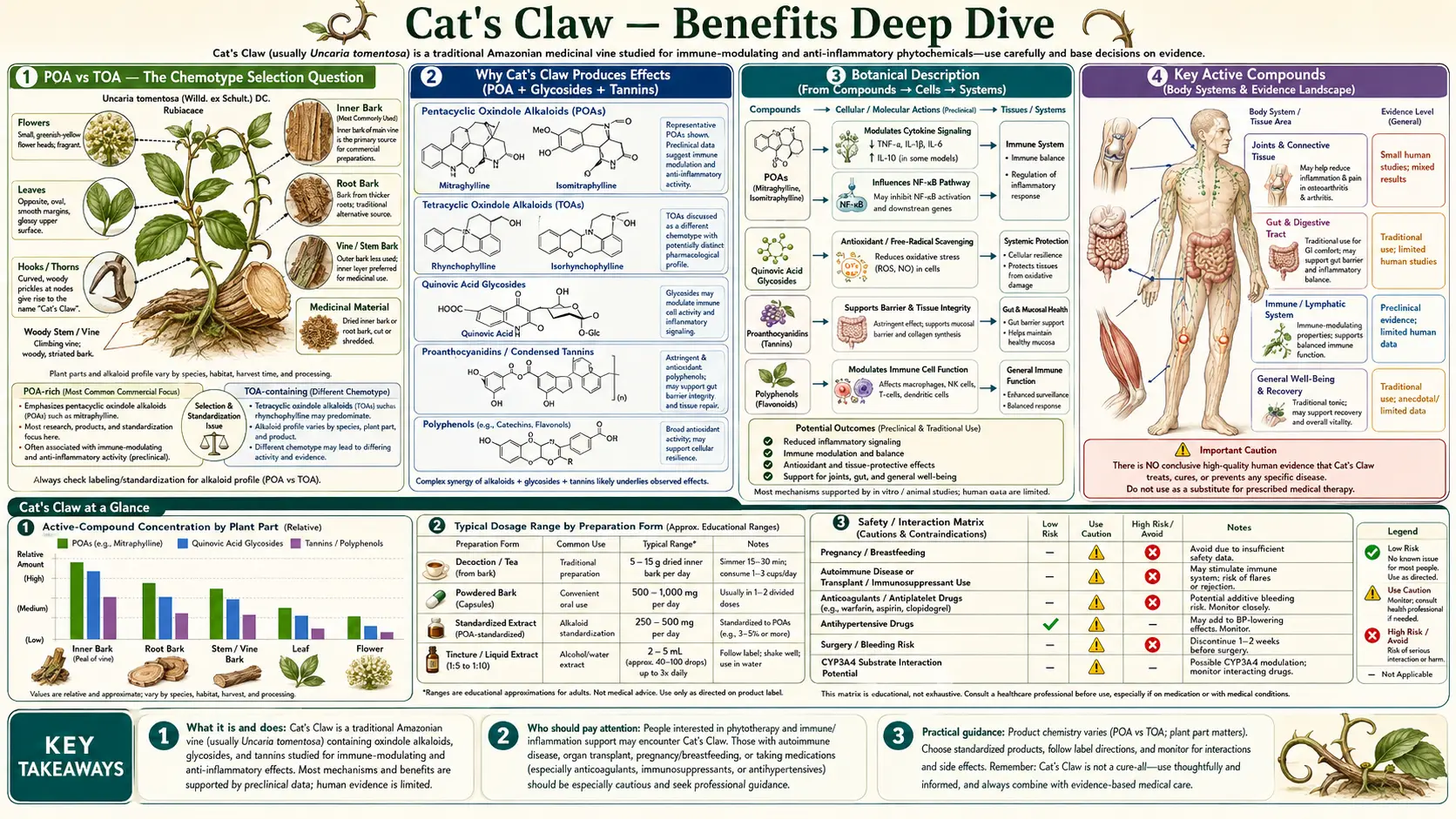
Cat's Claw (Uncaria tomentosa), known in Spanish as uña de gato, is a woody Amazonian vine whose inner bark has been used for over 2,000 years by the Asháninka and other Peruvian indigenous peoples as an immune and anti-inflammatory tonic. The critical practical fact, missed by most consumers and even some practitioners, is that Uncaria tomentosa exists in two visually indistinguishable chemotypes: the pentacyclic oxindole alkaloid (POA) chemotype is immunomodulatory and is the form documented in essentially every positive clinical trial, while the tetracyclic oxindole alkaloid (TOA) chemotype is centrally and cardiovascularly acting and — most importantly — actively antagonizes the immune-modulating effects of the POA chemotype. As little as 1% tetracyclic alkaloid contamination can reduce POA-driven immune activity by 30–70%. Buy only POA-standardized or TOA-free products (Samento, C-Med-100, and standardized capsules tested for chemotype purity). These four deep-dive pages explore the conditions where Cat's Claw produces the largest clinical effect — immune modulation, rheumatoid arthritis, broad anti-inflammatory disease, and adjunctive Lyme disease — with consistent attention to the POA-vs-TOA selection question.
Deep-Dive Articles
Immune Modulation
Why the POA chemotype matters more than the dose. Isopteropodine, pteropodine, mitraphylline, and uncarine F as phagocytosis enhancers (40–60% in vitro), C-Med-100 standardized hot-water extract clinical evidence, T-cell and NK-cell support, complement activation, leukocyte lifespan extension via reduced apoptosis, and the critical safety boundary at autoimmune disease and organ-transplant immunosuppression. Why TOA contamination as low as 1% can neutralize the entire immune signal.
Rheumatoid Arthritis
The Mur 2002 24-week randomized double-blind trial of POA-standardized Cat's Claw extract in rheumatoid arthritis (40 patients on sulfasalazine or hydroxychloroquine, add-on Cat's Claw vs placebo): 53% reduction in painful joints and 43% reduction in swollen joints at week 24. The Piscoya 2001 osteoarthritis-of-the-knee trial. NF-kB and TNF-alpha as the upstream mechanism. Practical positioning vs DMARDs, biologics, and NSAIDs — Cat's Claw is an adjunct, never a substitute, for established RA.
Anti-Inflammatory (NF-kB & TNF-alpha)
Cat's Claw is one of the most potent natural NF-kB inhibitors documented in botanical pharmacology (up to 65–85% suppression at therapeutic concentrations). The Sandoval-Chacon 1998 study establishing the NF-kB mechanism. TNF-alpha reduction in vitro and in vivo. The 1998 Sandoval pilot in Crohn's-style colitis. Comparison with sulfasalazine: Cat's Claw matches the NF-kB end-point but spares the gut microbiome, lacks the sulfa allergy risk, and does not cause folate depletion or hematologic toxicity.
Lyme Disease (Adjunctive)
The honest framing: no RCT has shown Cat's Claw eradicates Borrelia burgdorferi in humans. What we do have: the Theophilus 2015 in-vitro screen showing activity against spirochete, round-body, and biofilm forms; Datar et al. on the whole-herb preparation; the Cowden protocol (Samento) and the Buhner core-immune-herb protocols; and a robust mechanistic case for adjunctive use alongside conventional antibiotic therapy. Why TOA-free certification is non-negotiable for Lyme use and why Cat's Claw is positioned as immune-modulating adjunct, not stand-alone cure.
Table of Contents
- Deep-Dive Articles
- POA vs TOA — The Chemotype Selection Question
- Why Cat's Claw Produces Effects (POA + Glycosides + Tannins)
- Key Research Papers
- External Authoritative Resources
- Connections
- Featured Videos
POA vs TOA — The Chemotype Selection Question
If you remember nothing else about Cat's Claw, remember this: buy only products labeled POA-standardized or TOA-free. The two chemotypes look identical, grow on the same vine species, and are sold under the same common name — but they have opposite effects on the immune system, and TOA actively cancels POA. A bottle labeled simply "Cat's Claw 500 mg" with no chemotype certification is a coin-flip on whether you are getting any of the published clinical benefit at all.
The species Uncaria tomentosa contains two distinct populations of plants that produce different alkaloid profiles. Field botanists cannot tell them apart by appearance, leaf shape, or growing conditions — only laboratory chromatography can establish which chemotype a given bark harvest belongs to. The split was discovered and characterized by Austrian researcher Klaus Keplinger in the 1970s and 1980s, and the antagonism between the two alkaloid classes was demonstrated in subsequent work by Keplinger and Laus.
- Pentacyclic oxindole alkaloids (POA): isopteropodine, pteropodine, mitraphylline, speciophylline, isomitraphylline, uncarine F. These five-ring alkaloids are the immunomodulatory fraction. Every positive Cat's Claw clinical trial — including the Mur rheumatoid arthritis trial, the Piscoya osteoarthritis trial, and the Sheng C-Med-100 DNA repair trial — used extracts standardized to POA content with TOA contamination below 0.5%.
- Tetracyclic oxindole alkaloids (TOA): rhynchophylline and isorhynchophylline. These four-ring alkaloids have their own pharmacology — they are centrally acting, with effects on the CNS and cardiovascular system — but in the context of Cat's Claw supplementation for immune support, they are unwanted. TOA actively antagonizes the immune-modulating effects of POA. Keplinger and Laus showed that as little as 1% TOA content reduces POA immune activity by 30–70%. A bark harvest with 50% TOA may have no measurable immune effect at all, even at high doses.
- Why bulk “Cat's Claw” is a coin flip: Roughly half of wild-harvested Uncaria tomentosa is the TOA chemotype. Without laboratory testing and certification, a consumer purchasing generic bark powder or low-cost capsules is statistically likely to get a product with no clinical activity — or worse, a product with mixed chemotypes where the TOA actively cancels what little POA is present.
- What to buy: Look for the labels “Pentacyclic oxindole alkaloid standardized”, “POA-standardized”, “TOA-free”, or specific certified extracts such as Samento (the preparation used in the Cowden Lyme protocol, certified TOA-free), C-Med-100 / AC-11 (the patented hot-water extract used in the Sheng DNA-repair trial and other clinical research), and Saventaro (Keplinger's original European preparation). Generic capsules without chemotype certification should be avoided.
- Species substitution: The related species Uncaria guianensis is sometimes sold as Cat's Claw. It has its own pharmacology but a different alkaloid profile and far less research. The Piscoya 2001 osteoarthritis trial actually used U. guianensis, and there is reasonable evidence it is anti-inflammatory, but the immunomodulatory research base is almost entirely from U. tomentosa. Verify the species on the label.
Why Cat's Claw Produces Effects (POA + Glycosides + Tannins)
Most herbs have one or two principal active compounds. Cat's Claw has three distinct active fractions that work through three different mechanisms, and the clinical effect is the sum of all three. Understanding this is the difference between using the herb effectively and using it as a generic “immune supplement.”
- Pentacyclic oxindole alkaloids — immune modulation. The POA fraction (isopteropodine, pteropodine, mitraphylline, uncarine F, speciophylline) is the immune-modulating fraction. Mechanism: enhanced phagocytosis in granulocytes and macrophages (40–60% in vitro at therapeutic concentrations), increased lymphocyte proliferation, enhanced NK-cell activity, and modulation of cytokine production. Wurm et al. (Planta Medica 1998) and Sheng et al. (the C-Med-100 series) established the dose-response and the clinical translation. This is the fraction that drives the immune-modulation deep-dive.
- NF-kB inhibition (driven by both alkaloids and triterpenes) — anti-inflammatory. Cat's Claw is one of the most potent natural NF-kB inhibitors documented in botanical pharmacology. NF-kB is the master transcription factor controlling expression of TNF-alpha, IL-1, IL-6, COX-2, and dozens of other inflammatory mediators. By blocking NF-kB nuclear translocation, Cat's Claw reduces TNF-alpha output by >50% in macrophage models and matches the inflammatory end-point achieved by sulfasalazine in colitis models — without sulfasalazine's microbiome cost, sulfa allergy risk, or hematologic toxicity. This is the mechanism behind the anti-inflammatory deep-dive and the upstream driver of the rheumatoid arthritis trial results. Sandoval-Chacon and Sandoval mapped this pathway.
- Quinovic acid glycosides + proanthocyanidin tannins — direct antimicrobial and DNA repair. The quinovic acid glycoside fraction has direct (modest) antibacterial and antiviral activity in vitro. The proanthocyanidin tannins disrupt bacterial cell membranes, chelate metals essential for pathogen metabolism, and have biofilm-disrupting activity that is one mechanistic rationale for the Lyme-disease adjunctive role. Separately, Sheng et al. demonstrated that the C-Med-100 water extract enhances DNA repair capacity (base excision repair, nucleotide excision repair) in human lymphocytes — a unique property not shared by most immune herbs, and one that makes Cat's Claw structurally different from echinacea or astragalus.
The therapeutic implication: a high-quality POA-standardized whole-bark extract delivers all three fractions in their native ratio, which is why whole-plant preparations like C-Med-100 outperform isolated alkaloid concentrates in head-to-head comparison. The therapeutic complication: the same broad immune-activating profile that makes Cat's Claw useful for chronic inflammation and infection susceptibility is the reason it is strictly contraindicated in organ-transplant recipients on tacrolimus or cyclosporine, and the reason patients with frank autoimmune disease should use it only with practitioner supervision and disease-activity monitoring.
Key Research Papers
- Mur E, Hartig F, Eibl G, Schirmer M (2002). Randomized double blind trial of an extract from the pentacyclic alkaloid-chemotype of Uncaria tomentosa for the treatment of rheumatoid arthritis. Journal of Rheumatology 29(4): 678–681. — PubMed: Mur 2002 RA trial
- Sheng Y, Bryngelsson C, Pero RW (2000). Enhanced DNA repair, immune function and reduced toxicity of C-MED-100, a novel aqueous extract from Uncaria tomentosa. Journal of Ethnopharmacology 69(2): 115–126. — PubMed: Sheng C-MED-100
- Sandoval-Chacon M, Thompson JH, Zhang XJ, et al. (1998). Antiinflammatory actions of cat's claw: the role of NF-kappaB. Alimentary Pharmacology & Therapeutics 12(12): 1279–1289. — PubMed: Sandoval-Chacon NF-kB 1998
- Piscoya J, Rodriguez Z, Bustamante SA, et al. (2001). Efficacy and safety of freeze-dried cat's claw in osteoarthritis of the knee. Inflammation Research 50(9): 442–448. — PubMed: Piscoya OA 2001
- Keplinger K, Laus G, Wurm M, Dierich MP, Teppner H (1999). Uncaria tomentosa (Willd.) DC. — ethnomedicinal use and new pharmacological, toxicological and botanical results. Journal of Ethnopharmacology 64(1): 23–34. — PubMed: Keplinger Laus 1999 (POA/TOA antagonism)
External Authoritative Resources
- NCCIH — Herbs at a Glance (US National Center for Complementary and Integrative Health)
- MedlinePlus — Cat's Claw (Uncaria tomentosa)
- Memorial Sloan Kettering — Cat's Claw monograph (clinical summary with drug-interaction tables)
- WHO Monographs on Selected Medicinal Plants — Volume 3 covers Uncaria tomentosa
- PubMed — all research on Uncaria tomentosa (~1,200+ papers)
Connections
- All Herbs
- Cat's Claw (Main Page)
- Cat's Claw for Immune Modulation
- Cat's Claw for Rheumatoid Arthritis
- Cat's Claw Anti-Inflammatory (NF-kB)
- Cat's Claw for Lyme Disease (Adjunctive)
- Andrographis
- Astragalus
- Echinacea
- Japanese Knotweed
- Turmeric
- Berberine
- Goldenseal
- Pau d'Arco
- Neem
- Rheumatoid Arthritis
- Lyme Disease
- Crohn's Disease
- Urinary Tract Infections
- Immune Boosting