Cat's Claw: History and Traditional Use
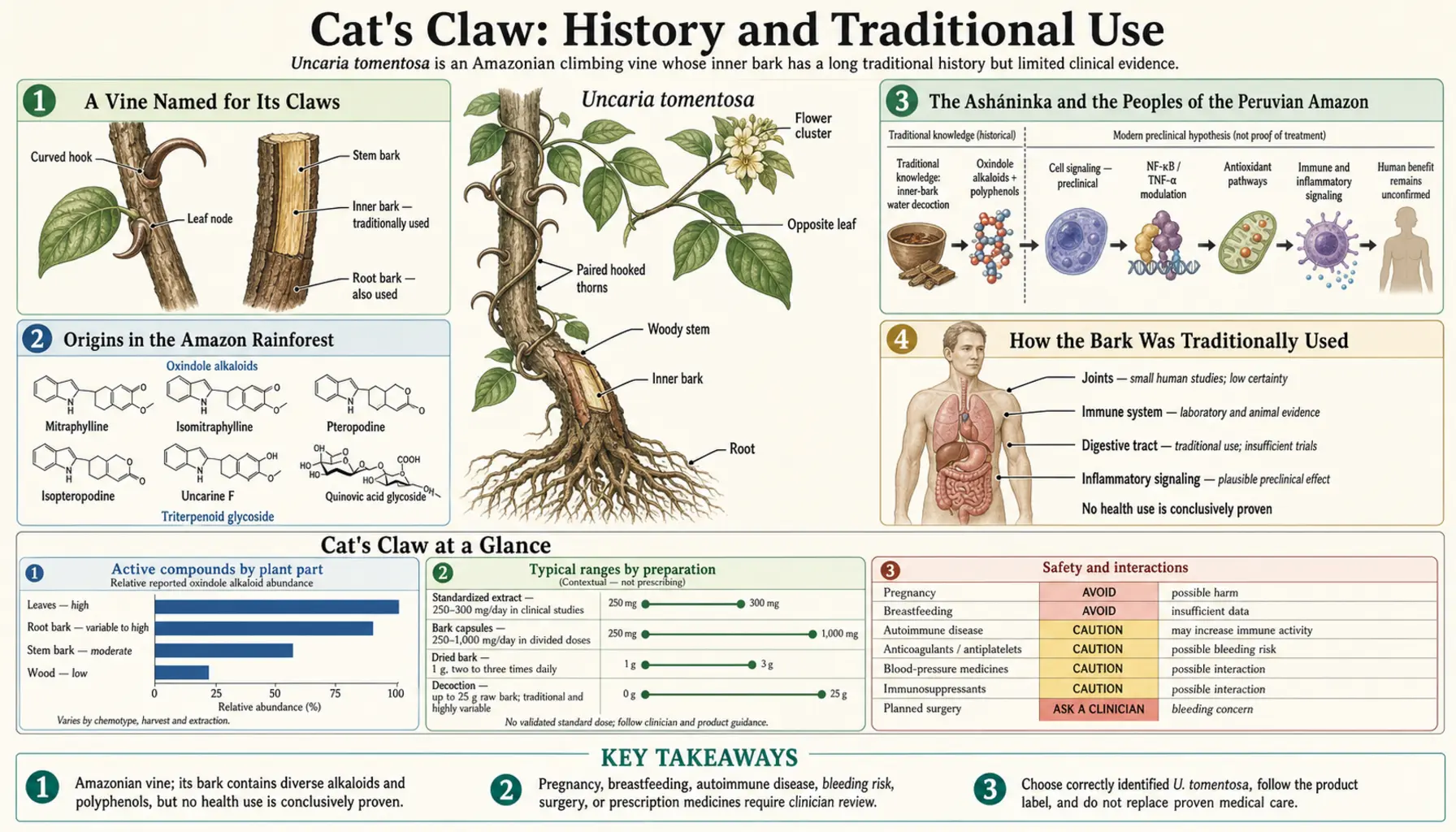
Cat's claw (Uncaria tomentosa) is unusual among famous medicinal herbs: it has no ancient Greek, Roman, or medieval European record at all. It is a woody vine of the Amazon rainforest, and its documented story belongs almost entirely to the indigenous peoples of the Peruvian Amazon — above all the Asháninka — and to the twentieth-century travellers and scientists who carried their knowledge out to the wider world. What follows separates what is reliably documented from what is told as tradition, so the history reads honestly.
Table of Contents
- A Vine Named for Its Claws
- Origins in the Amazon Rainforest
- The Asháninka and the Peoples of the Peruvian Amazon
- How the Bark Was Traditionally Used
- How Cat's Claw Reached the West
- Klaus Keplinger and the First Scientific Study
- Two Chemotypes and Global Recognition
- From Tradition to Modern Research
- Research Papers and References
- Connections
- Featured Videos
A Vine Named for Its Claws
The common name says exactly what the plant looks like. Cat's claw is the English translation of the Spanish uña de gato, and both names come from the small, curved, hook-shaped thorns that grow in pairs at the base of the plant's leaves — thorns that genuinely resemble a cat's claws and that the vine uses to hook onto neighbouring trees as it climbs. This is a literal, descriptive name, not the legacy of any single discoverer; like most herbs, cat's claw was not invented by anyone but was named independently by the people who lived alongside it. In Spanish-speaking South America the plant also carries regional names such as garabato and uña de gavilán (sparrowhawk's claw), all describing the same hooked thorns.
The plant most often sold and studied as cat's claw is Uncaria tomentosa, a member of the madder family (Rubiaceae), the same botanical family as coffee. Botanically it has a documented paper trail. It was first published under an earlier name, Nauclea tomentosa Willd. ex Schult. (1819), and was transferred to the genus Uncaria as Uncaria tomentosa in 1830 by the Swiss botanist Augustin Pyramus de Candolle, in the fourth volume of his great catalogue of plants, the Prodromus. (An unrelated early name, Nauclea aculeata Kunth, is today treated as a synonym.) This is why the plant's full scientific name is usually written Uncaria tomentosa (Willd. ex Schult.) DC. — the "DC." standing for De Candolle, who made that transfer. The species epithet tomentosa means "covered with fine, matted hairs," describing the soft down on the underside of the leaves.
One distinction matters for anyone reading the history closely: Uncaria tomentosa is not the only "cat's claw." A closely related Amazonian vine, Uncaria guianensis, shares the common name and many traditional uses, and a separate, unrelated genus of vines in Mexico and the southern United States (Senegalia, formerly Acacia) is also called cat's claw in English. When this article and the modern research literature speak of cat's claw, they mean the Peruvian Amazon vine Uncaria tomentosa unless otherwise stated.
Origins in the Amazon Rainforest
Unlike herbs such as mullein or sage, whose recorded medicinal careers begin in the classical Mediterranean, cat's claw has no presence in the ancient written record of the Old World for a simple reason: it does not grow there. Uncaria tomentosa is native to the tropical rainforests of Central and South America, and it is most strongly associated with the Amazon basin of Peru, where the great majority of the world's commercial supply still originates. It is a large woody liana — a climbing vine — that can reach well over twenty metres in length as it works its way up through the rainforest canopy, anchored by its hooked thorns.
Because the peoples of the Amazon passed their plant knowledge down by speech, demonstration, and apprenticeship rather than in writing, there is no dated manuscript marking the "first use" of cat's claw, and there cannot be. It is commonly said in both popular and scientific sources that cat's claw has been used in the Peruvian Amazon for roughly two thousand years; this figure should be read as a traditional estimate of great antiquity rather than as a precisely documented date. What can be stated with confidence is that by the time outsiders began recording indigenous Amazonian medicine in the twentieth century, cat's claw was already a deeply established and widely respected remedy — one of the most important medicinal plants of the entire Western Hemisphere.
This is the honest shape of cat's claw's early history: an oral, living tradition of unknown but evidently great age, carried by rainforest peoples, and entering the written record only recently. The sections that follow describe what those peoples are documented to have used the plant for, and how that knowledge was finally written down.
The Asháninka and the Peoples of the Peruvian Amazon
The people most closely associated with cat's claw are the Asháninka (also spelled Asháninca or Campa), one of the largest indigenous groups of the central and southern Peruvian Amazon. The Asháninka are widely described in the ethnobotanical literature as having the longest recorded tradition of using Uncaria tomentosa, and the plant occupies a place of unusual cultural importance for them — it is treated not merely as a medicine but as a sacred plant tied to the wellbeing of the whole community. According to widely repeated accounts, Asháninka healers prepared decoctions of the bark for community members recovering from illness and for warriors returning home, and the plant features prominently in their healing tradition.
The Asháninka were not alone. Cat's claw appears in the documented practice of a number of other Amazonian and Andean-Amazonian peoples, including the Aguaruna, Cashibo, Conibo, and Shipibo, who developed their own uses for the bark and root. That so many distinct groups, often working independently, arrived at the same plant for a similar core set of complaints — inflammation, infection, digestive trouble, and recovery from illness — is itself a kind of evidence: it tells us the plant earned its reputation through long, repeated experience rather than through a single founder's claim.
It is worth being clear about what the historical record can and cannot tell us here. The cultural details — that the Asháninka regard cat's claw as sacred, that healers used it to restore health after sickness — come largely from twentieth-century ethnobotanical reports and from the accounts of the outsiders who lived among these peoples, not from ancient documents written by the peoples themselves. They are best understood as faithfully recorded tradition. The peer-reviewed ethnobotanical reviews of Uncaria by Keplinger and colleagues and by Heitzman and colleagues collect and summarise these traditional uses and are the most reliable starting points for readers who want to go deeper.
How the Bark Was Traditionally Used
In Amazonian and later Peruvian folk medicine, the medicinal parts of cat's claw are the inner bark of the vine and, to a lesser extent, the root bark. The classic preparation is a decoction: the woody bark is simmered in water for a long time — far longer than an ordinary leaf tea — to draw out its constituents, and the resulting liquid is drunk. This long-simmered bark decoction is the form in which cat's claw has been taken traditionally for generations, and it remains the reference preparation against which modern capsules and extracts are measured.
The conditions for which the bark was traditionally used are broad, and several recur across many sources. Traditionally, healers reached for cat's claw for inflammatory and joint complaints such as arthritis and rheumatism and for bone pain; for digestive problems including gastritis, stomach pain, ulcers, and dysentery; for infections and fevers and for the urinary tract; for wounds, including deep wounds; and as a general tonic to help the body recover from any debilitating illness. The plant was also used in women's medicine, including in connection with recovery after childbirth. Folklore holds that the bark was valued as a restorer of strength and balance after sickness — a recovery remedy as much as a treatment for any one disease.
Two cautions belong with this list, for the sake of accuracy and safety. First, these are traditional indications — descriptions of how the plant has historically been used, not claims that it cures these conditions; the modern clinical evidence is far narrower than the traditional reputation, and is discussed in the companion articles. Second, the historical record also includes the traditional use of cat's claw preparations in connection with contraception and the prevention or termination of pregnancy among some Amazonian groups. This single fact is the reason cat's claw is firmly cautioned against in pregnancy today, and it is an important example of why a herb's traditional uses must be reported honestly rather than romanticised.
How Cat's Claw Reached the West
Cat's claw is a relative newcomer to medicine outside South America, and its journey northward is a twentieth-century story. The figure most often credited with carrying the plant toward European attention is Arturo Brell, a German-born naturalist. According to widely repeated accounts, Brell migrated in 1926 from Munich to Pozuzo, a remote settlement in the Peruvian rainforest founded by German and Austrian colonists, where he came to live alongside Amazonian peoples described as the Campa (Asháninka) and Amuesha (Yanesha). Tradition holds that Brell learned of cat's claw from these neighbours and used it to relieve his own long-standing rheumatic pain after other treatments had failed, and that this personal experience is what first drew European interest to the plant. These biographical details are repeated consistently across popular and herbal sources but are not all confirmed in the primary scientific literature, so they are presented here as the commonly told account rather than as established scientific fact.
What is clearer is the broader pattern. For most of the first half of the twentieth century, knowledge of cat's claw remained essentially local to Peru, passing between rainforest peoples and the small number of settlers, travellers, and naturalists who encountered it. There was no controlled study, no pharmacopoeia entry, and no commercial trade of any size. The plant's reputation travelled by word of mouth and personal testimony — the same way it had always travelled within the Amazon — and it would take a determined outside investigator, working decades after Brell, to turn that reputation into something the wider scientific and commercial world would take seriously.
Klaus Keplinger and the First Scientific Study
The pivotal figure in cat's claw's modern history is Klaus Keplinger, an Austrian from Innsbruck described in the literature as a journalist and self-taught ethnologist. Beginning in the early 1970s, Keplinger organised what is generally regarded as the first systematic scientific investigation of Uncaria tomentosa — collecting the traditional knowledge, obtaining plant material from Peru, and arranging laboratory analysis of what the bark actually contained. His work is the hinge on which cat's claw turns from a regional folk remedy into an internationally studied medicinal plant, and it is documented in the peer-reviewed literature, most notably in the 1999 review he co-authored in the Journal of Ethnopharmacology.
Keplinger's investigations identified a group of compounds called oxindole alkaloids as central to the plant's activity, and laboratory testing of these alkaloids reported effects on the immune system — in particular an enhancement of phagocytosis, the process by which certain white blood cells engulf and destroy microbes and debris. On the strength of this work, Keplinger filed several United States patents covering extraction methods for the immune-active alkaloids, and standardised cat's claw extracts derived from his research were sold as herbal medicines in Austria and Germany. This was the moment cat's claw entered the European medicine cabinet on more than anecdotal terms.
It is important to keep the achievement in proportion. Keplinger's contribution was real and genuinely foundational — he is the documented scientific milestone in this herb's history, which is why he can be named with confidence where the earlier oral tradition cannot attach to any single person. But his early findings were largely laboratory and observational, and like much early herbal research, some of his specific claims have been debated and were not all independently replicated. The honest summary is that Keplinger opened the modern scientific file on cat's claw; he did not close it.
Two Chemotypes and Global Recognition
One of the more important ideas to come out of Keplinger's circle is that Uncaria tomentosa is not chemically uniform. Research associated with Keplinger and the chemist Giorgio Laus described two chemotypes of the species — plants that look essentially identical in the forest but produce different alkaloids. One chemotype is rich in pentacyclic oxindole alkaloids (POA), held to be the immune-supporting fraction; the other is rich in tetracyclic oxindole alkaloids (TOA), which were reported to act differently and possibly to work against the immune effects of the pentacyclic group. This is the origin of the "POA-standardised" or "TOA-free" cat's claw products on the market today. Readers should know that this chemotype distinction, while widely adopted commercially, originated largely with researchers and a manufacturer connected to cat's claw products and has been questioned by some independent scientists; it is presented here as an influential and much-cited idea rather than as settled, universally accepted fact.
By the 1990s, cat's claw had moved from a curiosity into one of the best-selling herbal supplements in both Europe and North America, and that surge in demand left two clear historical marks. The first was economic and environmental: harvesting of the wild vine in Peru boomed, with exports reported to have peaked at hundreds of tonnes in the mid-1990s, and the resulting pressure on wild stands prompted concern about overharvesting and calls for sustainable management of this rainforest resource. The second mark was official recognition. The World Health Organization included Uncaria tomentosa (as Cortex Uncariae) among the plants treated in its authoritative Monographs on Selected Medicinal Plants — in Volume 3, published in 2007 — summarising its traditional uses, and the herb was later formally assessed by the European Medicines Agency, whose Committee on Herbal Medicinal Products reviewed the evidence and finalised its assessment in 2016. Tellingly, the European assessment concluded that the available evidence did not meet the standard required for a European herbal monograph — an honest reminder that international attention is not the same thing as proven efficacy.
From Tradition to Modern Research
The history of cat's claw is, in the end, a short and recent one compared with the classical herbs — but it is unusually clear about where its knowledge comes from. An oral, living tradition of the Peruvian Amazon, centred on the Asháninka and shared among several rainforest peoples, used the simmered inner bark for inflammation, infection, digestion, wounds, and recovery from illness. In the twentieth century that tradition reached the wider world — by the commonly told account through Arturo Brell in the 1920s, and unmistakably through Klaus Keplinger's laboratory work from the 1970s onward — and from there cat's claw became a globally traded supplement and a subject of WHO and European regulatory review.
Modern science has begun to test, rather than simply repeat, the old reputation. Work on cat's claw has isolated its oxindole alkaloids, quinovic acid glycosides, and proanthocyanidins; a randomised, double-blind trial published in the Journal of Rheumatology in 2002 reported a reduction in painful joints in rheumatoid arthritis patients taking a pentacyclic-alkaloid extract; a human study of a water-soluble extract reported enhanced DNA repair; and laboratory work published in Scientific Reports in 2019 examined a specific proanthocyanidin-rich extract against the brain plaques and tangles of Alzheimer's disease. These are real, named studies — but most are early-stage, several involve proprietary extracts, and none of them transform a traditional remedy into a proven cure. The detailed evidence, dosing, and safety are taken up in the companion Cat's Claw Benefits articles and on the main Cat's Claw page.
That is the thread worth keeping: a rainforest vine, named for its claws and unknown to Old World medicine, carried out of the Amazon by indigenous knowledge and a handful of twentieth-century investigators, and now slowly being examined in the laboratory and the clinic. Tradition raised the questions; research is still working through the answers — and the most respectful way to tell this herb's story is to say clearly which parts are documented science and which are honoured tradition.
Research Papers and References
The list below gives the key peer-reviewed sources for cat's claw's documented history, ethnobotany, and the scientific milestones named in this article, followed by curated PubMed topic-search links and authoritative external resources. Author names, titles, and journals are given as plain text; only stable identifiers (DOI, PMID) and topic searches are hyperlinked, and each opens in a new tab.
- Keplinger K, Laus G, Wurm M, Dierich MP, Teppner H. Uncaria tomentosa (Willd.) DC. — ethnomedicinal use and new pharmacological, toxicological and botanical results. Journal of Ethnopharmacology. 1999;64(1):23-34. — PMID: 10075119
- Heitzman ME, Neto CC, Winiarz E, Vaisberg AJ, Hammond GB. Ethnobotany, phytochemistry and pharmacology of Uncaria (Rubiaceae). Phytochemistry. 2005;66(1):5-29. — doi:10.1016/j.phytochem.2004.10.022
- Steinberg PN. Cat's Claw: an herb from the Peruvian Amazon (article in Spanish). Sidahora. 1995:35-36. — PMID: 11363206
- Mur E, Hartig F, Eibl G, Schirmer M. Randomized double blind trial of an extract from the pentacyclic alkaloid-chemotype of Uncaria tomentosa for the treatment of rheumatoid arthritis. Journal of Rheumatology. 2002;29(4):678-681. — PMID: 11950006
- Sheng Y, Bryngelsson C, Pero RW. Enhanced DNA repair, immune function and reduced toxicity of C-MED-100, a novel aqueous extract from Uncaria tomentosa. Journal of Ethnopharmacology. 2000;69(2):115-126. — doi:10.1016/S0378-8741(99)00070-7
- Snow AD, Castillo GM, Nguyen BP, et al. The Amazon rain forest plant Uncaria tomentosa (cat's claw) and its specific proanthocyanidin constituents are potent inhibitors and reducers of both brain plaques and tangles. Scientific Reports. 2019;9:561. — doi:10.1038/s41598-019-38645-0
- Uncaria tomentosa ethnobotany and traditional use — PubMed: Uncaria tomentosa ethnobotany traditional use
- Uncaria tomentosa oxindole alkaloids and chemotypes — PubMed: Uncaria tomentosa pentacyclic and tetracyclic oxindole alkaloids
External Authoritative Resources
- NCCIH — Herbs at a Glance
- European Medicines Agency — Uncariae tomentosae cortex (cat's claw) assessment
- PubMed — All research on Uncaria tomentosa
Connections
- All Herbs
- Cat's Claw Hub
- Cat's Claw Benefits Deep Dive
- Pau d'Arco
- Chanca Piedra
- Andrographis
- Japanese Knotweed
- Echinacea