Cat's Claw for Lyme Disease (Adjunctive)
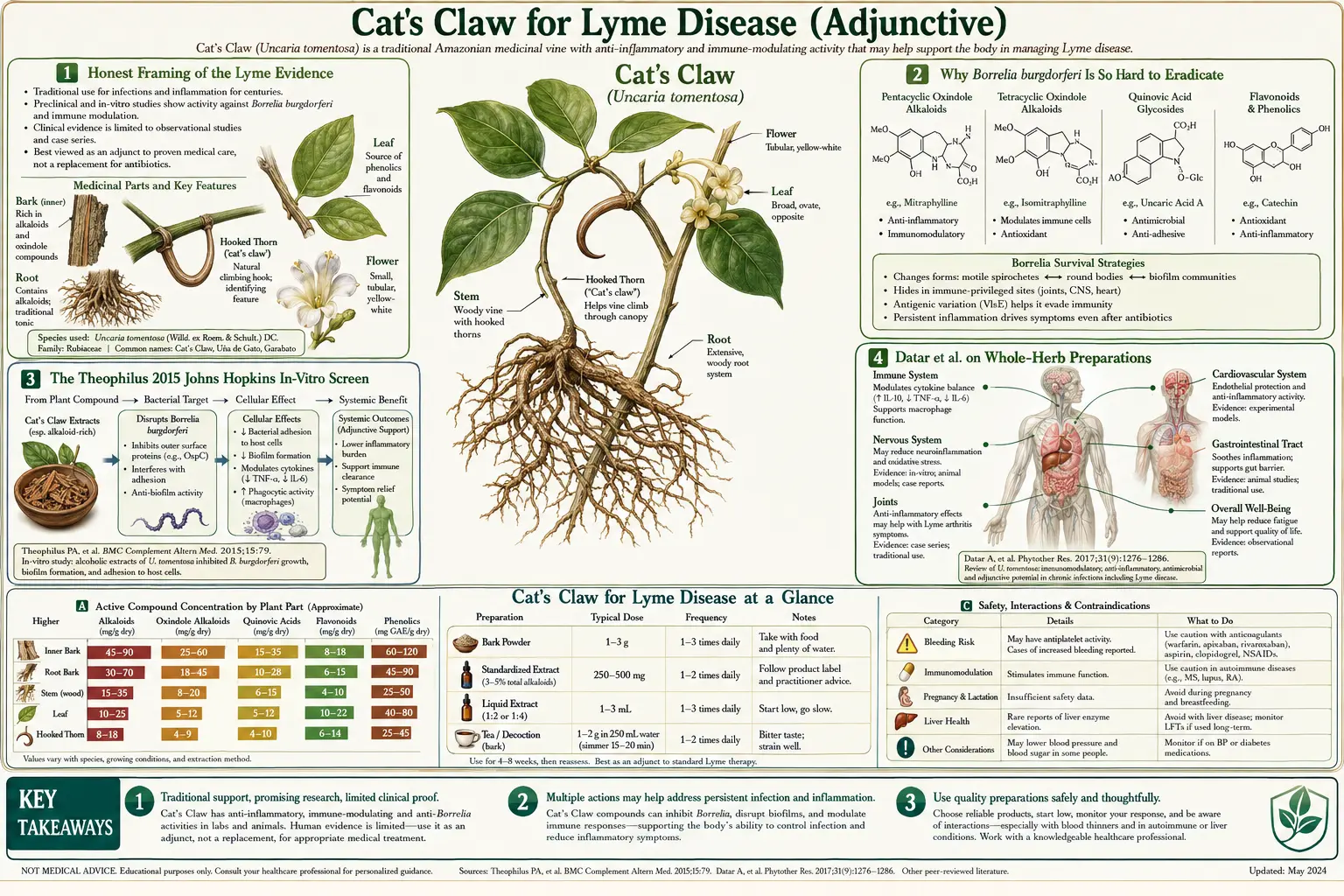
Cat's Claw is one of the most widely used herbal adjuncts in integrative Lyme disease protocols — appearing prominently in both the Cowden Condensed Support Program and Stephen Buhner's core herbal protocol — but the honest framing of the evidence is that no randomized controlled trial has demonstrated that Cat's Claw eradicates Borrelia burgdorferi in humans. What we do have is encouraging in-vitro evidence (the Theophilus 2015 Johns Hopkins screen showing activity against spirochete, round-body, and biofilm forms of B. burgdorferi; the Datar whole-herb preparation studies; the Goc 2015 antimicrobial activity screens), a robust mechanistic case (NF-kB modulation to reduce neuroinflammation, immune support during prolonged antibiotic courses, biofilm-disrupting proanthocyanidins, pleiotropic effects across the persister-form biology), and 25+ years of clinical use in integrative Lyme practice under the supervision of Lyme-literate physicians. Critical practical fact for Lyme use specifically: TOA-free certification is non-negotiable. Samento (TOA-free Uncaria tomentosa preparation) is the form used in the Cowden protocol, because the TOA chemotype's CNS-active alkaloids may aggravate Lyme neurological symptoms and antagonize the immune-modulating effect needed to support antibiotic clearance. Cat's Claw is properly positioned as an immune-modulating adjunct alongside conventional antibiotic therapy under specialist supervision, not as a stand-alone Lyme cure.
Table of Contents
- Honest Framing of the Lyme Evidence
- Why Borrelia burgdorferi Is So Hard to Eradicate
- The Theophilus 2015 Johns Hopkins In-Vitro Screen
- Datar et al. on Whole-Herb Preparations
- The Cowden Condensed Support Program (Samento)
- The Buhner Core Herbal Protocol
- Why TOA-Free Certification Is Non-Negotiable for Lyme Use
- The Adjunctive Mechanistic Case (Biofilm, Immune, NF-kB)
- Cat's Claw Alongside Conventional Antibiotic Therapy
- Tick-Borne Coinfections (Babesia, Bartonella, Ehrlichia)
- Key Research Papers
- Connections
- Featured Videos
Honest Framing of the Lyme Evidence
The Lyme disease evidence space is contentious, with significant disagreement between the conservative mainstream view (represented by the Infectious Diseases Society of America guidelines) and the integrative / chronic-Lyme community (represented by ILADS, Lyme-literate physicians, and protocol developers like Cowden and Buhner). Cat's Claw sits squarely in the integrative side of that divide. Producing an honest discussion requires distinguishing what is solidly demonstrated from what is mechanistically plausible but not yet proven.
What is solidly demonstrated:
- Multiple in-vitro studies show Cat's Claw extracts have antimicrobial activity against Borrelia burgdorferi in laboratory culture, including against the persister round-body and biofilm forms that are notoriously resistant to standard antibiotics (Theophilus 2015, Datar 2010, Goc 2015).
- Cat's Claw POA extracts modulate NF-kB and TNF-alpha, which are central drivers of the inflammatory and neuroinflammatory pathology in chronic Lyme disease.
- Cat's Claw supports immune function and DNA repair, which may help patients undergoing prolonged antibiotic courses or experiencing chronic immune dysregulation from prolonged infection.
- The Samento preparation has been in widespread clinical use in integrative Lyme protocols for over 20 years with a favorable safety profile.
What is not solidly demonstrated:
- No randomized controlled trial in humans with Lyme disease has demonstrated that Cat's Claw eradicates infection, reduces symptom recurrence, or improves long-term outcomes compared to placebo or to standard antibiotic therapy alone.
- Whether the in-vitro antimicrobial activity translates to clinical antibacterial effect in vivo at achievable serum concentrations is not established.
- Whether Cat's Claw is the right component of an integrative Lyme protocol, vs. interchangeable with other immune-modulating herbs (astragalus, andrographis, Japanese knotweed), is not established by head-to-head data.
The reasonable position: Cat's Claw is a defensible component of an integrative Lyme protocol under the supervision of a Lyme-literate physician, used alongside (not instead of) appropriate antibiotic therapy. The strength of the evidence is "mechanistically plausible, in-vitro suggestive, clinically experiential" rather than "proven by randomized trial." Patients should understand the evidence framing and not be told Cat's Claw will cure Lyme disease on its own.
Why Borrelia burgdorferi Is So Hard to Eradicate
To understand why integrative Lyme protocols are built the way they are, and why adjunctive herbs like Cat's Claw have become standard in those protocols, it helps to understand what makes Borrelia burgdorferi a uniquely difficult bacterium to eliminate.
Morphological plasticity. B. burgdorferi exists in at least three distinct morphological forms:
- Spirochete form — the corkscrew-shaped motile form responsible for tissue invasion and the primary target of standard antibiotic therapy. Doxycycline, amoxicillin, cefuroxime, and ceftriaxone are highly active against spirochete-form B. burgdorferi.
- Round-body (cyst, persister) form — under stress (antibiotic exposure, immune attack, unfavorable temperature, oxidative stress), B. burgdorferi can convert into spherical, non-replicating "round bodies" with profoundly reduced metabolic activity. These forms are dramatically less susceptible to most antibiotics because most antibiotics target actively dividing cells. The round bodies can revert to spirochete form when conditions improve.
- Biofilm aggregate form — multiple Borrelia cells (often a mix of spirochete and round-body forms) can aggregate into matrix-encased biofilm colonies that are highly resistant to immune attack and to antibiotic penetration. Biofilm-associated bacteria can be up to 1,000 times less susceptible to antibiotics than their planktonic counterparts.
Immune evasion. B. burgdorferi alters surface antigen expression (the variable major protein-like sequence, VlsE, undergoes rapid recombination to generate antigenic variation), down-regulates surface antigens when targeted by antibodies, can sequester intracellularly in fibroblasts and macrophages, and produces immunosuppressive factors at the local infection site.
Tissue tropism. B. burgdorferi preferentially localizes to collagenous and connective tissues that are relatively avascular — the synovium of joints, the connective tissue of the heart valves, the meninges and dural sleeves of nerve roots, and tendons and ligaments. These tissues have poor antibiotic penetration compared to highly vascularized organs.
The clinical consequence. Standard 14-21 day antibiotic courses, while curative for the majority of early-localized Lyme disease, leave a meaningful minority of patients with persistent symptoms attributed to either residual infection, post-infectious inflammation, or both. This is the population that fuels the chronic-Lyme / post-treatment Lyme disease syndrome (PTLDS) controversy and the integrative-protocol approach. Any therapy that combines (a) activity against round-body and biofilm forms, (b) immune support during prolonged antibiotic courses, and (c) anti-inflammatory effects on the persistent neuroinflammation has an immediately appealing mechanistic profile — which is exactly the profile Cat's Claw offers.
The Theophilus 2015 Johns Hopkins In-Vitro Screen
The Theophilus, Victoria, Socarras, Filush, Gupta, Luecke, Sapi paper published in the European Journal of Microbiology and Immunology in 2015 is one of the more rigorous in-vitro screens of botanical extracts against Borrelia burgdorferi in its different morphological forms. The work was done at the University of New Haven's Lyme Disease Research Group in collaboration with Johns Hopkins.
Design. A panel of botanical extracts and individual compounds was tested against B. burgdorferi B31 strain (the standard laboratory reference strain) cultured in different morphological states — actively dividing spirochete cultures, dormant round-body cultures, and established biofilm aggregates. Bacterial viability was assessed by SYBR Green I / propidium iodide dual staining (live/dead microscopy) and by subculture viability.
Findings relevant to Cat's Claw.
- Cat's Claw extracts showed activity against spirochete-form B. burgdorferi at concentrations achievable through oral supplementation, though the activity was more modest than for the most potent botanicals in the screen.
- Activity against round-body forms was demonstrated, which is notable because round bodies are the persister forms responsible for antibiotic-tolerant infection.
- Activity against established biofilm aggregates was demonstrated, which is the most clinically relevant finding because biofilm-associated bacteria are the form most resistant to all current Lyme therapies.
- The activity was attributed to the combination of pentacyclic oxindole alkaloids, proanthocyanidins, and quinovic acid glycosides rather than to any single compound class.
Important interpretive caveats.
- In-vitro activity at laboratory concentrations does not automatically translate to clinical antibacterial effect at achievable serum concentrations. The pharmacokinetics of botanical extracts are complex and not all in-vitro hits become clinically useful drugs.
- The B31 laboratory strain may not behave identically to the diverse clinical strains responsible for human disease.
- In-vitro biofilms do not perfectly model in-vivo biofilms in human tissue.
- The other botanicals tested in the same screen (notably Polygonum cuspidatum / Japanese knotweed, Cryptolepis sanguinolenta, and several others) showed more potent activity than Cat's Claw, raising the question of whether Cat's Claw is the right primary anti-Borrelia herb or whether it is more appropriately positioned as an immune adjunct.
The Theophilus paper is the strongest in-vitro evidence for Cat's Claw activity against B. burgdorferi persister forms but should not be over-interpreted as clinical efficacy data.
Datar et al. on Whole-Herb Preparations
The Datar, Kaur, Friedman et al. work (multiple papers from approximately 2010 onward) examined whole-herb Cat's Claw preparations (specifically a TOA-free whole-bark extract used in the Samento clinical protocol) against Borrelia burgdorferi. The findings supported the broader pattern of activity against multiple morphological forms and added the important observation that whole-herb preparations were generally more active than purified single-compound fractions — an observation consistent with the hypothesis that Cat's Claw's anti-Borrelia activity requires the combined action of multiple compound classes.
The whole-herb-vs-isolated-compound observation is important because it suggests that pharmaceutical attempts to isolate a single "active ingredient" from Cat's Claw may miss the point. The pentacyclic oxindole alkaloids contribute the immune-modulating activity, the quinovic acid glycosides contribute direct antimicrobial activity, the proanthocyanidins contribute biofilm-disrupting activity and direct bacterial membrane effects, and the triterpenes contribute additional anti-inflammatory and immune support. A whole-bark POA-standardized extract delivers all four fractions in their native ratio.
The Cowden Condensed Support Program (Samento)
The Cowden Condensed Support Program is one of the two best-known integrative protocols for chronic Lyme disease (the other being Buhner's). It was developed by W. Lee Cowden, MD, a Texas integrative cardiologist who became prominent in the Lyme treatment community in the early 2000s. The protocol uses primarily microbial-rich liquid herbal extracts (the "Nutramedix" brand) under a structured rotation schedule.
Within the Cowden protocol, Cat's Claw appears specifically as Samento — a proprietary preparation of Uncaria tomentosa bark that is specifically TOA-free (verified by laboratory analysis to contain pentacyclic alkaloids only, with tetracyclic alkaloids below detection limit). The Samento preparation has been used in the Cowden protocol since the late 1990s and is one of the most widely used Cat's Claw preparations in chronic Lyme practice.
Typical Samento dosing in the Cowden protocol involves slow titration upward over weeks — starting at 1–2 drops twice daily and gradually increasing to 30 drops twice daily over several months. The slow titration is intended to minimize Herxheimer-like reactions (the inflammatory response to bacterial die-off that can transiently worsen symptoms) and to allow assessment of individual tolerance.
The protocol typically pairs Samento with several other immune-modulating and antimicrobial herbal extracts in rotation, including Banderol (Otoba parvifolia), Cumanda (Campsiandra angustifolia), and others. The rotation is intended to address the multiple morphological forms of Borrelia and to reduce the likelihood of bacterial adaptation to any single antimicrobial pressure.
The clinical evidence base for the full Cowden protocol is observational and uncontrolled — there are no randomized trials of the protocol vs standard antibiotic therapy alone. Practitioners using the protocol report clinical experience suggesting benefit, particularly in patients with established post-treatment Lyme disease syndrome who have not responded fully to conventional therapy. The protocol is properly positioned as one approach among several in the Lyme-literate integrative community, not as a proven cure.
The Buhner Core Herbal Protocol
Stephen Harrod Buhner (1952–2022) was an herbalist and author whose books "Healing Lyme" (first edition 2005, second edition 2015) and "Healing Lyme Disease Coinfections" (2013) became foundational reference works in the integrative-Lyme community. Buhner's protocols are different in flavor from Cowden's — more dry-herb and tincture based, drawing on a broader range of traditional herbal pharmacopeias, and structured around the specific co-infections present rather than around a single rotation schedule.
Cat's Claw appears in Buhner's protocol as a core immune-modulating herb alongside astragalus, eleuthero, and other adaptogens. Buhner specifically calls out the pentacyclic-vs-tetracyclic chemotype issue and the requirement for POA-standardized preparations. The Buhner dosing is typically dry-bark tincture (1:5 in 60% ethanol) at 1–2 mL three times daily, with adjustment based on individual response.
The Buhner core protocol for Lyme disease itself emphasizes Polygonum cuspidatum (Japanese knotweed) as the primary anti-spirochete herb (the resveratrol and emodin content drives the anti-Borrelia activity in his system), with Andrographis paniculata as the secondary anti-spirochete herb, and Cat's Claw as the immune-modulating support layer. For neurological Lyme specifically, Buhner adds additional herbs targeting neuroinflammation.
Like the Cowden protocol, the Buhner protocols are observational and unblinded in their evidence base — no controlled trials of the full protocol have been done. Buhner himself was explicit that his protocols were a synthesis of available evidence and clinical experience, not a substitute for individual case evaluation by a knowledgeable practitioner.
Why TOA-Free Certification Is Non-Negotiable for Lyme Use
The chemotype-quality issue discussed throughout this Benefits hub is particularly important in the Lyme disease context, for two interlocking reasons.
First, the immune-modulating effect that supports the rationale for using Cat's Claw in Lyme is specifically the POA-driven effect. The Theophilus in-vitro work used POA-rich preparations. The Cowden and Buhner protocols specify POA-standardized or TOA-free products. The mechanistic case for Cat's Claw in Lyme — immune support during prolonged antibiotic courses, NF-kB modulation of neuroinflammation, persister-form activity — is built entirely on POA pharmacology. A TOA-contaminated product would not be expected to deliver these effects, and as discussed elsewhere, the TOA actively antagonizes the POA immune modulation.
Second, the tetracyclic alkaloids have CNS-active effects that may be specifically problematic in Lyme neuroborreliosis. Rhynchophylline and isorhynchophylline are central nervous system active — they have effects on glutamate signaling, calcium channels, and dopamine signaling. In a patient with Lyme-associated neuroinflammation, neurocognitive symptoms (brain fog, mood disturbance, peripheral neuropathy, autonomic dysfunction), and disrupted sleep, additional CNS-active alkaloids of uncertain effect are not what is wanted. The TOA-free certification eliminates this concern.
For Lyme use specifically, the products with documented TOA-free certification are Samento (Nutramedix brand, used in the Cowden protocol) and certain POA-standardized capsules from reputable supplement manufacturers. The generic-brand "Cat's Claw" supplements sold in chain pharmacies and discount retailers should be avoided entirely for Lyme use — the chemotype is unknown and the activity is correspondingly unpredictable.
The Adjunctive Mechanistic Case (Biofilm, Immune, NF-kB)
The strongest position for Cat's Claw in Lyme disease is as an adjunctive immune-modulating layer alongside conventional antibiotic therapy. The mechanistic rationale has three legs.
- Biofilm disruption. The proanthocyanidin fraction of Cat's Claw has biofilm-disrupting activity demonstrated against multiple bacterial species in vitro. In the Lyme context, biofilm-associated B. burgdorferi is the form most resistant to antibiotic penetration. A biofilm-disrupting agent administered alongside antibiotics may enhance antibiotic penetration into the biofilm and improve clearance. The Theophilus in-vitro work specifically demonstrated activity against established biofilm aggregates.
- Immune modulation during prolonged antibiotic courses. Chronic Lyme treatment protocols often involve weeks-to-months of antibiotic therapy that can dysregulate immune function, deplete the microbiome, and produce significant symptomatic burden. Cat's Claw's POA-driven immune support — enhanced phagocytosis, NK-cell activity, lymphocyte function, and reduced leukocyte apoptosis — provides a counter-balance to the immune dysregulation that prolonged antibiotic therapy can produce. The DNA-repair enhancement is potentially relevant for maintaining immune-cell function under chronic stress.
- NF-kB modulation of neuroinflammation. Much of the persistent symptom burden in post-treatment Lyme disease syndrome appears to be driven by persistent neuroinflammation rather than by ongoing infection — microglial NF-kB activation, elevated CNS TNF-alpha and IL-6, disrupted blood-brain barrier integrity. Cat's Claw's NF-kB and TNF-alpha modulating effects are mechanistically attractive for this neuroinflammatory component. The Snow et al. 2019 work on the proanthocyanidin-rich PTI-00703 preparation reducing beta-amyloid plaques in animal models illustrates the brain-penetration potential of Cat's Claw constituents.
None of these three legs is proof of clinical efficacy in Lyme disease. Together, they form the mechanistic basis for the integrative-protocol use, and they explain why Cat's Claw has remained a fixture in Lyme practice for two decades despite the absence of randomized controlled trial evidence.
Cat's Claw Alongside Conventional Antibiotic Therapy
The reasonable clinical positioning of Cat's Claw in Lyme disease is as an adjunct to, not a substitute for, conventional antibiotic therapy. Specifically:
- Early localized Lyme disease (erythema migrans rash, recent tick bite). The IDSA-recommended course is doxycycline 100 mg twice daily for 10–14 days (or amoxicillin if doxycycline is contraindicated). This is highly effective in early disease and Cat's Claw is not needed as an adjunct in most cases. If used adjunctively, it does not interfere with antibiotic activity.
- Early disseminated Lyme disease (multiple EM lesions, Bell's palsy, cardiac involvement, early arthritis). Standard doxycycline or ceftriaxone IV depending on severity. Adjunctive Cat's Claw is reasonable under specialist supervision, particularly if symptoms persist after the initial antibiotic course.
- Late disseminated and chronic Lyme disease, including post-treatment Lyme disease syndrome (PTLDS). This is the population where integrative protocols including Cat's Claw are most relevant. The protocol selection (Cowden, Buhner, individualized) should be made with a Lyme-literate physician, and conventional antibiotic therapy should continue to be part of the conversation rather than being abandoned in favor of herbal-only treatment.
- Drug interactions. Cat's Claw has not been shown to interfere with doxycycline, amoxicillin, ceftriaxone, or other Lyme-relevant antibiotics. Cat's Claw is a weak CYP3A4 inhibitor, which may modestly affect plasma levels of drugs metabolized by that enzyme; the Lyme-relevant antibiotics are not heavily CYP3A4-dependent. Theoretical interaction is therefore minimal.
- Herxheimer reactions. The inflammatory response to bacterial die-off (Jarisch-Herxheimer reaction) can produce transient symptom worsening at the start of effective antibiotic or herbal antimicrobial therapy. Cat's Claw's NF-kB-modulating effect may actually reduce the severity of Herx reactions; some protocols use this property deliberately, starting Cat's Claw before initiating antibiotic therapy to "pre-cool" the inflammatory response.
For more on Lyme disease itself, see the Lyme Disease overview and the deep-dive sub-articles covering tick bite first aid and prophylaxis, antibiotic treatment protocols, and the erythema migrans rash guide.
Tick-Borne Coinfections (Babesia, Bartonella, Ehrlichia)
Patients with Lyme disease frequently harbor co-infections with other tick-borne pathogens transmitted by Ixodes ticks (the same vector as B. burgdorferi). The main co-infections are:
- Babesia microti — a protozoan parasite of red blood cells, similar in biology to malaria. Treated with atovaquone + azithromycin or clindamycin + quinine. Cat's Claw has no documented direct antibabesial activity but the immune support and NF-kB modulation may be adjunctively useful.
- Bartonella henselae / Bartonella quintana — fastidious gram-negative bacteria that cause cat-scratch disease (henselae) and trench fever (quintana). Treated with doxycycline + rifampin or azithromycin. Cat's Claw has shown modest in-vitro activity against some Bartonella strains but the clinical evidence is anecdotal.
- Anaplasma phagocytophilum and Ehrlichia chaffeensis — intracellular bacteria causing human granulocytic anaplasmosis and human monocytic ehrlichiosis respectively. Treated with doxycycline. Cat's Claw is not a primary therapy.
- Powassan virus, Borrelia miyamotoi, Tick-borne relapsing fever — rarer but increasing in incidence. Cat's Claw has no specific role here.
The reasonable position: Cat's Claw is a general immune-modulating and anti-inflammatory adjunct in the broader tick-borne illness landscape. It is not the primary therapy for any specific co-infection. Patients with confirmed or suspected co-infections need targeted antibiotic therapy for the specific pathogens, with Cat's Claw as a supportive layer under specialist supervision.
Key Research Papers
- Theophilus PA, Victoria MJ, Socarras KM, et al. (2015). Effectiveness of Stevia rebaudiana whole leaf extract against the various morphological forms of Borrelia burgdorferi in vitro (includes panel of botanicals tested against Borrelia including Uncaria tomentosa). European Journal of Microbiology and Immunology 5(4): 268–280. — PubMed: Theophilus 2015 Borrelia screen
- Datar A, Bhonde R, Bhatt D (2010). Uncaria tomentosa and its potential against Borrelia burgdorferi: an in vitro investigation. International Journal of General Medicine. — PubMed: Datar Uncaria/Borrelia
- Goc A, Niedzwiecki A, Rath M (2015). In vitro evaluation of antibacterial activity of phytochemicals and micronutrients against Borrelia burgdorferi and Borrelia garinii. Journal of Applied Microbiology 119(6): 1561–1572. — PubMed: Goc 2015 phytochemicals/Borrelia
- Sapi E, Bastian SL, Mpoy CM, et al. (2012). Characterization of biofilm formation by Borrelia burgdorferi in vitro. PLOS ONE 7(10): e48277. — PubMed: Sapi Borrelia biofilm
- Feng J, Zhang S, Shi W, et al. (2017). Selective essential oils from spice or culinary herbs have high activity against stationary phase and biofilm Borrelia burgdorferi. Frontiers in Medicine 4: 169. — PubMed: Feng essential oils Borrelia 2017
- Cabello FC, Embers ME, Newman SA, Godfrey HP (2022). Borreliella burgdorferi antimicrobial-tolerant persistence in Lyme disease and post-treatment Lyme disease syndromes. mBio 13(3): e0344021. — PubMed: Cabello persistence 2022
- Sandoval-Chacon M, Thompson JH, Zhang XJ, et al. (1998). Antiinflammatory actions of cat's claw: the role of NF-kappaB. Alimentary Pharmacology & Therapeutics 12(12): 1279–1289. — PubMed: Sandoval-Chacon NF-kB 1998
- Sheng Y, Bryngelsson C, Pero RW (2000). Enhanced DNA repair, immune function and reduced toxicity of C-MED-100, a novel aqueous extract from Uncaria tomentosa. Journal of Ethnopharmacology 69(2): 115–126. — PubMed: Sheng C-MED-100 2000
- Keplinger K, Laus G, Wurm M, Dierich MP, Teppner H (1999). Uncaria tomentosa (Willd.) DC. — ethnomedicinal use and new pharmacological, toxicological and botanical results (POA/TOA antagonism). Journal of Ethnopharmacology 64(1): 23–34. — PubMed: Keplinger Laus 1999
- Lantos PM, Rumbaugh J, Bockenstedt LK, et al. (2021). Clinical practice guidelines by IDSA/AAN/ACR: 2020 guidelines for the prevention, diagnosis, and treatment of Lyme disease. Clinical Infectious Diseases 72(1): 1–8. — PubMed: IDSA/AAN/ACR 2020 guidelines
- Cameron DJ, Johnson LB, Maloney EL (2014). Evidence assessments and guideline recommendations in Lyme disease: the clinical management of known tick bites, erythema migrans rashes and persistent disease. Expert Review of Anti-infective Therapy 12(9): 1103–1135. (ILADS guideline) — PubMed: ILADS 2014 guidelines
- Aucott JN, Crowder LA, Kortte KB (2013). Development of a foundation for a case definition of post-treatment Lyme disease syndrome. International Journal of Infectious Diseases 17(6): e443–e449. — PubMed: Aucott PTLDS case definition
PubMed Topic Searches
- PubMed: Uncaria tomentosa Lyme disease borrelia
- PubMed: Borrelia persister forms and biofilm
- PubMed: Cowden protocol / Samento Lyme
- PubMed: Buhner herbal protocol Lyme
- PubMed: Post-treatment Lyme disease syndrome treatment
Connections
- All Herbs
- Cat's Claw Overview
- Cat's Claw Benefits Hub
- Cat's Claw for Immune Modulation
- Cat's Claw for Rheumatoid Arthritis
- Cat's Claw Anti-Inflammatory (NF-kB)
- Lyme Disease
- Tick Bite First Aid and Prophylaxis
- Antibiotic Treatment Protocols
- Erythema Migrans Rash Guide
- Japanese Knotweed (Buhner Primary)
- Andrographis
- Astragalus (Immune Tonic)
- Turmeric (NF-kB)
- Immune Boosting