Wormwood for Parasites: Evidence and Limits
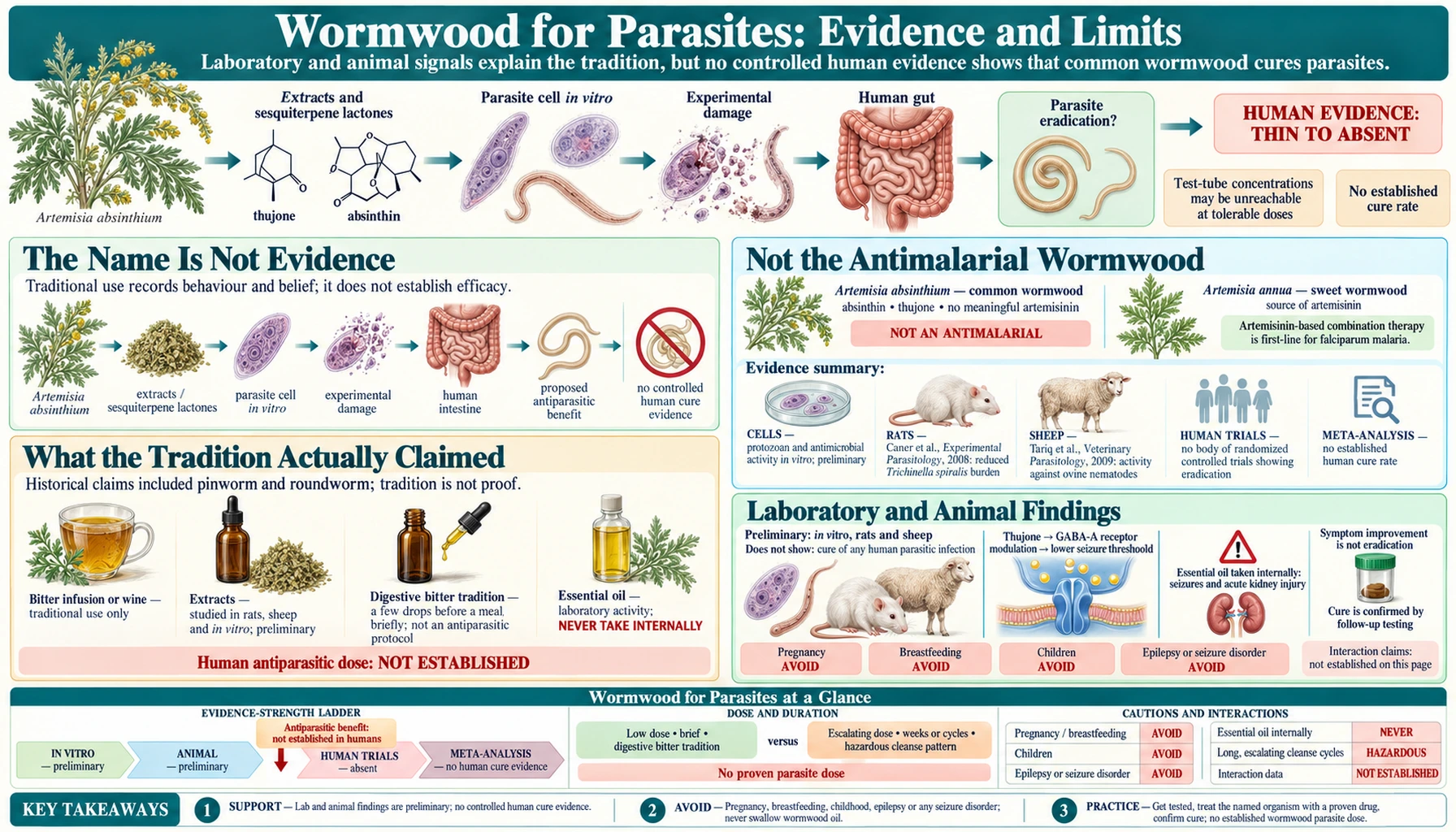
Wormwood is named for worms. That is where the reputation comes from, and a name is not a result. Artemisia absinthium has been used against intestinal worms in traditional European and Asian medicine for centuries, there are real laboratory and animal findings that make the tradition understandable, and no controlled human trial has been found showing that wormwood clears any specific parasitic infection in people.
That gap matters because many parasitic infections are curable with short courses of well-tested drugs, although cure rates differ widely by organism and drug (a 2008 meta-analysis of 20 randomized trials found single-dose cure rates from 15% to 95%, set out below). A diagnosed infection treated only with an untested herb may persist. This page sets out the standard drugs, organism by organism, alongside an account of what wormwood actually has behind it.
Table of Contents
- The Name Is Not Evidence
- Not the Antimalarial Wormwood
- What the Tradition Actually Claimed
- Laboratory and Animal Findings
- The Human Evidence: Thin to Absent
- What Regulators Say
- The Standard Drug Treatments
- How Parasitic Infection Is Diagnosed
- "Parasite Cleanse" Protocols
- Antibacterial and Antifungal Activity in the Lab
- Where the Risks Lie
- Summary of the Evidence
- Key Research Papers
- Connections
- Featured Videos
The Name Is Not Evidence
"Wormwood" descends from an old Germanic word whose exact origin is debated, and the English form has long been read as "worm" plus "wood", in keeping with the plant's use as a worm remedy. Similar associations occur in other languages: the herb is bitter, bitter herbs were given for worms, and the use became attached to the name.
What that shows is that people used it, not whether it worked. Pre-modern medicine had no way to distinguish "the worms were expelled by the herb" from "the worms were expelled anyway," or from "the patient had no worms to begin with" — intestinal parasites were assumed to underlie a very wide range of complaints. Traditional use is real historical evidence about human behaviour and belief. It is not evidence of efficacy, and the age of a tradition says nothing about the size of an effect.
Not the Antimalarial Wormwood
Two different plants share the name "wormwood", and in the parasite context the difference matters.
- Artemisia absinthium — common wormwood, absinthe wormwood. This page. Key compounds: absinthin (bitterness) and thujone (toxicity). It is not the plant from which artemisinin medicines are made.
- Artemisia annua — sweet wormwood, qinghao. A different species and the source of artemisinin, from which the artemisinin-based combination therapies (ACTs) used as first-line treatment for falciparum malaria are derived. See Artemisia annua.
Because malaria is a parasitic disease, the two plants are often run together online. They are not interchangeable, and artemisinin's antimalarial evidence does not apply to common wormwood. Even for the herb itself, the World Health Organization's 2019 information note on non-pharmaceutical forms of Artemisia states that WHO does not support the promotion or use of Artemisia plant material in any form for the prevention or treatment of malaria. Malaria in a non-immune traveller is a medical emergency.
The two large clinical trials most often cited for Artemisia teas — A. annua and A. afra infusions in the Democratic Republic of the Congo, one for malaria against artesunate-amodiaquine (2019) and one for schistosomiasis (2018), both in Phytomedicine — were retracted in 2020. The retraction notices state that concerns were raised "about the timely approval of the Ethics Committee for the study presented by this article, the consent of the trial participants to publish their data, as well as the reliability of the data included in the article," and that the authors were not able to provide reasonable explanations. Neither trial tested A. absinthium.
What the Tradition Actually Claimed
Evidence tier for this entire section: traditional use only.
- European herbal medicine. Szopa and colleagues' 2020 review records wormwood's use in traditional European and Asian medicine for gastrointestinal ailments and for helminthiasis (worm infections), among other complaints. It also carried an emmenagogue reputation; the European Medicines Agency's monograph notes that thujone is known for uterus-stimulating activity.
- Central Italian folk practice. Guarrera's 1999 survey of traditional antihelmintic, antiparasitic and repellent plant uses in central Italy (Journal of Ethnopharmacology) is a documented example of the pattern rather than a test of it.
- Asian traditional medicine. The same 2020 review lists use against worms in traditional Asian as well as European medicine; a 2009 study from Kashmir notes the plant's traditional use as a vermifuge, alongside other livestock uses.
- Veterinary use. Wormwood has been given to livestock as a worm remedy, and some of the better modern anthelmintic data on the plant is in sheep parasites.
- Absinthe. The wormwood spirit was banned at the beginning of the 20th century over its supposed unique harms. Padosch and colleagues' 2006 review concludes that the only consistent conclusion from the 19th-century studies is that wormwood oil, but not absinthe, is a potent agent to cause seizures, and that the thujone levels of both pre-ban and modern absinthes may not have been able to cause harm beyond that of alcohol itself.
The tradition is old and geographically widespread. It also coexisted with bloodletting and mercury, a reminder of what tradition can establish on its own.
Laboratory and Animal Findings
Evidence tier: preliminary throughout. These studies show that wormwood extracts can damage parasites under experimental conditions. That is a starting point, not a treatment.
- Trichinella spiralis in rats (animal study). Caner and colleagues (Experimental Parasitology, 2008) compared methanol extracts of Artemisia vulgaris and A. absinthium in rats with trichinellosis. In the intestinal (adult-worm) phase, 300 mg/kg of A. absinthium extract reduced muscle larval counts by 37.7% to 63.5% depending on the muscle; A. vulgaris did better (53.4% to 75.6%), and the authors' conclusion named A. vulgaris, not A. absinthium, as a possible alternative drug. Rats are not people.
- Sheep nematodes (lab and animal study). Tariq and colleagues (Veterinary Parasitology, 2009) found that aqueous and ethanolic extracts paralysed or killed adult Haemonchus contortus worms in the dish, and that in sheep the ethanolic extract cut faecal egg counts by 90.46% at 2.0 g/kg body weight on day 15, comparable to the reference drug albendazole in that study. Sheep gastrointestinal nematodes are different organisms in a different host.
- Schistosoma mansoni in the dish. De Almeida and colleagues (2016) reported that a crude A. absinthium extract at 200 µg/mL killed 100% of adult worms in vitro, while the two compounds isolated from it (artemetin and hydroxypelenolide) were inactive at 100 µM — so the active constituent was not identified. No animal or human test followed in that paper.
- The dose question. Whether the concentrations that work in a dish can be reached in a human gut at a tolerable dose has not been tested; this is the standing limitation of in-vitro antiparasitic screening.
- The essential oil. Thujone, the oil's best-known component, is described in Höld and colleagues' 2000 PNAS study as the toxic agent of absinthe and as having reported insecticidal and anthelmintic activity; the same study showed it acts on the GABA type A receptor, the mechanism behind its convulsant effect in mice. Activity against a parasite in a dish and safety in a person are separate questions.
The Human Evidence: Thin to Absent
This section is short because there is little to report.
A PubMed search for Artemisia absinthium combined with human parasitic infection returns reviews restating tradition, in-vitro screens, animal studies, and case reports of toxicity. No randomized controlled trial was found showing that wormwood eradicates Giardia, Blastocystis, Entamoeba, pinworm, roundworm, hookworm, whipworm, tapeworm or liver fluke in people, measured by the standard endpoint of parasitological cure on follow-up stool testing.
Some specific points:
- The controlled human trials of wormwood are not parasite trials. The best known, Omer and colleagues' 2007 double-blind study in Phytomedicine, gave 40 people with Crohn's disease a herbal blend containing wormwood herb (3 × 500 mg a day) or placebo for 10 weeks while their steroids were tapered; at week 8, 13 of the 20 wormwood patients (65%) had almost complete remission of symptoms, against none on placebo. It measured symptoms and steroid use, not any infection, and says nothing about parasites.
- No established cure rate exists for wormwood against any human parasite. A cure rate quoted on a label or in an article has no published trial behind it that this review could find.
- Absence of evidence is not evidence of absence. The trials have not been run. Wormwood may have modest antiparasitic activity in humans, or none; the current record does not distinguish these.
- The comparison that matters is not wormwood versus nothing but wormwood versus drugs with measured cure rates. In Keiser and Utzinger's 2008 JAMA meta-analysis of 20 randomized trials, single-dose albendazole cured 88% of roundworm (Ascaris) infections, 72% of hookworm and 28% of whipworm; single-dose mebendazole cured 95%, 15% and 36%. Whipworm treatment with single doses of current drugs was described as unsatisfactory.
- Symptom improvement is not eradication. Parasitic gut infections wax and wane, and bitters may affect digestive symptoms in their own right (see Wormwood for Digestion). Feeling better while still infected is possible, which is why cure is defined by a follow-up test rather than by symptoms.
What Regulators Say
- European Medicines Agency. The EU herbal monograph on Artemisia absinthium L., herba (Absinthii herba; EMA/HMPC/751490/2016, adopted May 2017) is a traditional-use monograph: its indications rest "exclusively based upon long-standing use", not on clinical trials. It covers two indications only — temporary loss of appetite, and mild dyspeptic or gastrointestinal disorders. No antiparasitic indication is listed.
- The monograph's contraindications are hypersensitivity to wormwood or other plants of the Asteraceae (daisy) family, and obstruction of the bile duct, cholangitis or liver disease. It states that use is not recommended during pregnancy and lactation and in children and adolescents under 18, and that if symptoms persist longer than 2 weeks a doctor or qualified health-care practitioner should be consulted.
- Thujone in the monograph. It notes that thujone is reported to be neurotoxic, that low-thujone chemotypes should be preferred, that the thujone content of a product must be specified with daily exposure below 6.0 mg, and that a dry ethanolic extract given to pregnant rats reduced implantation sites and the number of pups born.
- EU food law. Regulation (EC) No 1334/2008 on flavourings sets maximum thujone (alpha and beta) levels in Annex III: 35 mg/kg in alcoholic beverages produced from Artemisia species, 10 mg/kg in other alcoholic beverages, and 0.5 mg/kg in non-alcoholic beverages produced from Artemisia species.
The Standard Drug Treatments
These are the treatments named in public-health guidance and on this section's organism pages. The specific choice, dose and duration differ by country, by age and in pregnancy, and decisions about them belong with a clinician.
- Soil-transmitted helminths — roundworm (Ascaris), hookworm, whipworm: albendazole or mebendazole, the drugs used in mass deworming programmes. Single-dose cure rates differ widely by worm (88% to 95% for roundworm, much lower for whipworm, in the 2008 meta-analysis above).
- Pinworm (Enterobius vermicularis): albendazole, mebendazole or pyrantel pamoate, typically repeated after about two weeks to catch worms hatched from surviving eggs, with the whole household often treated at the same time because reinfection is common.
- Giardia: tinidazole, metronidazole or nitazoxanide (listed by CDC as effective).
- Amoebiasis (Entamoeba histolytica): metronidazole or tinidazole followed by a luminal agent such as paromomycin to clear the cysts the first drug leaves behind — a two-step regimen. See Entamoeba.
- Tapeworms: praziquantel or niclosamide for intestinal infection. Neurocysticercosis — larval pork tapeworm in the central nervous system — is a separate, specialist situation covered by its own 2017 IDSA/ASTMH clinical guideline.
- Flukes — Schistosoma, Clonorchis, Paragonimus: praziquantel; triclabendazole for Fasciola, which praziquantel does not reliably treat.
- Strongyloides: ivermectin, which CDC lists as the drug of choice here; it is not a general-purpose antiparasitic.
- Cryptosporidium: nitazoxanide, the FDA-approved drug, which CDC notes has not been shown superior to placebo for cryptosporidial diarrhoea in people with HIV or weakened immune systems.
- Cyclospora: trimethoprim-sulfamethoxazole, which CDC calls the treatment of choice. Cyclospora is a common food-borne outbreak organism, and CDC lists several antiparasitic and antibiotic drugs, including metronidazole, tinidazole and albendazole, as ineffective against it.
- Malaria: artemisinin-based combination therapy, given urgently. WHO does not support Artemisia plant material in any form, and common wormwood is not an antimalarial.
- Blastocystis: CDC states that whether Blastocystis causes disease in humans is unclear and that many people who carry it have no symptoms. Whether and how to treat it is an open clinical question, which does not make it evidence for herbal treatment.
The pattern: the standard treatment is usually one drug, matched to one organism, for a short course. Broad "kills all parasites" claims are a marketing category, not a pharmacological one.
How Parasitic Infection Is Diagnosed
Whether a person is infected at all, and by what, determines everything that follows.
- Symptoms do not identify the organism. Bloating, loose stools, fatigue, itching and abdominal discomfort are shared by parasitic infection, SIBO, coeliac disease, inflammatory bowel disease, bile-acid diarrhoea, lactose intolerance, thyroid disease and irritable bowel syndrome. Treating "parasites" without a test means treating a guess.
- Standard testing exists. Stool microscopy across multiple samples, stool antigen tests, molecular stool panels, the tape test for pinworm, serology for tissue parasites and imaging where indicated.
- Alternative "parasite tests" are not validated. Live-blood analysis, electrodermal testing, applied kinesiology and photographs of stool debris identified as parasites are not recognised methods of diagnosing infection.
- Exposure history guides testing. Travel, well or stream water, undercooked pork, freshwater fish, raw or pickled seafood, farm animals, childcare settings and immunosuppression all change which organisms are likely.
- Cure is confirmed by a test, not a feeling. Follow-up stool testing after treatment is standard practice.
"Parasite Cleanse" Protocols
Wormwood most often reaches people inside a three-herb formula with black walnut hull and clove, popularized in the late twentieth century and sold today in many variants. What the evidence shows:
- The rationale for the trio is theoretical. Proponents describe one herb for adult worms, one for larvae and one for eggs; no controlled human study has tested the combination.
- The claim it grew from is unsupported. The framework that made these protocols famous held that essentially all chronic disease, cancer included, is caused by a fluke plus a solvent. No evidence supports that claim.
- Many users were never infected. A "cleanse" taken without a diagnosis may treat nothing. When symptoms improve, plausible explanations include the natural fluctuation of gut symptoms, dietary changes made at the same time, the bitter effect on digestion, and expectation.
- Dose escalation is the specific hazard. These protocols escalate over weeks and are often repeated in cycles. That pattern — rising intake of a thujone-containing herb over a long period — contrasts with the European Medicines Agency's traditional-use monograph, which covers only appetite and mild digestive complaints, refers persisting symptoms to a doctor after 2 weeks, and caps daily thujone exposure below 6.0 mg.
- Some kits include the essential oil. A 1997 New England Journal of Medicine case report (Weisbord and colleagues) describes a 31-year-old man who drank wormwood oil bought online and developed tonic-clonic seizures, rhabdomyolysis and then acute renal failure, as summarised in Padosch and colleagues' 2006 review.
- Pregnancy. Cleanse kits are sold to the general public, while the EMA monograph states that wormwood use is not recommended in pregnancy and lactation.
Antibacterial and Antifungal Activity in the Lab
Evidence tier: preliminary (in vitro). Juteau and colleagues (Planta Medica, 2003) analysed wormwood essential oil from France and Croatia: the Croatian oils contained mainly (Z)-epoxyocimene and beta-thujone, while the French oils contained no thujone. Because of that, only the thujone-free French oil was screened, and it inhibited the growth of the two yeasts tested (Candida albicans and Saccharomyces cerevisiae). Kordali and colleagues (Journal of Agricultural and Food Chemistry, 2005) found that the oils of A. absinthium and two related Turkish species completely inhibited the growth of some agricultural plant-pathogenic fungi; against bacteria, all the oils tested gave smaller inhibition zones than penicillin.
Two points keep this in proportion. Many aromatic plant oils, including oregano, thyme, clove and cinnamon, inhibit microbes in a dish, and very few such results have translated into systemic antibacterial therapy. And the oil's composition varies greatly with the plant's origin, so a result for one oil does not transfer to another.
Botanicals with more antimicrobial research are covered on the Oregano, Thyme, Garlic, Berberine, Goldenseal and Barberry pages; none of them is an established replacement for an antibiotic or an antiparasitic drug.
Where the Risks Lie
- Delay. Untreated Entamoeba histolytica can cause liver abscess; Strongyloides can progress to hyperinfection in people given corticosteroids or other immunosuppressants, which is why CDC highlights screening those patients; untreated schistosomiasis damages the bladder or liver over years.
- Treating the wrong thing. Symptoms blamed on parasites are shared by many other conditions (listed above), which then go untreated.
- Thujone dose escalation. Cleanse protocols follow the pattern — rising intake, long duration — that runs furthest from the EMA's short-term, low-thujone traditional-use limits.
- The essential oil. Wormwood oil, as opposed to absinthe, is described in the historical literature as a potent cause of seizures, and the 1997 case report links swallowing it to seizures and kidney failure.
- Seizure disorders. Thujone acts on the GABA type A receptor (Höld 2000), and the research raises a concern for people with epilepsy or any other seizure disorder.
- Pregnancy. Wormwood has an emmenagogue reputation; the EMA monograph records thujone's uterus-stimulating activity and the rat reproductive findings, notes that there are no or limited data from use in pregnancy and lactation, and states that use is not recommended in either.
- Children. Pinworm is most common in school-age children, and the EMA monograph states that use under 18 is not recommended because safety has not been established for lack of adequate data.
- Liver and bile-duct disease, and daisy-family allergy. These are the EMA monograph's listed contraindications.
- False reassurance. Finishing a cleanse can feel like an ending. Without a follow-up test it establishes nothing.
Summary of the Evidence
- Wormwood has a long, widespread tradition as a worm remedy, recorded here as history rather than either endorsed or dismissed.
- It has preliminary support — a rat study in trichinellosis, sheep studies, and in-vitro kills of Schistosoma and Haemonchus worms — that makes the tradition intelligible.
- It has no controlled human evidence of curing any human parasitic infection, and no established cure rate. The controlled human trials that exist are in Crohn's disease.
- It is not artemisinin: the antimalarial evidence belongs to A. annua-derived drugs, and the large Artemisia tea trials were retracted.
- The standard drugs have measured cure rates that are high for some worms (roundworm) and low for others (whipworm after a single dose).
- The European Medicines Agency's monograph recognises wormwood only as a traditional bitter for temporary loss of appetite and mild digestive complaints, with contraindications and a thujone cap.
In standard care, a suspected parasite is confirmed by testing, the organism is identified, a drug matched to it is given, and cure is confirmed by a follow-up test. Wormwood's digestive use is covered on the Wormwood for Digestion page.
Key Research Papers
- Caner A, Döşkaya M, Değirmenci A, et al. (2008). Comparison of the effects of Artemisia vulgaris and Artemisia absinthium growing in western Anatolia against trichinellosis (Trichinella spiralis) in rats. Experimental Parasitology 119(1):173-179 — animal study (rats). — PubMed PMID: 18325496
- Tariq KA, Chishti MZ, Ahmad F, Shawl AS (2009). Anthelmintic activity of extracts of Artemisia absinthium against ovine nematodes. Veterinary Parasitology 160(1-2):83-88 — in vitro and in sheep. — PubMed PMID: 19070963
- Guarrera PM (1999). Traditional antihelmintic, antiparasitic and repellent uses of plants in Central Italy. Journal of Ethnopharmacology 68:183-192 — traditional use only; documents the practice without testing it. — PubMed PMID: 10624877
- Juteau F, Jerkovic I, Masotti V, et al. (2003). Composition and antimicrobial activity of the essential oil of Artemisia absinthium from Croatia and France. Planta Medica 69(2):158-161 — in vitro; thujone content varies by origin. — PubMed PMID: 12624823
- Kordali S, Kotan R, Mavi A, et al. (2005). Determination of the chemical composition and antioxidant activity of the essential oil of Artemisia dracunculus and of the antifungal and antibacterial activities of Turkish Artemisia absinthium, A. dracunculus, Artemisia santonicum, and Artemisia spicigera essential oils. Journal of Agricultural and Food Chemistry 53(24):9452-9458 — in vitro. — PubMed PMID: 16302761
- Batiha GE, Olatunde A, El-Mleeh A, et al. (2020). Bioactive compounds, pharmacological actions, and pharmacokinetics of wormwood (Artemisia absinthium). Antibiotics 9(6):353 — review. — PubMed PMID: 32585887
- Szopa A, Pajor J, Klin P, et al. (2020). Artemisia absinthium L. — importance in the history of medicine, the latest advances in phytochemistry and therapeutical, cosmetological and culinary uses. Plants 9(9):1063 — review; the historical use against worms in context. — PubMed PMID: 32825178
- Bora KS, Sharma A (2011). The genus Artemisia: a comprehensive review. Pharmaceutical Biology 49:101-109 — review across the genus. — PubMed PMID: 20681755
- Weisbord SD, Soule JB, Kimmel PL (1997). Poison on line — acute renal failure caused by oil of wormwood purchased through the Internet. New England Journal of Medicine 337(12):825-827 — case report. — PubMed PMID: 9297113
- Höld KM, Sirisoma NS, Ikeda T, Narahashi T, Casida JE (2000). Alpha-thujone (the active component of absinthe): gamma-aminobutyric acid type A receptor modulation and metabolic detoxification. Proceedings of the National Academy of Sciences USA 97(8):3826-3831 — mouse, fly and cell studies of the convulsant mechanism. — PubMed PMID: 10725394
- Keiser J, Utzinger J (2008). Efficacy of current drugs against soil-transmitted helminth infections: systematic review and meta-analysis. JAMA 299(16):1937-1948 — 20 randomized trials; single-dose cure rates by drug and worm. — PubMed PMID: 18430913
- Omer B, Krebs S, Omer H, Noor TO (2007). Steroid-sparing effect of wormwood (Artemisia absinthium) in Crohn's disease: a double-blind placebo-controlled study. Phytomedicine 14(2-3):87-95 — human randomized trial in Crohn's disease, not a parasite trial. — PubMed PMID: 17240130
- de Almeida LM, de Carvalho LS, Gazolla MC, et al. (2016). Flavonoids and sesquiterpene lactones from Artemisia absinthium and Tanacetum parthenium against Schistosoma mansoni worms. Evidence-Based Complementary and Alternative Medicine 2016:9521349 — in vitro. — PubMed PMID: 27980595
- Padosch SA, Lachenmeier DW, Kröner LU (2006). Absinthism: a fictitious 19th century syndrome with present impact. Substance Abuse Treatment, Prevention, and Policy 1:14 — review of absinthe, thujone and wormwood-oil seizures. — PubMed PMID: 16722551
- Munyangi J, Cornet-Vernet L, Idumbo M, et al. (2019). Artemisia annua and Artemisia afra tea infusions vs. artesunate-amodiaquine (ASAQ) in treating Plasmodium falciparum malaria in a large scale, double blind, randomized clinical trial. Phytomedicine 57:49-56 — PubMed PMID: 30668322 — Retracted (retraction notice: PubMed PMID: 32972797)
- Munyangi J, Cornet-Vernet L, Idumbo M, et al. (2018). Effect of Artemisia annua and Artemisia afra tea infusions on schistosomiasis in a large clinical trial. Phytomedicine 51:233-240 — PubMed PMID: 30466622 — Retracted (retraction notice: PubMed PMID: 32972796)
- White AC Jr, Coyle CM, Rajshekhar V, et al. (2018). Diagnosis and treatment of neurocysticercosis: 2017 clinical practice guidelines by the Infectious Diseases Society of America (IDSA) and the American Society of Tropical Medicine and Hygiene (ASTMH). Clinical Infectious Diseases 66(8):e49-e75 — PubMed PMID: 29481580
- European Medicines Agency, Committee on Herbal Medicinal Products (2017; corrected 2020). European Union herbal monograph on Artemisia absinthium L., herba. EMA/HMPC/751490/2016 Corr. 1 — traditional use; indications, contraindications and thujone limit. — EMA monograph (PDF)
- Regulation (EC) No 1334/2008 of the European Parliament and of the Council on flavourings and certain food ingredients with flavouring properties, Annex III — maximum thujone levels. — EUR-Lex
- World Health Organization (2019). The use of non-pharmaceutical forms of Artemisia. WHO/CDS/GMP/2019.14 — WHO information note
PubMed Topic Searches
Connections
- All Herbs
- Parasites — the full parasite section, organism by organism.
- Giardia — treated with tinidazole, metronidazole or nitazoxanide.
- Pinworm — the childhood infection wormwood was most often given for.
- Ascaris — roundworm; albendazole or mebendazole.
- Hookworm — soil-transmitted helminth.
- Blastocystis — where even whether to treat is contested.
- Entamoeba — amoebiasis; needs a two-step regimen.
- Cryptosporidium — nitazoxanide, with real limits.
- Cyclospora — trimethoprim-sulfamethoxazole specifically.
- Schistosoma — praziquantel.
- Fasciola — liver fluke; triclabendazole.
- Malaria — an emergency; treated with artemisinin-based combination therapy.
- Artemisia annua (Sweet Wormwood) — the artemisinin plant, not this one.
- Wormwood — the main overview page.
- Wormwood Benefits Hub — all four deep dives.
- Thujone, Absinthe and Dose Limits — thujone, absinthe and the regulatory limits.
- Black Walnut — the traditional partner herb in cleanse formulas.
- Clove — the third herb of the classic trio.
- Berberine — better-studied botanical for gut pathogens.
- Goldenseal — berberine-containing traditional antimicrobial.
- Oregano — strong in-vitro antimicrobial, same translation problem.
- Garlic — an antimicrobial botanical with some human trial data.
- SIBO — a frequent real cause of symptoms blamed on parasites.
- Epilepsy — thujone and the seizure threshold.
Educational information only, not medical advice. Wormwood is not an established treatment for any parasitic infection in humans, and no cure rate has been demonstrated for it against any human parasite. Many parasitic infections are diagnosable and curable with short courses of well-tested drugs, and regimens vary by organism, country, age and pregnancy status; decisions about medicines and supplements belong with a clinician. The European Medicines Agency's monograph states that wormwood use is not recommended in pregnancy, lactation or under 18, lists liver and bile-duct disease and daisy-family allergy as contraindications, and case reports link swallowing the essential oil to seizures and kidney failure.