Autism
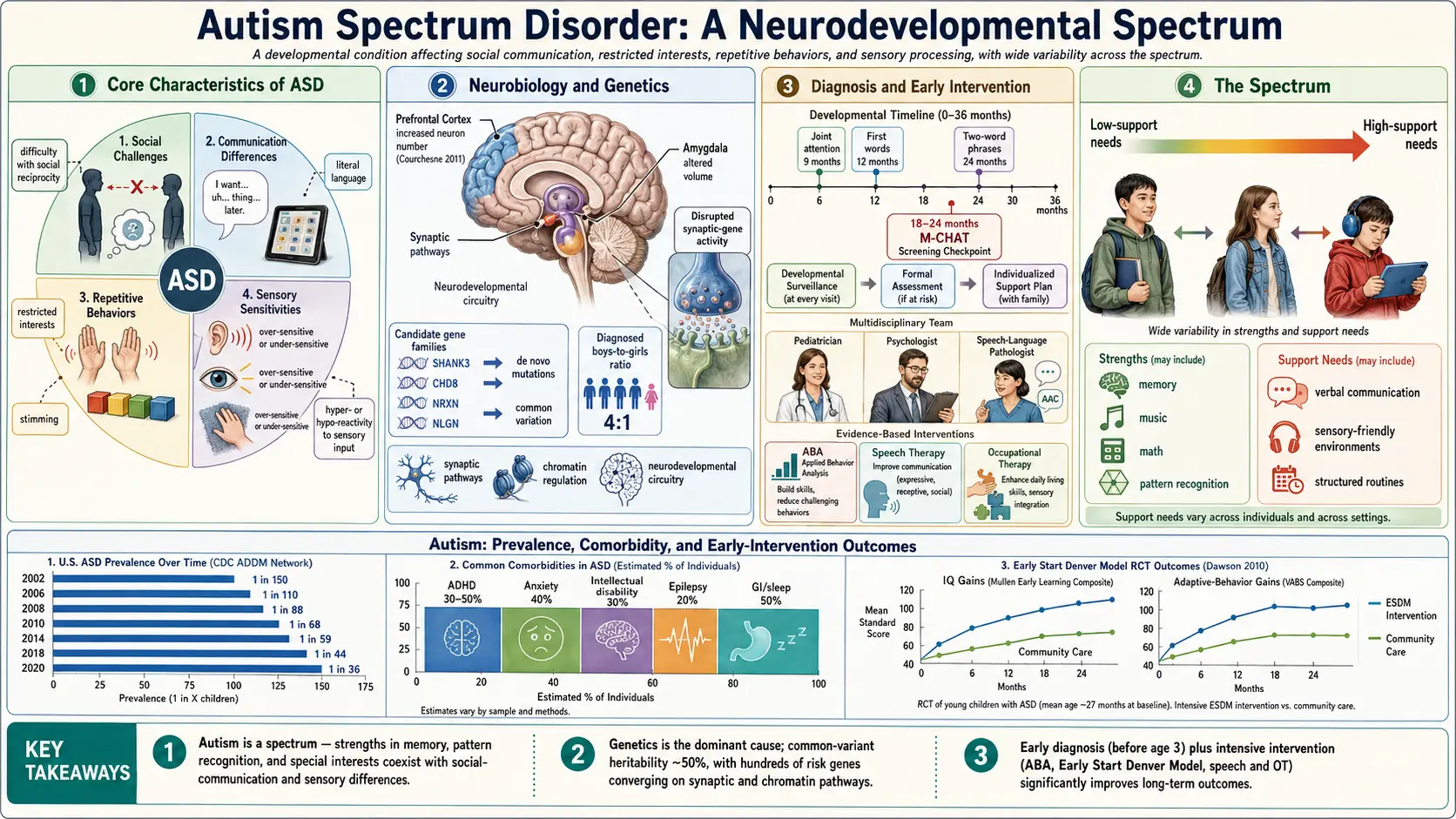
Table of Contents
- What is Autism?
- Characteristics of Autism
- Signs and Symptoms of Autism
- Causes and Risk Factors
- Diagnosis
- Treatment Options
- Prevention and Early Intervention
- Challenges and Support for Individuals with Autism
- Complications Associated with Autism
- Research Papers
- Connections
- Featured Videos
What is Autism?
Autism, or Autism Spectrum Disorder (ASD), is a developmental disorder that affects communication, behavior, and social interaction. It is called a "spectrum" disorder because there is a wide range of symptoms and severity among individuals.
Characteristics of Autism
- Social challenges: Difficulty with social interactions, understanding social cues, and forming relationships.
- Communication difficulties: Delayed speech and language skills, limited verbal interaction, or nonverbal communication.
- Repetitive behaviors: Engaging in repetitive motions or routines, such as hand-flapping or lining up objects.
- Restricted interests: Intense focus on particular topics or objects.
- Sensory sensitivities: Over- or under-sensitivity to sounds, lights, textures, or smells.
Signs and Symptoms of Autism
Signs and symptoms can vary widely among individuals, but common indicators include:
- Delays in speech and language development
- Limited eye contact or avoidance of social interaction
- Repetitive behaviors: Such as rocking, spinning, or repeating certain words or phrases
- Difficulty understanding others' emotions or expressing their own feelings
- Adherence to routines and distress at changes in the environment
- Exceptional abilities: Some individuals may display strengths in memory, music, art, or academic skills
Causes and Risk Factors
- Genetics: Family history and genetic mutations are linked to autism.
- Brain development: Differences in brain structure or function may contribute.
- Environmental factors: Advanced parental age, low birth weight, and certain complications during pregnancy may increase risk.
- Gender: Boys are more likely to be diagnosed with autism than girls.
Diagnosis
- Developmental screening: Early assessments during well-child visits to identify developmental delays.
- Comprehensive diagnostic evaluation: A multidisciplinary team may include a pediatrician, psychologist, or speech-language pathologist to conduct further assessments.
- Observation: Analyzing behavior patterns and social interactions.
- Parental reports: Information from parents or caregivers about the child's behavior and development.
Treatment Options
- Behavioral therapies:
- Applied Behavior Analysis (ABA): Uses positive reinforcement to encourage desired behaviors.
- Social skills training: Helps individuals develop appropriate social interactions.
- Speech and language therapy: Aims to improve communication skills and address language delays.
- Occupational therapy: Assists with daily activities and helps improve fine motor skills.
- Educational interventions: Tailored programs in schools to support learning and development.
- Medication: While there is no medication to treat autism directly, medications can help manage related symptoms like anxiety or hyperactivity.
Prevention and Early Intervention
- Early screening and diagnosis: Identifying and addressing developmental delays as early as possible can significantly improve outcomes.
- Early intervention programs: Specialized services that support children and their families can help improve social, communication, and cognitive skills.
Challenges and Support for Individuals with Autism
- Social integration: Difficulties forming relationships can lead to feelings of isolation.
- Educational support: Tailored education plans (IEPs) can help meet the needs of children with autism in school settings.
- Workplace support: Adults with autism may benefit from structured environments and support in job settings.
- Family support: Providing resources and guidance for caregivers can help manage the challenges of raising a child with autism.
Complications Associated with Autism
- Co-occurring conditions: Such as ADHD, anxiety disorders, or epilepsy.
- Social challenges: Difficulty navigating social interactions and relationships.
- Learning difficulties: Some individuals may face challenges in specific areas of learning.
- Emotional and behavioral issues: Tantrums, aggression, or self-injurious behavior in response to stress or sensory overload.
Research Papers
Historical Background
Autism was first described independently by Leo Kanner in 1943 and Hans Asperger in 1944. Kanner identified "early infantile autism" in children who displayed social withdrawal and insistence on sameness, while Asperger described similar traits in higher-functioning children. The term "autism spectrum disorder" was adopted in the DSM-5 (2013), unifying previously separate diagnoses under one umbrella.
Key Research Papers
- Christensen DL, et al. Prevalence and characteristics of autism spectrum disorder among children aged 8 years -- Autism and Developmental Disabilities Monitoring Network. MMWR Surveillance Summaries. 2016;65(3):1-23.
- Lai MC, Lombardo MV, Baron-Cohen S. Autism. The Lancet. 2014;383(9920):896-910.
- De Rubeis S, et al. Synaptic, transcriptional and chromatin genes disrupted in autism. Nature. 2014;515(7526):209-215.
- Geschwind DH, State MW. Gene hunting in autism spectrum disorder: on the path to precision medicine. The Lancet Neurology. 2015;14(11):1109-1120.
- Lord C, et al. Autism spectrum disorder. Nature Reviews Disease Primers. 2020;6(1):5.
- Hyman SL, et al. Identification, evaluation, and management of children with autism spectrum disorder (AAP Clinical Report). Pediatrics. 2020;145(1):e20193447.
- Dawson G, et al. Randomized, controlled trial of an intervention for toddlers with autism: the Early Start Denver Model. Pediatrics. 2010;125(1):e17-e23.
- Gaugler T, et al. Most genetic risk for autism resides with common variation. Nature Genetics. 2014;46(8):881-885.
- Courchesne E, et al. Neuron number and size in prefrontal cortex of children with autism. JAMA. 2011;306(18):2001-2010.
- Sanders SJ, et al. De novo mutations revealed by whole-exome sequencing are strongly associated with autism. Nature. 2012;485(7397):237-241.
- Weitlauf AS, et al. Therapies for children with autism spectrum disorder: behavioral interventions update. Comparative Effectiveness Reviews. 2014;137.
- Satterstrom FK, et al. Large-scale exome sequencing study implicates both developmental and functional changes in the neurobiology of autism. Cell. 2020;180(3):568-584.
PubMed Topic Searches
- PubMed: autism spectrum disorder prevalence
- PubMed: autism early intervention
- PubMed: autism ABA therapy
- PubMed: autism genetics GWAS
- PubMed: autism neurobiology
- PubMed: autism gut microbiome
- PubMed: autism vitamin D
- PubMed: autism omega-3
- PubMed: autism sleep
- PubMed: autism comorbidity anxiety
- PubMed: autism sensory processing
- PubMed: autism adult outcomes
Connections
- Psychiatry
- Anxiety
- ADHD
- Insomnia
- Vitamin B6
- Vitamin D3
- Magnesium
- Zinc
- Omega-3 Fatty Acids
- Sleep Hygiene
- Lead Poisoning
- Epilepsy
- Schizophrenia
- Depression
- Bipolar Disorder
- Gut Microbiome
- Gut Brain Axis
- Pesticides
- Mental Health
- Measles