Intestinal Tapeworm Symptoms — Taeniasis, Fish Tapeworm, and Dwarf Tapeworm
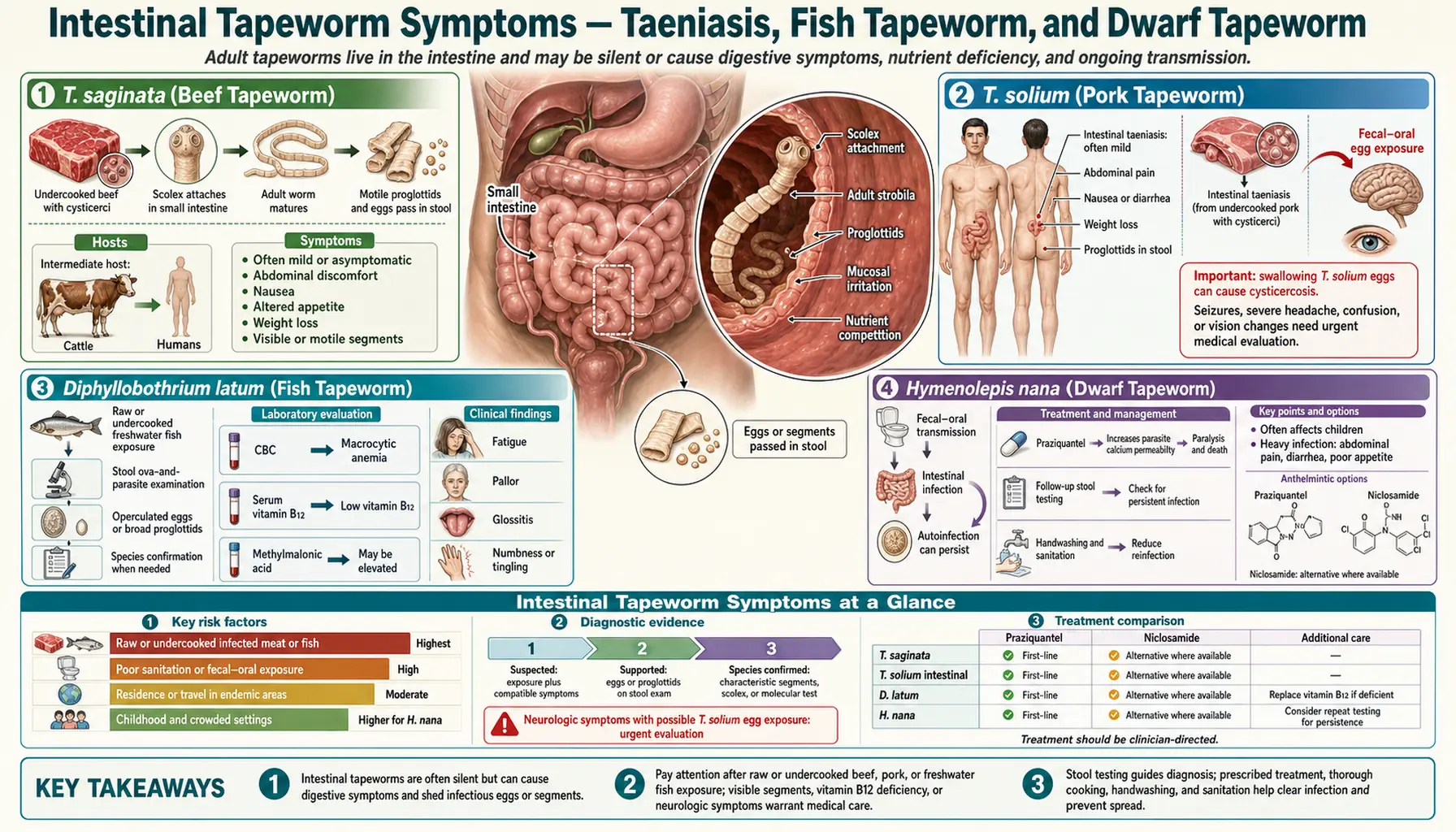
Four tapeworm species cause intestinal infection in humans: the beef tapeworm (Taenia saginata), the pork tapeworm (Taenia solium), the fish tapeworm (Diphyllobothrium latum), and the dwarf tapeworm (Hymenolepis nana). Each has a distinct clinical profile shaped by its size, its mechanism of infection, and how it interacts with the human host. Most intestinal tapeworm infections are mild or silent — yet one of them, T. solium, poses a hidden risk of a far more serious disease, and Diphyllobothrium can quietly deplete vitamin B12 over months or years. This page details each species in turn.
Table of Contents
- T. saginata (Beef Tapeworm)
- T. solium (Pork Tapeworm)
- Diphyllobothrium latum (Fish Tapeworm)
- Hymenolepis nana (Dwarf Tapeworm)
- Common Intestinal Symptoms
- Proglottid Segments in Stool
- Nutritional Consequences
- When to Suspect Intestinal Tapeworm
- Key Research Papers
- PubMed Searches
- Connections
- Featured Videos
1. T. saginata (Beef Tapeworm)
Taenia saginata, the beef tapeworm, is the most commonly diagnosed tapeworm in high-income countries and one of the most prevalent intestinal parasites globally. Its distribution mirrors raw or undercooked beef consumption: Ethiopia, the Middle East, Central Asia, Latin America, and parts of Eastern Europe account for the highest burden, but sporadic cases occur wherever beef is eaten with incomplete cooking.
Life cycle and acquisition: Humans acquire the adult worm by eating beef containing viable cysticerci (larval bladder cysts) in the muscle. Abattoir inspection does not catch all infected carcasses, particularly light infections. Once swallowed, the larva everts its scolex, attaches to the jejunal mucosa using four large suckers, and begins to grow. An adult T. saginata typically reaches 4–10 meters in length, though some individuals harbor worms approaching 25 meters. The worm may live in the intestine for 25–30 years if untreated.
Distinctive feature — proglottid migration: T. saginata proglottids are motile; each mature segment contains 80,000–100,000 eggs packed into a uterus with 15–30 lateral branches (used to distinguish it from T. solium's 7–12 branches). Segments regularly break off from the worm's distal end and migrate actively through the anal sphincter, sometimes while the host is walking or sitting quietly. Patients often describe the sensation of something moving in the anal region. Proglottids found on toilet paper, in underwear, or in the toilet bowl — actively moving — are pathognomonic.
No risk of cysticercosis: This is the single most important clinical distinction from T. solium. Even if a person ingests T. saginata eggs, the eggs cannot develop into tissue-invading larvae in the human body. Beef tapeworm infection carries no risk of brain cysts, eye cysts, or any other invasive larval disease.
Systemic symptoms: Usually mild or absent. Some carriers report vague epigastric discomfort, intermittent nausea, increased appetite, mild weight loss, or fatigue. In the absence of proglottid sightings, most infections go undiagnosed. Eosinophilia is variable and often absent in established chronic infection.
2. T. solium (Pork Tapeworm)
Taenia solium shares much of its biology with T. saginata but is far more medically important. The intestinal form — taeniasis — is similar to beef tapeworm infection in its mildness. What makes T. solium uniquely dangerous is what it does when its eggs rather than its larvae enter a human host.
Acquisition of the intestinal worm: Infection with the adult tapeworm comes from eating undercooked or raw pork containing cysticerci. The worm reaches 2–4 meters, shorter than T. saginata, and attaches to the small intestine by its scolex — which has both suckers and a rostellum (a crown of hooks), unlike the hookless scolex of T. saginata. The worm produces proglottid segments that are less motile than those of T. saginata and are generally passed passively in the stool rather than actively migrating.
Intestinal symptoms: Usually minimal — vague abdominal discomfort, nausea, occasional diarrhea, weight changes. Proglottids are found in the stool, though less dramatically than with T. saginata because they do not migrate as actively.
The critical risk — autoinfection and external transmission of eggs: An adult T. solium sheds thousands of eggs daily into the environment via proglottids in the stool. These eggs are immediately infectious for humans. If the tapeworm carrier swallows their own eggs — through poor hand hygiene after defecating — the eggs hatch in the intestine, the oncospheres penetrate the gut wall, enter the bloodstream, and seed the brain, muscles, and other tissues with cysticerci. This autoinfection pathway means a person carrying an intestinal T. solium is at risk of developing neurocysticercosis from their own worm. More commonly, the eggs spread to household contacts through contaminated hands, food, or water.
Why identifying the species matters: A clinician who knows a patient has T. saginata can reassure them there is no risk of tissue invasion. A clinician who identifies T. solium — or who suspects taeniasis but cannot distinguish the species — must treat promptly, investigate household contacts, and in some settings perform neuroimaging on the carrier to check for existing cysticerci, because a significant minority of patients with intestinal T. solium have concurrent asymptomatic neurocysticercosis.
3. Diphyllobothrium latum (Fish Tapeworm)
Diphyllobothrium latum, the broad fish tapeworm, holds the distinction of being the largest tapeworm parasite of humans and the only common species that causes a specific nutritional deficiency as a primary clinical manifestation.
Acquisition: The life cycle involves two intermediate hosts: a copepod (microscopic freshwater crustacean) and a freshwater fish. Humans acquire the infection by eating raw, undercooked, or lightly smoked freshwater fish containing plerocercoid larvae in the muscle. Implicated fish include pike, perch, burbot, turbot, ruffe, and Pacific salmon. Preparations at risk include raw sashimi, undercooked sushi containing freshwater fish, ceviche marinated in acid rather than heat, gravlax, and lightly smoked fish. Marine fish (ocean tuna, Atlantic salmon in saltwater) are not infectious; Pacific salmon that migrate between fresh and saltwater can be infectious during their freshwater phase.
Geographic distribution: Highest prevalence in Scandinavia, the Baltic states, Russia, Japan, South Korea, Chile, Argentina, the Great Lakes region of North America, and Pacific Northwest Canada. Cases have increased in some regions as sashimi and ceviche culture has spread.
Size: Adults routinely reach 4–10 meters; some specimens exceed 10 meters. The worm may harbor 3,000–4,000 proglottids. It attaches to the proximal jejunum by means of two elongated sucking grooves (bothria) on its scolex, rather than the suckers and hooks of Taenia species.
Intestinal symptoms: Most carriers are asymptomatic or have only mild symptoms: abdominal cramping, nausea, a sense of fullness, or occasional diarrhea. The sheer size of the worm can produce intestinal obstruction in heavy infections. Some patients report noticing large, ribbon-like segments or intact lengths of worm in the stool.
Vitamin B12 deficiency — the defining complication: In the distal ileum, dietary vitamin B12 bound to intrinsic factor is absorbed by specific mucosal receptors. D. latum residing in the proximal small intestine produces binding proteins that compete with this absorption process, taking up the intrinsic factor–B12 complex before it reaches the ileal receptors. The worm concentrates B12 at 10–20 times the concentration found in the host's plasma. In heavy or chronic infection, the host's B12 stores are gradually depleted. Clinical B12 deficiency — megaloblastic anemia, glossitis, and in severe cases subacute combined degeneration of the spinal cord — develops in approximately 2% of infected individuals, though sub-clinical reductions in serum B12 are more common. Historically, this was called "bothriocephalus anemia" and was common in Finnish coastal populations who ate raw pike.
Diagnosis: Stool examination reveals characteristic oval eggs with an operculum (lid) at one end and a small knob at the other — a finding not seen with Taenia species. Proglottids, when passed, are broader than long (unlike the elongated proglottids of Taenia). Serum B12 and CBC should be checked in any confirmed case.
4. Hymenolepis nana (Dwarf Tapeworm)
Hymenolepis nana is the most prevalent tapeworm in the world, with an estimated 75 million people infected globally, predominantly children. Despite this breadth, it is often the least appreciated tapeworm clinically because it is small, its symptoms are mild in most cases, and its mode of transmission differs fundamentally from the meat-borne tapeworms.
Unique biology — no obligatory intermediate host: Unlike all other tapeworms discussed here, H. nana can complete its entire life cycle within a single human host. Eggs swallowed from contaminated food, water, or hands hatch in the duodenum, penetrate the villi, and develop into cysticercoid larvae within the intestinal wall. These larvae then re-enter the intestinal lumen and mature into adult tapeworms without requiring an intermediate animal host. Adults are tiny — 2–4 cm — but a single host may harbor hundreds or thousands of worms, because eggs can re-infect the intestine directly (autoinfection) as they pass through.
Transmission: Fecal-oral route. Children in orphanages, schools, crowded households, or institutions with inadequate hand hygiene are the primary population at risk. Rodents (mice, rats) also carry H. nana and may serve as a reservoir, though direct person-to-person transmission is the predominant route in endemic settings. In the United States it is the most commonly diagnosed tapeworm infection, particularly in recent immigrants and children.
Symptoms:
- Light infections: Usually asymptomatic. Many cases are found incidentally on stool examinations performed for other reasons.
- Heavier infections: Abdominal pain (often periumbilical or diffuse cramping), nausea, diarrhea, irritability, fatigue, and anorexia. Children with high worm burdens may show failure to thrive or behavioral changes attributed to abdominal discomfort.
- Severe (immunocompromised): In patients with HIV, organ transplants, or prolonged corticosteroid use, autoinfection can amplify to extremely high worm burdens (hyperinfection), causing severe diarrhea, malabsorption, and systemic illness. This pattern parallels what is seen with Strongyloides in immunosuppressed hosts.
Diagnosis: Stool microscopy reveals characteristic eggs: spherical to oval, 30–47 micrometers, with a thin outer membrane and an inner membrane bearing two polar thickenings with 4–8 polar filaments between the membranes — a distinctive appearance under the microscope. Multiple stool samples may be needed given irregular egg shedding.
Treatment: Praziquantel is the drug of choice and is highly effective. Nitazoxanide is an alternative. The autoinfection cycle means that treatment should be followed by strict hand hygiene to prevent reinfection. Household members and institutional contacts should be screened and treated simultaneously.
5. Common Intestinal Symptoms
Despite the biological differences among the four intestinal tapeworm species, their intestinal symptom profiles overlap substantially — which is why epidemiological history and laboratory testing are essential for species identification. The following symptoms may occur with any of these species:
- Asymptomatic or minimally symptomatic carriage — the most common presentation for all four species; many infections are discovered only because a patient notices something unusual in the toilet
- Vague abdominal discomfort — a dull ache or pressure in the epigastrium, periumbilical region, or right lower quadrant; not typically severe enough to prompt emergency evaluation
- Nausea — intermittent; rarely accompanied by vomiting
- Altered appetite — some carriers report increased hunger (especially with T. saginata); others report anorexia
- Mild weight loss — from nutrient competition; rarely exceeds a few kilograms in intestinal-only disease
- Bloating and flatulence — nonspecific; may reflect altered gut motility or the physical bulk of a large worm
- Diarrhea — intermittent; more common with H. nana in heavy infections
- Constipation — occasional; more likely with very large worm burdens of T. saginata
- Pruritus ani — from migrating proglottids, especially with T. saginata
- Fatigue — nonspecific; may be contributed to by B12 depletion in Diphyllobothrium infection
None of these symptoms is specific to tapeworm infection. In practice, intestinal tapeworm disease is suspected and diagnosed when a patient finds segments in the stool or when stool microscopy is performed as part of evaluation for unexplained abdominal symptoms, weight loss, or eosinophilia.
6. Proglottid Segments in Stool
The passage of proglottid segments in the stool is the most distinctive and diagnostically useful manifestation of intestinal tapeworm disease. It also tends to be the symptom that finally brings a patient to medical attention, because it is visually alarming even when the patient has had no other symptoms.
What proglottids look like: Individual proglottids are flat, whitish to cream-colored, and roughly rectangular. Their size varies by species: T. saginata and T. solium proglottids are typically 5–10 mm wide and 10–20 mm long, resembling flattened melon seeds or grains of cooked rice when individual; larger segments may look like flattened white ribbons. Diphyllobothrium proglottids are characteristically wider than long, giving a different visual impression. H. nana proglottids are microscopic and not grossly visible.
Motility — the key diagnostic clue: T. saginata proglottids are distinctly motile: fresh segments contract and elongate visibly when placed in water or on a surface. Their ability to migrate through the anal sphincter independently — without accompanying bowel movement — and crawl on the perianal skin or on clothing is almost pathognomonic for T. saginata taeniasis. T. solium proglottids are far less motile and are generally passed passively with the stool. Diphyllobothrium proglottids are not independently motile.
Clinical implications of finding a proglottid: When a patient brings in a segment (wrapped in tissue or in a sealed container), the laboratory should attempt morphological identification. The structure of the uterine branches within the proglottid distinguishes T. saginata (15–30 lateral branches) from T. solium (7–12 lateral branches) when the proglottid is pressed between two glass slides to reveal its internal structure. If the species cannot be confirmed as T. saginata, it should be treated as T. solium with all the associated implications for household contact investigation.
Chains of segments: Tapeworms periodically shed groups of proglottids as connected chains rather than individual segments. A chain of 3–10 segments passed in a single bowel movement — looking like a piece of pale, segmented ribbon — is a striking and unmistakable finding that should prompt urgent parasite investigation.
7. Nutritional Consequences
For three of the four intestinal tapeworm species, direct nutritional competition with the host is modest and rarely clinically significant in well-nourished individuals. For the fourth — Diphyllobothrium latum — a specific, measurable nutritional deficiency is a real clinical consequence.
Taenia species (saginata and solium): Adult tapeworms absorb nutrients passively through their tegument (body surface) without a mouth or gut, consuming some of the host's digested food in the small intestine. The worm's bulk is large enough — sometimes several meters — to represent meaningful competition, but in practice significant malnutrition from intestinal taeniasis alone is uncommon in adults with adequate food intake. Mild weight loss (2–5 kg), reduced serum iron, and subtle decreases in some B vitamins have been documented in carriers. In malnourished children in endemic areas, the additional nutritional drain of a tapeworm may contribute meaningfully to growth failure.
Diphyllobothrium latum — vitamin B12 depletion: The mechanism here is specific and different from simple nutrient competition. The fish tapeworm selectively sequesters vitamin B12 by binding the intrinsic factor–B12 complex in the proximal small intestine before it reaches ileal absorption sites. This is not about the worm simply absorbing more food than the host; it is about the worm intercepting a specific molecular complex and preventing its delivery to the host's absorptive mucosa.
Consequences in order of progression with worsening deficiency:
- Low serum B12 (often the earliest finding, detectable by blood test before symptoms develop)
- Megaloblastic changes on bone marrow examination
- Macrocytic (megaloblastic) anemia: fatigue, dyspnea on exertion, pallor
- Glossitis: smooth, red, painful tongue
- Subacute combined degeneration of the spinal cord: dorsal column dysfunction (loss of vibration sense and proprioception), lateral column dysfunction (weakness, spasticity, hyperreflexia) — can be irreversible if not treated promptly
- Cognitive and psychiatric manifestations: memory loss, irritability, depression ("megaloblastic madness") in severe prolonged deficiency
Hymenolepis nana: Light infections cause negligible nutritional impact. Heavy infections in malnourished children can contribute to protein-losing enteropathy and malabsorption, amplifying existing nutritional deficits.
8. When to Suspect Intestinal Tapeworm
Intestinal tapeworm disease is frequently missed because the symptoms are nonspecific and most patients have no dramatic findings on routine examination. Several epidemiological and clinical clues should trigger consideration of the diagnosis:
The strongest trigger: visible segments in stool or on clothing. Any patient who presents with the finding of flat, whitish, worm-like segments — especially if any are moving — has tapeworm infection until proven otherwise. Ask specifically whether the segments appeared to move, because motility points strongly to T. saginata.
Dietary history:
- Raw or undercooked beef in the past several years (even a single exposure several years earlier can explain a current infection, since worms live for decades) → consider T. saginata
- Raw or undercooked pork, particularly in Latin America, Asia, or Africa → consider T. solium
- Raw freshwater fish (sushi, ceviche, gravlax, lightly smoked pike or perch) in the past year → consider Diphyllobothrium
- Any raw fish preparation in a patient presenting with megaloblastic anemia and low B12 → strongly consider Diphyllobothrium
Geographic and travel history:
- Recent travel to or immigration from Latin America, sub-Saharan Africa, or South/Southeast Asia → consider T. solium and the possibility of concurrent neurocysticercosis
- Residence in or origin from Scandinavia, Japan, Russia, Chile → consider Diphyllobothrium
- Living in crowded conditions or institutional settings (especially children) → consider H. nana
Laboratory findings:
- Unexplained eosinophilia — may be present during migration of larvae; less common in established adult worm infection
- Macrocytic anemia with low serum B12 — in the context of raw fish consumption, should prompt consideration of fish tapeworm even before stool microscopy results are available
- Elevated MCV on routine CBC in a person from a Diphyllobothrium-endemic region
New-onset seizures: In a person from T. solium-endemic areas, new-onset seizures should trigger both stool examination (looking for concurrent taeniasis) and neuroimaging, because the most important implication of intestinal T. solium is the risk of neurocysticercosis in the carrier and their contacts.
Key Research Papers
Peer-reviewed studies and reviews on intestinal tapeworm species, their clinical presentations, and nutritional complications. The year/volume/pages link opens the PubMed record.
- Garcia HH, Gonzalez AE, Evans CAW, Gilman RH. Taenia solium Cysticercosis. The Lancet. Search PubMed [PubMed PMID 17269187]
- Del Brutto OH, Nash TE, White AC Jr, et al. Revised Diagnostic Criteria for Neurocysticercosis. Journal of the Neurological Sciences. Search PubMed [PubMed PMID 22900875]
- Scholz T, Garcia HH, Kuchta R, Wicht B. Update on the Human Broad Tapeworm (Genus Diphyllobothrium), Including Clinical Relevance. Clinical Microbiology Reviews. Search PubMed [PubMed PMID 24528876]
- Gripper LB, Welburn SC. Neurocysticercosis Infection and Disease — A Review. Acta Tropica. Search PubMed [PubMed PMID 26272177]
- Garcia HH, Nash TE, Del Brutto OH. Clinical Symptoms, Diagnosis, and Treatment of Neurocysticercosis. The Lancet Neurology. Search PubMed [PubMed PMID 15929899]
- Ndimubanzi PC, Carabin H, Budke CM, et al. A Systematic Review of the Frequency of Neurocysticercosis with a Focus on People with Epilepsy. PLoS Neglected Tropical Diseases. Search PubMed [PubMed PMID 23079626]
- Nash TE, Garcia HH. Diagnosis and Treatment of Neurocysticercosis. Nature Reviews Neurology. Search PubMed [PubMed PMID 21572778]
- Carabin H, Ndimubanzi PC, Budke CM, et al. Clinical Manifestations Associated with Neurocysticercosis: A Systematic Review. PLoS Neglected Tropical Diseases. Search PubMed [PubMed PMID 25023047]
- Coyle CM, Mahanty S, Zunt JR, et al. Neurocysticercosis: Neglected but Not Forgotten. PLoS Neglected Tropical Diseases. Search PubMed [PubMed PMID 22030207]
- White AC Jr, Coyle CM, Rajshekhar V, et al. Diagnosis and Treatment of Neurocysticercosis: 2017 Clinical Practice Guidelines by the IDSA and the ASTMH. Clinical Infectious Diseases. Search PubMed [PubMed PMID 28260308]
PubMed Searches
Each link opens a live PubMed query so results stay current as new papers are indexed.
- Taenia saginata proglottid
- Taenia solium autoinfection
- Diphyllobothrium B12 deficiency
- Hymenolepis nana children
- Tapeworm intestinal symptoms
- Taeniasis megaloblastic anemia
- Pork tapeworm household cysticercosis
- Tapeworm stool microscopy
- Fish tapeworm raw fish sushi
Connections
- All Parasites
- Tapeworm Hub
- Tapeworm Symptoms Overview
- Neurocysticercosis — Brain Cysts
- Diagnosis — Imaging & Serology
- Tapeworm Treatments
- Praziquantel & Albendazole
- Prevention & Food Safety
- Acanthamoeba
- Giardia
- Pinworm
- Ascaris
- Hookworm
- Vitamin B12
- Neurology
- Infectious Disease