Preventing Schistosomiasis: Avoiding Freshwater
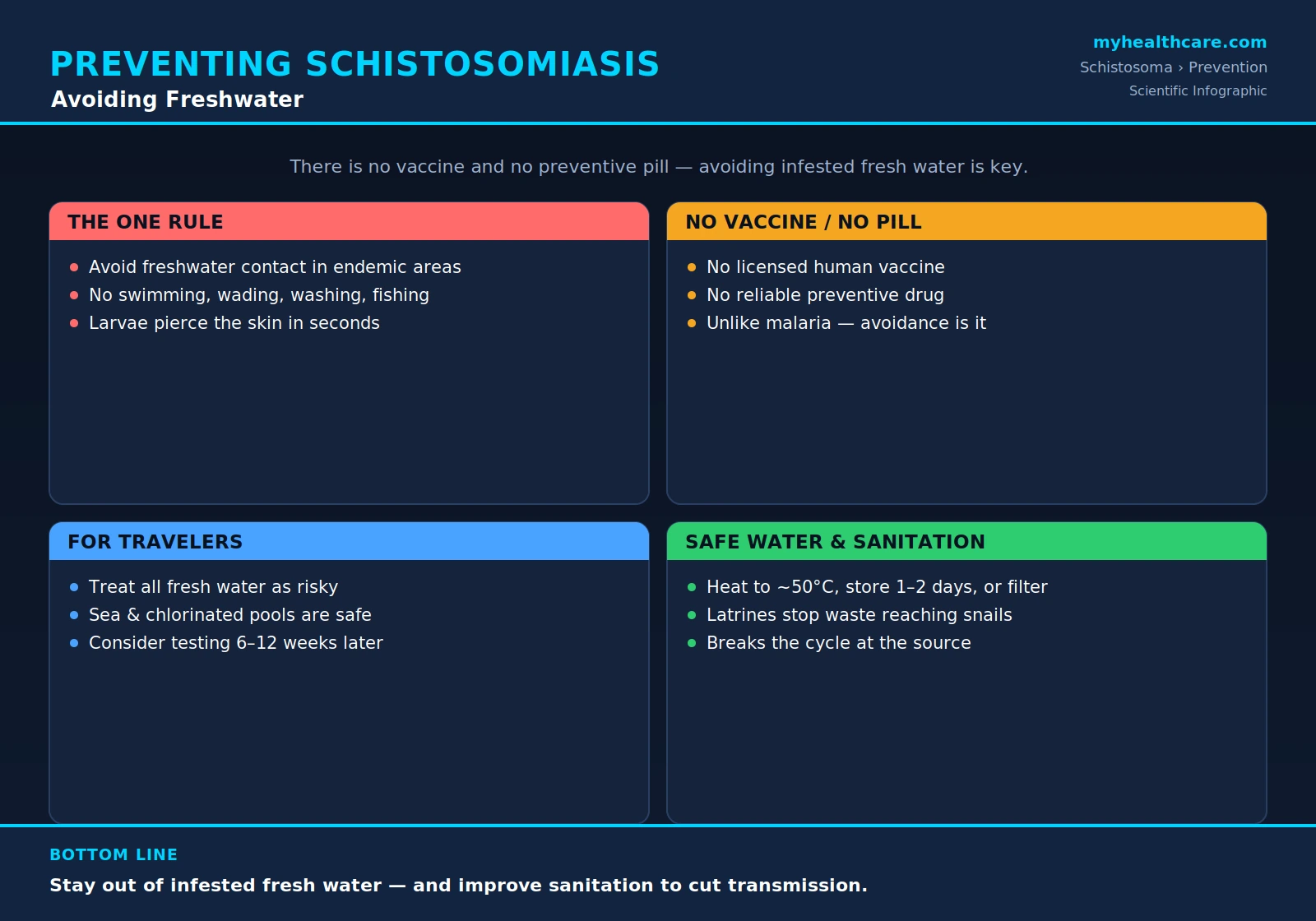
Schistosomiasis is one of the most preventable serious parasitic diseases in the world — and the single most important thing to understand about it is also the simplest. The parasite cannot infect you from food, from another person, or from drinking water that is properly treated. It infects you in only one way: when your skin touches fresh water that carries the larval form of the worm. In the lakes, rivers, ponds, irrigation canals, and dams of regions where the disease is common, those larvae can pass straight through unbroken skin in a matter of seconds. This page explains the one rule that prevents nearly every infection, why there is no vaccine or pill to fall back on, what travelers and residents can actually do, how to make daily-use water safe, and why sanitation is the quiet hero that breaks the whole cycle.
Table of Contents
- The One Rule That Matters Most
- No Vaccine, No Pill to Prevent It
- For Travelers
- Safe Water for Daily Life
- Why Sanitation Breaks the Cycle
- Protecting Children
- Putting It Together
- Key Research Papers
- Featured Videos
1. The One Rule That Matters Most
If you remember nothing else, remember this: in regions where schistosomiasis occurs, do not let your skin touch fresh water. That means no swimming, no wading, no bathing, no washing clothes or dishes by hand, and no fishing in lakes, ponds, rivers, streams, irrigation canals, reservoirs, or dams where the disease is present. The freshwater snails that host the parasite live in exactly these still and slow-moving waters, and it is from the snails that the infectious larvae are released.
The reason the rule is so strict is that infection is astonishingly fast and requires no cut, scrape, or open wound. The larval stage of the parasite, called a cercaria, swims freely in the water. When it senses the warmth and chemistry of human skin, it attaches and burrows directly through the intact surface — a process that takes only seconds to a few minutes. You do not have to swallow the water, and you do not have to stay in for long. A brief paddle across a stream, a moment standing in a flooded field, or a single dip to cool off can be enough.
It is worth emphasizing what is not a risk, because needless fear helps no one. The parasite is not spread from person to person. It is not caught from food. The ocean and the sea are safe — the snail hosts cannot live in salt water. Properly chlorinated swimming pools are safe. Drinking water that has been boiled, filtered, or chlorinated is safe to drink. The entire danger is confined to direct skin contact with untreated fresh water in places where transmission occurs.
2. No Vaccine, No Pill to Prevent It
People who have traveled know that some tropical infections can be guarded against with a shot or a tablet. Malaria, for instance, can be prevented with antimalarial medication taken before, during, and after travel, and many viral diseases have vaccines. Schistosomiasis is different. As of now there is no licensed human vaccine, and there is no reliable preventive medication you can take to keep the parasite from establishing an infection.
Several vaccine candidates have moved into human trials and remain an active area of research, but none is yet approved or available for routine use. And while praziquantel — the drug used to treat schistosomiasis — is highly effective at clearing established worms, it is not a preventive: it does not stop new larvae from penetrating the skin, and taking it before exposure does not protect you. (Praziquantel works on mature worms, not on the freshly arrived larval stages.)
The practical meaning of all this is straightforward but important. Because there is no chemical or immunological shield to fall back on, prevention rests entirely on avoiding contact with the water. Unlike malaria, where you can take a calculated risk and rely on prophylaxis, with schistosomiasis the only dependable protection is to keep your skin out of untreated fresh water in the first place.
3. For Travelers
If you are visiting a region where schistosomiasis occurs — large parts of sub-Saharan Africa, with foci also in the Middle East, parts of South America, the Caribbean, and East and Southeast Asia — the safest mindset is simple: assume that every body of fresh water is a potential source of infection. Whether or not a lake or river looks clean, whether or not local people are swimming in it, and whether or not a guide assures you it is fine, treat all untreated fresh water as a risk. The water gives no visible sign of whether cercariae are present.
Within that rule, some forms of water recreation remain perfectly safe:
- The sea and the ocean are safe. The snails that transmit the parasite cannot survive in salt water.
- Properly maintained swimming pools — chlorinated or saltwater pools that are regularly treated — are safe.
- Boiled, filtered, or chlorinated water is safe for drinking, bathing, and washing.
What about accidental exposure — an unplanned fall into a river, a rafting splash, or a wade you could not avoid? If your skin does get wet with untreated fresh water, drying off can help but cannot be relied upon. Vigorous towel-drying of the skin immediately afterward — rubbing briskly rather than patting — may dislodge some cercariae before they finish burrowing in, and so may reduce the chance of infection. It does not reliably prevent it, because penetration can be complete within seconds and you cannot towel away larvae that are already through the skin. Treat brisk drying as a small hedge, not a safeguard.
Because infection often causes no symptoms at first, travelers who have had any meaningful freshwater exposure in an endemic area should consider getting tested even if they feel completely well. Testing is generally most informative when done about 6 to 12 weeks after exposure, the interval the worms need to mature and begin producing the eggs and antibody responses that diagnostic tests detect. A negative test taken too soon can be falsely reassuring. If you have had freshwater contact and later develop fever, rash, cough, abdominal symptoms, or blood in the urine or stool, seek medical care and tell the clinician about your travel and water exposure. See the Symptoms & Diagnosis page for what to watch for.
4. Safe Water for Daily Life
For people who live where schistosomiasis is endemic, simply “avoiding fresh water” is not always possible — water for bathing, cooking, and washing has to come from somewhere. The good news is that the cercaria is a fragile, short-lived organism, and a few simple treatments make even snail-source water safe to use on the skin. Any one of the following will do it:
- Heat it. Bringing water to a boil kills the larvae outright. Even short of boiling, heating water to about 50 °C (roughly 122 °F) for several minutes is enough to kill cercariae, making it safe for bathing or washing once it cools.
- Store it snail-free. Cercariae cannot live indefinitely once they leave the snail. If water is collected and stored in a clean container, free of snails, for one to two days, the larvae die on their own — cercariae typically survive only about 48 hours in water. Water held safely for a couple of days is then fine to use.
- Filter it. Passing water through a fine filter physically removes the larvae before the water reaches your skin.
- Boil or chlorinate for drinking. For drinking water specifically, boiling and chlorination both work and are the standard recommendations.
These measures are inexpensive and use ordinary household methods, which is part of why schistosomiasis is considered so preventable. The key idea is that the parasite’s infectious stage has a short fuse: deny it warm skin within its brief window — by heating, storing, or filtering the water — and it simply dies.
5. Why Sanitation Breaks the Cycle
So far the focus has been on protecting individuals. But schistosomiasis is unusual among parasites in that humans themselves keep the cycle going, which means sanitation can shut it down at the source. To understand why, it helps to see the loop the parasite travels.
The adult worms live in the blood vessels of an infected person and lay eggs. Those eggs leave the body in urine or stool. If that human waste reaches fresh water — a river used as a latrine, a field that drains into a pond, a canal contaminated by runoff — the eggs hatch and release a larval form that must find and infect a particular species of freshwater snail. Inside the snail the parasite multiplies and eventually releases the cercariae that go on to penetrate human skin. Break any link and the chain collapses.
This is why clean water and sanitation are so powerful against schistosomiasis. Three interventions attack the cycle at the human end:
- Latrines and toilets keep urine and stool out of the water, so the eggs never reach the snails.
- Safe disposal of human waste more broadly — including not urinating or defecating in or near water bodies — cuts off the parasite’s route back to the environment.
- Clean, protected water supplies — piped water, protected wells, and safe washing points — give people an alternative to entering infested water for daily tasks, reducing both contamination and exposure.
Together these are often summarized as WASH — water, sanitation, and hygiene. Reviews of the evidence link better access to safe water and sanitation, and behaviors that keep human waste out of water, with lower odds of schistosome infection. WASH does not work overnight, and it works best alongside treatment programs, but it addresses the disease’s root cause rather than only its symptoms.
6. Protecting Children
Children carry a strikingly large share of the schistosomiasis burden, and the reason is behavioral as much as biological. Children play, swim, and bathe in fresh water — it is where they cool off, fetch water, fish, and have fun — so they are exposed early and often. Repeated infection through childhood is why the heaviest worm burdens, and much of the long-term organ damage, tend to build up in school-age children and adolescents.
This makes children both the most vulnerable group and the group where prevention pays the largest dividends. Two community measures matter most:
- Safe community water supplies and washing points, so that children do not have to enter rivers and ponds to collect water or wash.
- Safe places to play and swim — access to protected water sources or treated pools where that is feasible — so that the natural urge to be in the water does not mean repeated exposure to cercariae.
Because children are so consistently exposed, they are also the focus of large-scale treatment efforts, in which school-age children are regularly given praziquantel to clear infections and reduce both their own illness and the contamination they contribute to the water. Prevention through clean water and safe play, and periodic treatment, work hand in hand — the topic of the Mass Drug Administration & Control page.
7. Putting It Together
No single measure ends schistosomiasis on its own. The most durable protection comes from combining three complementary approaches, each attacking the parasite at a different point:
- Avoidance protects the individual right now — keep skin out of untreated fresh water, make daily-use water safe by heating, storing, or filtering it, and (for travelers) get tested after any exposure.
- Sanitation and clean water protect the whole community over time — latrines, safe waste disposal, and protected water supplies keep human eggs out of the water and keep people out of infested water, breaking the cycle at its source.
- Community control programs — above all the periodic mass treatment of at-risk groups with praziquantel — lower the reservoir of infection in the population, so there are fewer eggs to seed the water in the first place.
These pieces reinforce one another. Treatment clears existing worms but cannot stop reinfection if people keep entering contaminated water; avoidance protects you today but does nothing for the next person; sanitation slowly drains the source but takes time. Used together — avoidance plus WASH plus periodic treatment — they have driven schistosomiasis down dramatically in places that have committed to them, and elimination is a realistic goal where all three are sustained. For how the treatment-and-control leg of that strategy works at scale, continue to Mass Drug Administration & Control.
Key Research Papers
Peer-reviewed reviews and studies on schistosomiasis prevention, the role of water, sanitation, and hygiene (WASH), snail-host control, and global control strategy. Journal names appear as plain text; the year/volume/pages link opens the full citation via DOI.
- Colley DG, Bustinduy AL, Secor WE, King CH. Human Schistosomiasis. The Lancet. 2014;383(9936):2253–2264.
- McManus DP, Dunne DW, Sacko M, Utzinger J, Vennervald BJ, Zhou XN. Schistosomiasis. Nature Reviews Disease Primers. 2018;4:13.
- Ross AGP, Bartley PB, Sleigh AC, et al. Schistosomiasis. New England Journal of Medicine. 2002;346(16):1212–1220.
- Grimes JET, Croll D, Harrison WE, Utzinger J, Freeman MC, Templeton MR. The Roles of Water, Sanitation and Hygiene in Reducing Schistosomiasis: A Review. Parasites & Vectors. 2015;8:156.
- Grimes JET, Croll D, Harrison WE, Utzinger J, Freeman MC, Templeton MR. The Relationship between Water, Sanitation and Schistosomiasis: A Systematic Review and Meta-Analysis. PLoS Neglected Tropical Diseases. 2014;8(12):e3296.
- Sokolow SH, Huttinger E, Jouanard N, et al. Reduced Transmission of Human Schistosomiasis after Restoration of a Native River Prawn That Preys on the Snail Intermediate Host. Proceedings of the National Academy of Sciences. 2015;112(31):9650–9655.
- Lo NC, Addiss DG, Hotez PJ, et al. A Call to Strengthen the Global Strategy against Schistosomiasis and Soil-Transmitted Helminthiasis. The Lancet Infectious Diseases. 2017;17(2):e64–e69.
- Rollinson D. A Wake Up Call for Urinary Schistosomiasis: Reconciling Research Effort with Public Health Importance. Parasitology. 2009;136(12):1593–1610.
- Verjee MA. Schistosomiasis: Still a Cause of Significant Morbidity and Mortality. Research and Reports in Tropical Medicine. 2020;10:153–163.
Live PubMed Searches
Each link opens a live PubMed query so results stay current as new papers are indexed.
- Schistosomiasis prevention
- Schistosomiasis water sanitation hygiene (WASH)
- Schistosomiasis travelers freshwater exposure
- Schistosomiasis cercariae skin penetration
- Schistosomiasis snail control
- Schistosomiasis vaccine development
- Schistosomiasis elimination control strategy
- Schistosomiasis school-age children
Connections
- All Parasites
- Schistosoma Overview
- Symptoms & Diagnosis
- Urogenital Schistosomiasis
- Intestinal & Hepatic Schistosomiasis
- Acute Schistosomiasis & Swimmer's Itch
- Treatment & Prevention
- Praziquantel Treatment
- Mass Drug Administration & Control
- Giardia
- Cryptosporidium
- Entamoeba
- Infectious Disease
- All Conditions
- Schistosomiasis — the main disease page covering symptoms, diagnosis, and treatment.