Schistosomiasis Treatment and Prevention
Praziquantel Treatment
The single drug that treats all major species — how it works, its limits, and retreatment.
Read the deep dive →Prevention: Avoiding Freshwater
Why staying out of infested fresh water is the main personal defense — there is no vaccine.
Read the deep dive →Mass Drug Administration & Control
School-based deworming, snail control, and the global push toward elimination.
Read the deep dive →Schistosomiasis — also called bilharzia — is one of the most widespread parasitic diseases in the world, infecting more than 200 million people, mostly in sub-Saharan Africa. The good news is that it is highly treatable. A single, inexpensive, well-tolerated medicine taken by mouth on one day can clear infection with all of the major species of Schistosoma that affect people. The harder news is that treatment alone is not a permanent fix: a person who is cured today can be reinfected tomorrow simply by wading into the same contaminated water, and the scarring left behind by long-standing infection may not heal even after the worms are gone. This page explains what treatment can realistically accomplish, how individuals protect themselves, and how whole communities are pushed toward elimination.
Table of Contents
1. The Goal of Treatment
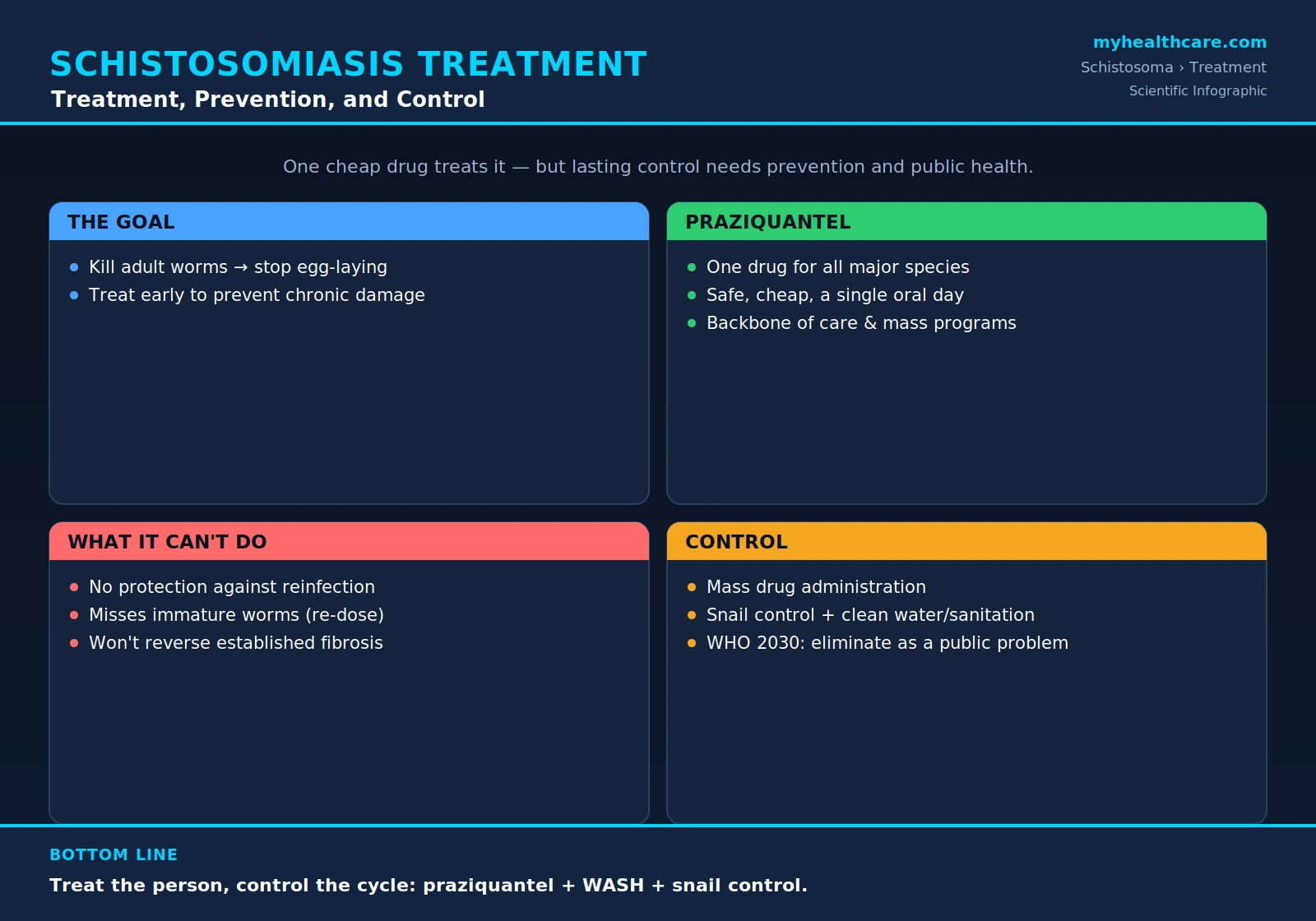
The purpose of treating schistosomiasis is straightforward: kill the adult worms so they stop laying eggs. This matters because the worms themselves cause surprisingly little direct harm. It is the eggs — vast numbers of them, produced continuously over years — that drive nearly all of the disease. Many eggs become trapped in the tissues of the bladder, intestine, and liver, where the body surrounds each one with inflammation. Over time that chronic inflammation hardens into scar tissue (fibrosis), and the scarring is what produces the most serious complications of long-standing infection.
Because the damage accumulates egg by egg, the single most important principle of treatment is to treat early. Clearing the worms while a person is still young, or soon after infection, stops the steady deposition of new eggs and prevents the gradual march toward irreversible chronic disease. A child treated before years of egg-laying have scarred the liver or bladder can expect a far better outcome than an adult whose organs have already been remodeled by decades of infection. In this sense, the goal of treatment is not only to cure the current infection but to halt new tissue damage before it becomes permanent.
2. Praziquantel — One Drug for All Major Species
Almost the entire global effort against schistosomiasis rests on a single medicine: praziquantel. It is remarkable for how much it accomplishes with how little. It is active against all of the major human Schistosoma species — S. haematobium (which causes urinary disease), S. mansoni and S. japonicum (intestinal and liver disease), and the less common S. mekongi and S. intercalatum. One drug covers the whole spectrum.
Praziquantel is also safe, cheap, and simple to give. It is taken by mouth, usually as a single dose (sometimes split across one day), with side effects that are generally mild and short-lived — nausea, abdominal discomfort, dizziness, or headache that pass within hours. It is inexpensive enough to be distributed to tens of millions of people each year. For all these reasons praziquantel is the backbone of both individual care and mass programs: it is what a traveler takes after a diagnosis, and it is what a schoolchild swallows during a community deworming campaign. For a detailed look at how the drug works, how a dose is calculated, what its limits are, and why some people need to be re-treated, see the dedicated Praziquantel Treatment page.
3. What Treatment Can and Cannot Do
Praziquantel is excellent at what it does, but it is important to understand its boundaries — because misunderstanding them leads to disappointment and, sometimes, to missed disease.
First, treatment does not protect against reinfection. Curing the worms confers no lasting immunity. A person who is treated and then returns to the same infested pond, river, or irrigation canal can be infected all over again within weeks. In communities where exposure is part of daily life — fishing, farming, fetching water, washing clothes, children swimming — reinfection is the rule, not the exception. This is precisely why prevention and repeated mass treatment, not a one-time cure, anchor the global strategy.
Second, praziquantel works mainly on adult worms and is much less effective against the immature, migrating stages of the parasite. This has a practical consequence in acute schistosomiasis (Katayama syndrome), the feverish illness that can appear a few weeks after a first heavy exposure, when the parasites are still maturing. Treating too early may fail to clear worms that have not yet become susceptible, so timing and retreatment matter — a dose given during the acute phase is often repeated weeks later, once the worms have matured, to ensure the infection is actually cleared.
Third, and most sobering, established fibrosis may not reverse. Killing the worms stops new eggs and new damage, and in children and in earlier disease a surprising amount of organ change can heal. But once scarring is advanced — a heavily fibrosed liver, a thickened and damaged bladder wall — that structural injury can be permanent. The worms are gone, yet the complications they set in motion may persist. This is the deepest reason that treating early, before fibrosis sets, is so much more valuable than treating late.
4. Managing Chronic Complications
When schistosomiasis has gone untreated for years, deworming is necessary but no longer sufficient. The chronic complications that follow from long-term egg deposition require their own specialist care that goes beyond killing the parasite. Among the most important are:
- Portal hypertension and variceal bleeding. In hepatosplenic disease caused by S. mansoni or S. japonicum, eggs lodged in the liver provoke a characteristic scarring around the portal blood vessels. This raises the pressure in the portal venous system (portal hypertension), which forces blood through fragile collateral veins in the esophagus and stomach. These swollen veins (varices) can rupture and bleed catastrophically. Managing them is the work of gastroenterology and hepatology — endoscopic treatment of varices, medications to lower portal pressure, and, in selected cases, surgery — not something praziquantel can address.
- Bladder damage from urinary disease. Years of S. haematobium eggs in the bladder wall produce chronic inflammation, scarring, and sometimes obstruction of the ureters and damage to the kidneys; long-standing infection is also a recognized risk factor for bladder cancer. These problems fall to urology — imaging, surveillance, and surgical management as needed.
- Female genital schistosomiasis (FGS). In girls and women, S. haematobium eggs can lodge in the tissues of the cervix, vagina, and vulva, causing lesions, bleeding, pain, and increased vulnerability to other infections, including HIV. FGS is widely under-recognized and needs dedicated gynecological attention; while early praziquantel can prevent it, established lesions require their own assessment and care.
For more on how these complications present, and how the underlying urinary and intestinal-hepatic disease is recognized, see the Urogenital Schistosomiasis and Intestinal and Hepatic Schistosomiasis pages.
5. Prevention for Individuals
For a single person — a resident of an endemic area, an aid worker, or a traveler — the most reliable protection is also the simplest: avoid contact with fresh water in endemic areas. The infectious larvae (cercariae) are released from freshwater snails and swim freely in lakes, slow rivers, ponds, dams, and irrigation channels, ready to penetrate intact skin within minutes of contact. They are not found in the open sea, and they are killed by proper water treatment. The core message is therefore blunt: in regions where schistosomiasis occurs, do not swim, wade, bathe, or paddle in fresh water, however clean and inviting it looks.
Practical measures that follow from this principle include drinking only safe (treated, bottled, or boiled) water; heating bathing water or letting stored water stand before use; and, when freshwater contact truly cannot be avoided, drying the skin vigorously afterward — though none of these is a guaranteed substitute for staying out of the water. It is also worth being clear about what does not exist: there is no vaccine against schistosomiasis. Despite decades of research and several promising candidates, no licensed vaccine is available, so personal protection rests entirely on avoiding exposure. For a fuller, practical guide to staying safe, see the Prevention: Avoiding Freshwater page.
6. Control at the Population Level
Protecting individuals is necessary, but lifting the burden off an entire endemic community requires a coordinated public-health strategy. The World Health Organization frames this around several complementary tools that work together:
- Preventive chemotherapy (mass drug administration). The centerpiece is the periodic, large-scale distribution of praziquantel to whole at-risk populations — most often delivered through schools, since school-age children carry the heaviest worm burdens and shed the most eggs. By treating everyone at risk on a regular schedule, regardless of whether each person has been individually tested, these campaigns drive down the overall intensity of infection in a community and, with it, the rate of transmission. The intervals between rounds are set by how common infection is in that area.
- Snail control. Every Schistosoma parasite must pass through a specific freshwater snail to complete its life cycle, so reducing snail populations breaks the chain of transmission. This can be done with molluscicides (chemicals that kill snails), by modifying habitats, or, more recently, by restoring natural snail predators such as river prawns — an approach that can suppress transmission without repeated chemical use.
- Water, sanitation, and hygiene (WASH). Transmission ultimately depends on human waste reaching fresh water (where parasite eggs hatch and infect snails) and on people contacting that water. Providing safe water supplies, building and using latrines, and offering safe places to bathe and wash all reduce both ends of the cycle. WASH is what makes gains durable: without it, communities slide back into transmission no matter how many treatment rounds they receive.
These population-level efforts — mass treatment, snail control, and sanitation — are described in more depth on the Mass Drug Administration and Control page.
7. The Road to Elimination
For most of its history, schistosomiasis was managed simply by reducing illness — treating enough people to limit severe disease. The ambition has now grown far larger. The WHO 2030 roadmap for neglected tropical diseases targets schistosomiasis for elimination as a public-health problem across endemic countries, with the longer-term goal of interrupting transmission entirely in some settings. This represents a shift from merely controlling the disease to actively driving it toward disappearance.
The path there is genuinely promising. Praziquantel is cheap and effective, donation programs have made hundreds of millions of treatments available, and the combination of mass treatment with snail control and improved sanitation has eliminated or nearly eliminated the disease in several countries. Yet two stubborn obstacles remain. The first is reinfection: because treatment confers no lasting immunity and the snails and contaminated water persist, gains can evaporate the moment programs lapse — durable success demands sustained effort over many years, not a single push. The second is access: reaching the poorest and most remote communities, where the disease is concentrated, is logistically hard and chronically underfunded, and people missed by campaigns become reservoirs that seed new infections. Closing those two gaps — keeping treatment going long enough, and reaching everyone who needs it — is the real work of the road to elimination.
Key Research Papers
Peer-reviewed reviews and studies on the treatment, prevention, and control of human schistosomiasis — covering the drug praziquantel, the spectrum of disease and its lasting morbidity, snail and environmental control, and the global strategy for elimination. Journal names appear as plain text; the year/volume/pages link opens the full citation via DOI.
- Colley DG, Bustinduy AL, Secor WE, King CH. Human Schistosomiasis. The Lancet. 2014;383(9936):2253–2264. — doi:10.1016/S0140-6736(13)61949-2
- McManus DP, Dunne DW, Sacko M, Utzinger J, Vennervald BJ, Zhou XN. Schistosomiasis. Nature Reviews Disease Primers. 2018;4:13. — doi:10.1038/s41572-018-0013-8
- Gryseels B, Polman K, Clerinx J, Kestens L. Human Schistosomiasis. The Lancet. 2006;368(9541):1106–1118. — doi:10.1016/S0140-6736(06)69440-3
- Vale N, Gouveia MJ, Rinaldi G, Brindley PJ, Gärtner F, Correia da Costa JM. Praziquantel for Schistosomiasis: Single-Drug Metabolism Revisited, Mode of Action, and Resistance. Antimicrobial Agents and Chemotherapy. 2017;61(5):e02582-16. — doi:10.1128/AAC.02582-16
- Doenhoff MJ, Cioli D, Utzinger J. Praziquantel: Mechanisms of Action, Resistance and New Derivatives for Schistosomiasis. Current Opinion in Infectious Diseases. 2008;21(6):659–667. — doi:10.1097/QCO.0b013e328318978f
- Olliaro PL, Vaillant MT, Belizario VJ, et al. A Multicentre Randomized Controlled Trial of the Efficacy and Safety of Single-Dose Praziquantel at 40 mg/kg vs. 60 mg/kg for Treating Intestinal Schistosomiasis. PLoS Neglected Tropical Diseases. 2011;5(6):e1165. — doi:10.1371/journal.pntd.0001165
- King CH, Dickman K, Tisch DJ. Reassessment of the Cost of Chronic Helminthic Infection: A Meta-Analysis of Disability-Related Outcomes in Endemic Schistosomiasis. The Lancet. 2005;365(9470):1561–1569. — doi:10.1016/S0140-6736(05)66457-4
- Sokolow SH, Huttinger E, Jouanard N, et al. Reduced Transmission of Human Schistosomiasis after Restoration of a Native River Prawn that Preys on the Snail Intermediate Host. Proceedings of the National Academy of Sciences. 2015;112(31):9650–9655. — doi:10.1073/pnas.1502651112
- Grimes JET, Croll D, Harrison WE, Utzinger J, Freeman MC, Templeton MR. The Relationship between Water, Sanitation and Schistosomiasis: A Systematic Review and Meta-Analysis. PLoS Neglected Tropical Diseases. 2014;8(12):e3296. — doi:10.1371/journal.pntd.0003296
- Rollinson D. A Wake Up Call for Urinary Schistosomiasis: Reconciling Research Effort with Public Health Importance. Parasitology. 2009;136(12):1593–1610. — doi:10.1017/S0031182009990552
PubMed Topic Searches
Each link opens a live PubMed query so results stay current as new papers are indexed.
- PubMed: Schistosomiasis treatment praziquantel
- PubMed: Praziquantel efficacy Schistosoma
- PubMed: Schistosomiasis mass drug administration
- PubMed: Schistosomiasis preventive chemotherapy
- PubMed: Schistosomiasis snail control transmission
- PubMed: Schistosomiasis elimination and control
- PubMed: Schistosomiasis water sanitation hygiene
- PubMed: Schistosomiasis reinfection after praziquantel
Connections
- All Parasites
- Schistosoma Overview
- Symptoms & Diagnosis
- Urogenital Schistosomiasis
- Intestinal & Hepatic Schistosomiasis
- Acute Schistosomiasis & Swimmer's Itch
- Praziquantel Treatment
- Prevention: Avoiding Freshwater
- Mass Drug Administration & Control
- Infectious Disease
- Gastroenterology
- Urology
- All Conditions
- Schistosomiasis (Infectious Disease Overview) — the blood-fluke disease, its global burden, and its complications.