Acute Schistosomiasis and Swimmer's Itch
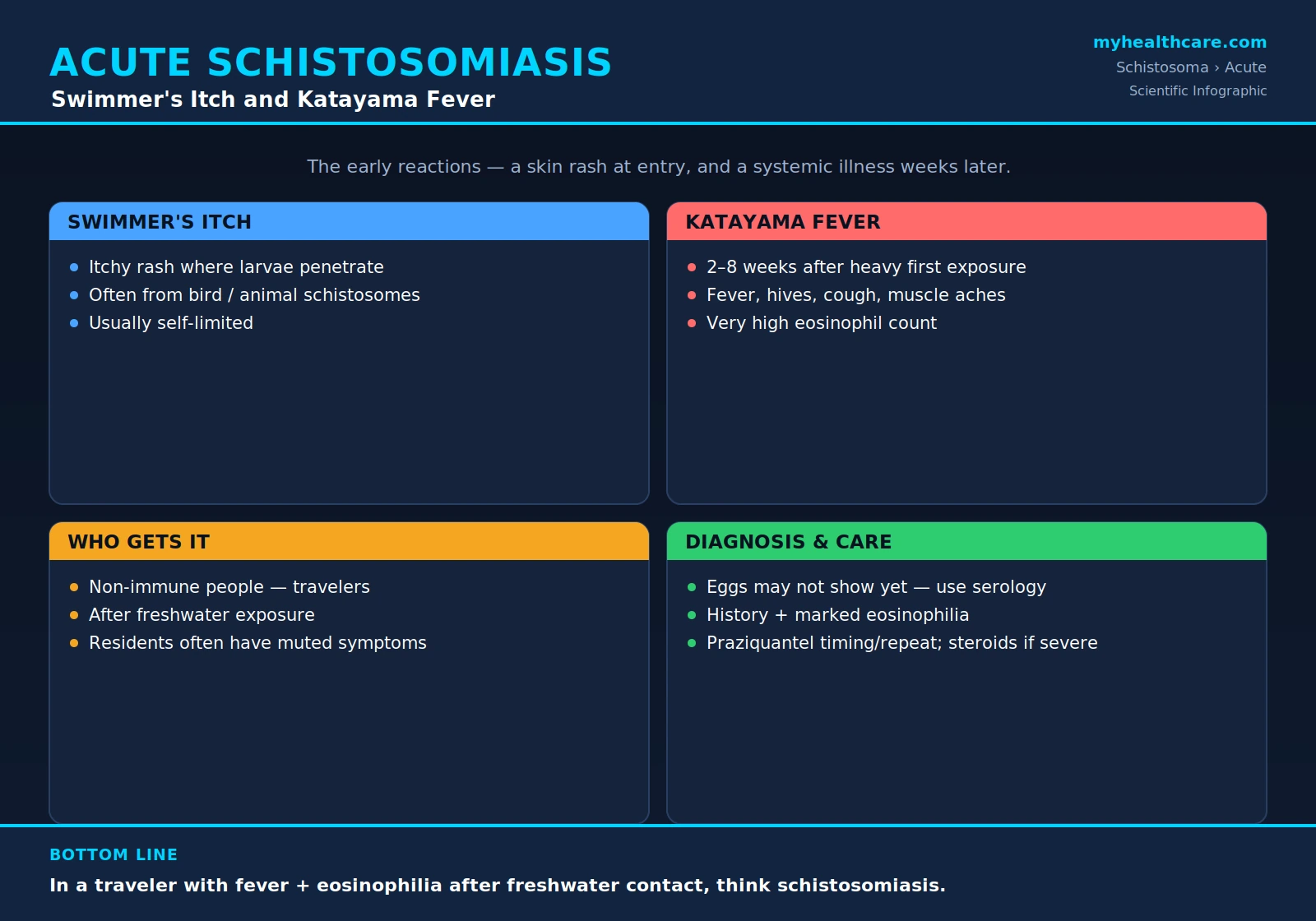
The earliest signs of contact with schistosome parasites have nothing to do with the long-term bladder or bowel disease that schistosomiasis is famous for. They are two short-lived, mostly self-limited reactions that happen close to the moment of exposure: an itchy skin rash where the larvae burrow in, and a whole-body allergic illness that can erupt weeks later. This page explains both — swimmer's itch (cercarial dermatitis) and Katayama fever (acute schistosomiasis) — who gets them, why they happen, why they are so easy to misdiagnose, and how they are managed. For the chronic disease that can follow, see the Urogenital and Intestinal & Hepatic pages.
Table of Contents
- Two Early Reactions
- Swimmer's Itch / Cercarial Dermatitis
- Why It Itches
- Katayama Fever / Acute Schistosomiasis
- Who Gets Acute Disease
- Diagnosis Is Tricky Early
- Management
- Key Research Papers
- Featured Videos
1. Two Early Reactions
When a person wades or swims in fresh water carrying schistosome parasites, the larvae — called cercariae — do not float into the body passively. They actively detect the skin, attach, and bore through it within minutes. That penetration is the start of infection, and it triggers the first of two early-stage problems this page covers.
These two reactions are easy to confuse, but they are distinct in timing, mechanism, and meaning:
- Swimmer's itch (cercarial dermatitis) is the skin reaction. It is a local, itchy rash at the points where cercariae burrow in, appearing within hours of water contact.
- Katayama fever (acute schistosomiasis) is the whole-body reaction. It is a systemic, flu-like, allergic illness that arrives weeks later, as the surviving worms mature and the female parasites begin laying their first eggs.
One is a rash you can see and scratch; the other is a fever-and-fatigue illness that an emergency room can easily mistake for something else. Crucially, swimmer's itch is most often not caused by the human-infecting schistosomes at all, while Katayama fever always reflects a genuine, developing human infection. Understanding the difference is the key to this whole topic.
2. Swimmer's Itch / Cercarial Dermatitis
Swimmer's itch, known medically as cercarial dermatitis, is an itchy, raised, red rash that develops where schistosome cercariae burrow into the skin. Tingling or itching can begin within minutes to a few hours of leaving the water, followed over the next day by small red bumps — sometimes blistering — concentrated on skin that was exposed to the water (the rash typically spares areas covered by a swimsuit, where larvae could not reach).
The single most important fact about swimmer's itch is the source of most cases. Worldwide, the great majority of cercarial dermatitis is caused not by the human blood flukes but by schistosomes of birds and other animals — ducks, geese, gulls, and aquatic mammals — whose larvae are released by freshwater (and sometimes brackish or saltwater) snails. These avian and animal cercariae mistake a swimming human for their normal host. They penetrate the skin, but they cannot mature or reproduce in a person; the immune system kills them right there in the skin. The result is an annoying, self-limited rash and nothing more. This is why classic swimmer's itch — common around lakes in North America, Europe, and elsewhere — is not "true" schistosomiasis and carries no risk of the chronic bladder or bowel disease.
The human-infecting species (Schistosoma mansoni, S. haematobium, S. japonicum, and others) can also produce a penetration rash when their cercariae enter the skin. In that setting the dermatitis is the visible opening act of a real infection that may go on to cause acute or chronic schistosomiasis. So the same-looking rash can mean two very different things depending on the species and the location: a harmless reaction to bird parasites, or the first footprint of a human blood fluke. Geography and exposure history — a North American lake versus an African river — are the practical clues that distinguish them.
For the harmless avian form, the rash is self-limited and usually fades over about a week as the trapped larvae are destroyed.
3. Why It Itches
The itch of cercarial dermatitis is not caused by the larvae crawling around or by mechanical irritation. It is an allergic, immune-driven reaction to the cercariae dying in the skin. As the larvae penetrate and are killed, their disintegrating bodies release foreign proteins (antigens) into the surrounding tissue. The immune system recognizes these proteins and mounts an inflammatory hypersensitivity response — releasing histamine and recruiting immune cells — which produces the redness, swelling, bumps, and intense itching.
This allergic basis explains a characteristic feature of swimmer's itch: repeat exposures cause stronger reactions. The first time someone is exposed, the rash may be mild or even unnoticed, because the immune system has not yet been sensitized to the larval antigens. Once sensitized, later exposures trigger a faster and more vigorous response, so people who swim repeatedly in affected water often develop progressively itchier and more pronounced rashes. It is the same principle that makes many other allergies worsen with repeated contact.
Because the reaction is immune-mediated rather than infectious in the avian form, treatment is aimed at calming the allergic response and relieving the itch, not at killing a parasite — there is no living, multiplying organism left to kill.
4. Katayama Fever / Acute Schistosomiasis
Katayama fever, also called acute schistosomiasis, is a systemic illness that appears weeks after the initial exposure — typically 2 to 8 weeks following a heavy first contact with contaminated fresh water. Unlike swimmer's itch, it is not a skin event; it is a whole-body reaction that coincides with the parasites maturing into adult worms and the females releasing their first wave of eggs.
The mechanism is a systemic hypersensitivity (allergic) reaction: as worms mature and eggs begin to be produced and deposited in the tissues, the body is suddenly flooded with new parasite antigens, and the immune system reacts strongly throughout the body. The resulting illness can include:
- Fever and chills.
- Fatigue and a general feeling of being unwell (malaise).
- Muscle aches (myalgia) and headache.
- Cough, which can be prominent.
- Hives or an urticarial rash (itchy welts), reflecting the allergic nature of the reaction.
- Abdominal pain, sometimes with diarrhea.
- Enlargement of the liver and spleen in some patients.
- A very high eosinophil count on a blood test (marked eosinophilia) — one of the most telling laboratory clues, as eosinophils are the white blood cells that surge in response to parasites and allergy.
Katayama fever is most often seen in travelers and others who have no prior immunity to schistosomes — people meeting the parasite for the first time. It is sometimes severe and, rarely, can involve serious complications when egg-related inflammation reaches sensitive organs. Because the worms themselves are still maturing during this phase, the timing of treatment matters (see Management).
5. Who Gets Acute Disease
Acute schistosomiasis is overwhelmingly a disease of the non-immune — people whose immune systems have never encountered schistosomes before. The classic patients are travelers, migrants, missionaries, aid workers, soldiers, and adventure tourists who have freshwater exposure in an endemic region: swimming in a river or lake, rafting, wading to cross water, or bathing. A single afternoon in the wrong stretch of African fresh water has caused outbreaks of Katayama fever in entire tour groups returning home.
This is in sharp contrast to long-term residents of endemic areas, who are often first exposed in early childhood and are repeatedly re-exposed throughout life. Their immune systems have adapted to the parasite over years, and as a result they usually do not develop a dramatic acute illness on re-infection — their acute symptoms are typically muted or absent, even though they may still carry worms and go on to develop chronic disease. In endemic populations, schistosomiasis tends to present as the slow, chronic organ damage covered on the other Symptoms pages, rather than as the explosive allergic fever seen in first-time visitors.
The practical lesson for clinicians is that any traveler returning from a schistosomiasis-endemic region with unexplained fever, fatigue, and a high eosinophil count — especially with a history of freshwater contact — should be evaluated for acute schistosomiasis, even if they feel they "only went in for a minute."
6. Diagnosis Is Tricky Early
Acute schistosomiasis is notoriously hard to diagnose, and the central reason is a matter of timing. The standard confirmatory test for schistosomiasis is finding parasite eggs in stool or urine. But during the acute, Katayama-fever phase, the worms have only just begun to lay eggs — or have not started yet — so eggs may not yet appear in the stool or urine at all. A patient can be acutely, even severely, ill while their egg tests are still negative. Relying on egg microscopy alone at this stage will frequently miss the diagnosis.
Because of this gap, early diagnosis leans on indirect evidence:
- Exposure history. A clear account of freshwater contact in an endemic region, with symptoms beginning weeks later, is often the strongest clue.
- Marked eosinophilia. A strikingly elevated eosinophil count in a returning traveler with fever points firmly toward a tissue-invading parasite such as a schistosome.
- Antibody (serology) testing. Blood tests that detect antibodies against schistosome antigens can become positive before eggs are detectable, helping to confirm exposure during the acute window. (Antibody tests cannot, however, distinguish a current from a past infection, which is one of their limitations.)
Because the egg-shedding phase catches up over time, a key strategy is repeat egg testing later: an initially negative stool or urine examination is repeated weeks afterward, by which point patent egg production has usually begun and the diagnosis can be confirmed directly. In specialized centers, newer tests that detect schistosome DNA or circulating parasite antigens in blood or urine can also help bridge the early diagnostic gap. The takeaway is that a single negative egg test early on does not rule out acute schistosomiasis — the clinical picture and follow-up testing matter just as much.
7. Management
The two early reactions are managed very differently, because one is a finished allergic event and the other is an active, evolving infection.
Swimmer's itch (cercarial dermatitis) is treated with simple, soothing care. Because the larvae are already dead and the problem is an allergic skin reaction, management focuses on relieving the itch and preventing a scratch-related skin infection: cool compresses, anti-itch lotions (such as calamine), colloidal oatmeal baths, topical corticosteroid creams for inflammation, and oral antihistamines to dampen the allergic response. The rash resolves on its own over roughly a week, and antiparasitic drugs are not needed for the harmless avian form.
Katayama fever (acute schistosomiasis) is more complex, and its care should be specialist-guided. The mainstay drug for schistosomiasis is praziquantel, but there is an important catch: praziquantel reliably kills only the adult worms and is far less effective against the immature, developing stages (schistosomula) that are present during the acute phase. Treating too early, while the worms are still maturing, can therefore fail to clear the infection. For this reason, clinicians carefully consider the timing of treatment and the use of repeat dosing — often treating during the acute illness and then giving a second course of praziquantel weeks later, once any remaining worms have matured and become susceptible.
A further consideration is that praziquantel itself can transiently worsen the allergic reaction as dying worms release more antigen. In severe Katayama fever, corticosteroids are sometimes given alongside or before antiparasitic treatment to control the intense hypersensitivity response and protect against complications. Decisions about drug timing, repeat dosing, and steroid use are individualized and belong with infectious-disease or tropical-medicine specialists. For the full treatment picture, see the Praziquantel page; and for the best protection of all — not entering the parasite's water in the first place — see Prevention and Avoiding Freshwater and the broader Treatment & Prevention overview.
Key Research Papers
Peer-reviewed reviews and reports on the early phases of schistosome infection — cercarial penetration and swimmer's itch, the Katayama-fever (acute schistosomiasis) syndrome, and its diagnosis in returning travelers. Journal names appear as plain text; the year/volume/pages link opens the full citation via DOI.
- Ross AG, Bartley PB, Sleigh AC, Olds GR, et al. Schistosomiasis. New England Journal of Medicine. 2002;346(16):1212–1220.
- Ross AG, Vickers D, Olds GR, Shah SM, McManus DP. Katayama Syndrome. The Lancet Infectious Diseases. 2007;7(3):218–224.
- Jauréguiberry S, Paris L, Caumes E. Acute Schistosomiasis, a Diagnostic and Therapeutic Challenge. Clinical Microbiology and Infection. 2010;16(3):225–231.
- Rochat L, Bizzini A, Senn N, Bochud PY, Genton B, et al. Acute Schistosomiasis: A Risk Underestimated by Travelers and a Diagnosis Frequently Missed by General Practitioners. Journal of Travel Medicine. 2015;22(3):168–173.
- Clerinx J, Bottieau E, Wichmann D, Tannich E, Van Esbroeck M. Acute Schistosomiasis in a Cluster of Travelers From Rwanda: Diagnostic Contribution of Schistosome DNA Detection in Serum. Journal of Travel Medicine. 2011;18(6):367–372.
- Horák P, Mikeš L, Lichtenbergová L, Skála V, Soldánová M, et al. Avian Schistosomes and Outbreaks of Cercarial Dermatitis. Clinical Microbiology Reviews. 2015;28(1):165–190.
- Colley DG, Bustinduy AL, Secor WE, King CH. Human Schistosomiasis. The Lancet. 2014;383(9936):2253–2264.
- Gryseels B, Polman K, Clerinx J, Kestens L. Human Schistosomiasis. The Lancet. 2006;368(9541):1106–1118.
- McManus DP, Dunne DW, Sacko M, Utzinger J, Vennervald BJ, et al. Schistosomiasis. Nature Reviews Disease Primers. 2018;4:13.
Live PubMed Searches
Each link opens a live PubMed query so results stay current as new papers are indexed.
- Acute schistosomiasis Katayama fever
- Cercarial dermatitis swimmer's itch
- Avian schistosomes cercarial dermatitis
- Acute schistosomiasis travelers eosinophilia
- Katayama syndrome praziquantel corticosteroids
- Schistosomiasis serology early diagnosis
- Imported schistosomiasis returning travelers
- Cercariae skin penetration immune response
Connections
- All Parasites
- Schistosoma Overview
- Symptoms & Diagnosis
- Urogenital Schistosomiasis
- Intestinal & Hepatic Schistosomiasis
- Treatment & Prevention
- Praziquantel Treatment
- Prevention & Avoiding Freshwater
- Mass Drug Administration & Control
- Dermatology
- Infectious Disease
- Urology
- Gastroenterology
- All Conditions
- Schistosomiasis — the main disease overview, covering the chronic infection that follows these early reactions.