Mass Drug Administration and Schistosomiasis Control
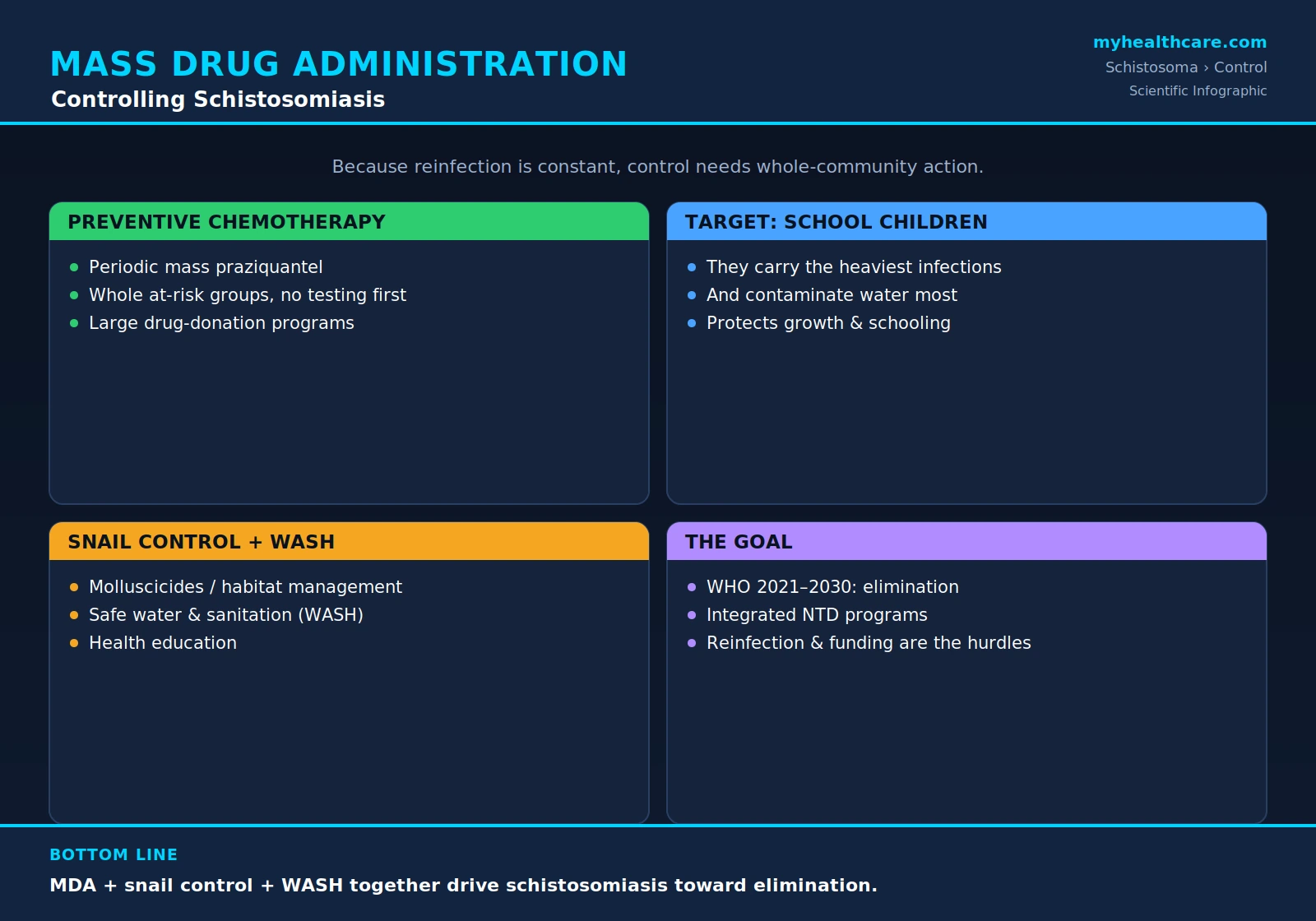
Treating one person who has schistosomiasis is straightforward: a single course of praziquantel kills most of the adult worms and lets the body heal. But curing individuals one at a time does little to push back a disease that infects more than 200 million people across Africa, the Middle East, Asia, and South America. Where the parasite's freshwater snail host still lives in the water people use every day, a person who is cured today can be reinfected within weeks. Lasting progress therefore depends on something larger than the clinic: a coordinated public-health strategy that treats whole communities, attacks the snail, supplies clean water and toilets, and teaches people how the parasite spreads. This page explains how schistosomiasis is controlled at the level of populations — the tools, the logic behind them, and the obstacles that still stand between control and elimination.
Table of Contents
- From Individual Cure to Population Control
- Preventive Chemotherapy / Mass Drug Administration
- Why School-Age Children Are Targeted
- Snail Control
- Water, Sanitation, and Hygiene (WASH)
- Health Education and Behavior Change
- The Push Toward Elimination
- The Hard Parts
- Key Research Papers
- Featured Videos
1. From Individual Cure to Population Control
Schistosomiasis is a disease of the environment as much as of the body. The adult worms living in a person's blood vessels do not multiply inside the human host; instead, the eggs they produce leave the body in urine or stool, hatch in fresh water, and infect a particular species of freshwater snail. Inside the snail the parasite multiplies enormously, and weeks later thousands of swimming larvae (cercariae) emerge from the snail into the water, ready to burrow through the skin of anyone who wades, washes, swims, or fishes there. As long as that cycle keeps turning in the local water, infection is not a one-time event — it is a steady, repeated exposure.
This is why treating sick individuals, while essential and humane, cannot by itself control the disease in a community where transmission continues. A child cured with praziquantel today is still drinking, bathing, and playing in the same infested stream tomorrow, and the snails in that stream are still shedding cercariae. Reinfection is constant. Studies repeatedly show that worm burdens rebound after treatment unless the underlying transmission is also reduced. Controlling schistosomiasis therefore requires population-wide action — interrupting the cycle at several points at once — rather than a clinic-by-clinic, patient-by-patient response.
The modern strategy recognizes this by working on two fronts simultaneously. The first front aims to reduce the burden of disease in people now, mainly through repeated mass treatment, so that infected individuals carry fewer worms and suffer less of the organ damage the parasite causes. The second front aims to shrink transmission itself — through snail control, clean water, sanitation, and behavior change — so that the gains from treatment are not erased by a fresh wave of infection. Used together over years, these approaches can drive prevalence and intensity steadily downward.
2. Preventive Chemotherapy / Mass Drug Administration (MDA)
The cornerstone of modern schistosomiasis control is a strategy the World Health Organization (WHO) calls preventive chemotherapy, delivered through mass drug administration (MDA). The idea is deliberately simple. Rather than testing every individual for infection — which is slow, expensive, and impractical at scale — entire at-risk groups are offered a dose of praziquantel periodically, typically once a year, regardless of whether any given person is known to be infected. Because praziquantel is safe and the disease is so common in endemic areas, treating everyone in a high-risk group is more efficient and reaches more truly infected people than trying to find and treat them one by one.
The biological rationale rests on a key feature of the disease: most of the harm schistosomiasis causes is driven by the intensity of infection — the number of worms and, above all, the number of eggs they lodge in the body's tissues — rather than by mere presence of the parasite. Periodic mass treatment dramatically lowers that egg burden across the whole population. Even if some people become reinfected between treatment rounds, keeping their worm and egg loads low year after year prevents the slow accumulation of tissue damage that leads to the disease's worst consequences: liver fibrosis and portal hypertension in intestinal disease, and bladder damage, kidney injury, and increased cancer risk in urogenital disease. The goal of MDA, in WHO's framing, is to control morbidity — the suffering and organ damage — not necessarily to cure every individual.
Historically, MDA campaigns focused on school-age children, who carry the heaviest infections and are reached efficiently through schools. As programs have matured and ambitions have shifted from controlling disease toward interrupting transmission, WHO has increasingly recommended treating whole at-risk communities — including adults — in places where prevalence is high, because children alone are not the only ones contaminating the water or suffering from the disease.
None of this would be possible without an extraordinary supply of medicine. Praziquantel for these programs is provided in enormous quantities through large-scale donation programs — most prominently a long-standing pharmaceutical donation channeled through WHO — that ship hundreds of millions of tablets to endemic countries each year. This donated supply, distributed by national ministries of health alongside partners, is what makes treating tens of millions of children annually financially feasible. The availability of cheap or donated praziquantel is one of the central reasons large-scale schistosomiasis control became practical at all.
3. Why School-Age Children Are Targeted
School-age children sit at the very center of schistosomiasis transmission, which is why nearly every control program begins with them. There are several overlapping reasons.
They carry the heaviest infections. Across endemic regions, the intensity of infection — the worm and egg burden — typically peaks in late childhood and the early teenage years before declining in adulthood. Children are the group most heavily parasitized, and therefore the group with the most to gain from treatment and the group whose treatment removes the largest share of parasites from the population.
They contaminate the water the most. The same children who are most heavily infected are also, through their behavior, among the biggest contributors to keeping the cycle going. Children swim, play, bathe, and urinate or defecate in or near the very water bodies that harbor the snails, seeding those waters with the parasite's eggs. Because they shed so many eggs and have so much contact with fresh water, reducing infection in children disproportionately reduces transmission for the entire community — an indirect benefit that protects untreated adults and toddlers as well.
The damage matters most while they are growing. Chronic schistosomiasis in childhood is not a trivial condition. It is associated with anemia, stunted growth and undernutrition, fatigue, and impaired performance and attendance at school. Treating children protects their physical development and their education at the stage of life when both are being built, with benefits that carry into adulthood. Reaching children through the existing structure of schools also makes treatment cheap, fast, and repeatable. Protecting the child, in short, protects the child's future and the wider community at the same time.
4. Snail Control
Because the parasite cannot complete its life cycle without passing through a freshwater snail, the snail is the cycle's single indispensable link — and therefore a logical target for attack. Killing or removing the snails breaks the chain between human waste and human infection no matter how many people are carrying the parasite. Snail control is one of the oldest tools in the field and remains a powerful complement to drug-based programs.
The most direct method is the use of molluscicides — chemicals that kill snails. The standard agent is niclosamide, applied to ponds, irrigation canals, and other transmission sites to reduce the snail population and, with it, the density of infectious cercariae in the water. Focal application of niclosamide at well-defined transmission "hot spots" can sharply cut local transmission, and historically, intensive molluscicide programs contributed to schistosomiasis control and even local elimination in several countries.
Snail numbers can also be reduced through environmental management — modifying the habitat so it can no longer support the snails or the contact between people and infested water. This includes clearing the aquatic vegetation that snails feed on and cling to, lining or maintaining irrigation canals, managing water flow and levels, and draining or filling marginal water bodies. A growing body of work also explores biological control, such as restoring native predators of the snails; for example, reintroducing river prawns that prey on the host snails has been shown to reduce snail densities and human reinfection in a West African transmission site. Snail control is most effective when transmission is concentrated in a limited number of identifiable water sites, and when it is sustained — snail populations rebound quickly if pressure is removed. Used alongside mass treatment, it attacks the problem from the environmental side that drugs alone cannot reach.
5. Water, Sanitation, and Hygiene (WASH)
If snail control attacks the parasite's host, WASH attacks the two human behaviors that feed and sustain the cycle: contaminating fresh water with infected waste, and contacting that water in the first place. WASH — safe water supply, sanitation, and hygiene — is the part of the strategy that offers the most durable, structural protection, because it removes the conditions transmission depends on rather than repeatedly knocking the parasite back after the fact.
The two halves of WASH map directly onto the two halves of the life cycle:
- Sanitation stops human waste from reaching the snails. Latrines and proper disposal of urine and feces keep the parasite's eggs out of the ponds, streams, and canals where the snails live. If the eggs never reach fresh water, they cannot hatch, cannot infect snails, and cannot generate the next wave of cercariae.
- Safe water supply stops people from needing to enter infested water. When clean water for drinking, washing, cooking, and laundry is available close to home — from wells, pumps, or piped supplies — people no longer have to wade into the very ponds and rivers where cercariae are waiting. Safe places to swim and bathe serve the same purpose.
Reviews of the evidence find that access to safe water and adequate sanitation is associated with significantly lower odds of schistosome infection. WASH is essential for lasting control: mass treatment lowers the worm burden, but only safe water and sanitation can permanently sever the link between people and the parasite's habitat. The catch is that WASH requires sustained investment in infrastructure, which is slower and more expensive than distributing tablets — which is precisely why drug-based MDA, snail control, and WASH are meant to work together rather than as substitutes for one another.
6. Health Education and Behavior Change
Tablets, molluscicides, and wells all work better when the people they are meant to protect understand what is happening and choose to participate. Health education and behavior change form the human glue that holds a control program together, turning passive recipients into active partners in their own protection.
At its heart, education means teaching communities how transmission actually works — that the disease comes from contact with certain fresh water, that the snails in that water are part of the cycle, that urinating or defecating near water perpetuates it, and that the swimming larvae are invisible. This knowledge is empowering precisely because the cycle is otherwise mysterious: people cannot see the parasite, the snail's role, or the connection between today's swim and next month's blood in the urine. When a community understands the chain, the reasons behind every other intervention — taking the annual tablet, using the latrine, fetching water from the pump, keeping children out of the infested pond — suddenly make sense.
Practically, this translates into supporting safe water use and safe sanitation behavior: encouraging people to use the safe water sources and latrines that WASH programs provide, to avoid unnecessary contact with high-risk water, and to bring their children to school-based treatment days. Education also sustains the high participation (coverage) that mass drug administration needs to succeed, and it helps counter fear, rumor, or misunderstanding about the medicine. Behavior change is slow and culturally specific, and it cannot replace clean water or treatment — but without it, the other tools are used less, less consistently, and less well.
7. The Push Toward Elimination
For most of the modern era, the realistic goal of schistosomiasis programs was morbidity control — keeping infection intensities low enough to prevent serious organ damage. In the past decade, ambition has grown. The question is no longer only "how do we stop people from getting sick?" but increasingly "can we stop transmission altogether?"
The current global framework is the WHO 2021–2030 road map for neglected tropical diseases (NTDs). For schistosomiasis it sets two tiers of targets: elimination as a public-health problem — reducing heavy-intensity infections to very low levels — as a goal for endemic countries broadly, and the more demanding elimination of transmission (interrupting the cycle entirely) as a goal in selected countries where it is within reach. This represents a deliberate shift in mindset from indefinitely managing the disease toward actually ending it in defined places.
A second feature of the modern push is integration. Schistosomiasis rarely travels alone; the same impoverished communities are often burdened by other worm infections — soil-transmitted helminths such as roundworm, whipworm, and hookworm — and by other NTDs. Rather than mounting a separate campaign for each parasite, integrated NTD programs deliver several treatments together, sharing the same school days, community drug distributors, mapping, and supply chains. Treating several worms at once is far more cost-effective than treating each in isolation, and it has become the standard way large-scale deworming is organized. Modelling and program experience suggest that, with high and sustained coverage — and, crucially, with transmission-reducing measures layered on top of treatment — the road map's morbidity and elimination targets are achievable in many settings, though not effortlessly.
8. The Hard Parts
Schistosomiasis control works — prevalence and intensity have fallen substantially in many countries — but it is genuinely difficult, and the obstacles are the reason the disease still infects hundreds of millions of people. Several stand out.
Rapid reinfection. The single hardest fact about control is that praziquantel kills worms but confers no lasting immunity, so a treated person living beside infested water is reinfected quickly. Without parallel reductions in transmission — snail control, WASH, behavior change — treatment becomes a treadmill: the program runs hard every year just to keep infection from climbing back to where it started. See the Prevention page for how individuals reduce their own exposure between rounds.
Reaching everyone who is missed. School-based programs, by design, miss two important groups: pre-school children, who are too young for school but increasingly recognized as infected and harmed, and adults — especially fishers, farmers, and women doing laundry — whose occupational water contact sustains transmission. Closing these gaps means moving from school-based to community-wide treatment, which is harder and costlier to deliver, and (for the youngest children) has historically been complicated by the lack of a suitable pediatric praziquantel formulation.
Reliance on a single drug. Essentially the entire global strategy rests on praziquantel alone — one medicine, used over and over, across the whole world. This concentration is a strategic vulnerability: the drug does not kill the immature (juvenile) worms well, requiring repeat dosing, and decades of mass use raise the long-term concern of reduced susceptibility or resistance, for which there is no widely available backup drug. The Praziquantel page covers the drug's strengths and limits in detail.
Funding and sustained coverage. Control is not a one-time campaign but a commitment that must be renewed every year for many years — potentially decades — before transmission is durably broken. That demands stable funding, reliable drug donation, functioning health systems, and the ability to keep coverage high round after round. When attention, money, or political will fades — or when conflict, displacement, or a competing health emergency disrupts delivery — coverage drops, transmission rebounds, and hard-won gains can be lost. Sustaining the effort, year in and year out, in some of the world's poorest places, is ultimately the central challenge of schistosomiasis control.
Key Research Papers
Peer-reviewed reviews, meta-analyses, and program studies on the control of schistosomiasis — covering preventive chemotherapy and mass drug administration, the burden the disease imposes, snail and environmental control, water and sanitation, and the modern drive toward elimination. Journal names appear as plain text; the year/volume/pages link opens the full citation via DOI.
- Colley DG, Bustinduy AL, Secor WE, King CH. Human Schistosomiasis. The Lancet. 2014;383(9936):2253–2264.
- King CH, Dickman K, Tisch DJ. Reassessment of the Cost of Chronic Helminthic Infection: A Meta-Analysis of Disability-Related Outcomes in Endemic Schistosomiasis. The Lancet. 2005;365(9470):1561–1569.
- Ross AGP, Bartley PB, Sleigh AC, et al. Schistosomiasis. New England Journal of Medicine. 2002;346(16):1212–1220.
- Hotez PJ, Molyneux DH, Fenwick A, et al. Control of Neglected Tropical Diseases. New England Journal of Medicine. 2007;357(10):1018–1027.
- Colley DG, Secor WE. Immunology of Human Schistosomiasis. Parasite Immunology. 2014;36(8):347–357.
- Grimes JET, Croll D, Harrison WE, et al. The Relationship between Water, Sanitation and Schistosomiasis: A Systematic Review and Meta-Analysis. PLoS Neglected Tropical Diseases. 2014;8(12):e3296.
- Sokolow SH, Huttinger E, Jouanard N, et al. Reduced Transmission of Human Schistosomiasis after Restoration of a Native River Prawn That Preys on the Snail Intermediate Host. Proceedings of the National Academy of Sciences. 2015;112(31):9650–9655.
- Rollinson D, Knopp S, Levitz S, et al. Time to Set the Agenda for Schistosomiasis Elimination. Acta Tropica. 2013;128(2):423–440.
- Toor J, Alsallaq R, Truscott JE, et al. Are We on Our Way to Achieving the 2020 Goals for Schistosomiasis Morbidity Control Using Current World Health Organization Guidelines? Clinical Infectious Diseases. 2018;66(suppl_4):S245–S252.
Live PubMed Searches
Each link opens a live PubMed query so results stay current as new papers are indexed.
- Schistosomiasis mass drug administration
- Schistosomiasis preventive chemotherapy
- Snail control and molluscicides
- Schistosomiasis WASH
- Schistosomiasis elimination and control
- School-age children and morbidity
- Reinfection after treatment
- Integrated NTD control
Connections
- All Parasites
- Schistosoma Overview
- Symptoms & Diagnosis
- Urogenital Schistosomiasis
- Intestinal & Hepatic Schistosomiasis
- Acute Schistosomiasis & Swimmer's Itch
- Treatment & Prevention
- Praziquantel Treatment
- Prevention & Avoiding Freshwater
- Malaria
- Hookworm
- Ascaris (Roundworm)
- Infectious Disease
- All Conditions
- Schistosomiasis — the main disease overview these control programs are designed to eliminate.