Praziquantel: The Mainstay Treatment for Schistosomiasis
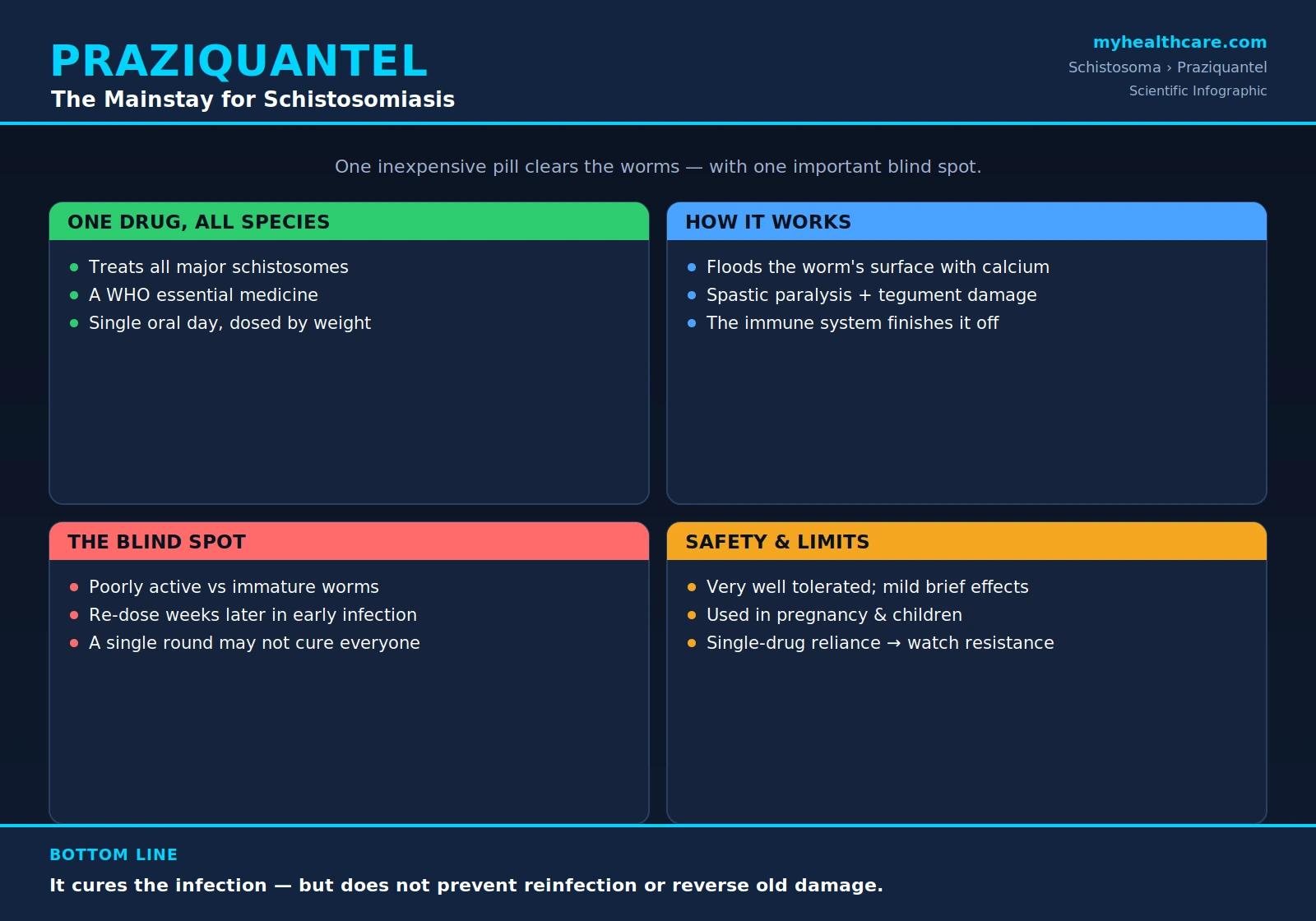
For nearly all forms of schistosomiasis, one medicine does the work: praziquantel. It is inexpensive, taken by mouth, usually given on a single day, and effective against every major species of the blood fluke that infects people. The World Health Organization (WHO) lists it among its essential medicines, and it is the drug delivered to hundreds of millions of people each year in mass-treatment campaigns across Africa, Asia, and South America. Yet praziquantel is not perfect — it has one important blind spot, it does not prevent reinfection, and decades of relying on a single drug have raised worries about resistance. This page explains how praziquantel works, what it does and does not do, how doctors check whether it worked, and where the science is heading.
Table of Contents
- One Drug, All Major Species
- How It Works
- The Big Limitation — It Misses Young Worms
- Safety and Side Effects
- Cure, Egg Reduction, and Retest
- Reliance on a Single Drug and Resistance Concerns
- Historical and Alternative Drugs
- What It Does Not Do
- Key Research Papers
- Featured Videos
1. One Drug, All Major Species
Schistosomiasis is caused by several species of the parasitic blood fluke Schistosoma. The three that infect the most people are S. mansoni and S. japonicum, which cause intestinal and liver disease, and S. haematobium, which causes urinary and genital disease. What makes praziquantel so valuable is that it works against all of them — and against most of the other human-infecting flukes (such as the liver flukes Clonorchis and Opisthorchis, and the lung fluke Paragonimus) and tapeworms as well. A single medicine covers an enormous range of parasites.
Because of this breadth, low cost, and good safety record, praziquantel is the global treatment of choice for schistosomiasis and appears on the WHO Model List of Essential Medicines. It is given as a short oral course, typically all on a single day, and the dose is calculated by body weight — the standard target for schistosomiasis is 40 mg per kilogram of body weight, sometimes divided into two doses a few hours apart, and 60 mg/kg for the often-harder-to-treat S. japonicum. Tablets are usually taken with food, which helps the body absorb the drug. In mass-treatment programs, a simple height-based "dose pole" is often used in place of a scale so that field workers can give the right amount quickly to large numbers of children.
2. How It Works
Praziquantel attacks the worm at its outer surface. A schistosome is covered by a living skin called the tegument, and it is this surface that the drug targets. Within minutes of exposure, praziquantel makes the tegument suddenly and abnormally permeable to calcium. Calcium normally sits in much higher concentration outside the worm's cells than inside, and the drug throws open a gateway that lets it flood in.
This rush of calcium has two devastating effects. First, the worm's muscles seize up in a sustained, rigid contraction — a spastic paralysis — that loosens the fluke's grip on the wall of the blood vessel where it has been living. Second, the tegument itself is damaged, blistering and unraveling so that proteins hidden underneath become exposed on the surface. With its hiding place blown, the paralyzed and surface-damaged worm is swept along the bloodstream to the liver, where the host's immune system recognizes the newly exposed antigens and destroys it. In other words, praziquantel does not poison the worm outright so much as cripple it and strip away its camouflage, letting the body finish the job — which is one reason the drug works less well in people whose immune defenses are severely weakened.
Exactly which molecule in the tegument senses the drug was debated for decades. Earlier work pointed to voltage-gated calcium channels, and more recent research has identified a specific transient receptor potential (TRP) calcium channel in the worm, called Sm.TRPMPZQ, as a direct target that praziquantel switches on — tying the long-observed "calcium influx" effect to a concrete protein.
3. The Big Limitation — It Misses Young Worms
Praziquantel has one critical blind spot, and understanding it explains a great deal about how the drug is used. The medicine is highly active against mature, adult worms but only poorly active against the immature stages — the young, still-developing flukes known as schistosomula that are present in the weeks after a person is first infected. There is a window, roughly the first three to six weeks after exposure, during which the parasites are partly or largely shielded from the drug. Susceptibility then returns as the worms mature.
This stage-dependent gap has real consequences:
- People treated during early or acute infection may not be cured by a single dose. If a traveler is treated soon after a freshwater exposure — while the worms are still immature — the parasites can survive and mature, and symptoms can return. For this reason, an initial dose is commonly repeated several weeks later (often around six to twelve weeks after exposure) to catch the worms once they have matured into a vulnerable stage.
- People with ongoing exposure need a different mindset. In communities where contact with contaminated water happens repeatedly, a person may always have some young, drug-resistant-by-virtue-of-immaturity worms on board. A single round of treatment lowers the worm burden but does not guarantee a complete cure, which is part of why control programs treat on a repeating schedule rather than once.
- A single round may not cure everyone, even with mature worms. In field studies, one dose typically cures a large fraction of people and dramatically reduces egg output in nearly all, but a minority remain egg-positive and benefit from re-treatment.
None of this means praziquantel is failing — it means the drug is being given at the wrong moment in the parasite's life cycle. The practical answer is timing and repetition: re-dose after the worms have grown up.
4. Safety and Side Effects
One of praziquantel's great virtues is how well tolerated it is. The vast majority of people experience either no side effects or only mild, short-lived ones that pass within a day. Commonly reported effects include:
- Abdominal discomfort or cramping, sometimes with nausea or, occasionally, vomiting.
- Dizziness, drowsiness, or headache.
- Mild fever, malaise, or itching in some people.
Importantly, many of these reactions are not caused by the drug acting on the patient so much as by the dying worms themselves. As large numbers of parasites are killed at once, the body mounts an inflammatory response to the disintegrating worms and released antigens. As a rule of thumb, the more worms a person is carrying, the more pronounced the post-treatment symptoms tend to be — so side effects are often a sign of a heavy infection being cleared rather than of drug toxicity.
Praziquantel's safety record is good enough that it is given routinely to young children and to pregnant and breastfeeding women in mass-treatment programs; the WHO concluded that the benefits of treating infected pregnant women outweigh any theoretical risks, and removed pregnancy as a barrier to treatment. The taste is bitter, which can be a practical hurdle for small children, and pediatric-friendly formulations have been developed to address this. People with neurocysticercosis (tapeworm cysts in the brain) or with schistosome eggs lodged in the spinal cord or brain require special caution and specialist supervision, because the inflammatory reaction to dying parasites in nervous tissue can itself be dangerous.
5. Cure, Egg Reduction, and Retest
How do you know whether praziquantel worked? You cannot easily see the worms, so success is judged indirectly — chiefly by counting the parasite eggs the worms shed, which appear in stool (for intestinal species) or urine (for S. haematobium). Two related measures are used:
- Cure rate — the proportion of treated people who have no detectable eggs when re-tested.
- Egg reduction rate — how far the average egg count drops compared with before treatment. Even when a few worms survive, a large fall in egg output greatly reduces a person's illness and their contribution to transmission.
In practice, egg reduction is usually excellent — commonly well above 90% — even in people who are not fully cured, while the complete cure rate is good but more variable. Because eggs can persist for a short time and because immature worms may have escaped the first dose, the standard advice is to re-test several weeks after treatment (often around four to six weeks, sometimes longer) rather than immediately. If eggs are still present, the patient is simply re-treated. This "treat, wait, check, re-treat if needed" loop is the backbone of both individual care and population-level control.
6. Reliance on a Single Drug and Resistance Concerns
For more than four decades, the world's response to schistosomiasis has rested almost entirely on one drug. That concentration is efficient, but it is also a strategic vulnerability. Whenever a single medicine is used at vast scale — hundreds of millions of treatments a year — there is steady evolutionary pressure on the parasite, and the natural worry is that strains with reduced susceptibility or outright resistance could emerge and spread.
The evidence so far is reassuring but not absolute. Praziquantel resistance can be selected for in the laboratory, and reduced cure rates have been reported from some heavily treated settings, raising legitimate concern. At the same time, decades of monitoring have not produced clear, widespread clinical resistance in the field, and lower cure rates in a given study can also reflect other factors — immature worms missed by treatment, intense ongoing reinfection, or differences in how the drug is absorbed. Because the stakes are so high, the response is vigilant surveillance of cure and egg-reduction rates and an active search for new and partner drugs so that the world is not caught flat-footed if resistance ever does take hold. For the program-level side of this story — how repeated, population-wide treatment is delivered and monitored — see Mass Drug Administration and Control.
7. Historical and Alternative Drugs
Before praziquantel swept the field, schistosomiasis was treated with several older, narrower drugs. They are mostly of historical interest now, but they remain worth knowing — both as a backup and as a reminder of why a single broad-spectrum drug was such an advance.
- Oxamniquine works only against S. mansoni (the intestinal species common in Africa and the Americas) and has no useful activity against S. haematobium or S. japonicum. It was used heavily in Brazil in particular but has largely been displaced by praziquantel; its main interest today is as a potential reserve agent and as a research tool, since its mechanism (it must be activated by an enzyme inside the worm) is well understood.
- Metrifonate works only against S. haematobium (the urinary species) and required multiple doses over several weeks, which made it cumbersome. It too has largely fallen out of routine use.
- Artemisinin derivatives (such as artesunate and artemether), best known as antimalarial drugs, are interesting precisely because they have the opposite specificity to praziquantel: they have some activity against the young, immature worms that praziquantel misses, while being weaker against adults. This complementarity has prompted research into combining an artemisinin with praziquantel, or using artemisinins for prevention in short-term high-risk exposures — though a major caveat is that widespread use in malaria-endemic regions risks encouraging artemisinin resistance in the malaria parasite, so this is approached cautiously.
The broad picture is that praziquantel made the older, species-specific drugs largely redundant, while the artemisinins represent the most promising direction for shoring up praziquantel's one weakness.
8. What It Does Not Do
Praziquantel is powerful, but it is important to be clear about its limits, because over-expecting from the drug leads to disappointment and avoidable harm.
- It does not prevent reinfection. Killing today's worms does nothing to stop new larvae (cercariae) from penetrating the skin during the next contact with contaminated freshwater. A person who is cured and then swims again in an infested lake can be reinfected within weeks. Lasting protection comes from avoiding exposure and from environmental and sanitation measures, not from the pill — see Prevention and Avoiding Freshwater.
- It does not reverse established organ damage. Much of the harm in chronic schistosomiasis comes from years of inflammation around trapped eggs, which leaves behind scarring (fibrosis) — in the liver, in the wall of the bladder, or elsewhere. Praziquantel can stop the process from getting worse by removing the egg-producing worms, and some early or mild fibrosis may improve over time once the inflammatory stimulus is gone, but well-established scarring is generally permanent.
- It does not undo cancer risk. Long-standing urinary schistosomiasis is a recognized risk factor for bladder cancer, and treating the worms does not erase the elevated risk that decades of chronic infection may have created.
In short, praziquantel is a cure for the infection, not a cure for everything the infection may already have caused. Its full value is realized only when it is paired with prevention and, where damage has occurred, with appropriate follow-up care.
Key Research Papers
Peer-reviewed reviews and primary studies on praziquantel — its pharmacology and mode of action, its activity against different developmental stages of the parasite, its clinical efficacy and safety, and the long-running questions of resistance and future drug development. Journal names appear as plain text; the year/volume/pages link opens the full citation via DOI.
- Vale N, Gouveia MJ, Rinaldi G, Brindley PJ, Gärtner F, Correia da Costa JM. Praziquantel for Schistosomiasis: Single-Drug Metabolism Revisited, Mode of Action, and Resistance. Antimicrobial Agents and Chemotherapy. 2017;61(5):e02582-16.
- Doenhoff MJ, Cioli D, Utzinger J. Praziquantel: Mechanisms of Action, Resistance and New Derivatives for Schistosomiasis. Current Opinion in Infectious Diseases. 2008;21(6):659–667.
- Colley DG, Bustinduy AL, Secor WE, King CH. Human Schistosomiasis. The Lancet. 2014;383(9936):2253–2264.
- Gryseels B, Polman K, Clerinx J, Kestens L. Human Schistosomiasis. The Lancet. 2006;368(9541):1106–1118.
- Xiao S-h, Catto BA, Webster LT. Effects of Praziquantel on Different Developmental Stages of Schistosoma mansoni in Vitro and in Vivo. Journal of Infectious Diseases. 1985;151(6):1130–1137.
- Park S-K, Gunaratne GS, Chulkov EG, Moehring F, McCusker P, Dosa PI, et al. The Anthelmintic Drug Praziquantel Activates a Schistosome Transient Receptor Potential Channel. Journal of Biological Chemistry. 2019;294(49):18873–18880.
- Greenberg RM. Are Ca2+ Channels Targets of Praziquantel Action? International Journal for Parasitology. 2005;35(1):1–9.
- Cioli D, Pica-Mattoccia L, Basso A, Guidi A. Schistosomiasis Control: Praziquantel Forever? Molecular and Biochemical Parasitology. 2014;195(1):23–29.
- Zwang J, Olliaro PL. Clinical Efficacy and Tolerability of Praziquantel for Intestinal and Urinary Schistosomiasis — A Meta-analysis of Comparative and Non-comparative Clinical Trials. PLoS Neglected Tropical Diseases. 2014;8(11):e3286.
- Liu R, Dong H-F, Guo Y, Zhao Q-P, Jiang M-S. Efficacy of Praziquantel and Artemisinin Derivatives for the Treatment and Prevention of Human Schistosomiasis: A Systematic Review and Meta-analysis. Parasites & Vectors. 2011;4:201.
Live PubMed Searches
Each link opens a live PubMed query so results stay current as new papers are indexed.
- Praziquantel schistosomiasis treatment
- Praziquantel mechanism of action (tegument, calcium)
- Praziquantel immature schistosomula stage
- Praziquantel resistance in Schistosoma
- Praziquantel cure rate and egg reduction
- Praziquantel pregnancy and children safety
- Artemisinin derivatives schistosomiasis prevention
- Oxamniquine and S. mansoni
Connections
- All Parasites
- Schistosoma Overview
- Symptoms & Diagnosis
- Urogenital Schistosomiasis
- Intestinal & Hepatic Schistosomiasis
- Acute Schistosomiasis & Swimmer's Itch
- Treatment & Prevention
- Prevention & Avoiding Freshwater
- Mass Drug Administration & Control
- Bladder Cancer
- Hepatitis
- Gastroenterology
- Urology
- All Conditions