Hypertension
Interactive Visualization The Heart & Circulation — watch a blood cell make the loop Trace a blood cell through all four chambers and both circuits, with a live ECG, chamber pressures, and an exercise mode. Launch → Interactive Visualization How Your Body Controls Blood Pressure Watch the kidney fire renin, angiotensin clamp the arteries, and aldosterone hold sodium — then eat salt, or take an ACE inhibitor. Launch → Interactive Visualization Nitric Oxide — make an artery relax Watch the endothelium turn L-arginine into nitric oxide and widen the artery — then let oxidative stress uncouple eNOS and stiffen it, or pour in beet nitrate to rescue the flow. Launch → Interactive Visualization The Baroreflex — catch a falling blood pressure Stand up and watch your blood pressure dip, then get caught in a heartbeat by the baroreceptors and brainstem — or trip a vasovagal faint and see why passing out rescues the brain. Launch → Interactive Visualization What Happens in a Stroke (and Why Minutes Matter) Block a brain artery and watch the core die while the penumbra flickers — then reopen the clot and see why 'time is brain' means about 1.9 million neurons a minute. Launch → Interactive Visualization How Heart Failure Develops Weaken the pump and watch the ejection fraction fall, fluid back up into the lungs, and the body's own 'fixes' quietly make it worse — then unload it with the right drugs. Launch →
Table of Contents
What is Hypertension?
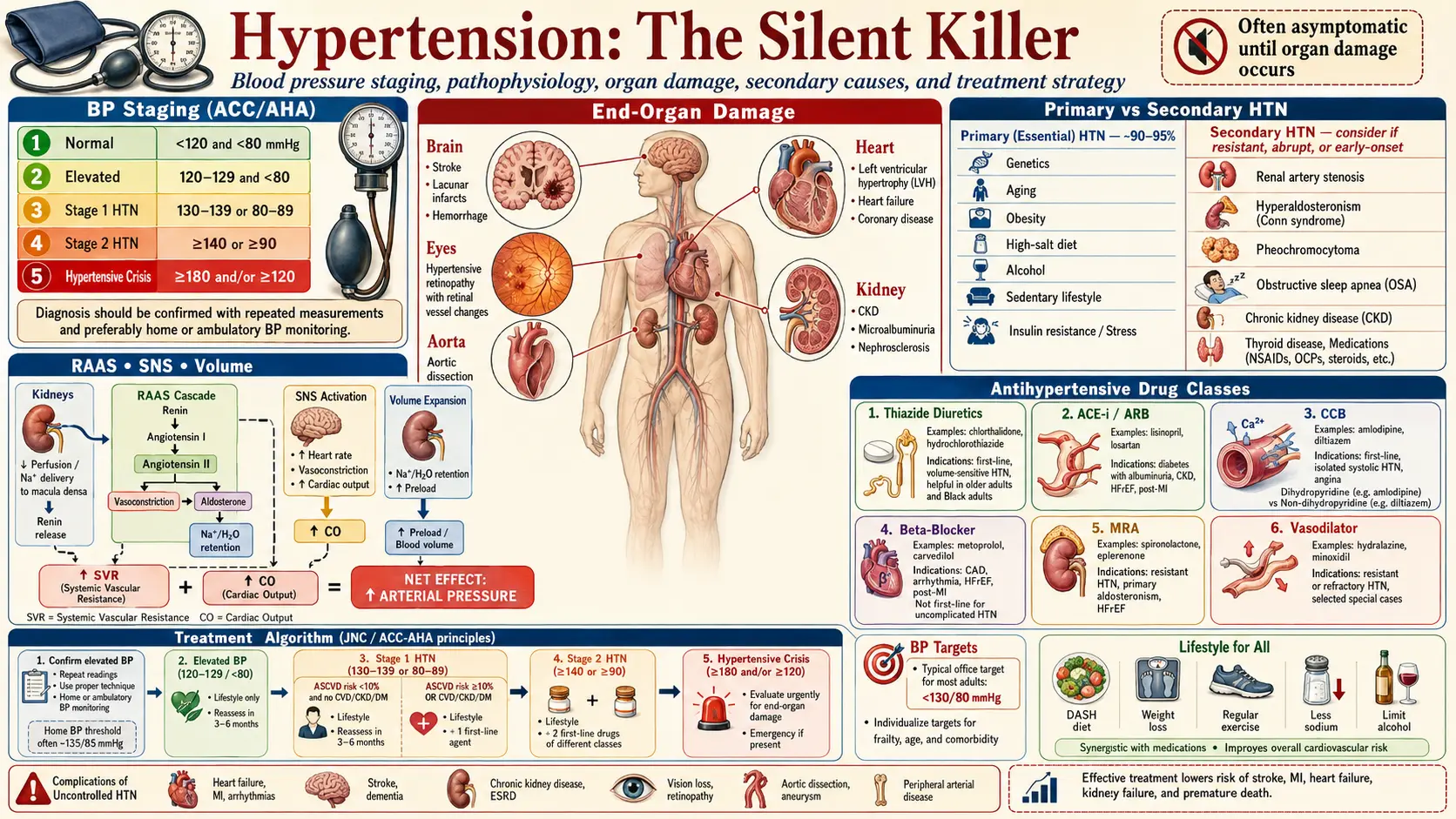
Hypertension, also known as high blood pressure, is a chronic medical condition in which the force of the blood against the artery walls is consistently too high. This can lead to serious health complications, including heart disease and stroke.
What is actually being measured
Blood pressure is the pressure inside your arteries, and it has two components because the heart works in cycles. The top number (systolic) is the peak pressure as the heart contracts. The bottom number (diastolic) is the resting pressure between beats — and that one matters more than people assume, because the heart's own arteries fill during that resting phase.
Only two things set the pressure: how much blood the heart pushes out per minute, and how tight the arteries are. Think of a garden hose. Turn the tap up and the pressure rises; squeeze the nozzle and the pressure rises too. Almost every blood-pressure drug works on one of those two levers — diuretics reduce the volume in the system, calcium channel blockers relax the nozzle, ACE inhibitors and ARBs block the hormone that tightens it, beta-blockers turn down the tap.
Why chronic high pressure damages things
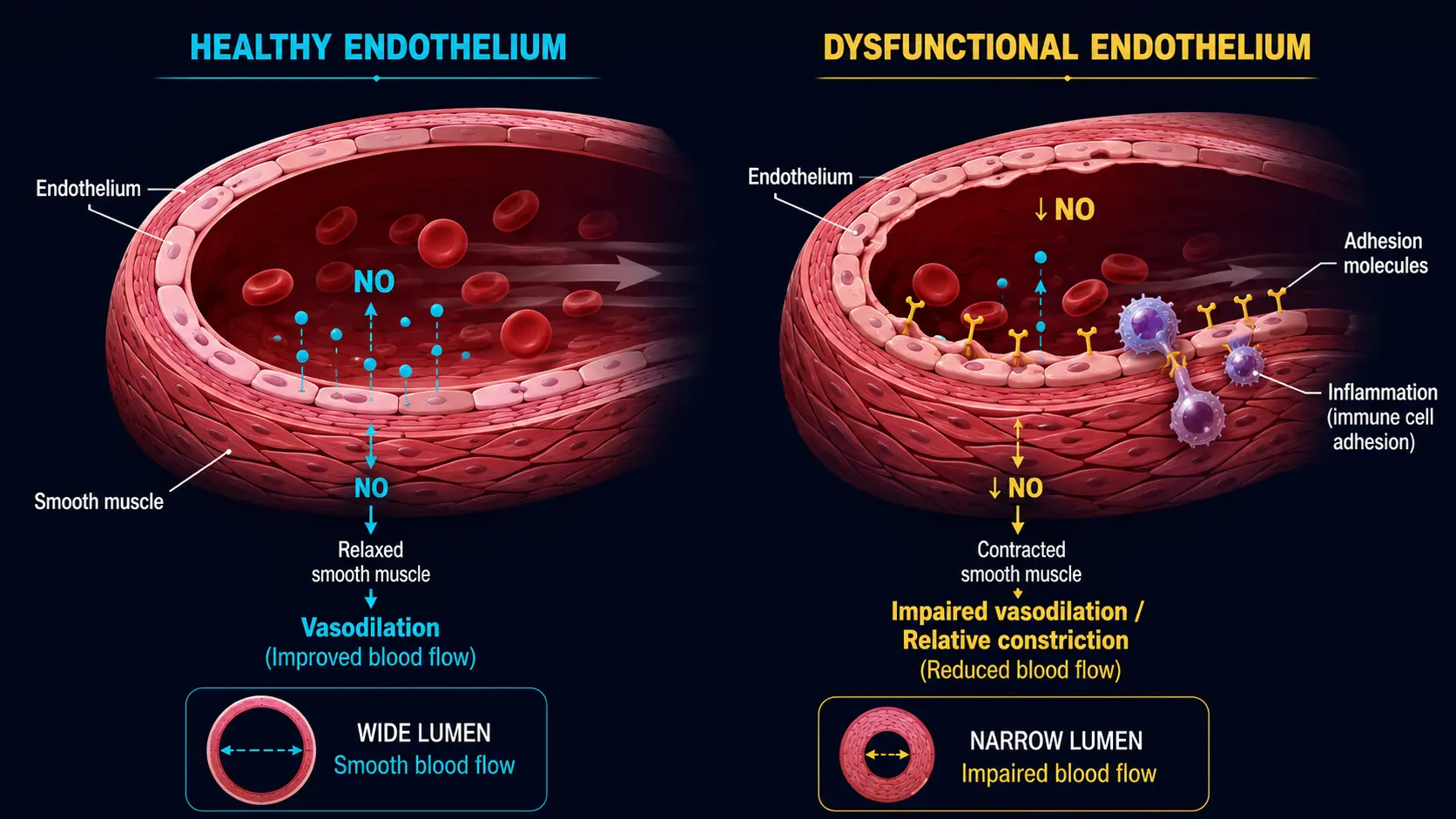
Arteries are elastic tubes lined with a delicate single layer of cells, the endothelium, which is the organ that decides how relaxed the vessel is. Sustained high pressure injures that lining, and injured endothelium lets LDL particles into the wall — which is why hypertension accelerates atherosclerosis rather than being a separate problem alongside it.
The heart responds to pushing against higher pressure the way any muscle responds to load: it thickens. That thickening (left ventricular hypertrophy) makes the ventricle stiff and hard to fill, raising pressure in the left atrium, stretching it — which is the direct pathway to both HFpEF and atrial fibrillation. Meanwhile the smallest arteries in the kidneys, the brain and the retina, which have no muscular protection, take the pressure directly. That is the whole complication list in one mechanism.
Reading the Numbers, and Measuring Them Right
The categories
- Normal — under 120 and under 80.
- Elevated — 120–129 systolic and under 80 diastolic.
- Stage 1 hypertension — 130–139 systolic or 80–89 diastolic.
- Stage 2 hypertension — 140 or above systolic, or 90 or above diastolic.
- Hypertensive crisis — above 180/120. Repeat after five minutes; if it stays there with any symptom of organ damage, it is an emergency.
These are the US thresholds; several other countries still define hypertension from 140/90. The disagreement is about where to start drug treatment, not about whether the risk is continuous — it is, all the way down. Diagnosis should rest on readings from more than one occasion, not a single high number in a clinic.
How to measure it so the number means something
Most badly managed hypertension is badly measured hypertension. The technique matters as much as the device:
- No caffeine, smoking or exercise for 30 minutes beforehand; empty your bladder first.
- Sit quietly for five minutes before the first reading. Not thirty seconds.
- Back supported, feet flat on the floor, legs uncrossed, arm resting at heart level.
- Cuff on bare skin, not over a sleeve, and the right size — a cuff that is too small reads falsely high, which is a common cause of unnecessary treatment in people with larger arms.
- Do not talk during the reading. Talking adds several mmHg.
- Take two readings a minute apart and average them. Record morning and evening for seven days when a decision is being made.
Home readings predict outcomes better than clinic readings, and home thresholds are slightly lower than clinic ones — a home average of 130/80 corresponds roughly to a clinic 135/85. Two patterns are worth naming: white-coat hypertension, high only in clinic, which generally needs monitoring rather than drugs; and masked hypertension, normal in clinic but high at home, which is the more dangerous of the two precisely because it goes untreated. Both are invisible without home or 24-hour monitoring.
Buy a validated upper-arm monitor. Wrist and finger devices are much less reliable. Take yours to an appointment once and check it against the clinic device.
Types of Hypertension
1. Primary (Essential) Hypertension
- Most common type: Develops gradually over many years.
- No identifiable cause: Typically linked to genetics, aging, and lifestyle factors.
- Accounts for roughly 90–95% of cases. "No identifiable cause" means no single switch to flip — it is the combined effect of arterial stiffening with age, salt handling by the kidneys, body weight, alcohol, activity and inherited susceptibility.
2. Secondary Hypertension
- Less common: Caused by an underlying condition.
- Potential causes include:
- Kidney disease
- Hormonal disorders (e.g., adrenal gland tumors)
- Obstructive sleep apnea
- Medications (e.g., birth control pills, decongestants)
When to suspect a secondary cause — and push for the tests. Onset before 30 or after 65; blood pressure that stays high on three drugs including a diuretic; a sudden loss of previously good control; low potassium without a diuretic to explain it; or symptoms such as episodic pounding headache with sweating and palpitations.
The most under-diagnosed cause by a wide margin is primary aldosteronism, an adrenal gland overproducing aldosterone. It is far more common than the textbooks once suggested, it is often missed because potassium can be normal, and it matters because it responds specifically to spironolactone or to surgery. The screening test is an aldosterone-to-renin ratio. See Aldosterone / Renin Ratio.
Obstructive sleep apnea is the other big one, and is worth chasing in anyone with resistant hypertension who snores. A blood-pressure pattern that does not dip overnight on 24-hour monitoring is a strong clue.
Substances that raise blood pressure and are easy to overlook: NSAIDs taken regularly, decongestants containing pseudoephedrine, oral contraceptives, corticosteroids, some antidepressants (venlafaxine), stimulants, excess alcohol, and liquorice root — real liquorice, which raises blood pressure and lowers potassium through a well-described mechanism.
Symptoms of Hypertension
Often referred to as a "silent killer", hypertension may not present noticeable symptoms until it reaches severe or life-threatening levels. However, some potential signs include:
- Headaches
- Shortness of breath
- Nosebleeds (less common and usually occur when blood pressure is extremely high)
Take "silent" literally. The belief that you can tell when your pressure is up is one of the most consequential misconceptions in medicine, because it leads people to take tablets only when they "feel high" — which means most of the time they are untreated. Studies of people asked to predict their own readings find they do no better than chance.
Headache in particular is a poor guide. Ordinary daily headaches are not usually caused by ordinary hypertension; a headache genuinely caused by blood pressure generally means severe elevation, and typically presents on waking, at the back of the head, with visual disturbance. Nosebleeds are likewise usually a coincidence rather than a symptom.
The symptoms that do mean something are those of organ damage: chest discomfort, breathlessness on exertion or lying flat, blurred vision, blood in the urine or a marked change in how much you pass, and one-sided weakness or slurred speech.
Risk Factors
- Age: Risk increases with age, as arteries stiffen. This is why the systolic number tends to rise steadily after 50 while the diastolic may fall — a widening gap between the two is itself a marker of stiff arteries.
- Family history: Genetics can play a role.
- Being overweight or obese: Increases the risk. Weight loss is one of the more reliable non-drug levers, with roughly 1 mmHg of systolic reduction per kilogram lost in many studies.
- Physical inactivity: Sedentary lifestyle contributes to higher risk.
- Poor diet: High salt intake and low potassium intake are the two dietary drivers that matter most — and the potassium half is usually ignored.
- Excessive alcohol consumption: Linked to increased blood pressure, in a dose-dependent way, and it is one of the fastest levers to move.
- Smoking: Damages blood vessel walls, contributing to high blood pressure.
- Chronic stress: Can contribute to temporary or long-term blood pressure spikes.
- Poor or short sleep, and sleep apnea: Independent contributors, and treatable.
- Chronic kidney disease: Both a cause and a consequence — each drives the other, which is why kidney function is checked at diagnosis and monitored on treatment.
Prevention and Management
- Healthy diet: Emphasize vegetables, fruit, legumes, nuts, whole grains and fish (the DASH pattern).
- Regular physical activity: At least 30 minutes of moderate exercise most days of the week.
- Maintaining a healthy weight: Helps manage blood pressure.
- Limiting alcohol intake: Reduces blood pressure risks.
- Quitting smoking: Improves overall cardiovascular health.
- Managing stress: Techniques such as meditation and deep breathing can be beneficial.
How much each lever is actually worth
The DASH eating pattern — strong evidence. In the original DASH trial, a diet rich in fruit, vegetables and dairy, with reduced saturated fat, lowered systolic pressure by 11.4 mmHg and diastolic by 5.5 mmHg more than the control diet in people who already had hypertension [2]. That is comparable to a blood-pressure drug, achieved with food.
Salt — real, and smaller than the headlines. DASH-Sodium tested three sodium levels within each diet. Going from high to low sodium lowered systolic pressure by about 6.7 mmHg on the control diet, but only about 3 mmHg on top of the DASH diet — and the two combined gave an 11.5 mmHg reduction in people with hypertension compared with a high-sodium control diet [3]. The lesson is that salt reduction and the eating pattern overlap: if you have already moved to a whole-food pattern, cutting salt further adds less than you would expect.
Potassium, and the salt substitute that changed the conversation. The neglected half of the salt story is that most people eat too little potassium. SSaSS randomized 20,995 people in rural China — most with a prior stroke or aged over 60 with high blood pressure — to use a potassium-enriched salt substitute (75% sodium chloride, 25% potassium chloride) instead of ordinary salt. Over 4.74 years, stroke fell (rate ratio 0.86), major cardiovascular events fell (0.87), and death from any cause fell (0.88), with no significant excess of serious high-potassium events [4]. Swapping the salt in the shaker is an unusually simple intervention with hard outcome evidence behind it.
Important caution: salt substitutes are not safe for everyone. If you have significant kidney disease, or take an ACE inhibitor, an ARB, or spironolactone, the extra potassium can be dangerous. Ask before switching, and have your potassium checked.
Food, plainly. Build the plate around potassium-rich whole foods: leafy greens, potatoes with the skin, beans and lentils, avocado, bananas, oranges, tomatoes, beetroot, plain yogurt, salmon and sardines. Nuts and seeds most days. Whole grains rather than refined — oats, barley, and brown rice. Where salt gets cut, the biggest wins are bread, processed meat, canned soup, sauces and restaurant food; the shaker on the table is a small fraction of most people's intake. See Potassium and Magnesium.
Exercise — strong, and it works best in the people who need it most. A meta-analysis of 93 randomized trials in 5,223 participants found endurance training lowered blood pressure by 8.3/5.2 mmHg in people who already had hypertension, against only about 2.1/1.7 mmHg in those who were merely pre-hypertensive. Dynamic resistance training helped too, and the small isometric-training literature showed the largest reductions of all, though from few trials [5]. Practically: brisk walking, cycling or swimming most days, plus resistance work twice a week. Isometric handgrip training is cheap and looks promising, but rests on a much smaller evidence base.
Alcohol, weight and sleep. Cutting heavy drinking can lower systolic pressure by several mmHg within weeks. Weight loss delivers roughly 1 mmHg per kilogram. Treating sleep apnea helps, particularly in resistant hypertension.
Supplements — modest at best. Beetroot juice, rich in dietary nitrate, produces a small short-term reduction of a few mmHg in trials, and is harmless; it is a nice addition, not a treatment. Magnesium and potassium supplements help mainly where intake is genuinely low, and potassium supplements carry real risk in kidney disease or on potassium-sparing drugs — food is the safer route. Garlic, hibiscus and CoQ10 show small effects in small studies of variable quality. None of these is a substitute for a drug when your pressure is stage 2, and treating them as one is how people end up with avoidable strokes.
Treatment Options
- Medications: Commonly prescribed drugs include diuretics, ACE inhibitors, beta-blockers, calcium channel blockers, and more.
- Lifestyle changes: Essential to support medication and reduce blood pressure naturally.
- Regular monitoring: Tracking blood pressure at home helps manage treatment effectiveness.
How low, and how hard?
SPRINT randomized 9,361 adults at increased cardiovascular risk to a systolic target below 120 or below 140. The intensive group had fewer major cardiovascular events (1.77% versus 2.40% per year) and lower all-cause mortality (1.06% versus 1.41% per year), and the benefit persisted after the trial ended [6]. But intensive treatment also caused significantly more low blood pressure, fainting, electrolyte disturbance and acute kidney injury.
That is a real trade-off, not a formality. A fit 65-year-old with kidney function to spare is a different proposition from an 85-year-old who has fallen twice this year. Note also that SPRINT excluded people with diabetes and those with prior stroke, and measured blood pressure with an unattended automated protocol that tends to read a few mmHg lower than a routine clinic reading — so "under 120 in SPRINT" is not exactly "under 120 at your surgery". The 2025 US guideline sets out how these targets are applied in practice [1].
The drug classes, and what to expect from each
- Thiazide-type diuretics (chlorthalidone, indapamide, hydrochlorothiazide) — remove fluid and relax vessels. Cheap and effective. Watch for low potassium and low sodium; chlorthalidone and indapamide are longer-acting than hydrochlorothiazide.
- ACE inhibitors (lisinopril, ramipril) — block the vessel-tightening hormone; particularly useful with diabetes, kidney disease or heart failure. A persistent dry cough affects a minority; the fix is an ARB.
- ARBs (losartan, valsartan, candesartan) — the same pathway without the cough.
- Calcium channel blockers (amlodipine, nifedipine) — relax the arteries directly. Ankle swelling is the common nuisance, and it is not fluid overload — it does not respond to a diuretic, but often does to reducing the dose or combining with an ACE inhibitor or ARB.
- Beta-blockers — no longer first-line for uncomplicated hypertension, but strongly indicated when you also have coronary disease, heart failure or certain arrhythmias.
- Spironolactone — the evidence-based fourth agent for resistant hypertension, and the specific treatment when primary aldosteronism is the cause. Needs potassium monitoring.
Two doses of two drugs usually beats one full dose of one, because side effects rise steeply with dose while the extra blood-pressure effect does not. Many people do better on a single combination tablet. If you are on three drugs including a diuretic and still not controlled, that is resistant hypertension and it should trigger a search for a secondary cause rather than simply a fourth prescription.
On timing: whether taking tablets at night is better than the morning has been studied repeatedly with conflicting results, and the current honest answer is that the time you will reliably remember is the right time.
Complications of Untreated Hypertension
- Heart disease: Includes heart attack, heart failure, and arrhythmias — especially atrial fibrillation, via a stretched left atrium.
- Stroke: Caused by reduced blood flow to the brain. Hypertension is the single largest modifiable risk factor for stroke, and it causes both the blocked kind and the bleeding kind.
- Kidney damage: May lead to kidney failure. An early urine albumin test detects this long before creatinine moves.
- Vision loss: Damage to blood vessels in the eyes can lead to vision problems. A routine eye examination can reveal hypertensive changes before anything else does.
- Aneurysms: Increased pressure can cause blood vessels to weaken and bulge. See Aortic Aneurysm.
- Cognitive decline and vascular dementia: The same small-vessel damage affects the brain's white matter. Midlife hypertension is one of the more consistently identified modifiable risk factors for later dementia. See Vascular Dementia.
Red Flags and Common Traps
Go to an emergency department if a reading above 180/120 comes with any of: chest pain, severe breathlessness, sudden severe headache, blurred or lost vision, one-sided weakness, slurred speech, confusion, or seizure. That combination is a hypertensive emergency and is treated urgently.
A reading above 180/120 with no symptoms at all is different. Sit quietly for five minutes and repeat. If it is still that high, contact your doctor the same day — but dropping blood pressure too fast is itself harmful, so this is a same-day call rather than a race.
Traps worth avoiding
- Stopping tablets because your pressure is now normal. Normal on treatment is the treatment working, not a cure. Pressure usually climbs back within weeks of stopping, and abruptly stopping a beta-blocker or clonidine can cause a dangerous rebound.
- Dosing by feel. You cannot sense your blood pressure. Take it on schedule.
- Regular NSAIDs. Ibuprofen, naproxen and diclofenac raise blood pressure and blunt several antihypertensives. This is one of the commonest reasons for apparently resistant hypertension.
- Cold and flu remedies containing pseudoephedrine or phenylephrine.
- Liquorice root and some Chinese herbal preparations containing it — a genuine, documented cause of high blood pressure with low potassium.
- Grapefruit juice with certain calcium channel blockers such as felodipine and nifedipine.
- Checking too often. Blood pressure varies naturally through the day. Measuring twenty times a day produces anxiety and a scary-looking spread, not information. Structured runs of a week around a decision are far more useful.
Key Research Papers
The following PubMed topic searches return current peer-reviewed literature relevant to this condition. Each link opens a live PubMed query.
Key Research Papers
Every citation below was verified against its PubMed record before publication — author list, journal, year and title all checked against the source.
- Jones DW, Ferdinand KC, Taler SJ, et al. 2025 AHA/ACC/AANP/AAPA/ABC/ACCP/ACPM/AGS/AMA/ASPC/NMA/PCNA/SGIM Guideline for the Prevention, Detection, Evaluation and Management of High Blood Pressure in Adults: A Report of the American College of Cardiology/American Heart Association Joint Committee on Clinical Practice Guidelines. Hypertension. 2025;82(10):e212-e316 — PubMed PMID: 40811516 · doi:10.1161/HYP.0000000000000249
- Appel LJ, Moore TJ, Obarzanek E, et al. A clinical trial of the effects of dietary patterns on blood pressure. DASH Collaborative Research Group. N Engl J Med. 1997;336(16):1117-24 — PubMed PMID: 9099655 · doi:10.1056/NEJM199704173361601
- Sacks FM, Svetkey LP, Vollmer WM, et al. Effects on blood pressure of reduced dietary sodium and the Dietary Approaches to Stop Hypertension (DASH) diet. DASH-Sodium Collaborative Research Group. N Engl J Med. 2001;344(1):3-10 — PubMed PMID: 11136953 · doi:10.1056/NEJM200101043440101
- Neal B, Wu Y, Feng X, et al. Effect of Salt Substitution on Cardiovascular Events and Death. N Engl J Med. 2021;385(12):1067-1077 — PubMed PMID: 34459569 · doi:10.1056/NEJMoa2105675
- Cornelissen VA, Smart NA. Exercise training for blood pressure: a systematic review and meta-analysis. J Am Heart Assoc. 2013;2(1):e004473 — PubMed PMID: 23525435 · doi:10.1161/JAHA.112.004473
- Lewis CE, Fine LJ, Beddhu S, et al. Final Report of a Trial of Intensive versus Standard Blood-Pressure Control. N Engl J Med. 2021;384(20):1921-1930 — PubMed PMID: 34010531 · doi:10.1056/NEJMoa1901281
PubMed Topic Searches
Each link opens a live PubMed query returning current peer-reviewed literature on that sub-topic.
- PubMed: Hypertension guidelines
- PubMed: SPRINT trial blood pressure
- PubMed: DASH diet hypertension
- PubMed: Resistant hypertension
- PubMed: Ambulatory blood pressure monitoring
- PubMed: Antihypertensive medication
- PubMed: Hypertension cardiovascular outcomes
- PubMed: Hypertension pregnancy
- PubMed: Secondary hypertension
- PubMed: Hypertension sodium intake
- PubMed: Renal denervation hypertension
- PubMed: Hypertension prevalence worldwide
Connections
- Cardiology
- DASH Diet — the eating pattern with real feeding-trial blood-pressure numbers
- How Heart Failure Develops — interactive animation
- What Happens in a Stroke — interactive animation
- The Baroreflex: Your Blood Pressure’s Split-Second Autopilot — interactive animation
- Nitric Oxide & Vessel Dilation — interactive animation
- How Your Body Controls Blood Pressure — interactive animation
- The Heart & Circulation — interactive animation
- Slowing CKD Progression
- Stroke
- Heart Failure
- Coronary Artery Disease
- Cardiovascular Disease
- Aortic Aneurysm
- Headache
- Edema
- Magnesium
- Potassium
- Garlic
- Lipid Panel
- Omega-3 Fatty Acids
- Anti-Inflammatory Diet
- Celery Juice and Blood Pressure
- Lead Poisoning
- Kidney Disease
- Obstructive Sleep Apnea
- Pulmonary Hypertension
- Kidney Cancer
- Diabetic Retinopathy
- Polycystic Kidney Disease
- Takayasu Arteritis
- HELLP Syndrome — a severe hypertensive complication of pregnancy; women who survive it carry a markedly higher lifetime risk of chronic hypertension.
- Herbs covered on this site that discuss this condition: Hawthorn (Crataegus monogyna) · Chanca Piedra (Phyllanthus niruri) · Hibiscus · Cinnamon (Cinnamomum verum) · Horehound · Licorice (Glycyrrhiza glabra)
- Discussed in depth on these pages: Pulmonary Arterial Hypertension · Cor Pulmonale · Cerebral Venous Thrombosis · Liver Cirrhosis
- Aldosterone / Renin Ratio — the screening test for primary aldosteronism, the most under-diagnosed secondary cause
- Vascular Dementia — the same small-vessel damage, in the brain's white matter
- HFpEF — the thickened, stiff ventricle that long-standing hypertension produces
- Celery Juice