Obstructive Sleep Apnea (OSA)
Interactive Visualization Breathing & Gas Exchange — move the diaphragm yourself Fill the alveoli and watch oxygen diffuse into the blood while carbon dioxide leaves, with live pO₂/pCO₂ meters and an exercise mode. Launch → Interactive Visualization Sleep Apnea — collapse the airway, then splint it open with CPAP Watch the throat close as sleep deepens, the chest heave against a shut airway and oxygen slide into the 80s — then switch on CPAP and see the whole night go quiet. Launch →
Table of Contents
- What is Obstructive Sleep Apnea?
- Why the Airway Closes
- Common Symptoms of OSA
- How It Varies Between People
- Causes and Risk Factors
- Diagnosis: The Tests and the Numbers
- Reading Your Sleep Study Report
- Treatment Options
- Making CPAP Actually Work
- What the Cardiovascular Trials Actually Showed
- What the Evidence Does Not Support
- Prevention and Management Strategies
- Red Flags and Safety
- Complications of OSA
- Key Research Papers
- Connections
- Featured Videos
What is Obstructive Sleep Apnea?
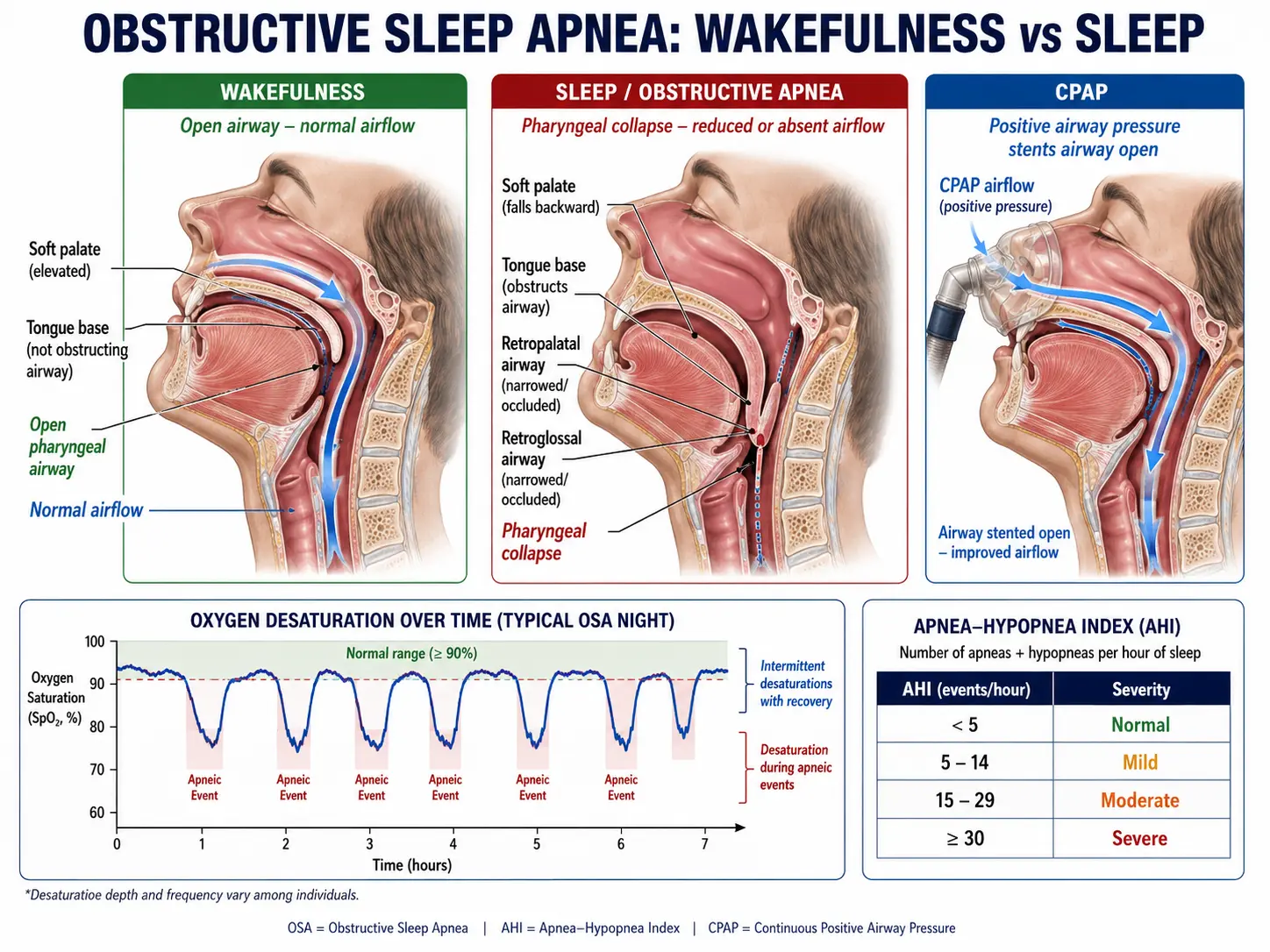
Obstructive sleep apnea (OSA) is the repeated collapse of the upper airway during sleep. The chest and diaphragm keep trying to breathe — the effort is there — but no air moves, because the throat has closed. Oxygen falls, carbon dioxide rises, and the brain briefly wakes just enough to restore muscle tone and reopen the airway. Then sleep resumes and the cycle repeats, sometimes hundreds of times a night.
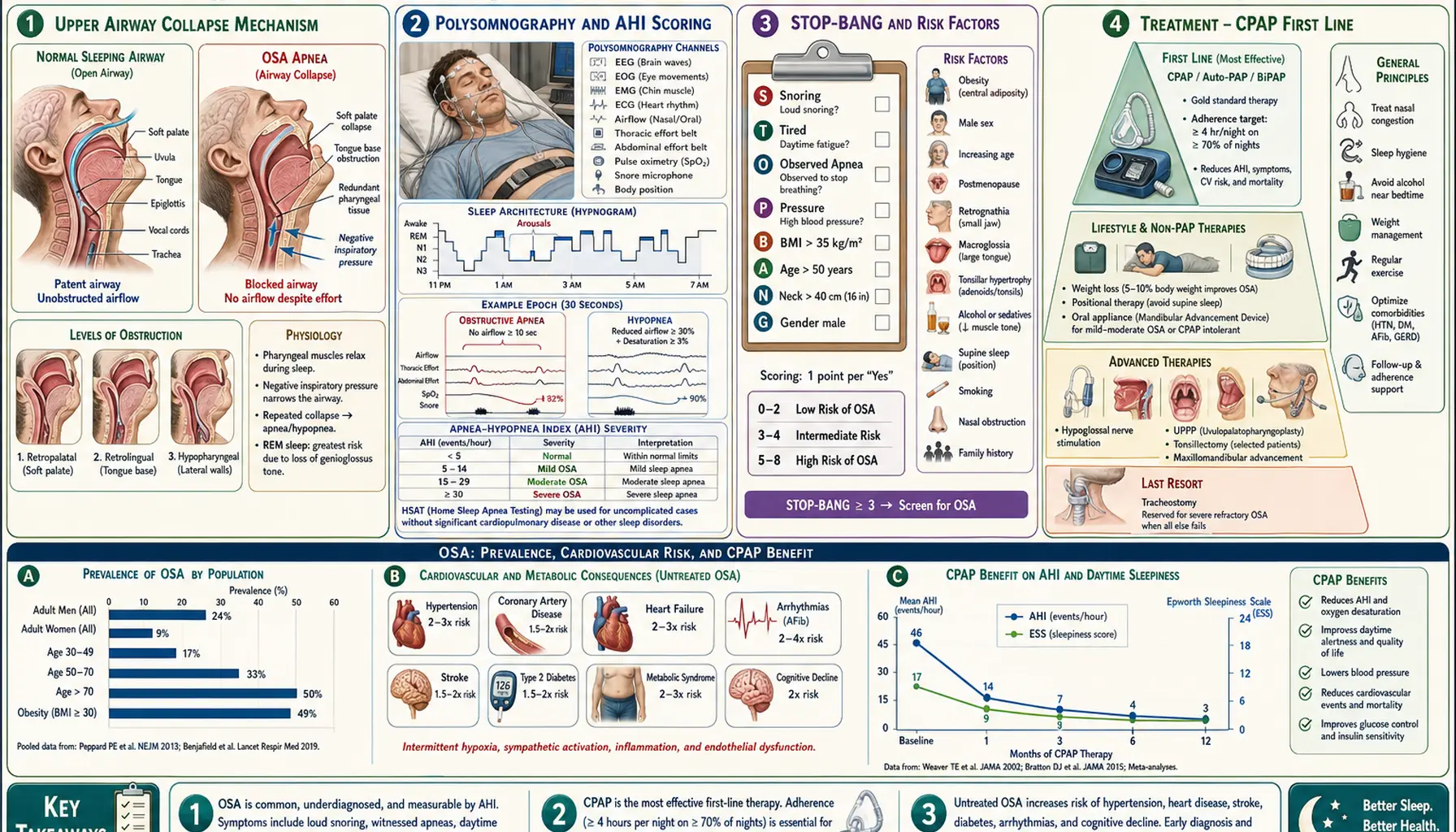
The mechanical picture is straightforward. The upper airway between the back of the nose and the voice box has no bone or cartilage holding it open — it is a soft tube held open only by muscle tone. Think of a drinking straw made of thin rubber: while you sip gently it stays open, but suck hard and it collapses in on itself. Awake, the dilator muscles of the pharynx keep it stiff. Asleep, that tone falls, and if the airway is already narrow, the negative pressure of inhaling pulls it shut.
Crucially, the person almost never remembers any of this. The arousals are too brief to be recalled. What they experience is unrefreshing sleep, daytime sleepiness, and a bed partner who has stopped sleeping in the same room. OSA is therefore usually diagnosed on the account of someone else, and enormously under-diagnosed — population estimates suggest the majority of moderate-to-severe cases have never been identified.
Why the Airway Closes
Four separate factors contribute, in different proportions in different people. This matters because it predicts which treatment will work.
- Anatomy — a narrow or crowded airway. Causes include obesity with fat deposition in the tongue and lateral pharyngeal walls, large tonsils (the dominant cause in children), a small or set-back lower jaw, a large tongue, and nasal obstruction. This is the factor most people know about, and it is present in nearly everyone with OSA.
- Poor dilator muscle responsiveness — the genioglossus muscle should contract harder when the airway starts to narrow. In some people this reflex is sluggish.
- A low arousal threshold — waking too easily. This sounds protective but is not: waking at the first hint of narrowing prevents the deeper stages of sleep in which airway muscle tone stabilises, so the sleep fragments without ever settling.
- High loop gain — an over-reactive breathing control system that overshoots and undershoots. Overbreathing after an event drops carbon dioxide below the level needed to drive the next breath, and the airway collapses again.
Dempsey and colleagues’ 2010 review in Physiological Reviews remains the standard account. The practical consequence: two people with the same apnea count can have entirely different dominant mechanisms, which is why one does brilliantly on a mandibular advancement device and another needs CPAP.
Sleeping on the back makes all of this worse, because gravity pulls the tongue and soft palate backwards. In some people, apneas occur almost exclusively when supine — a pattern worth identifying, because it is directly treatable.
Common Symptoms of OSA
Night-time
- Loud, habitual snoring, often for years before diagnosis. Snoring alone is not OSA, but OSA almost always snores.
- Witnessed pauses in breathing, usually ending with a gasp, snort or choke. This is the single most specific symptom.
- Waking with a sensation of choking or suffocating.
- Nocturia — getting up two or more times to pass urine. Repeated intrathoracic pressure swings stretch the heart and release atrial natriuretic peptide, which produces urine. In men this is routinely misattributed to the prostate.
- Restless, thrashing sleep, and sweating at night.
- Reflux symptoms at night, driven by the same pressure swings.
Daytime
- Excessive daytime sleepiness — falling asleep watching television, in meetings, or at traffic lights. Distinguish sleepiness (an urge to sleep) from fatigue (low energy without an urge to sleep); OSA causes both but sleepiness is the more specific.
- Morning headache, usually frontal and clearing within an hour or two of getting up.
- Dry mouth or sore throat on waking, from mouth-breathing.
- Impaired concentration, memory and mood, often mistaken for depression, burnout or early dementia.
- Irritability and reduced libido.
- Difficult-to-control blood pressure, particularly hypertension that stays high overnight or resists three or more drugs.
How It Varies Between People
- Women present differently and are under-diagnosed as a result. Insomnia, fatigue, morning headache, anxiety and depression are more prominent than classic snoring with witnessed apneas, and events cluster more in REM sleep. A woman describing exhaustion and poor sleep is more likely to be given an antidepressant than a sleep study.
- Not everyone with OSA is sleepy. A substantial proportion have severe disease on a sleep study with a normal Epworth score. Absence of sleepiness does not mean the cardiovascular consequences are absent, though it does change how strongly CPAP improves quality of life.
- Not everyone with OSA is overweight. Around a fifth to a quarter have a normal BMI, with craniofacial anatomy — a small or receding jaw, a high narrow palate — as the dominant factor. This group is frequently dismissed.
- Children present as behaviour, not sleepiness. Hyperactivity, inattention, poor school performance, bedwetting and mouth-breathing are the usual picture, and enlarged tonsils and adenoids are the usual cause. Adenotonsillectomy is often curative, which makes recognition genuinely important.
- REM-predominant OSA — events concentrated in REM sleep, which is when muscle tone is lowest. Because REM is heavier in the last third of the night, someone who takes their CPAP off at 4 a.m. may be discarding the most important hours.
- Positional OSA — at least twice as many events supine as non-supine. In this group, staying off the back is a genuine treatment rather than an afterthought.
Causes and Risk Factors
- Obesity — the strongest modifiable risk factor. A 10% weight gain is associated with roughly a sixfold increase in the odds of developing moderate-to-severe OSA; a 10% loss produces a substantial fall in the apnea count. Neck circumference above about 43 cm (17 inches) in men or 40 cm (16 inches) in women is a practical marker.
- Male sex — two to three times commoner in men, though the gap narrows sharply after menopause.
- Age — prevalence rises through middle age and plateaus after about 65.
- Craniofacial anatomy — retrognathia (a set-back lower jaw), micrognathia, a high arched palate, midface hypoplasia. These run in families, which is part of why OSA does.
- Enlarged tonsils and adenoids — the dominant cause in children and a contributor in some adults.
- Nasal obstruction — deviated septum, chronic rhinitis, polyps. Nasal blockage increases the negative pressure needed to inhale and worsens collapse.
- Menopause — loss of the protective effect of progesterone on ventilatory drive.
- Alcohol, sedatives, opioids and muscle relaxants, all of which reduce dilator muscle tone and blunt arousal.
- Smoking, which inflames and swells the upper airway.
- Hypothyroidism and acromegaly — both cause soft tissue enlargement; both are worth excluding where suggested by other features.
- Fluid shift — in heart failure and kidney disease, fluid accumulated in the legs during the day redistributes to the neck when lying down. This is a specific and treatable driver.
- Down syndrome and other conditions with midface hypoplasia or low muscle tone, in which prevalence is very high and screening is warranted regardless of symptoms.
Diagnosis: The Tests and the Numbers
Screening questionnaires
The STOP-BANG questionnaire scores eight items: Snoring, Tiredness, Observed apneas, blood Pressure, BMI over 35, Age over 50, Neck circumference, and male Gender. A score of 0–2 is low risk; 3–4 intermediate; 5–8 high risk of moderate-to-severe OSA. The Epworth Sleepiness Scale rates the chance of dozing in eight situations from 0 to 3, giving a total out of 24; above 10 is abnormal. Neither questionnaire diagnoses anything — they decide who gets tested. A normal Epworth in a high STOP-BANG scorer should not stop the referral.
Sleep studies
- Home sleep apnea testing (HSAT) — a portable device recording airflow, respiratory effort, oxygen saturation and heart rate, worn in your own bed. The 2017 American Academy of Sleep Medicine guideline (Kapur et al.) recommends it as an appropriate first test in uncomplicated adults with a high pre-test probability of moderate-to-severe OSA. Its limitation is that it can only under-call: it usually divides events by total recording time rather than actual sleep time, so a negative or borderline home study in a symptomatic person should be followed by a laboratory study, not accepted.
- In-laboratory polysomnography — the full study, with EEG to stage sleep, plus eye movements, chin and leg muscle activity, airflow, effort belts, oximetry, ECG and body position. It is required where there is significant cardiopulmonary disease, suspected hypoventilation, neuromuscular disease, opioid use, or where central sleep apnea or another sleep disorder is possible.
Supporting investigations
- Thyroid function, where hypothyroidism is plausible.
- Full blood count — secondary polycythaemia suggests sustained nocturnal hypoxaemia.
- Blood gas or serum bicarbonate where obesity hypoventilation syndrome is suspected; a bicarbonate above about 27 mmol/L is a useful screening flag for daytime carbon dioxide retention.
- Echocardiogram where pulmonary hypertension or right heart strain is suspected.
Reading Your Sleep Study Report
Ask for the actual report rather than a verbal summary. These are the numbers that matter.
- AHI (apnea–hypopnea index) — events per hour of sleep. An apnea is a near-complete stop for at least 10 seconds; a hypopnea is a partial reduction with a drop in oxygen or an arousal. Severity bands in adults: normal under 5; mild 5–14.9; moderate 15–29.9; severe 30 or more. In children the threshold is far lower — more than 1 event per hour is abnormal.
- RDI (respiratory disturbance index) — AHI plus respiratory effort-related arousals. Higher than the AHI, and sometimes the number that explains symptoms when the AHI looks mild.
- ODI (oxygen desaturation index) and nadir SpO2 — how often and how far oxygen fell. A nadir below 80% is significant regardless of what the AHI says.
- Time below 90% saturation (T90) — increasingly regarded as a better predictor of cardiovascular consequences than the AHI itself, which counts a 10-second event and a 60-second event identically.
- Supine versus non-supine AHI — identifies positional OSA.
- REM versus non-REM AHI — identifies REM-predominant disease.
- Total sleep time and sleep efficiency — a study in which you slept two hours is not a reliable study.
The AHI is a crude measure and should not be treated as the whole picture. Someone with an AHI of 12 who desaturates to 78% and is falling asleep driving has more serious disease than someone with an AHI of 35 and no desaturation or symptoms.
Treatment Options
Positive airway pressure
CPAP delivers a constant column of pressurised air through a mask that splints the airway open — a pneumatic splint rather than a ventilator. It is the most effective treatment, essentially abolishing events when worn. The original demonstration was Colin Sullivan’s 1981 Lancet paper, which reversed severe OSA in five patients using pressure applied through the nose — one of the more direct routes from a physiological idea to a standard treatment in modern medicine.
- Auto-titrating CPAP (APAP) adjusts pressure through the night and is now the usual starting device.
- BiPAP gives separate inspiratory and expiratory pressures, used where high pressures are poorly tolerated or where hypoventilation coexists.
- The AASM systematic review (Patil et al., 2019) found positive airway pressure improves sleepiness, quality of life and blood pressure — the last modestly, on the order of 2–3 mmHg on average, with larger falls in resistant hypertension.
Mandibular advancement devices
A custom-fitted dental appliance that holds the lower jaw forward, pulling the tongue base with it. Less effective than CPAP at reducing the AHI, but often better tolerated — and because benefit equals efficacy multiplied by hours used, real-world outcomes can be comparable in mild-to-moderate disease. Best results come from a titratable device made by a dentist experienced in sleep medicine; boil-and-bite devices bought online perform poorly and can move teeth. Side effects are jaw discomfort, excess salivation and, over years, changes in bite.
Positional therapy
For positional OSA. Modern vibrating positional trainers worn on the neck or chest have reasonable evidence and far better adherence than the traditional tennis-ball-in-a-sock, though the latter is free and worth trying. Raising the head of the bed by 30–45 degrees also reduces events in some people.
Weight loss and metabolic treatment
Weight loss reduces the AHI substantially and improves symptoms, though it rarely cures moderate-to-severe disease alone. The most significant recent development is the SURMOUNT-OSA trial (Malhotra et al., NEJM 2024): tirzepatide reduced the AHI by roughly 25–29 events per hour compared with about 5–6 on placebo over a year, in adults with obesity and moderate-to-severe OSA, both with and without CPAP. A meaningful fraction reached the threshold for disease resolution. This is the first drug therapy with substantial effect on OSA itself, and it works by treating the obesity that drives it. Bariatric surgery produces comparable or larger reductions in suitable candidates.
Surgery and implanted devices
- Adenotonsillectomy — first-line in children with enlarged tonsils, and frequently curative.
- Nasal surgery — septoplasty or turbinate reduction rarely cures OSA but often makes CPAP tolerable, which is a legitimate goal in itself.
- Hypoglossal nerve stimulation — an implanted device that senses breathing and stimulates the nerve to the tongue, contracting it forward with each breath. In the STAR trial (Strollo et al., NEJM 2014) the median AHI fell by about 68% at 12 months in selected patients. Eligibility is restricted — typically moderate-to-severe OSA, CPAP failure, BMI below a defined limit, and no complete concentric palatal collapse on drug-induced sleep endoscopy.
- Maxillomandibular advancement — moving both jaws forward surgically. Highly effective in appropriately selected patients with skeletal restriction, and major surgery.
- Palatal surgery alone (uvulopalatopharyngoplasty) has modest and unpredictable success as a standalone cure, and should not be presented as an easy alternative to CPAP.
Making CPAP Actually Work
Roughly a third to a half of people are not using CPAP adequately at one year, and almost all of the reasons are fixable. Adherence is conventionally defined as four or more hours a night on 70% of nights — a low bar that exists for insurance purposes, not because four hours is optimal. Benefit rises with hours used, and the last hours of the night carry the most REM sleep.
- The mask is the problem far more often than the pressure. Nasal pillows, nasal masks and full-face masks all suit different faces. Insist on trying more than one; this is the single highest-yield intervention.
- Treat the nose first. Untreated rhinitis makes nasal masks impossible. A saline rinse and an intranasal steroid frequently rescue a failing setup.
- Use heated humidification, and a heated tube if condensation (“rainout”) is waking you.
- Air leak past the mask causes dry eyes and drops effective pressure. Check the fit lying down in your normal sleeping position, not sitting up.
- Aerophagia — swallowing air, causing bloating — usually responds to lowering pressure, switching to bi-level, or adjusting the ramp.
- Claustrophobia responds to graded desensitisation: wear the mask while awake watching television, then during naps, before full nights. Brief cognitive behavioural therapy has good evidence here.
- Read your own data. Modern machines report hours used, residual AHI and leak. A residual AHI above 5 means the treatment is not working and the settings need review — do not assume that using the machine equals being treated.
- Costs. Machines typically run several hundred to around a thousand US dollars, with masks and cushions replaced on a schedule; most insurers and the NHS cover them, usually conditional on documented adherence data. If a supplier will not release your usage data, ask again — it is your clinical record.
What the Cardiovascular Trials Actually Showed
This is where honest reporting matters most, because the observational and randomised evidence disagree.
Observational data are striking. Marin and colleagues (Lancet 2005) followed men for a mean of over ten years and found untreated severe OSA carried roughly a threefold higher rate of fatal and non-fatal cardiovascular events than healthy controls, with CPAP-treated patients close to control rates.
The randomised evidence is more sobering. SAVE (McEvoy et al., NEJM 2016) randomised 2,717 adults with moderate-to-severe OSA and established cardiovascular disease to CPAP plus usual care or usual care alone. Over a mean 3.7 years, CPAP did not reduce the primary composite of cardiovascular death, myocardial infarction, stroke or hospitalisation. It did improve snoring, daytime sleepiness, mood and quality of life. The key limitation is adherence: mean CPAP use was only 3.3 hours a night, and a propensity-matched analysis suggested benefit in those using it more than four hours — but that is a secondary observational finding inside a negative trial, not proof.
The honest summary: CPAP reliably improves sleepiness, quality of life, mood, driving safety and blood pressure, and reduces the AHI to near zero. It has not been shown in randomised trials to prevent heart attacks and strokes at the adherence levels typically achieved. Sleepy patients were largely excluded from these trials for ethical reasons, so the group with the clearest indication was never tested for this outcome. Anyone told CPAP will definitely prevent a heart attack has been over-sold; anyone told it therefore does not matter has been badly advised.
What the Evidence Does Not Support
- Oxygen alone as a treatment for OSA. Supplemental oxygen can raise saturation without opening the airway, so events continue, arousals continue, and carbon dioxide may rise. It does not substitute for CPAP.
- Sleeping pills to “sleep through it”. Most sedative-hypnotics reduce airway muscle tone and blunt the arousals that terminate an apnea, prolonging events and deepening desaturation.
- Anti-snoring sprays, strips and pillows sold as OSA treatments. They may reduce snoring noise without touching the underlying airway collapse, which is the harmful part. Reduced noise with continuing apneas is worse than useless, because it removes the warning sign.
- Over-the-counter boil-and-bite mouthguards. Poorly retained, not titratable, and capable of moving teeth. Custom devices are what the evidence is based on.
- Palatal surgery as a routine substitute for CPAP in adults, given its inconsistent success rate.
- Assuming treated snoring means treated apnea. After any intervention that is not CPAP, a repeat sleep study is how you know whether it worked.
Prevention and Management Strategies
- Reach and hold a healthier weight. This is the intervention with the largest effect on the underlying disease.
- Avoid alcohol within three to four hours of bed, and avoid sedatives where possible. Alcohol in the evening reliably worsens apnea severity that same night.
- Stop smoking.
- Sleep off your back if your study shows positional dependence.
- Treat nasal obstruction.
- Keep a regular sleep schedule and adequate sleep duration. Sleep deprivation deepens the following night’s apneas by lowering arousal responses.
- Myofunctional therapy — targeted oropharyngeal exercises — produces a modest reduction in AHI, on the order of 50% in some trials, and is a reasonable adjunct in mild disease or alongside other treatment. It is not a replacement for CPAP in severe disease.
- Eat in a way that supports the weight goal without extremes. Vegetables, fruit, olive oil, nuts, legumes, fish, eggs, and whole grains such as brown rice, oats and barley form a pattern that is sustainable and reduces the cardiometabolic risk that accompanies OSA.
- Have your blood pressure checked properly, ideally with 24-hour ambulatory monitoring if OSA is confirmed. Loss of the normal night-time blood pressure dip is a characteristic finding and a treatable risk.
Red Flags and Safety
- Falling asleep while driving, or near-miss episodes. This is an emergency in the practical sense. Sleepy driving carries a substantially increased crash risk; in many jurisdictions there is a legal duty to notify the licensing authority, and treatment usually restores fitness to drive. Do not drive while sleepy.
- Falling asleep during conversation, eating or at traffic lights — a marker of severe sleepiness needing urgent assessment.
- Morning headache with daytime breathlessness and ankle swelling — consider obesity hypoventilation syndrome, which needs blood gas measurement and often bi-level ventilation rather than CPAP.
- New atrial fibrillation, resistant hypertension, or nocturnal angina — all warrant testing for OSA specifically.
- Before any surgery, tell the anaesthetist you have or may have OSA. Sedatives and opioids are considerably more dangerous with an unstable airway, and untreated OSA raises perioperative complication rates. Bring your CPAP machine to hospital.
- Opioids plus untreated OSA is a specific and serious combination, capable of causing central as well as obstructive events.
- In children, persistent mouth-breathing, snoring most nights, restless sleep with unusual postures, or unexplained behavioural and school difficulties should prompt referral rather than reassurance.
Complications of OSA
- Hypertension, particularly resistant hypertension and non-dipping nocturnal blood pressure. OSA is the commonest identifiable cause of secondary hypertension.
- Atrial fibrillation, with markedly higher recurrence after cardioversion or ablation when OSA is untreated.
- Coronary artery disease, heart failure and stroke, associated in observational cohorts; see the trial caveats above.
- Pulmonary hypertension and cor pulmonale in severe long-standing disease.
- Type 2 diabetes and worsened insulin resistance, independent of obesity — the cardiometabolic clustering described by Drager and colleagues.
- Fatty liver disease, with intermittent hypoxia contributing to progression.
- Motor vehicle and workplace accidents, with a two- to threefold increase in crash risk that falls substantially with treatment.
- Cognitive impairment — attention, executive function and memory, partly reversible with treatment.
- Depression and anxiety, commonly improving with effective treatment.
- Perioperative respiratory complications.
- Glaucoma and non-arteritic anterior ischaemic optic neuropathy, both associated with OSA.
- In children: impaired growth, behavioural and attentional problems, and reduced school performance.
Key Research Papers
Historical background
Charles Dickens described a red-faced, perpetually somnolent boy named Joe in The Pickwick Papers (1836), and for over a century the association of obesity with sleepiness was known as the Pickwickian syndrome. The repetitive airway obstruction underlying it was only characterised in 1965–66, and treatment until 1981 meant tracheostomy — bypassing the collapsible segment entirely. Colin Sullivan’s demonstration that pressurised air delivered through the nose could hold the airway open replaced that with something non-invasive, and remains the basis of treatment today.
Key research papers
Each citation below was checked against its PubMed record; the linked DOI resolves to the paper named.
- Sullivan CE, Issa FG, Berthon-Jones M, Eves L. Reversal of obstructive sleep apnoea by continuous positive airway pressure applied through the nares. Lancet. 1981;1(8225):862–865. — doi:10.1016/s0140-6736(81)92140-1 · PubMed PMID: 6112294
- Dempsey JA, Veasey SC, Morgan BJ, O’Donnell CP. Pathophysiology of sleep apnea. Physiol Rev. 2010;90(1):47–112. — doi:10.1152/physrev.00043.2008 · PubMed PMID: 20086074
- Jordan AS, McSharry DG, Malhotra A. Adult obstructive sleep apnoea. Lancet. 2014;383(9918):736–747. — doi:10.1016/S0140-6736(13)60734-5 · PubMed PMID: 23910433
- Young T, Peppard PE, Gottlieb DJ. Epidemiology of obstructive sleep apnea: a population health perspective. Am J Respir Crit Care Med. 2002;165(9):1217–1239. — doi:10.1164/rccm.2109080 · PubMed PMID: 11991871
- Peppard PE, Young T, Barnet JH, et al. Increased prevalence of sleep-disordered breathing in adults. Am J Epidemiol. 2013;177(9):1006–1014. — doi:10.1093/aje/kws342 · PubMed PMID: 23589584
- Marin JM, Carrizo SJ, Vicente E, Agusti AG. Long-term cardiovascular outcomes in men with obstructive sleep apnoea–hypopnoea with or without treatment with continuous positive airway pressure: an observational study. Lancet. 2005;365(9464):1046–1053. — doi:10.1016/S0140-6736(05)71141-7 · PubMed PMID: 15781100
- McEvoy RD, Antic NA, Heeley E, et al. CPAP for prevention of cardiovascular events in obstructive sleep apnea (SAVE). N Engl J Med. 2016;375(10):919–931. — doi:10.1056/NEJMoa1606599 · PubMed PMID: 27571048 — a negative trial for the primary cardiovascular endpoint.
- Kapur VK, Auckley DH, Chowdhuri S, et al. Clinical practice guideline for diagnostic testing for adult obstructive sleep apnea: an American Academy of Sleep Medicine clinical practice guideline. J Clin Sleep Med. 2017;13(3):479–504. — doi:10.5664/jcsm.6506 · PubMed PMID: 28162150
- Patil SP, Ayappa IA, Caples SM, et al. Treatment of adult obstructive sleep apnea with positive airway pressure: an American Academy of Sleep Medicine systematic review, meta-analysis, and GRADE assessment. J Clin Sleep Med. 2019;15(2):301–334. — doi:10.5664/jcsm.7638 · PubMed PMID: 30736888
- Lévy P, Kohler M, McNicholas WT, et al. Obstructive sleep apnoea syndrome. Nat Rev Dis Primers. 2015;1:15015. — doi:10.1038/nrdp.2015.15 · PubMed PMID: 27188535
- Gottlieb DJ, Punjabi NM. Diagnosis and management of obstructive sleep apnea: a review. JAMA. 2020;323(14):1389–1400. — doi:10.1001/jama.2020.3514 · PubMed PMID: 32286648
- Drager LF, Togeiro SM, Polotsky VY, Lorenzi-Filho G. Obstructive sleep apnea: a cardiometabolic risk in obesity and the metabolic syndrome. J Am Coll Cardiol. 2013;62(7):569–576. — doi:10.1016/j.jacc.2013.05.045 · PubMed PMID: 23770180
- Strollo PJ Jr, Soose RJ, Maurer JT, et al. Upper-airway stimulation for obstructive sleep apnea (STAR). N Engl J Med. 2014;370(2):139–149. — doi:10.1056/NEJMoa1308659 · PubMed PMID: 24401051
- Malhotra A, Grunstein RR, Fietze I, et al. Tirzepatide for the treatment of obstructive sleep apnea and obesity (SURMOUNT-OSA). N Engl J Med. 2024;391(13):1193–1205. — doi:10.1056/NEJMoa2404881 · PubMed PMID: 38912654
PubMed Topic Searches
The following PubMed topic searches surface the current peer-reviewed literature on obstructive sleep apnea. Each link opens a live query; results update as new papers are indexed.
- PubMed: Search: obstructive sleep apnea
- PubMed: Search: CPAP adherence
- PubMed: Search: home sleep apnea testing
- PubMed: Search: mandibular advancement device sleep apnea
- PubMed: Search: hypoglossal nerve stimulation sleep apnea
- PubMed: Search: sleep apnea cardiovascular outcomes
- PubMed: Search: sleep apnea atrial fibrillation
- PubMed: Search: positional therapy obstructive sleep apnea
- PubMed: Search: pediatric obstructive sleep apnea adenotonsillectomy
- PubMed: Search: obesity hypoventilation syndrome
- PubMed: Search: sleep apnea women underdiagnosis
- PubMed: Search: myofunctional therapy sleep apnea
- PubMed: Search: tirzepatide obstructive sleep apnea
- PubMed: Search: sleep apnea hypoxic burden
Connections
- Pulmonology
- Sleep Apnea: Why Breathing Stops at Night — interactive animation
- Breathing & Gas Exchange — interactive animation
- Sleep Apnea — the general overview covering the obstructive, central, and mixed forms.
- Hypertension
- Atrial Fibrillation
- Sleep Hygiene
- Fatigue
- Pulmonary Hypertension
- Magnesium
- Brain Fog
- Insomnia
- Headache
- Obesity
- Metabolic Syndrome
- Insulin Resistance
- Stroke
- Heart Failure
- Arrhythmia
- Anxiety
- Anemia
- Mouth Taping