Cardiovascular Disease
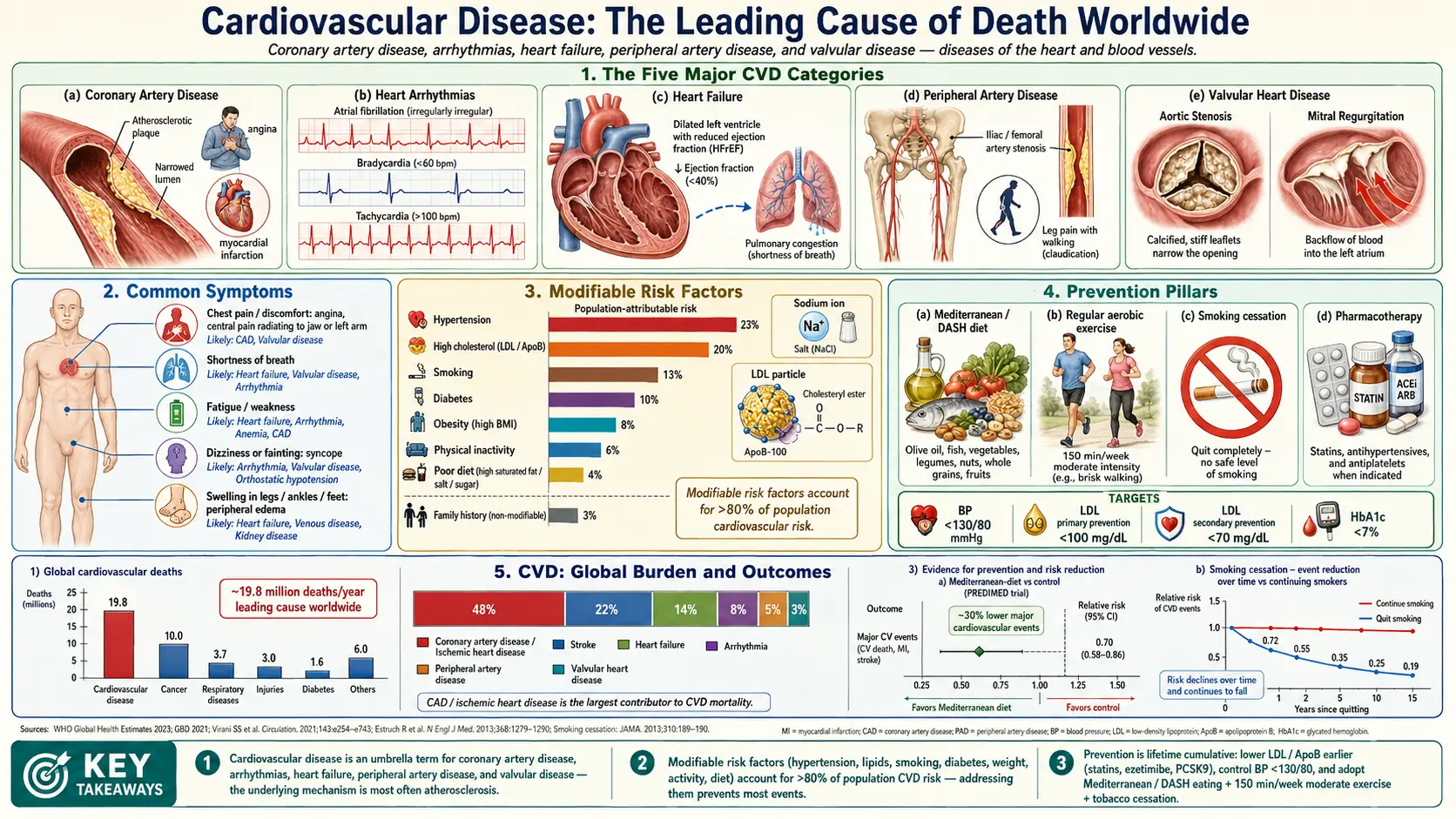
Table of Contents
What is Cardiovascular Disease?
Cardiovascular disease (CVD) refers to a class of diseases involving the heart and blood vessels. It encompasses various conditions that affect the cardiovascular system and is a leading cause of death worldwide.
One pump, one network, many failure points
The circulatory system is a pump attached to about 60,000 miles of tubing that has to deliver oxygen everywhere and take waste away. "Cardiovascular disease" is the umbrella for everything that can go wrong in that system, and grouping such different problems together only makes sense because they share the same underlying processes and, largely, the same prevention.
Almost all of it comes down to four kinds of failure. The plumbing narrows or blocks — atherosclerosis in the heart's own arteries, in the brain's, in the legs'. The electrics misfire — the arrhythmias. The pump weakens or stiffens — heart failure. The valves leak or jam. A given person may have several at once, and one commonly causes another: a blocked artery kills muscle, the scarred muscle triggers an arrhythmia, the arrhythmia and the damage together produce heart failure.
The single most useful thing to understand is that the plumbing problems are all the same disease in different locations. Atherosclerosis in the coronary arteries is a heart attack; in the brain's arteries a stroke; in the legs, peripheral artery disease. This is why someone with leg claudication should have their heart assessed, and why the drugs and the diet are broadly the same wherever the plaque happens to sit.
Globally, cardiovascular disease accounts for roughly a third of all deaths, and the number of people living with it has roughly doubled since 1990 as populations have grown and aged [1]. It remains the leading cause of death worldwide. That scale is worth stating alongside the more hopeful fact in the next section: most of the risk is modifiable.
Types of Cardiovascular Disease
1. Coronary Artery Disease (CAD)
- Most common type: Affects blood flow to the heart.
- Caused by plaque buildup in the arteries, leading to narrowed or blocked vessels.
- Can result in: Chest pain (angina), heart attacks.
- Key point most people get wrong: the heart attacks usually come from moderate plaques that tear, not from the tightest narrowing. See Coronary Artery Disease, Angina and Heart Attack.
2. Heart Arrhythmias
- Irregular heartbeats: The heart may beat too fast, too slow, or irregularly.
- Common types include:
- Atrial fibrillation
- Bradycardia (slow heartbeat)
- Tachycardia (fast heartbeat)
- Danger varies enormously — from harmless extra beats to cardiac arrest. With atrial fibrillation the main hazard is stroke rather than the rhythm itself. See Arrhythmia and Atrial Fibrillation.
3. Heart Failure
- Occurs when the heart cannot pump blood effectively.
- Causes: CAD, high blood pressure, or other underlying conditions.
- Splits in two: a weak squeeze (reduced ejection fraction) or a stiff chamber that will not fill (HFpEF). They look alike from the outside and are treated differently. See Heart Failure.
4. Peripheral Artery Disease (PAD)
- Affects blood flow to the limbs.
- Common symptoms: Leg pain, especially when walking.
- Treat it as a coronary warning. PAD marks the same disease elsewhere, and people with it have a high risk of heart attack and stroke. See Peripheral Artery Disease.
5. Heart Valve Disease
- Problems with heart valves not opening or closing properly.
- Examples include: Mitral valve regurgitation, aortic stenosis.
- Often silent for years, then symptomatic quite suddenly. Aortic stenosis classically declares itself with breathlessness, chest tightness or fainting on exertion. See Valvular Heart Disease.
6. Cerebrovascular Disease
- The same atherosclerosis, in the brain's supply. A clot or a bleed produces a stroke; a brief blockage that clears produces a transient ischaemic attack, which is a warning that must be acted on within hours, not weeks.
7. Aortic Disease
- Aneurysm — a weakened, ballooning section of the body's main artery, usually silent until it leaks or bursts. See Aortic Aneurysm.
- Dissection — a tear in the aortic wall. Sudden tearing chest or back pain of maximum intensity at onset. See Aortic Dissection.
8. Venous Disease
- Deep vein thrombosis and pulmonary embolism — clots that form in veins rather than arteries. Different mechanism, different treatment, and worth distinguishing: a swollen painful calf or sudden breathlessness with chest pain on breathing in is a different emergency from a heart attack. See Pulmonary Embolism.
Common Symptoms of Cardiovascular Disease
- Chest pain or discomfort (angina)
- Shortness of breath
- Fatigue and weakness
- Swelling in legs, ankles, and feet
- Dizziness or fainting
What the symptom is usually telling you
- Discomfort brought on by effort and relieved by rest — whether in the chest, the jaw or the calf — is the signature of a supply-demand mismatch, meaning a narrowed artery. Where it hurts tells you which artery.
- Breathlessness lying flat, needing extra pillows points to fluid backing up behind the left side of the heart — a heart-failure pattern.
- Ankle swelling that pits when you press it, plus abdominal fullness points to congestion behind the right side.
- Palpitations with sudden onset and offset point to an electrical problem rather than a plumbing one.
- Fainting during exertion is the one symptom that is never to be shrugged off — it suggests severe valve narrowing or a dangerous rhythm.
Symptoms are often atypical, and in predictable groups. Women more frequently present with breathlessness, unusual fatigue, nausea, or jaw and back discomfort rather than classic chest pain. People with diabetes may feel little or nothing because of nerve damage. Older adults may present as confusion, a fall or a general decline. None of these is a rare exception; together they cover a very large share of presentations, and they are the reason so many events are missed at first contact.
Risk Factors
- High blood pressure (hypertension)
- High cholesterol
- Smoking
- Diabetes
- Obesity
- Physical inactivity
- Poor diet: High in saturated fat, salt, and sugar
- Family history of cardiovascular disease
Nine factors account for about 90% of the risk
The INTERHEART study compared 15,152 people having a first heart attack with 14,820 matched controls across 52 countries, and asked how much of the risk the standard factors actually explain. The answer was strikingly high: nine modifiable factors accounted for about 90% of the population-attributable risk in men and 94% in women — consistently across every region, both sexes and all ages [2].
The nine, with their measured contributions: abnormal lipids (the ApoB/ApoA1 ratio, the largest single contributor at 49.2%), smoking (35.7%), psychosocial factors including chronic stress and depression (32.5%), abdominal obesity (20.1%), hypertension (17.9%), too little fruit and vegetables (13.7%), physical inactivity (12.2%), diabetes (9.9%), and alcohol intake.
Two things stand out. Psychosocial factors rank third — higher than obesity, higher than blood pressure — which is a strong argument against treating stress and depression as soft add-ons to cardiac care. And the factors are the same everywhere, which means prevention advice does not need to be re-derived for each population.
Risk factors that get left off the history
- Lipoprotein(a) — inherited, common, not lowered by statins, and measured once in a lifetime. See Lipoprotein(a).
- Chronic kidney disease — a powerful risk multiplier in its own right.
- Chronic inflammatory conditions — rheumatoid arthritis, lupus, psoriasis, inflammatory bowel disease.
- Pregnancy history — pre-eclampsia, gestational diabetes and premature menopause all predict later cardiovascular disease, and are rarely asked about.
- Obstructive sleep apnea — and it is treatable.
- Cancer treatment history — anthracyclines, trastuzumab and chest radiation can injure the heart years later.
- Gum disease — consistently associated with cardiovascular risk, plausibly through chronic low-grade inflammation.
Know Your Numbers
Cardiovascular disease is largely silent until it is not, so prevention runs on measurements rather than symptoms. These are the ones worth knowing about yourself, and roughly what they mean.
- Blood pressure. Under 120/80 is normal; 130/80 and above is stage 1 hypertension by current US thresholds. Measure it properly — seated, back supported, feet flat, arm at heart level, no caffeine or exercise for 30 minutes, and take the average of two readings after five minutes of quiet. A home monitor with a correctly sized cuff is one of the best-value purchases in health care, and home readings predict outcomes better than clinic ones. See Hypertension.
- LDL cholesterol and ApoB. LDL targets depend on your overall risk — generally under 100 mg/dL for low risk, under 70 for established disease, and lower still for very high risk. ApoB counts the actual particles and is more informative when triglycerides are high. See Lipid Panel and ApoB.
- Lipoprotein(a). Once, ever. A high result raises the urgency of everything else and flags your relatives.
- HbA1c. Under 5.7% is normal, 5.7–6.4% is prediabetes, 6.5% or more is diabetes. Prediabetes already carries elevated cardiovascular risk and is the point at which it is easiest to change course.
- Waist circumference. A better marker of the metabolically active fat that drives risk than weight or BMI alone.
- Coronary artery calcium score — useful specifically when you are undecided about starting a statin. A score of zero is genuinely reassuring in the short term; 100 or more argues for treatment. See Coronary Calcium Score.
- Kidney function and urine albumin — because kidney disease is both a consequence and a driver.
Prevention Strategies
- Maintain a healthy diet: Focus on vegetables, fruit, legumes, whole grains, fish, nuts and olive oil.
- Regular physical activity: At least 150 minutes of moderate exercise per week.
- Quit smoking: Reduces risk significantly.
- Manage stress: Techniques such as yoga, meditation, or deep breathing.
- Control other health conditions: Keep diabetes, high blood pressure, and cholesterol under control.
What the evidence actually supports, in order of size
Blood pressure — strong. SPRINT randomized 9,361 high-risk adults to a systolic target below 120 or below 140. The intensive group had fewer major cardiovascular events (1.77% versus 2.40% per year) and lower all-cause mortality (1.06% versus 1.41% per year), and the benefit persisted after the trial ended [3]. Intensive treatment also caused more low blood pressure, fainting, electrolyte disturbance and acute kidney injury — so the target is a genuine trade-off to discuss, not a universal rule. It is not the same for everyone: frailty, falls and kidney function all shift it.
LDL cholesterol — strong. Across 26 randomized trials in 170,000 people, every 1.0 mmol/L (about 39 mg/dL) reduction in LDL cut major vascular events by roughly a fifth per year and all-cause mortality by 10%, with no threshold below which benefit stopped [4].
Diet — strong for a whole pattern, weak for single nutrients. PREDIMED randomized 7,447 people at high risk and found a Mediterranean pattern supplemented with extra-virgin olive oil or with nuts reduced major cardiovascular events (hazard ratios 0.69 and 0.72) [5]. Note the shape of the intervention: it added good fats and whole foods rather than removing fat. In practice that means extra-virgin olive oil as the main added fat, nuts most days, vegetables at most meals, legumes several times a week — lentils, chickpeas, black beans — oily fish twice a week, whole grains rather than refined (oats, barley, brown rice), fruit for dessert, and much less processed meat, sugary drinks and refined baked goods. Eggs and full-fat dairy in reasonable amounts are not the villains they were once made out to be; ultra-processed food is the thing to cut.
Physical activity — strong, with most of the gain at the start. A pooled analysis of over 660,000 adults found the mortality curve is steepest at the low end: even half the recommended amount was associated with a 20% lower risk of death compared with none, with the recommended 150 minutes a week giving about 31%, and the curve flattening beyond three to five times that [6]. The message for someone doing nothing is that the first walk is worth far more than the last mile of a marathon.
Stopping smoking — the largest single step available to a smoker, larger than any medication discussed here.
Sleep and mental health — real, and routinely dismissed. Psychosocial factors carried a population-attributable risk of 32.5% in INTERHEART [2]. Untreated sleep apnea, chronic short sleep, depression and sustained stress all belong on the list of things to actually treat. The American Heart Association's Life's Essential 8 framework formally added sleep alongside diet, activity, nicotine exposure, weight, lipids, glucose and blood pressure [7].
Supplements — weak to absent. Vitamin E, beta-carotene, vitamin C and folate have all failed to reduce cardiovascular events in randomized trials. Routine fish-oil capsules have not consistently reduced events at ordinary doses, and high doses increase the risk of atrial fibrillation. Multivitamins have no demonstrated cardiovascular benefit. This is not an argument against food sources — it is an argument against expecting a capsule to substitute for the pattern.
Treatment Options
- Lifestyle changes: Essential for managing cardiovascular health.
- Medications: May include blood pressure medications, statins, and antiplatelet drugs.
- Medical procedures: Such as angioplasty, stent placement, or bypass surgery.
- Cardiac rehabilitation: A supervised program involving exercise, health education, and counseling.
Sorting what extends life from what relieves symptoms
This distinction is worth carrying into every consultation, because the two are easily confused and the more dramatic intervention is not always the more valuable one.
- Mostly life-extending: statins and other lipid-lowering therapy; blood-pressure control; stopping smoking; the four drug classes used in heart failure with reduced ejection fraction; anticoagulation for atrial fibrillation; opening the artery during a heart attack; and cardiac rehabilitation after an event.
- Mostly symptom-relieving: stents for stable angina; diuretics in heart failure; rate-control drugs in atrial fibrillation; nitrates.
Both categories are worth having. But "we opened the blockage" in stable disease is not the same claim as "we reduced your risk of dying", and being clear about which one is on offer changes how you weigh a procedure. See Coronary Artery Disease for the trial evidence behind that distinction.
Cardiac rehabilitation deserves a specific mention because it is consistently under-referred and under-attended. It is a supervised programme of exercise, education and psychological support after an event, and attendance is associated with better outcomes. If it is not offered, ask.
Complications of Cardiovascular Disease
- Heart attack: Sudden blockage of blood flow to the heart muscle.
- Stroke: Reduced blood flow to the brain, leading to potential brain damage.
- Aneurysm: Abnormal bulging of a blood vessel, which can burst and cause life-threatening bleeding.
- Heart failure: Chronic condition where the heart fails to pump effectively.
- Peripheral artery disease: Can result in pain, infection, and amputation.
Two further consequences are worth naming because they are common and under-recognised. Vascular cognitive impairment — the same small-vessel disease that damages the heart also damages the brain's white matter, and better blood-pressure control appears to reduce that risk. And cardiorenal decline — heart and kidney disease drive one another, so worsening kidney function in someone with heart disease is a signal to review the whole picture rather than just one organ.
Red Flags: What Cannot Wait
Call emergency services immediately for:
- Chest pressure or tightness lasting more than a few minutes, or spreading to arm, jaw, neck or back — especially with sweating, nausea or breathlessness.
- Stroke signs — face drooping, arm weakness, speech difficulty. Time is the treatment: clot-busting drugs and clot retrieval both work on a clock measured in hours. Note the time symptoms began; it decides what treatment is possible.
- Sudden severe breathlessness, or coughing pink frothy sputum.
- Fainting, particularly during exertion.
- Sudden tearing chest or back pain at maximum intensity from the first second — the pattern of aortic dissection.
- A cold, pale, painful leg or arm that has come on suddenly — an acutely blocked artery is limb-threatening within hours.
- A swollen, painful calf, or sudden breathlessness with pain on breathing in — possible clot in a vein or lung.
The single most common fatal error is waiting. People delay because they do not want to make a fuss, because the symptom is not classic, or because they hope it will pass. Heart muscle and brain tissue die over minutes. A false alarm costs an afternoon.
Key Research Papers
The following PubMed topic searches return current peer-reviewed literature relevant to this condition. Each link opens a live PubMed query.
Key Research Papers
Every citation below was verified against its PubMed record before publication — author list, journal, year and title all checked against the source.
- Roth GA, Mensah GA, Johnson CO, et al. Global Burden of Cardiovascular Diseases and Risk Factors, 1990-2019: Update From the GBD 2019 Study. J Am Coll Cardiol. 2020;76(25):2982-3021 — PubMed PMID: 33309175 · doi:10.1016/j.jacc.2020.11.010
- Yusuf S, Hawken S, Ounpuu S, et al. Effect of potentially modifiable risk factors associated with myocardial infarction in 52 countries (the INTERHEART study): case-control study. Lancet. 2004;364(9438):937-52 — PubMed PMID: 15364185 · doi:10.1016/S0140-6736(04)17018-9
- Lewis CE, Fine LJ, Beddhu S, et al. Final Report of a Trial of Intensive versus Standard Blood-Pressure Control. N Engl J Med. 2021;384(20):1921-1930 — PubMed PMID: 34010531 · doi:10.1056/NEJMoa1901281
- Baigent C, Blackwell L, Emberson J, et al. Efficacy and safety of more intensive lowering of LDL cholesterol: a meta-analysis of data from 170,000 participants in 26 randomised trials. Lancet. 2010;376(9753):1670-81 — PubMed PMID: 21067804 · doi:10.1016/S0140-6736(10)61350-5
- Estruch R, Ros E, Salas-Salvadó J, et al. Primary Prevention of Cardiovascular Disease with a Mediterranean Diet Supplemented with Extra-Virgin Olive Oil or Nuts. N Engl J Med. 2018;378(25):e34 — PubMed PMID: 29897866 · doi:10.1056/NEJMoa1800389
- Arem H, Moore SC, Patel A, et al. Leisure time physical activity and mortality: a detailed pooled analysis of the dose-response relationship. JAMA Intern Med. 2015;175(6):959-67 — PubMed PMID: 25844730 · doi:10.1001/jamainternmed.2015.0533
- Lloyd-Jones DM, Allen NB, Anderson CAM, et al. Life's Essential 8: Updating and Enhancing the American Heart Association's Construct of Cardiovascular Health: A Presidential Advisory From the American Heart Association. Circulation. 2022;146(5):e18-e43 — PubMed PMID: 35766027 · doi:10.1161/CIR.0000000000001078
PubMed Topic Searches
Each link opens a live PubMed query returning current peer-reviewed literature on that sub-topic.
- PubMed: Cardiovascular disease epidemiology
- PubMed: Cardiovascular disease prevention
- PubMed: Cardiovascular disease risk factors
- PubMed: Statin cardiovascular disease
- PubMed: Mediterranean diet cardiovascular disease
- PubMed: Exercise cardiovascular disease
- PubMed: Cardiovascular disease mortality
- PubMed: Inflammation cardiovascular disease
- PubMed: Cardiovascular disease prevention guidelines
- PubMed: Women cardiovascular disease
- PubMed: Cardiovascular disease biomarkers
- PubMed: Atherosclerosis pathophysiology
Connections
- Cardiology
- Coronary Artery Disease
- Heart Failure
- Peripheral Artery Disease
- Stroke
- Hypertension
- Atherosclerosis
- Atrial Fibrillation
- Valvular Heart Disease
- Lipid Panel
- Garlic
- Magnesium
- Anti-Inflammatory Diet
- Omega-3 Fatty Acids
- Diabetes
- Obesity
- Chest Pain
- NAC and Cardiovascular Health
- Vitamin D3
- Rheumatoid Arthritis
- Gum Disease
- Herbs covered on this site that discuss this condition: Astragalus (Astragalus membranaceus) · Japanese Knotweed (Polygonum cuspidatum / Reynoutria japonica) · Stevia (Stevia rebaudiana) · Cardamom (Elettaria cardamomum) · Chanca Piedra (Phyllanthus niruri) · Red Clover
- Arrhythmia — the electrical failures, from harmless extra beats to cardiac arrest
- Heart Attack — what happens when a moderate plaque tears
- Angina — effort-related discomfort as a supply-demand mismatch
- HFpEF — the stiff-ventricle half of heart failure
- Aortic Dissection — sudden tearing pain, maximal from the first second
- Lipoprotein(a) — inherited risk, measured once in a lifetime
- ApoB — counts the atherogenic particles LDL-C can under-report
- Coronary Calcium Score — for when the statin decision is genuinely undecided
- Obstructive Sleep Apnea — a treatable driver of blood pressure and arrhythmia