⚠ Evidence warning: Clinical trials or other evidence do not support the claims that hawthorn improves exercise tolerance, gives a mortality benefit in heart failure, and consistently lowers blood pressure by 5-10 mmHg systolic and 2-5 mmHg diastolic. This page keeps it as a report of what people, websites or other media say.
Hawthorn (Crataegus monogyna)
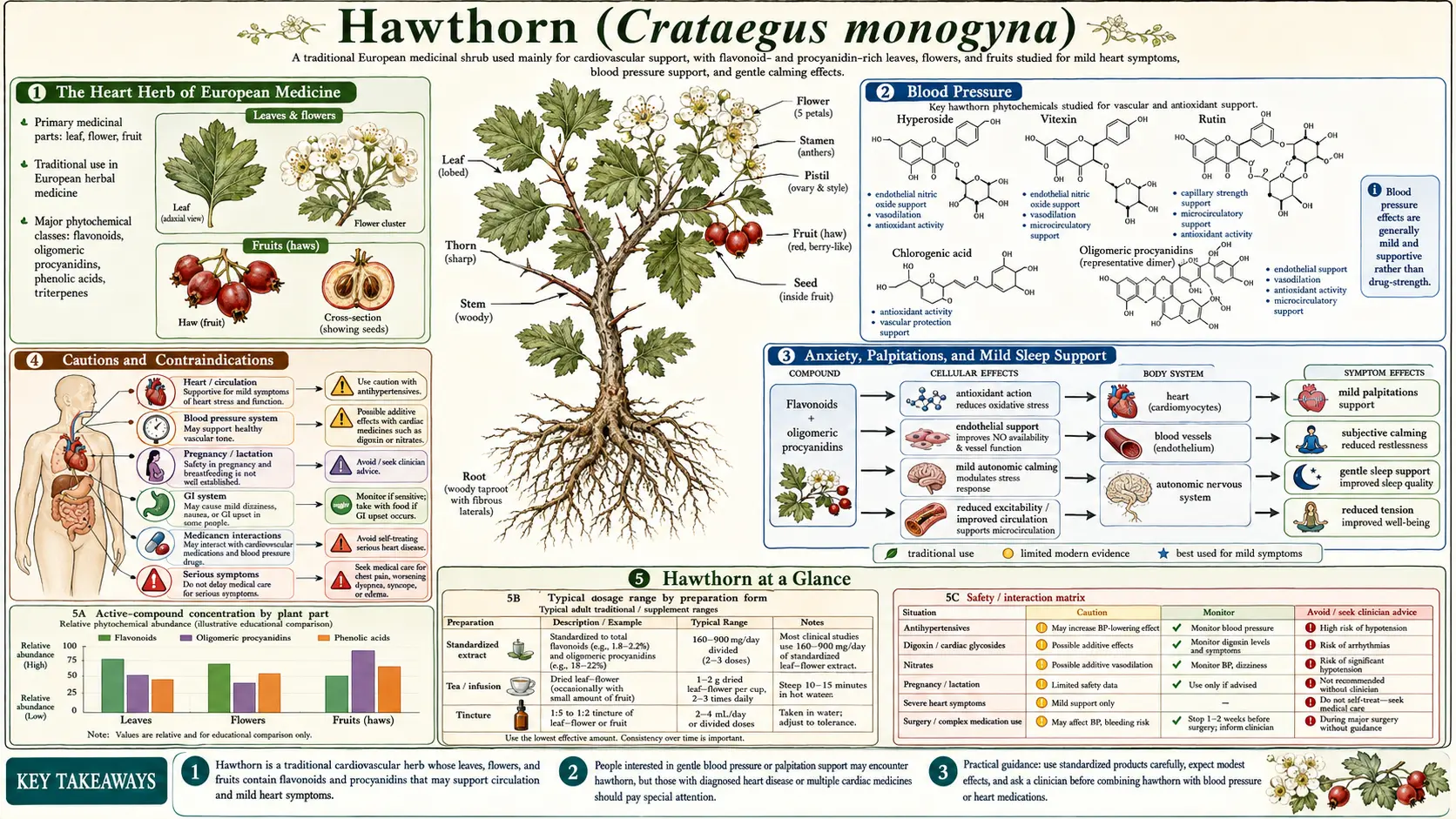
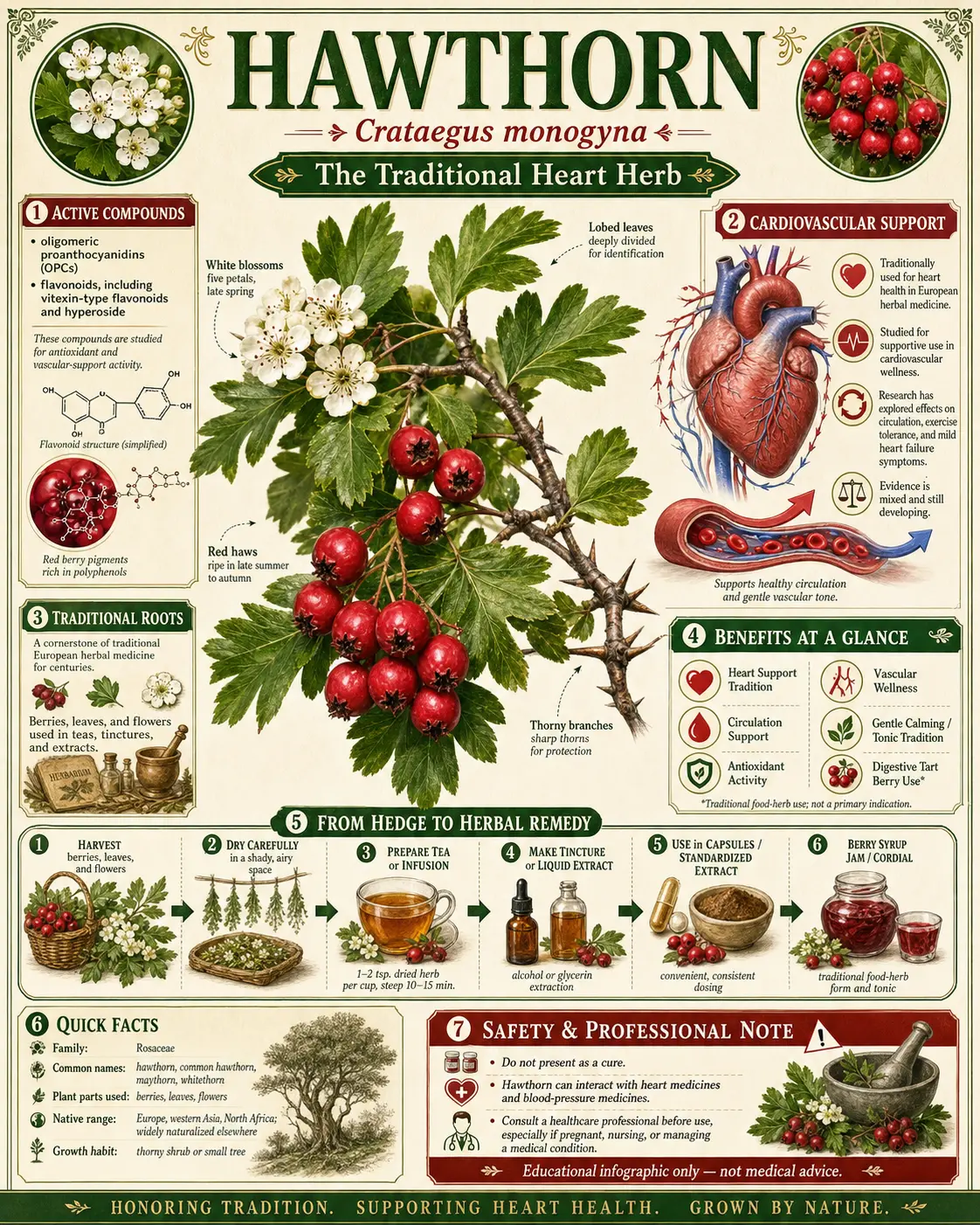
Table of Contents
The Heart Herb of European Medicine
Hawthorn is a thorny tree of the rose family, with white spring flowers and bright red autumn berries (haws), found across Europe, North Africa, and Western Asia. Its name and lore reach back to the ancient Greek botanists and to the "May tree" and fairy-thorn folklore of the British Isles, while in China the fruit (shan zha) is an age-old digestive food-medicine; the herb's famous reputation for the heart, however, is largely a story of the last century and a half, carried into modern medicine by figures such as the French physician Henri Leclerc and, more recently, by a standardized German leaf-and-flower extract — the fuller story is told in the dedicated History & Traditional Use article.
Active Compounds
Hawthorn's cardiovascular activity comes from a synergistic blend of polyphenolic compounds:
- Oligomeric proanthocyanidins (OPCs) — complex polyphenols with strong antioxidant, anti-inflammatory, and vascular-protective activity; concentrated in the leaves and flowers
- Flavonoids — including vitexin, hyperoside, rutin, and quercetin; active on cardiac contractility and vascular tone
- Triterpene acids — ursolic acid, oleanolic acid; mild positive inotropic and antioxidant effects
- Catechins and epicatechins — additional antioxidant and endothelial-protective compounds
Standardized extracts are typically calibrated to OPC content (often 18.75%, as in the extract used in the large heart-failure trials) or to total flavonoid content, drawn from leaves and flowers (the most pharmacologically active parts). Berry preparations are also used but contain different proportions of constituents.
Chronic Heart Failure
The strongest evidence base for hawthorn is in mild to moderate chronic heart failure — New York Heart Association (NYHA) classes I to III in the trials. Trials and reviews of hawthorn leaf-and-flower extracts, many of them using a standardized extract at 900 mg/day, have reported:
- Improved exercise tolerance (longer 6-minute walk distance, higher maximum workload on bicycle ergometry)
- Exercise testing: a 2008 Cochrane review (Pittler and colleagues; 10 trials, 855 patients in NYHA classes I to III) found a higher maximal workload with hawthorn than with placebo, while the 2009 HERB CHF trial (Zick and colleagues; 120 patients in NYHA classes II to III taking standard heart-failure medicines) found no difference from placebo in 6-minute walk distance or quality of life
- Reduced symptoms of fatigue, dyspnea (shortness of breath) on exertion, and palpitations
- Modest improvements in left ventricular ejection fraction in some studies
- Quality of life improvements similar to those seen with low-dose angiotensin-converting enzyme inhibitor (ACE inhibitor) therapy
- Mortality benefit (modest but in the direction of benefit)
- Death and heart events in the SPICE trial (Holubarsch and colleagues, 2008; 2,681 patients in NYHA classes II to III, 900 mg/day or placebo for 24 months): no significant effect on the main outcome, the time to a first cardiac event; a trend toward fewer cardiac deaths (hazard ratio 0.89) was not statistically significant; fewer sudden cardiac deaths were seen only in the subgroup whose left ventricular ejection fraction was 25% or more
In most of these trials hawthorn was given on top of, not instead of, standard heart failure medicines (angiotensin-converting enzyme inhibitors (ACE inhibitors), beta-blockers, mineralocorticoid receptor antagonists, sodium-glucose cotransporter-2 (SGLT2) inhibitors). It is used for symptom relief and quality of life on top of established therapy in mild to moderate heart failure.
Blood Pressure
Hawthorn produces modest but consistent reductions in blood pressure in clinical trials, on the order of 5-10 mmHg systolic and 2-5 mmHg diastolic. Blood-pressure trials of hawthorn have given mixed results. In a 2006 UK trial (Walker and colleagues) of 79 people with type 2 diabetes, most of them already taking blood-pressure medicines, 1,200 mg of hawthorn extract daily for 16 weeks lowered diastolic pressure more than placebo did (from 85.6 to 83.0 mmHg, against 84.5 to 85.0 mmHg), while the fall in systolic pressure did not differ between the groups. A 2002 pilot trial in mild high blood pressure (500 mg daily for 10 weeks) found no difference between the treatment groups, and a 2012 crossover trial in 21 adults with high-normal or mildly high blood pressure (1,000 to 2,500 mg twice daily for three and a half days) found no dose-related effect on blood pressure. The mechanism appears to involve nitric oxide-mediated vasodilation, mild ACE-inhibition-like activity, and reduction of catecholamine-driven vascular tone.
The effects reported are too small for hawthorn to serve as the only treatment for established hypertension; herbal practitioners use it in:
- Stage 1 hypertension as part of lifestyle-first management
- Adjunctive therapy in patients on suboptimal pharmacotherapy
- Stress-related blood pressure elevation
- Patients seeking a heart-supportive daily tonic
Antioxidant and Vascular Protection
The OPC content of hawthorn is among the highest of commonly used herbs. OPCs are powerful antioxidants that protect vascular endothelium, reduce low-density lipoprotein (LDL) oxidation, improve nitric oxide bioavailability, and stabilize the basement membrane of small blood vessels. These effects translate to long-term cardiovascular protection beyond the immediate symptomatic benefits.
Animal studies suggest hawthorn may slow atherosclerotic plaque progression, reduce ischemia-reperfusion injury after a cardiac event, and protect cardiac muscle from oxidative damage during exercise. Human evidence for these long-term outcomes is more limited but biologically plausible.
Anxiety, Palpitations, and Mild Sleep Support
Hawthorn has a long traditional use for "palpitations of nervous origin" the kind of fluttery, racing heart sensation that occurs with anxiety, stress, or hormonal transitions, even in the absence of structural heart disease. It is gentle and non-sedating, making it suitable for daytime use, and pairs well with lemon balm, motherwort, and passionflower in formulas for anxiety with cardiac symptoms.
Its mild effect on autonomic balance also makes it useful as a daily cardiovascular tonic for individuals with stress-related cardiovascular complaints, including premature ventricular contractions and benign tachycardia related to caffeine sensitivity or anxiety.
Forms and Preparations
- Standardized leaf-and-flower extract — the form used in clinical trials; standardized to OPCs (18.75%) or flavonoids (typically 2-3%)
- A standardized leaf-and-flower extract (18.75% oligomeric procyanidins) — the most-studied preparation; it is the extract tested in the SPICE and HERB CHF heart failure trials
- Whole-berry preparations — traditional jelly, syrup, or tincture from the red autumn berries; gentler tonic action
- Combination preparations — often combined with motherwort, lemon balm, and lily of the valley for cardiac herbal formulas (under clinical guidance)
- Tea — dried leaves and flowers in hot water, 10-15 minutes; pleasant, mildly astringent flavor
Dosage Ranges
- Standardized leaf-flower extract — 160-1,800 mg daily, divided in two or three doses; the heart failure trials used 900 mg/day of a standardized leaf-and-flower extract
- Tincture (1:5) — 4-5 mL three times daily
- Dried leaf and flower tea — 1-2 g three times daily
- Berry preparations — 1-2 teaspoons of berry syrup or 5-10 g of dried berries daily
- Onset — effects build gradually; meaningful symptomatic improvement is typical at 6-12 weeks
- Long-term use — described as well tolerated for long-term daily use; in the 24-month SPICE trial adverse events were similar with hawthorn and placebo. In the 6-month HERB CHF trial significantly more adverse events were reported with hawthorn than with placebo, most of them not heart-related, and a later analysis of that trial's data (Zick and colleagues, 2008) found that hawthorn did not slow the worsening of heart failure and appeared to raise its early risk
Cautions and Contraindications
- Existing heart disease and medication — the European Medicines Agency recognises hawthorn leaf and flower only as a traditional herbal medicine: for temporary nervous heart complaints such as palpitations, after a doctor has ruled out a serious condition, and for mild stress and sleep. It does not recommend the heart use for anyone under 18, and it lists no reported drug interactions. Theoretical interactions have been raised with all major cardiac drug classes (digoxin, beta-blockers, calcium channel blockers, angiotensin-converting enzyme inhibitors, antiarrhythmics). The monograph names these as signs needing immediate medical attention: swollen ankles or legs, pain in the region of the heart that may spread to the arms, upper abdomen or neck, and breathlessness (dyspnea).
- Digoxin — in a 2003 study (Tankanow and colleagues), 8 healthy volunteers took digoxin 0.25 mg together with a standardized hawthorn extract (450 mg twice daily) for 21 days, and hawthorn did not significantly change any measured digoxin pharmacokinetic value, including blood levels and kidney clearance. The US National Library of Medicine's LactMed database states that hawthorn "can possibly increase the effect of anticoagulants, digoxin and hypotensive medications." Hawthorn may potentiate digoxin's positive inotropic effect.
- Hypotension — in combination with antihypertensives, additive blood pressure lowering may produce symptomatic hypotension
- Pregnancy and breastfeeding — the European Medicines Agency states that safety during pregnancy and breastfeeding has not been established and, for lack of data, does not recommend use then
- Severe heart failure — hawthorn has not been shown to replace established therapy in NYHA class III-IV heart failure; in the trials it was given on top of standard care
- Surgery — stopping hawthorn at least two weeks before planned surgery is a common precaution, because of its possible effects on blood pressure and heart contraction during anesthesia
- Mild side effects — mild gastrointestinal (GI) upset, headache, dizziness; generally well tolerated
Key Research Papers
- Holubarsch CJ, Colucci WS, Meinertz T, Gaus W, Tendera M; Survival and Prognosis: Investigation of Crataegus Extract WS 1442 in CHF (SPICE) trial study group. The efficacy and safety of Crataegus extract WS 1442 in patients with heart failure: the SPICE trial. Eur J Heart Fail. 2008;10(12):1255-1263. — PubMed PMID: 19019730
- Pittler MH, Guo R, Ernst E. Hawthorn extract for treating chronic heart failure. Cochrane Database Syst Rev. 2008;(1):CD005312. — PubMed PMID: 18254076
- Zick SM, Vautaw BM, Gillespie B, Aaronson KD. Hawthorn Extract Randomized Blinded Chronic Heart Failure (HERB CHF) trial. Eur J Heart Fail. 2009;11(10):990-999. — PubMed PMID: 19789403
- Zick SM, Gillespie B, Aaronson KD. The effect of Crataegus oxycantha Special Extract WS 1442 on clinical progression in patients with mild to moderate symptoms of heart failure. Eur J Heart Fail. 2008;10(6):587-593. — PubMed PMID: 18490196
- Walker AF, Marakis G, Simpson E, Hope JL, Robinson PA, Hassanein M, Simpson HC. Hypotensive effects of hawthorn for patients with diabetes taking prescription drugs: a randomised controlled trial. Br J Gen Pract. 2006;56(527):437-443. — PubMed PMID: 16762125
- Walker AF, Marakis G, Morris AP, Robinson PA. Promising hypotensive effect of hawthorn extract: a randomized double-blind pilot study of mild, essential hypertension. Phytother Res. 2002;16(1):48-54. — PubMed PMID: 11807965
- Asher GN, Viera AJ, Weaver MA, Dominik R, Caughey M, Hinderliter AL. Effect of hawthorn standardized extract on flow mediated dilation in prehypertensive and mildly hypertensive adults: a randomized, controlled cross-over trial. BMC Complement Altern Med. 2012;12:26. — PubMed PMID: 22458601
- Tankanow R, Tamer HR, Streetman DS, Smith SG, Welton JL, Annesley T, Aaronson KD, Bleske BE. Interaction study between digoxin and a preparation of hawthorn (Crataegus oxyacantha). J Clin Pharmacol. 2003;43(6):637-642. — PubMed PMID: 12817526
PubMed Topic Searches
The following PubMed search links provide curated entry points into the published clinical and mechanistic literature on Hawthorn (Crataegus monogyna). Each link opens directly in PubMed at the National Library of Medicine.
- Crataegus extract for chronic heart failure — PubMed: Crataegus heart failure
- Hawthorn for hypertension — PubMed: hawthorn hypertension
- Hawthorn oligomeric proanthocyanidins — PubMed: hawthorn OPC proanthocyanidin
- Hawthorn and angina pectoris — PubMed: Crataegus angina
- Hawthorn antioxidant mechanism — PubMed: hawthorn antioxidant mechanism
- Hawthorn standardized leaf-and-flower extract — PubMed: hawthorn standardized extract
- Hawthorn safety and drug interactions — PubMed PMID: 30000891