HFpEF — Heart Failure with Preserved Ejection Fraction
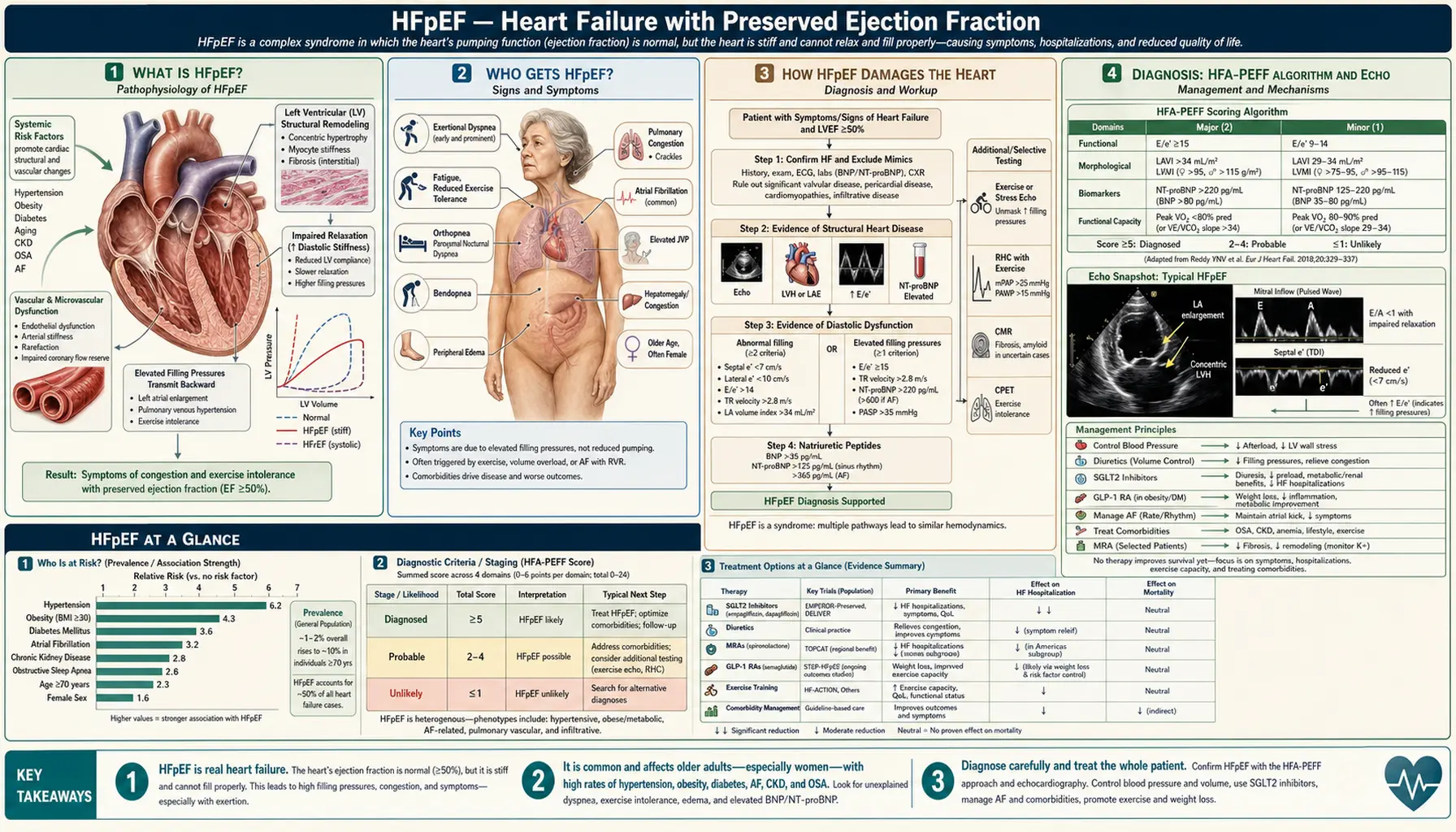
Table of Contents
- HFpEF Explained
- Who Develops HFpEF
- How HFpEF Damages the Heart
- Diagnosis: HFA-PEFF Algorithm and Echo
- Diastolic Dysfunction Grading
- Symptoms: Exercise Intolerance and Dyspnea
- Treatment: Landmark Trials and Approved Therapies
- Lifestyle: Weight Loss, Exercise, and Salt Restriction
- Prognosis and Hospitalizations
- Key Research Papers
- Connections
- Featured Videos
HFpEF Explained
Heart failure with preserved ejection fraction (HFpEF) is a form of heart failure in which the left ventricle pumps normally — the ejection fraction (EF) is 50% or higher — but the heart muscle is abnormally stiff and cannot relax properly between beats. Because the ventricle fills poorly, less blood enters before each contraction, so total cardiac output falls short of what the body needs, especially during physical activity.
HFpEF now accounts for roughly 50% of all heart failure cases in the United States and its share is rising as the population ages. Unlike heart failure with reduced ejection fraction (HFrEF), where the pump is visibly weak, HFpEF can be deceptively "normal-looking" on a standard echocardiogram, making it historically under-diagnosed and under-treated.
Who Develops HFpEF
HFpEF has a distinctive patient profile that differs sharply from HFrEF:
- Older women — women develop HFpEF more often than men, and incidence rises steeply after age 65.
- Hypertension — present in more than 80% of HFpEF patients; chronic pressure overload drives left ventricular hypertrophy and stiffening.
- Obesity — adipose tissue secretes pro-inflammatory cytokines (interleukin-6 (IL-6), tumor necrosis factor alpha (TNF-α)) that directly stiffen myocardial tissue; abdominal obesity also compresses the pericardium.
- Type 2 diabetes — advanced glycation end-products cross-link collagen in the myocardium, reducing compliance independent of blood pressure.
- Atrial fibrillation (AFib) — both a cause and consequence of HFpEF; loss of atrial "kick" worsens filling; the two conditions share the same risk-factor cluster.
- Chronic kidney disease — fluid overload and uremic inflammation accelerate myocardial fibrosis.
- Sleep apnea — intermittent hypoxia and nocturnal hypertension further impair diastolic function.
Cardiologists often refer to HFpEF as a "syndrome" rather than a single disease because so many comorbidities converge to produce it.
How HFpEF Damages the Heart
In HFpEF the primary problem is diastolic dysfunction — impaired relaxation and reduced compliance of the left ventricle. Several interconnected mechanisms drive this:
- Myocardial fibrosis — fibroblasts deposit excess collagen in response to hypertension, inflammation, and diabetes. Collagen is stiffer than normal myocardium, raising filling pressures.
- Cardiomyocyte hypertrophy — individual heart muscle cells grow larger but less efficient; the sarcomeric protein titin becomes less compliant (hypophosphorylation of the N2B isoform), directly increasing passive stiffness.
- Coronary microvascular dysfunction — small coronary vessels fail to dilate adequately during exertion, causing subendocardial ischemia that further impairs relaxation.
- Elevated left atrial pressure — the left atrium must work against the stiff ventricle; over time it dilates, predisposing to atrial fibrillation and pulmonary congestion.
- Pulmonary hypertension — chronically elevated left-sided filling pressures transmit backward into the pulmonary vasculature, eventually producing pulmonary arterial hypertension and right heart failure.
- Pericardial restraint — in obesity, visceral fat compresses the pericardium, raising pericardial pressure and reducing effective diastolic compliance.
Diagnosis: HFA-PEFF Algorithm and Echo
Diagnosing HFpEF requires proving that (1) symptoms of heart failure are present, (2) EF ≥50%, and (3) elevated filling pressures are the cause. The HFA-PEFF diagnostic algorithm, published by the Heart Failure Association of the European Society of Cardiology, provides a structured four-step framework (Pieske and colleagues, 2019):
- Step 1 — Pre-test assessment (P) — heart-failure symptoms and signs, the typical clinical profile (obesity, hypertension, diabetes, older age, AFib), routine laboratory tests, an electrocardiogram and a standard echocardiogram. HFpEF can be suspected when the ejection fraction is normal, there is no significant heart-valve disease or cardiac ischaemia, and at least one typical risk factor is present. Raised natriuretic peptides support the diagnosis, but normal levels do not exclude it.
- Step 2 — Echocardiography and natriuretic peptide score (E) — a full echocardiogram (e' velocity, E/e' ratio, left atrial volume index (LAVI), tricuspid regurgitation velocity (TRV), left ventricular mass index, relative wall thickness and global longitudinal strain) plus a blood test for B-type natriuretic peptide (BNP) or its fragment NT-proBNP (N-terminal pro-B-type natriuretic peptide). Major criteria score 2 points and minor criteria 1 point: 5 points or more means definite HFpEF, 1 point or fewer makes HFpEF unlikely, and 2–4 points leaves the diagnosis uncertain. Note that obesity lowers natriuretic peptides, so the threshold is adjusted downward for body mass index (BMI) >35.
- Step 3 — Functional testing (F1) — for an uncertain score, exercise stress testing by echocardiography or by invasive measurement. A negative resting echo does not rule out HFpEF. Exercise echocardiography or right-heart catheterization during exertion can unmask elevated pulmonary capillary wedge pressure (PCWP >15 mmHg at rest or >25 mmHg with exercise); right-heart catheterization remains the gold standard when non-invasive tests are inconclusive.
- Step 4 — Final aetiology (F2) — a search for a specific cause of HFpEF or for another explanation of the symptoms.
A separate tool, the H2FPEF score (Reddy and colleagues, 2018), is not part of the HFA-PEFF algorithm. It adds up six features — obesity, atrial fibrillation, age over 60, treatment with two or more blood-pressure medicines, an echo E/e' ratio over 9 and a pulmonary artery systolic pressure over 35 mmHg — into a score from 0 to 9. In the study that built it, the odds of HFpEF roughly doubled with each 1-point increase (odds ratio 1.98).
Key echocardiographic findings in HFpEF include: E/e' >14, LAVI >34 mL/m², TRV >2.8 m/s, and LV mass index above sex-specific thresholds.
Diastolic Dysfunction Grading
The 2016 American Society of Echocardiography (ASE) and European Association of Cardiovascular Imaging (EACVI) guidelines grade diastolic dysfunction in four stages:
- Grade I (impaired relaxation) — E/A ratio <0.8 with normal filling pressures. The ventricle relaxes slowly but can still fill adequately at rest. Very common in older adults; often asymptomatic.
- Grade II (pseudonormal) — E/A ratio 0.8–2.0 with elevated filling pressures (E/e' 10–14, LAVI elevated). The pattern superficially resembles normal but invasive measurements reveal elevated PCWP. Patients may be symptomatic with exertion.
- Grade III (restrictive filling) — E/A ratio >2.0, short deceleration time (<160 ms), severely elevated filling pressures. Symptoms at minimal exertion or at rest.
- Grade IV (irreversible restrictive) — Grade III pattern that does not normalize (become "pseudonormal") with Valsalva maneuver. Associated with advanced myocardial fibrosis.
Grades I–II represent a spectrum from normal aging to early HFpEF; Grades III–IV carry substantially worse prognosis and indicate advanced structural disease.
The grading above reflects the 2016 guidance. In 2025 the ASE published an update (Nagueh and colleagues) that adds newer echocardiographic measures, such as left atrial strain, whose link with left ventricular filling pressures emerged after 2016. The update also covers the use of echocardiography in diagnosing HFpEF.
Symptoms: Exercise Intolerance and Dyspnea
The hallmark symptom of HFpEF is exertional dyspnea — breathlessness with activities that the patient previously tolerated easily. Unlike HFrEF, patients with HFpEF often feel reasonably well at rest, which can lead both patients and doctors to underestimate the severity of the condition.
Common symptoms include:
- Exercise intolerance — reduced peak oxygen uptake (peak VO₂) on cardiopulmonary exercise testing (CPET) is the most objective marker; impaired chronotropic response (the heart cannot increase rate adequately with exercise) contributes independently.
- Orthopnea and paroxysmal nocturnal dyspnea — lying flat redistributes fluid from the legs to the lungs, raising pulmonary venous pressure at night.
- Leg swelling (peripheral edema) — fluid retention from elevated venous pressures; worsens through the day.
- Fatigue — low cardiac reserve means organs and muscles receive inadequate oxygen during activity.
- Rapid weight gain — a weight gain of 2 kg (4–5 lb) over 2–3 days signals acute fluid retention and impending decompensation.
- Palpitations — often due to associated atrial fibrillation or frequent atrial ectopy.
Because symptoms can mimic deconditioning, obesity hypoventilation, or lung disease, formal CPET with simultaneous echocardiography is increasingly used to confirm HFpEF as the cause of exertional symptoms.
Treatment: Landmark Trials and Approved Therapies
HFpEF was historically a "therapy desert" — every drug proven in HFrEF failed to show benefit in HFpEF trials. That changed with the sodium-glucose cotransporter-2 (SGLT2) inhibitor trials.
TOPCAT Trial — Spironolactone (Equivocal)
The TOPCAT trial (N=3,445, 2014) randomized patients with heart failure and a left ventricular ejection fraction of 45% or more to spironolactone 15–45 mg/day vs placebo. The primary composite endpoint (cardiovascular death, aborted cardiac arrest, heart failure hospitalization) was not significantly reduced (hazard ratio (HR) 0.89, p=0.14), though hospitalization for heart failure was lower in the spironolactone arm (12.0% vs 14.2%; HR 0.83, 95% CI 0.69–0.99). Spironolactone doubled the rate of high blood potassium (hyperkalemia; 18.7% vs 9.1%) and raised serum creatinine, a marker of kidney function. Post-hoc analyses revealed major geographic heterogeneity — patients enrolled in Russia/Georgia had unexpectedly low event rates suggesting enrollment of non-HFpEF patients. The Americas subgroup showed a significant benefit. Spironolactone remains commonly used to reduce hospitalizations despite the neutral overall result.
EMPEROR-Preserved — Empagliflozin (First Approved Therapy)
The EMPEROR-Preserved trial (N=5,988, NEJM 2021) was the pivotal trial that changed HFpEF treatment. Empagliflozin 10 mg/day reduced the composite of cardiovascular death or hospitalization for heart failure by 21% (hazard ratio 0.79, p<0.001) in patients with EF >40%. The benefit was consistent across the full EF spectrum and was driven primarily by fewer heart failure hospitalizations. Empagliflozin became the first drug U.S. Food and Drug Administration-approved specifically for HFpEF in February 2022, when the indication was broadened to heart failure regardless of EF.
DELIVER Trial — Dapagliflozin
The DELIVER trial (N=6,263, NEJM 2022) tested dapagliflozin 10 mg/day in HFpEF (EF >40%). It reduced the primary composite (worsening heart failure or cardiovascular death) by 18% (hazard ratio 0.82, p<0.001). Worsening heart failure on its own was lower (hazard ratio 0.79), while the drop in cardiovascular death alone was not statistically significant (hazard ratio 0.88, 95% CI 0.74–1.05). Total events and symptom burden were lower with dapagliflozin, and results were similar in people with an ejection fraction of 60% or more and below 60%.
A prespecified meta-analysis of DELIVER and EMPEROR-Preserved (Vaduganathan and colleagues, 2022; 12,251 participants) found that sodium-glucose cotransporter-2 inhibitors lowered the combined risk of cardiovascular death or first hospitalization for heart failure (hazard ratio 0.80, 95% CI 0.73–0.87) and of first hospitalization for heart failure (0.74, 0.67–0.83); the reduction in cardiovascular death alone was borderline (0.88, 0.77–1.00). Effects on the main outcome were generally consistent across the subgroups examined, including ejection fraction.
STEP-HFpEF Trial — Semaglutide
The STEP-HFpEF trial (N=529, NEJM 2023) tested semaglutide 2.4 mg/week (the weight-loss dose) in obese HFpEF patients (body mass index ≥30). At 52 weeks, semaglutide produced a 16.6-point improvement in the Kansas City Cardiomyopathy Questionnaire (KCCQ) clinical summary score vs 8.7 points for placebo (difference 7.8 points, p<0.001), accompanied by 13.3% weight reduction (vs 2.6% with placebo), a 21.5 m gain in 6-minute walk distance (vs 1.2 m) and a 43.5% fall in C-reactive protein, a blood marker of inflammation (vs 7.3%). This was the first trial to show that treating obesity directly improves HFpEF symptoms, establishing weight loss as a therapeutic target — not merely a risk factor.
FINEARTS-HF Trial — Finerenone
The FINEARTS-HF trial (N=6,001, NEJM 2024) gave people with heart failure and an ejection fraction of 40% or more finerenone (a non-steroidal mineralocorticoid receptor antagonist, at a maximum dose of 20 or 40 mg once daily) or placebo, on top of usual therapy. Over a median of 32 months, the combined total of worsening heart-failure events (first or repeat unplanned hospitalization or urgent visit for heart failure) and cardiovascular deaths was lower with finerenone (rate ratio 0.84, 95% CI 0.74–0.95; p=0.007). Cardiovascular death alone did not differ significantly (8.1% vs 8.7%; hazard ratio 0.93, 95% CI 0.78–1.11). Finerenone raised the risk of high blood potassium (hyperkalemia) and lowered the risk of low blood potassium.
SUMMIT Trial — Tirzepatide
The SUMMIT trial (N=731, NEJM 2025) gave people with heart failure, an ejection fraction of at least 50% and obesity (body mass index ≥30) weekly tirzepatide injections (up to 15 mg) or placebo for at least 52 weeks. Over a median follow-up of 104 weeks, cardiovascular death or a worsening heart-failure event occurred in 9.9% of the tirzepatide group vs 15.3% of the placebo group (hazard ratio 0.62, 95% CI 0.41–0.95). At 52 weeks the KCCQ clinical summary score rose 19.5 points with tirzepatide vs 12.7 points with placebo (difference 6.9 points, p<0.001). Cardiovascular deaths were few (8 vs 5 people; hazard ratio 1.58, 95% CI 0.52–4.83). Side effects, mainly gastrointestinal, led 6.3% of the tirzepatide group and 1.4% of the placebo group to stop the trial drug.
Other Therapies
- Diuretics (loop diuretics — furosemide, torsemide) — relieve congestion and reduce symptoms, but have not been shown to improve survival in HFpEF. The rule "start low, go slow" applies because over-diuresis causes hypotension and renal impairment in a heart that depends on adequate preload to fill.
- Blood pressure control — angiotensin-converting enzyme inhibitors (ACE inhibitors), angiotensin receptor blockers (ARBs), or beta-blockers to keep blood pressure (BP) <130/80 mmHg reduce the hypertensive driver of myocardial stiffening.
- Rate control for AFib — maintaining a resting heart rate of 60–80 bpm allows more time for diastolic filling.
- Sacubitril/valsartan (neprilysin inhibitor) — the PARAGON-HF trial showed a trend toward benefit in women and those with EF 45–57%, leading some guidelines to suggest consideration in these subgroups.
Lifestyle: Weight Loss, Exercise, and Salt Restriction
Lifestyle modification is a cornerstone of HFpEF management because so many causal comorbidities respond to behavioral change:
- Weight loss — even modest 5–10% weight reduction reduces pericardial fat, lowers cardiac filling pressures, decreases systemic inflammation, and improves exercise capacity. The STEP-HFpEF data confirmed that pharmacologic weight loss with semaglutide produces clinically meaningful symptom benefit.
- Aerobic exercise training — in the Ex-DHF pilot trial (Edelmann and colleagues, 2011), 64 people with HFpEF were randomized to 3 months of supervised endurance and resistance training plus usual care, or usual care alone. Peak VO₂ rose by a mean of 3.3 ml/min/kg more with training; the E/e' filling-pressure marker and left atrial volume index fell, and the physical-functioning quality-of-life score improved. Exercise programmes commonly describe about 150 minutes a week of moderate-intensity exercise, and cardiac rehabilitation programmes offer supervised training.
- Sodium restriction — limiting dietary sodium to 2,000–2,300 mg/day reduces fluid retention and daily weight fluctuations. A stricter target was tested in the SODIUM-HF trial (806 outpatients with chronic heart failure): a diet under 1,500 mg sodium a day did not reduce clinical events compared with usual care over 12 months (cardiovascular hospital admission, emergency visit or death in 15% vs 17%; hazard ratio 0.89, 95% CI 0.63–1.26). All-cause deaths were 6% vs 4%, a difference that was not statistically significant.
- Fluid restriction — in patients with recurrent fluid overload, limiting total fluid intake to 1.5–2 L/day reduces decompensation episodes.
- Sleep apnea treatment — continuous positive airway pressure (CPAP) therapy reduces nocturnal hypertensive episodes and sympathetic surges that worsen diastolic function.
- Daily weight monitoring — patients who weigh themselves every morning and call their care team for a 2 kg rise have significantly fewer emergency hospitalizations.
Prognosis and Hospitalizations
HFpEF carries a 5-year mortality of approximately 50%, comparable to HFrEF and many common cancers, yet it remains under-recognized as a serious illness. Most deaths are from cardiovascular causes (sudden death, progressive heart failure, stroke), but non-cardiovascular deaths from comorbidities (cancer, renal failure, infection) are proportionally higher in HFpEF than in HFrEF.
Heart failure hospitalizations are both common and costly — patients with HFpEF have a 30-day readmission rate of 20–25%. Each hospitalization accelerates disease progression. Poor prognostic markers include: LAVI >40 mL/m², pulmonary arterial hypertension, right ventricular dysfunction, persistent NT-proBNP elevation above 1000 pg/mL, and low peak VO₂ (<14 mL/kg/min) on exercise testing.
Frailty, sarcopenia, and poor nutritional status independently worsen outcomes in the predominantly elderly HFpEF population, underscoring the need for multidisciplinary care that addresses skeletal muscle health alongside cardiac function.
Key Research Papers
The following citations are from published peer-reviewed literature on HFpEF diagnosis and treatment. PubMed links open the specific article or a targeted search.
- Anker SD, Butler J, Filippatos G, et al. (2021). Empagliflozin in Heart Failure with a Preserved Ejection Fraction. New England Journal of Medicine 385(16):1451–1461. — PubMed PMID: 34449189
- Solomon SD, McMurray JJV, Claggett B, et al. (2022). Dapagliflozin in Heart Failure with Mildly Reduced or Preserved Ejection Fraction. New England Journal of Medicine 387(12):1089–1098. — PubMed PMID: 36027570
- Kosiborod MN, Abildstrøm SZ, Borlaug BA, et al. (2023). Semaglutide in Patients with Heart Failure with Preserved Ejection Fraction and Obesity. New England Journal of Medicine 389(12):1069–1084. — PubMed PMID: 37622681
- Pitt B, Pfeffer MA, Assmann SF, et al. (2014). Spironolactone for heart failure with preserved ejection fraction. New England Journal of Medicine 370(15):1383–1392. — PubMed PMID: 24716680
- Pieske B, Tschöpe C, de Boer RA, et al. (2019). How to diagnose heart failure with preserved ejection fraction: the HFA-PEFF diagnostic algorithm: a consensus recommendation from the Heart Failure Association (HFA) of the European Society of Cardiology (ESC). European Heart Journal 40(40):3297–3317. — PubMed PMID: 31504452
- Nagueh SF, Smiseth OA, Appleton CP, et al. (2016). Recommendations for the Evaluation of Left Ventricular Diastolic Function by Echocardiography: An Update from the American Society of Echocardiography and the European Association of Cardiovascular Imaging. Journal of the American Society of Echocardiography 29(4):277–314. — PubMed PMID: 27037982
- Nagueh SF, Sanborn DY, Oh JK, et al. (2025). Recommendations for the Evaluation of Left Ventricular Diastolic Function by Echocardiography and for Heart Failure With Preserved Ejection Fraction Diagnosis: An Update From the American Society of Echocardiography. Journal of the American Society of Echocardiography 38(7):537–569. — PubMed PMID: 40617625
- Search PubMed (HFpEF phenotyping and comorbidity clusters)
- Reddy YNV, Carter RE, Obokata M, Redfield MM, Borlaug BA (2018). A Simple, Evidence-Based Approach to Help Guide Diagnosis of Heart Failure With Preserved Ejection Fraction. Circulation 138(9):861–870. — PubMed PMID: 29792299
- Search PubMed (Pathophysiology of HFpEF — diastolic dysfunction mechanisms)
- Vaduganathan M, Docherty KF, Claggett BL, et al. (2022). SGLT-2 inhibitors in patients with heart failure: a comprehensive meta-analysis of five randomised controlled trials. Lancet 400(10354):757–767. — PubMed PMID: 36041474
- Edelmann F, Gelbrich G, Düngen HD, et al. (2011). Exercise training improves exercise capacity and diastolic function in patients with heart failure with preserved ejection fraction: results of the Ex-DHF (Exercise training in Diastolic Heart Failure) pilot study. Journal of the American College of Cardiology 58(17):1780–1791. — PubMed PMID: 21996391
- McDonagh TA, Metra M, Adamo M, et al. (2021). 2021 ESC Guidelines for the diagnosis and treatment of acute and chronic heart failure. European Heart Journal 42(36):3599–3726. — PubMed PMID: 34447992
- Solomon SD, McMurray JJV, Vaduganathan M, et al. (2024). Finerenone in Heart Failure with Mildly Reduced or Preserved Ejection Fraction. New England Journal of Medicine 391(16):1475–1485. — PubMed PMID: 39225278
- Packer M, Zile MR, Kramer CM, et al. (2025). Tirzepatide for Heart Failure with Preserved Ejection Fraction and Obesity. New England Journal of Medicine 392(5):427–437. — PubMed PMID: 39555826
- Ezekowitz JA, Colin-Ramirez E, Ross H, et al. (2022). Reduction of dietary sodium to less than 100 mmol in heart failure (SODIUM-HF): an international, open-label, randomised, controlled trial. Lancet 399(10333):1391–1400. — PubMed PMID: 35381194