Hesperidin: The Citrus Flavonoid for Veins, Circulation, and Vascular Health
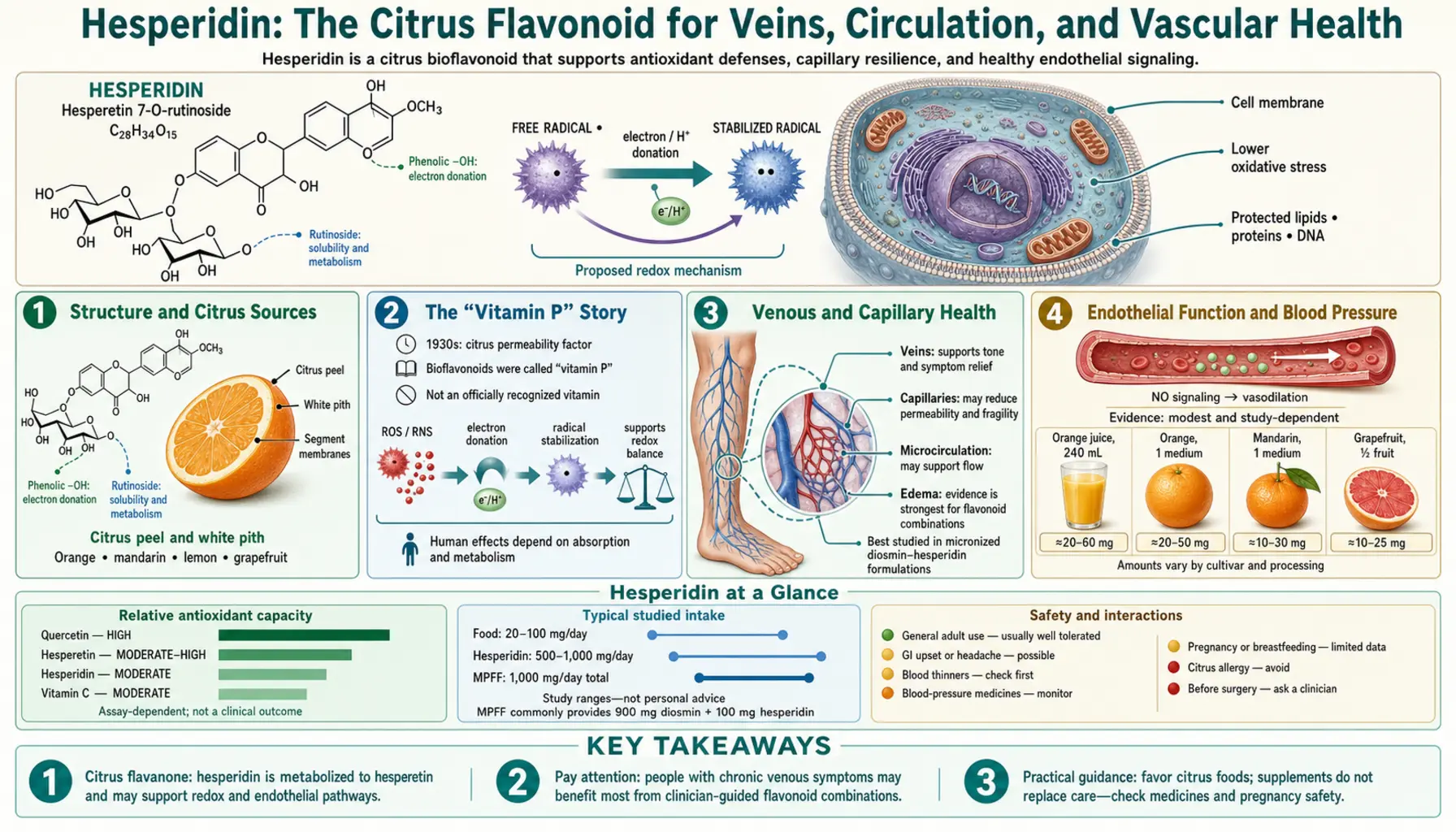
Hesperidin is the major flavonoid of citrus fruit — the compound that gives oranges, lemons, limes, and tangerines much of their hidden value. Chemically it is a flavanone glycoside: a sugar (the disaccharide rutinose) attached to an aglycone called hesperetin. It is concentrated not in the juicy segments most people eat, but in the parts most people throw away — the colored peel, the white spongy pith (albedo), and the thin membranes around each segment. Because of where it sits in the fruit, the amount you get from a glass of juice is far lower than the amount in the whole orange. Hesperidin is the historic core of the so-called “vitamin P” bioflavonoids, and for decades it has been used — usually paired with a closely related flavonoid, diosmin — to support the veins and small blood vessels.
This article covers what hesperidin actually is and where it comes from, the “vitamin P” story and why that label was eventually retired, and what the human evidence shows. The strongest, best-documented use is for chronic venous disease — heavy, achy, swollen legs, varicose veins, and hemorrhoids — where micronized diosmin-plus-hesperidin has a substantial randomized-trial record. We also look at the more preliminary work on blood pressure, the endothelium, metabolic health, and inflammation; the antioxidant mechanism and the way hesperidin and vitamin C support each other; the very real problem of poor absorption and how modified forms try to fix it; and the safety profile and drug interactions worth knowing about.
Table of Contents
- Structure and Citrus Sources
- The “Vitamin P” Story
- Venous and Capillary Health
- Endothelial Function and Blood Pressure
- Anti-Inflammatory and Metabolic Effects
- Antioxidant Mechanism
- Forms, Dosing, and Bioavailability
- Safety and Interactions
- Research Papers
- Connections
- Featured Videos
Structure and Citrus Sources
Hesperidin belongs to the flavanone subclass of flavonoids and is essentially the citrus signature compound. In the fruit it exists as a glycoside — hesperetin (the active part) bound to rutinose (rhamnose + glucose). That attached sugar matters enormously for absorption, as we will see, because the human small intestine cannot easily strip it off. The richest part of the fruit by far is not the flesh but the peel and the white pith; gram for gram, the albedo and membranes hold several times more hesperidin than the juice. Practically, this means:
- Whole oranges, tangerines, mandarins, and clementines — eating the segments with their thin membranes intact
- Lemons and limes — especially the zest and pith; lemon peel is a particularly dense source
- Grapefruit — though grapefruit is also high in naringin, a different citrus flavanone
- Citrus peel and zest used in cooking, marmalade, and candied peel
- 100% orange juice — a meaningful but modest source, lower than the whole fruit because the pith is largely removed
Because so much of the hesperidin lives in the pith and peel, the gap between “eating an orange” and “drinking orange juice” is real. Commercial supplements are typically extracted from the peel of immature or processing citrus, which is why citrus-peel waste has become a target for hesperidin recovery.
The “Vitamin P” Story
Hesperidin sits at the origin of the bioflavonoid concept. In the mid-1930s, the same era that produced the isolation of vitamin C, researchers studying citrus noticed that a crude flavonoid fraction from peel seemed to reduce capillary fragility and permeability — the tendency of small vessels to leak and bruise — in ways that purified ascorbic acid alone did not fully explain. The active flavonoid factor was named “vitamin P” (P for permeability), and hesperidin, together with rutin, was one of its defining members.
The label did not survive scientific scrutiny. A true vitamin is something the body cannot make and will develop a deficiency disease without; flavonoids did not meet that bar, since no defined human deficiency syndrome was ever established. By the 1950s nutrition authorities formally retired the term “vitamin P,” and these compounds were reclassified simply as bioflavonoids — beneficial plant polyphenols rather than essential nutrients. That history is worth keeping in mind: hesperidin is biologically active and useful, but it is not a vitamin, and claims that frame it as one are using an obsolete term. The vascular observations that started the whole story, however, turned out to be the most durable part of hesperidin’s record.
Venous and Capillary Health
The best-evidenced use of hesperidin is for chronic venous disease — the cluster of problems that arises when leg veins and their valves fail to return blood efficiently, producing heaviness, aching, cramps, swelling (edema), varicose veins, and hemorrhoids. In this setting hesperidin is almost always used alongside diosmin in a specific preparation called micronized purified flavonoid fraction (MPFF) — roughly 90% diosmin and 10% hesperidin, milled to tiny particle size to improve absorption. The familiar branded version is Daflon. These flavonoids act as venotonics: they appear to increase venous tone, reduce capillary leakiness, protect the microcirculation, and dampen the inflammatory cascade that damages vein-wall and valve tissue.
The randomized-trial literature here is genuinely substantial rather than promotional. In controlled studies, MPFF improves the symptoms and signs of chronic venous insufficiency — leg heaviness, pain, cramps, and ankle or calf edema — and it is one of the few oral agents that international venous-disease guidelines actually mention for symptom relief. A 2021 evidence review in Vascular Health and Risk Management compared diosmin alone against the diosmin-plus-hesperidin fraction and concluded both can benefit chronic venous disorders, while noting the larger body of trial data sits with the combined micronized fraction.
For hemorrhoids, the evidence is strongest for acute flare-ups. A 2015 prospective, randomized, triple-blind trial of a flavonoid mixture (diosmin, troxerutin, and hesperidin) in acute hemorrhoidal disease found significant reductions in pain, bleeding, edema, and thrombosis over twelve days compared with placebo. A 2020 systematic review and meta-analysis in Advances in Therapy pooled the MPFF hemorrhoid trials and reported reduced bleeding and overall symptom improvement. Honest framing matters: these flavonoids relieve symptoms and reduce the risk of a flare not improving — they are an adjunct, not a cure, and they do not replace fiber, fluids, or, when needed, a procedure. Much of the trial literature is industry-sponsored and uses combination products, so it speaks to the diosmin-plus-hesperidin fraction as a whole rather than to isolated hesperidin.
Endothelial Function and Blood Pressure
Beyond the veins, hesperidin has been studied for the lining of the arteries — the endothelium — and for blood pressure. A frequently cited 2011 randomized, placebo-controlled crossover trial in the Journal of Clinical Endocrinology & Metabolism gave 500 mg/day of hesperidin for three weeks to adults with metabolic syndrome and found improved flow-mediated dilation (a marker of how well arteries relax) along with lower inflammatory markers; in companion lab work, hesperetin stimulated endothelial cells to produce nitric oxide, the molecule that signals vessels to widen. A later randomized trial known as the Citrus study (2021) reported that hesperidin delivered in 100% orange juice improved endothelial function in people with elevated blood pressure or stage 1 hypertension.
A 2024 systematic review and meta-analysis of randomized trials in Phytotherapy Research looked at hesperidin’s effect on blood pressure and lipids across pooled studies. The signal for blood pressure is real but modest, and trials are not all consistent — effects tend to show up more clearly in people who start with metabolic or cardiovascular risk than in healthy normotensive volunteers. The fair summary is that hesperidin is a plausible, mild supportive influence on endothelial health, not a substitute for blood-pressure medication. People being treated for hypertension should keep taking their prescribed therapy.
Anti-Inflammatory and Metabolic Effects
Hesperidin’s vascular effects overlap with broader anti-inflammatory and metabolic activity. Mechanistically, hesperetin downregulates the master inflammatory switch NF-κB and lowers pro-inflammatory mediators such as TNF-α, interleukin-6, COX-2, and iNOS in experimental models. In humans, several randomized trials in people with metabolic syndrome or related risk factors have reported reductions in inflammatory markers (such as high-sensitivity CRP and TNF-α) and improvements in lipid and glucose parameters with hesperidin supplementation, though results across the literature are mixed and some individual trials have been small.
A point of caution about the evidence base: at least one randomized trial on hesperidin in metabolic syndrome that circulated widely was later retracted, which is exactly why the human metabolic claims should be read as promising but not settled rather than proven. The pattern that holds up best is that hesperidin’s metabolic benefits, where they appear, are modest and most visible in people who already have elevated inflammation, lipids, or glucose — consistent with a supportive role in a diet rich in citrus and other polyphenols rather than a stand-alone treatment.
Antioxidant Mechanism
As a polyphenol, hesperidin (and especially its aglycone hesperetin) is a free-radical scavenger: its hydroxyl groups can donate electrons to neutralize reactive oxygen species and quench lipid peroxidation. But direct scavenging is only part of the story. Hesperidin also acts indirectly by activating the Nrf2/ARE pathway, the cell’s built-in antioxidant-defense program, which raises the body’s own protective enzymes such as superoxide dismutase, catalase, and glutathione peroxidase. This “teach the cell to defend itself” mechanism is often more important biologically than the modest amount of direct scavenging a poorly absorbed flavonoid can provide.
Hesperidin also fits the classic antioxidant network alongside vitamin C. Like other flavonoids, oxidized hesperetin can be regenerated back to its active form with the help of vitamin C, so the two work cooperatively — part of why the original “vitamin P” fraction was studied together with ascorbic acid, and why citrus naturally packages the two in the same fruit. The 2014 review in Phytotherapy Research on the antioxidant and anti-inflammatory properties of hesperidin and hesperetin remains a thorough summary of these molecular mechanisms.
Forms, Dosing, and Bioavailability
The central practical problem with hesperidin is poor absorption. Plain hesperidin is barely soluble in water, and the rutinose sugar attached to it cannot be removed by the small intestine. As a result, most of an oral dose travels intact to the colon, where gut bacteria use α-rhamnosidase and β-glucosidase enzymes to cleave off the sugar and release the absorbable aglycone, hesperetin. Because the rate-limiting bacterial enzyme is in short supply in many people, how much benefit you actually get depends partly on your individual gut microbiome — which is one reason responses vary so much from person to person. Common forms include:
- Glucosyl hesperidin (G-hesperidin) — an enzymatically modified, far more water-soluble form; rat studies show hesperetin appears in the blood faster and reaches a substantially higher overall exposure than from plain hesperidin.
- Plain hesperidin — the standard, inexpensive form found in most “citrus bioflavonoid” products; cheap but poorly and erratically absorbed.
- Micronized diosmin + hesperidin (MPFF / Daflon) — the micronized fraction used specifically for venous and hemorrhoidal disease; the small particle size improves uptake.
- Hesperetin — the aglycone itself, occasionally sold directly to bypass the gut-conversion step.
Typical doses in the literature: about 500 mg/day of hesperidin for the cardiovascular and metabolic studies, and the venous/hemorrhoid trials generally use the standardized micronized fraction (commonly 1000 mg/day of diosmin-plus-hesperidin, sometimes higher for short courses during an acute hemorrhoidal flare). Taking hesperidin with food — and alongside vitamin C — is sensible. For people simply wanting dietary intake, eating whole citrus, including the pith and membranes, is the most reliable everyday source.
Safety and Interactions
Hesperidin is well tolerated and has a long history of use. It is found in ordinary foods, and supplemental and prescription-grade citrus-flavonoid products have a good safety record. Still, a few real cautions apply:
- Common side effects are mild — occasional stomach upset, diarrhea, or headache, usually at higher doses.
- Mild antiplatelet effect — like many flavonoids, hesperidin can modestly affect platelet activity, so use caution if you take anticoagulants or antiplatelet drugs (warfarin, the newer oral anticoagulants, aspirin, clopidogrel) and discuss supplemental doses with your clinician.
- Citrus / CYP and calcium-channel-blocker considerations — the famous “grapefruit-juice effect,” in which citrus compounds inhibit the CYP3A4 enzyme and raise blood levels of drugs such as certain calcium-channel blockers, statins, and others, is driven mainly by furanocoumarins in grapefruit rather than by hesperidin itself. Hesperidin is a weaker influence on drug metabolism, but anyone on narrow-therapeutic-window medication who is taking concentrated citrus-flavonoid supplements should be aware of the issue and check with a pharmacist.
- Blood pressure — because hesperidin may mildly lower blood pressure, watch for additive effects if you take antihypertensives.
- Pregnancy and breastfeeding — dietary citrus is fine, but there is not enough data to recommend concentrated supplemental doses; it is reasonable to avoid them.
Research Papers
A selection of peer-reviewed studies on hesperidin spanning its venous, endothelial, metabolic, antioxidant, and bioavailability evidence. Each citation links to the verified DOI record.
- Parhiz H, Roohbakhsh A, Soltani F, Rezaee R, Iranshahi M. Antioxidant and Anti-Inflammatory Properties of the Citrus Flavonoids Hesperidin and Hesperetin: An Updated Review of their Molecular Mechanisms and Experimental Models. Phytotherapy Research — 2014;29(3):323–331.
- Rizza S, Muniyappa R, Iantorno M, et al. Citrus Polyphenol Hesperidin Stimulates Production of Nitric Oxide in Endothelial Cells while Improving Endothelial Function and Reducing Inflammatory Markers in Patients with Metabolic Syndrome. The Journal of Clinical Endocrinology & Metabolism — 2011;96(5):E782–E792.
- Valls RM, Pedret A, Calderón-Pérez L, et al. Hesperidin in orange juice improves human endothelial function in subjects with elevated blood pressure and stage 1 hypertension: A randomized, controlled trial (Citrus study). Journal of Functional Foods — 2021;85:104646.
- Shylaja H, Viswanatha GL, Sunil V, Hussain SM, Farhana SA. Effect of hesperidin on blood pressure and lipid profile: A systematic review and meta-analysis of randomized controlled trials. Phytotherapy Research — 2024;38(5):2560–2571.
- Cazaubon M, Benigni JP, Steinbruch M, Jabbour V, Gouhier-Kodas C. Is There a Difference in the Clinical Efficacy of Diosmin and Micronized Purified Flavonoid Fraction for the Treatment of Chronic Venous Disorders? Review of Available Evidence. Vascular Health and Risk Management — 2021;17:591–600.
- Giannini I, Amato A, Basso L, et al. Flavonoids mixture (diosmin, troxerutin, hesperidin) in the treatment of acute hemorrhoidal disease: a prospective, randomized, triple-blind, controlled trial. Techniques in Coloproctology — 2015;19(6):339–345.
- Sheikh P, Lohsiriwat V, Shelygin Y. Micronized Purified Flavonoid Fraction in Hemorrhoid Disease: A Systematic Review and Meta-Analysis. Advances in Therapy — 2020;37(6):2792–2812.
- Mas-Capdevila A, Teichenne J, Domenech-Coca C, et al. Effect of Hesperidin on Cardiovascular Disease Risk Factors: The Role of Intestinal Microbiota on Hesperidin Bioavailability. Nutrients — 2020;12(5):1488.
- Jin MJ, Kim U, Kim IS, et al. Effects of Gut Microflora on Pharmacokinetics of Hesperidin: A Study on Non-Antibiotic and Pseudo-Germ-Free Rats. Journal of Toxicology and Environmental Health, Part A — 2010;73(21-22):1441–1450.
Live PubMed Searches
- Hesperidin and chronic venous insufficiency
- Diosmin + hesperidin micronized flavonoid fraction
- Hesperidin and hemorrhoids
- Hesperidin and endothelial function
- Hesperidin and blood pressure (randomized trials)
- Hesperidin and metabolic syndrome
- Glucosyl hesperidin and bioavailability
- Hesperetin and Nrf2 antioxidant defense
Connections
- Rutin
- Quercetin
- Luteolin
- Apigenin
- Anthocyanins
- EGCG
- Grape Seed Extract
- Pycnogenol
- Vitamin C
- Hypertension
- Cardiovascular Disease
- Diabetes
- Oxidative Stress
- Immune Boosting
- Pomegranate
- Antioxidants
- Chen Pi (Aged Tangerine Peel) — aged citrus peel used to keep tonic formulas from causing bloating