Hesperidin: Antioxidant & Anti-Inflammatory Mechanisms
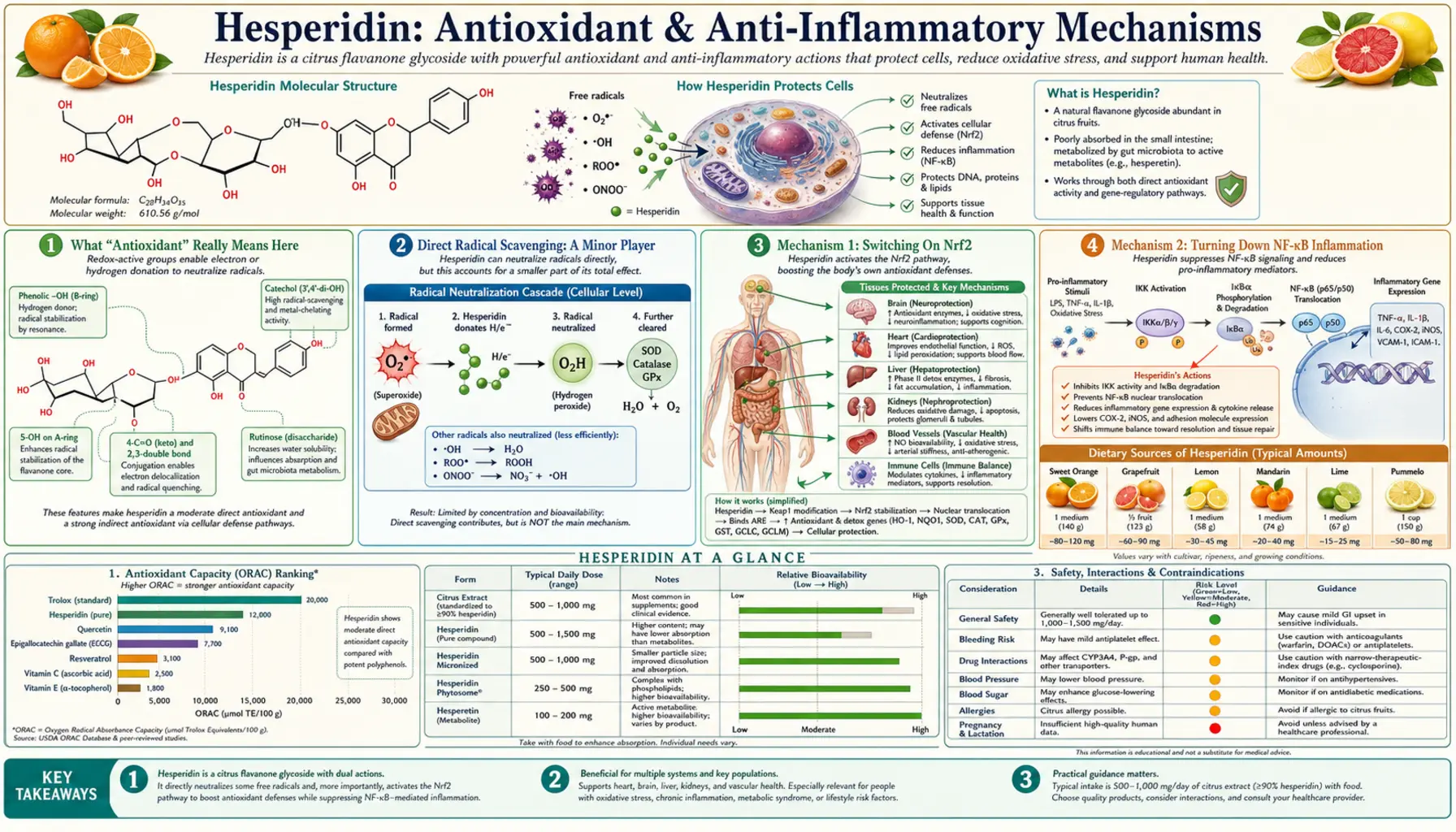
"Antioxidant" is the word on every hesperidin supplement label, and it is also the most misleading. The popular image — a molecule floating through your blood mopping up free radicals like a tiny sponge — is only a small and probably minor part of what hesperidin actually does. The concentrations that reach your bloodstream are too low, and too heavily modified by your liver, for direct scavenging to explain the effects seen in real trials. The more accurate and more interesting story is that hesperetin, hesperidin's active form, works like a signal: it switches on the cell's own antioxidant-defense program (the Nrf2 pathway) and turns down the master switch of inflammation (NF-κB). This page explains those mechanisms in plain language, why the metabolites matter, and — importantly — where the biology is solid versus where it is still preclinical.
Table of Contents
- What "Antioxidant" Really Means Here
- Direct Radical Scavenging: A Minor Player
- Mechanism 1: Switching On Nrf2
- Mechanism 2: Turning Down NF-κB Inflammation
- The Metabolites Do the Work
- Hesperetin vs Hesperidin: Why the Aglycone Matters
- What Shows Up in Human Trials
- Preclinical Signals in Other Conditions
- Honest Limits & Cautions
- Key Research Papers
- Connections
- Featured Videos
What "Antioxidant" Really Means Here
Oxidative stress is the imbalance between reactive oxygen species (ROS) — unstable, electron-hungry molecules produced during normal metabolism and amplified by inflammation, pollution, and disease — and the body's ability to neutralize them. Unchecked, ROS damage lipids, proteins, and DNA, and they help drive atherosclerosis, aging, and chronic inflammation.
There are two fundamentally different ways a dietary compound can help. It can act as a direct antioxidant, chemically donating an electron to quench a radical (this is what the label implies). Or it can act as an indirect antioxidant, sending a signal that makes the cell build its own, far more powerful antioxidant defenses. For hesperidin, the evidence points strongly toward the second. That distinction is not academic hair-splitting — it explains why a molecule present at low blood levels can still matter, and why the crude "antioxidant capacity" numbers printed on marketing materials are a poor guide to real biological effect.
Direct Radical Scavenging: A Minor Player
In a test tube, hesperetin can scavenge radicals thanks to its hydroxyl and methoxy groups on the flavonoid ring system, and hesperidin registers a measurable "antioxidant capacity" in assays such as ORAC, DPPH, and FRAP. Reviews by Garg and by Parhiz catalog this chemistry in detail. But two facts deflate the significance of direct scavenging in a living person:
- Concentrations are low. After eating citrus or taking a supplement, blood levels of hesperetin peak in the nanomolar-to-low-micromolar range — orders of magnitude below the concentrations used in the cell-free antioxidant assays. There is simply not enough of the molecule circulating to soak up a meaningful fraction of the body's radicals directly.
- The molecule arrives disguised. As covered under absorption, most hesperetin in your blood is not free hesperetin but liver-attached conjugates (glucuronides and sulfates). These conjugates generally have reduced direct radical-scavenging power compared with the free molecule.
So while it is technically true that hesperidin is an antioxidant, direct scavenging is almost certainly not the reason it does anything useful in people. The interesting mechanisms are the signaling ones below.
Mechanism 1: Switching On Nrf2
Nrf2 (nuclear factor erythroid 2-related factor 2) is the master regulator of the cell's antioxidant-defense system. In everyday conditions Nrf2 is held captive in the cytoplasm by a partner protein called Keap1 and continuously destroyed. When the cell senses oxidative or electrophilic stress — or is nudged by certain plant compounds — Nrf2 escapes Keap1, travels into the nucleus, and binds to stretches of DNA called antioxidant response elements (AREs). This switches on a coordinated program of protective genes.
The genes Nrf2 turns on read like the body's antioxidant toolkit:
- Heme oxygenase-1 (HO-1) — a powerful cytoprotective, anti-inflammatory enzyme
- NAD(P)H quinone oxidoreductase 1 (NQO1) — detoxifies reactive quinones
- Glutamate-cysteine ligase — the rate-limiting enzyme for making glutathione, the cell's main internal antioxidant
- Superoxide dismutase (SOD), catalase, and glutathione peroxidase — the frontline enzymes that neutralize superoxide and peroxides
Unlike a single sacrificial antioxidant molecule, this is a catalytic, self-renewing, cell-built defense that keeps working. Research by Li and colleagues shows hesperetin activating exactly this axis (via PI3K/AKT signaling upstream of Nrf2) to reduce oxidative stress and inflammation, and broader reviews such as Jayasuriya and colleagues place citrus flavonoids among the natural agents that target the Nrf2/Keap1 pathway. This "make the cell defend itself" mechanism is the most credible explanation for hesperidin's antioxidant reputation.
Mechanism 2: Turning Down NF-κB Inflammation
If Nrf2 is the antioxidant master switch, NF-κB (nuclear factor kappa B) is the inflammation master switch. When cells are stressed or infected, NF-κB moves into the nucleus and switches on the genes for inflammatory messengers — tumor necrosis factor-alpha (TNF-α), interleukin-1β (IL-1β), interleukin-6 (IL-6) — and for inflammatory enzymes such as cyclooxygenase-2 (COX-2) and inducible nitric oxide synthase (iNOS). A short burst of this is healthy defense; chronic activation drives the low-grade inflammation behind atherosclerosis, insulin resistance, and many degenerative conditions.
Hesperetin and hesperidin have been shown, across many cell and animal studies summarized by Parhiz and Roohbakhsh, to dampen NF-κB activation. The downstream consequences are lower TNF-α, IL-6, and IL-1β, less COX-2 and iNOS, and therefore less of the inflammatory nitric oxide made by iNOS (which is distinct from the beneficial endothelial nitric oxide discussed on the Heart & Blood Pressure page). More recent work, such as Guan and colleagues, continues to map these anti-inflammatory and cell-protective effects on the vascular endothelium.
The Nrf2 and NF-κB pathways are also interconnected: activating Nrf2 tends to suppress NF-κB and vice versa. Hesperidin nudging the balance toward Nrf2 and away from NF-κB is a tidy, mechanistically coherent explanation for a molecule that is simultaneously "antioxidant" and "anti-inflammatory."
The Metabolites Do the Work
A crucial and often-ignored point: the molecule that leaves your gut is not the molecule that reaches your tissues. After gut bacteria release hesperetin from its sugar and the intestine absorbs it, the liver rapidly attaches glucuronide and sulfate groups. The dominant species circulating in your blood are therefore hesperetin-7-O-glucuronide, hesperetin-3'-O-glucuronide, and various sulfates — not free hesperetin.
This matters for two reasons. First, it is why crude "antioxidant capacity" is the wrong lens: the conjugates are weaker direct scavengers but can still act as signaling molecules at receptors and enzymes, and some may be de-conjugated back to the active form at sites of inflammation. Second, gut bacteria also break the flavonoid skeleton down further into small phenolic acids (such as hydroxyphenylpropionic acids), which are absorbed, circulate, and have their own biological activities. In other words, hesperidin's effects are the sum of a family of derived molecules, shaped heavily by an individual's gut microbiome — which is a major reason different people respond differently.
Hesperetin vs Hesperidin: Why the Aglycone Matters
It is worth keeping the two names straight because supplement labels blur them:
- Hesperidin is the glycoside — hesperetin with a rutinose sugar attached. This is the form abundant in citrus and in most supplements. It is poorly absorbed as-is.
- Hesperetin is the aglycone — the sugar-free active molecule released by gut bacteria (or by enzymatic processing). It is the more potent and more readily absorbed form, and it is the species that actually engages the Nrf2 and NF-κB machinery.
Much of the mechanistic cell research is done with hesperetin precisely because that is the biologically relevant form. When you read that "hesperidin is a potent antioxidant," the honest translation is usually "hesperetin and its metabolites act as signaling antioxidants once the body manages to produce and absorb them."
What Shows Up in Human Trials
Mechanisms in a dish are only worth so much; the fair test is what changes in people. Here the human evidence is real but modest, and it clusters around inflammatory markers rather than dramatic clinical endpoints:
- Rizza and colleagues found that 500 mg/day hesperidin for three weeks lowered high-sensitivity CRP, serum amyloid A, and soluble E-selectin in people with metabolic syndrome, alongside improved endothelial function.
- Homayouni and colleagues reported reduced inflammatory markers (and blood pressure) with hesperidin in type 2 diabetes.
- Haidari and colleagues found hesperidin modulated inflammatory responses in patients recovering from a heart attack.
The consistent thread — a nudge downward in circulating inflammatory proteins like CRP and IL-6 — fits the NF-κB mechanism nicely. But these are surrogate markers measured over weeks in modest-sized trials, not proof of prevented disease. Read them as biologically encouraging, not as a cure.
Preclinical Signals in Other Conditions
Because Nrf2 activation and NF-κB suppression are broadly protective, hesperidin shows up in a very large animal-and-cell literature spanning the liver, kidney, brain, and even cancer-cell models — for example the ischemia-reperfusion protection discussed on the heart page, and the anti-cancer and anti-diabetic mechanisms reviewed by Roohbakhsh and colleagues. These studies are genuinely useful for understanding how the molecule works.
They are not, however, evidence that hesperidin treats or prevents any of these diseases in humans. A compound that reduces oxidative markers in a mouse liver or slows a cancer cell line in a dish has cleared only the very first hurdle. We present this preclinical work to explain mechanism and to be complete — and we deliberately stop short of implying clinical benefit that has not been demonstrated in people.
Honest Limits & Cautions
- The label oversells. "Antioxidant" on a hesperidin bottle is technically true but conceptually misleading; the real action is signaling, and the real-world effects are modest.
- Antioxidant supplements have a mixed record. The broader history of isolated antioxidant supplements in clinical trials is humbling — several once-promising antioxidants failed to reduce disease, and a few high-dose ones caused harm. This is a reason for modesty about any single flavonoid, hesperidin included.
- Not a treatment. Nothing here means hesperidin should be used to treat a diagnosed disease. It is a food-derived compound with plausible, modest supportive effects — not a substitute for medical care.
- Generally safe, but tell your clinician. Hesperidin from food and typical supplement doses is well tolerated; still, disclose supplements to your prescriber, particularly if you take medication, are pregnant or breastfeeding, or have a chronic condition.
- Whole food beats isolate. The most defensible way to benefit from these mechanisms is eating whole citrus regularly, where hesperidin arrives with fiber, vitamin C, and a matrix that supports the gut conversion that makes it work at all.
Key Research Papers
- Parhiz H, et al. (2015). Antioxidant and anti-inflammatory properties of the citrus flavonoids hesperidin and hesperetin: an updated review. Phytother Res. — PubMed 25394264
- Roohbakhsh A, et al. (2015). Molecular mechanisms behind the biological effects of hesperidin and hesperetin for the prevention of cancer and cardiovascular diseases. Life Sci. — PubMed 25625242
- Garg A, et al. (2001). Chemistry and pharmacology of the citrus bioflavonoid hesperidin. Phytother Res. — PubMed 11746857
- Li J, et al. (2021). Hesperetin ameliorates hepatic oxidative stress and inflammation via the PI3K/AKT-Nrf2-ARE signaling pathway. Food Funct. — PubMed 33977953
- Jayasuriya R, et al. (2021). Targeting Nrf2/Keap1 signaling pathway by bioactive natural agents: possible therapeutic strategy. Phytomedicine. — PubMed 34583226
- Guan Y, et al. (2025). Hesperidin alleviates endothelial cell inflammation and apoptosis. Chem Biol Interact. — PubMed 39987982
- Rizza S, et al. (2011). Citrus polyphenol hesperidin stimulates production of nitric oxide in endothelial cells while reducing inflammatory markers in metabolic syndrome. J Clin Endocrinol Metab. — PubMed 21346065
- Haidari F, et al. (2015). Hesperidin supplementation modulates inflammatory responses following myocardial infarction. J Am Coll Nutr. — PubMed 25757593
- Homayouni F, et al. (2018). Blood pressure lowering and anti-inflammatory effects of hesperidin in type 2 diabetes. Phytother Res. — PubMed 29468764
- Li X, et al. (2016). Short-term hesperidin pretreatment attenuates rat myocardial ischemia/reperfusion injury (oxidative-stress mechanism, animal). Cell Physiol Biochem. — PubMed 27744432
PubMed Topic Searches
- PubMed: Hesperidin & Nrf2/ARE
- PubMed: Hesperetin & NF-κB inflammation
- PubMed: Hesperetin glucuronide metabolites
- PubMed: Hesperidin & endogenous antioxidant enzymes
- PubMed: Citrus flavonoids & inflammatory markers
External Resources
Connections
- Hesperidin Overview
- Hesperidin Benefits Hub
- Hesperidin for Veins & Circulation
- Hesperidin for Heart & Blood Pressure
- Sources & Absorption
- Quercetin
- Luteolin
- Apigenin
- EGCG
- Glutathione
- Curcumin
- Vitamin C
- All Antioxidants