EGCG (Epigallocatechin Gallate): The Most-Studied Green Tea Catechin
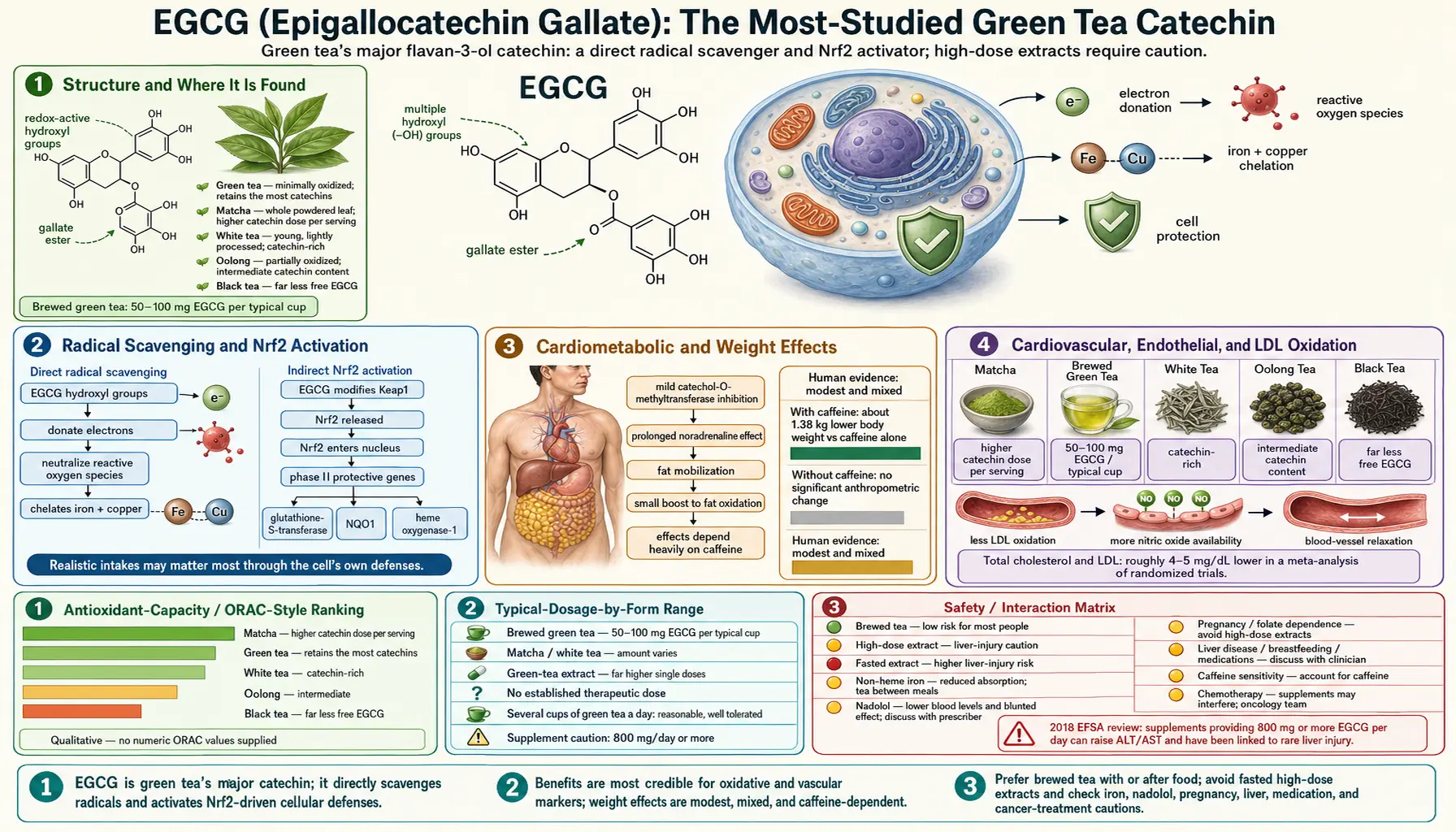
EGCG (epigallocatechin gallate) is the major catechin — a type of flavan-3-ol polyphenol — in the leaves of Camellia sinensis, the tea plant. It is the single most abundant and most-studied antioxidant compound in green tea, typically making up roughly half of the total catechins in a brewed cup. Because green tea is one of the most widely consumed beverages on Earth, EGCG is also one of the most heavily researched plant compounds in nutrition science, with thousands of laboratory studies and a growing (if uneven) body of human trials.
This article separates what is well established from what is still hopeful. EGCG is a genuinely powerful free-radical scavenger and a strong activator of the body's own antioxidant defenses, and brewed green tea is a healthful, low-risk habit. But many of the dramatic claims attached to EGCG — fat-burning, cancer cures, brain rejuvenation — rest mostly on cell-culture and animal work that does not translate cleanly to people, partly because EGCG is poorly absorbed when swallowed. We cover the structure and food sources, the antioxidant mechanisms, the modest and mixed cardiometabolic data, cardiovascular and neuroprotective effects, the cancer-chemoprevention evidence, dosing and bioavailability, and the real safety issues with high-dose supplements.
Table of Contents
- Structure and Where It Is Found
- Radical Scavenging and Nrf2 Activation
- Cardiometabolic and Weight Effects
- Cardiovascular, Endothelial, and LDL Oxidation
- Neuroprotection and the Brain
- Cancer Chemoprevention (Not a Treatment)
- Forms, Dosing, and Bioavailability
- Safety and Interactions
- Research Papers
- Connections
- Featured Videos
Structure and Where It Is Found
EGCG is a flavan-3-ol (a subclass of flavonoid polyphenols) carrying multiple hydroxyl (−OH) groups and a gallate ester. Those abundant hydroxyl groups are what make it such an effective antioxidant: they readily donate electrons to neutralize reactive molecules. Its chemical relatives in tea include epicatechin (EC), epigallocatechin (EGC), and epicatechin gallate (ECG), but EGCG is the dominant one and accounts for most of green tea's measured antioxidant activity.
EGCG is found almost exclusively in tea made from Camellia sinensis. The richest sources are:
- Green tea — the classic source; minimally oxidized leaves retain the most catechins.
- Matcha — powdered whole green-tea leaf, so you consume the leaf itself, giving a higher catechin dose per serving.
- White tea — young, lightly processed leaves and buds, also catechin-rich.
- Oolong tea — partially oxidized, with intermediate catechin content.
Black tea is fully oxidized during processing, which converts much of the EGCG into larger polymerized polyphenols (theaflavins and thearubigins), so black tea contains far less free EGCG than green tea. A typical brewed cup of green tea delivers on the order of 50–100 mg of EGCG, though the exact amount varies widely with leaf quality, water temperature, and steeping time.
Radical Scavenging and Nrf2 Activation
EGCG protects cells against oxidative stress in two distinct ways, and the distinction matters for understanding the evidence.
1. Direct radical scavenging. The hydroxyl-rich structure lets EGCG directly quench reactive oxygen species and chelate (bind) transition metals such as iron and copper that otherwise catalyze damaging free-radical reactions. In a test tube, EGCG is one of the most potent dietary antioxidants known. The catch is that to scavenge radicals directly throughout the body, the molecule has to reach the tissues at meaningful concentrations — and, as the dosing section explains, very little swallowed EGCG actually does.
2. Indirect "antioxidant response" (Nrf2) activation. This is the mechanism researchers increasingly think matters most at realistic intakes. EGCG activates Nrf2 (nuclear factor erythroid 2–related factor 2), the master transcription factor that switches on the cell's own antioxidant and detoxification machinery. It does this largely by modifying Keap1, the protein that normally holds Nrf2 inactive; releasing Nrf2 lets it move into the nucleus and turn up genes for protective phase II enzymes such as glutathione-S-transferase, NAD(P)H:quinone oxidoreductase 1 (NQO1), and heme oxygenase-1. In this model, EGCG behaves less like a pure antioxidant you consume and more like a mild hormetic signal that trains your cells to produce more of their own antioxidants — the same logic behind compounds like sulforaphane.
Cardiometabolic and Weight Effects
EGCG is heavily marketed for fat loss and metabolism, so it is worth being honest: the human data are real but modest and mixed. Proposed mechanisms include mild inhibition of catechol-O-methyltransferase (which prolongs the fat-mobilizing effect of noradrenaline) and a small boost to fat oxidation — effects that appear to depend heavily on caffeine being present alongside the catechins.
A systematic review and meta-analysis of randomized trials in the American Journal of Clinical Nutrition found that green tea catechins with caffeine reduced body weight by about 1.38 kg versus caffeine alone, with similar small reductions in BMI and waist circumference. Crucially, catechins taken without caffeine produced no significant change in any anthropometric measure. Effects also tended to be larger in Japanese studies than in trials run elsewhere, hinting at population and methodological differences. In plain terms: green-tea catechins may nudge body weight down by a kilogram or two over a few months, typically only when paired with caffeine and usually as a small add-on to diet and exercise — not a stand-alone weight-loss drug.
Cardiovascular, Endothelial, and LDL Oxidation
The cardiovascular signal is more consistent than the weight signal. EGCG and the other green-tea catechins have been shown to improve several markers of vascular health.
- Cholesterol. A meta-analysis of randomized controlled trials reported that green tea intake modestly lowered total cholesterol (by roughly 4–5 mg/dL) and LDL ("bad") cholesterol (by a similar amount) compared with controls. The effect is small per individual but meaningful at a population level.
- LDL oxidation. Oxidized LDL is a key step in plaque formation. By scavenging radicals and chelating metals, EGCG reduces the oxidative modification of LDL particles in laboratory and human studies, which is thought to be part of how tea benefits arteries.
- Endothelial function. Catechins support the production and availability of nitric oxide, the molecule that lets blood vessels relax and widen; improved flow-mediated dilation has been reported after green-tea intake.
Large population studies consistently link habitual green-tea drinking with lower cardiovascular and all-cause mortality, which fits with these mechanisms. As always, observational associations cannot prove cause and effect, but the direction is encouraging and consistent.
Neuroprotection and the Brain
EGCG is one of the few dietary polyphenols shown to cross the blood-brain barrier, though only a very small fraction of an oral dose reaches the brain. Once there (and via its metabolites), it has shown a range of neuroprotective actions in laboratory and animal models: scavenging radicals, chelating the excess iron implicated in neurodegeneration, activating Nrf2-driven defenses, dampening neuroinflammation, and — notably — inhibiting the misfolding and aggregation of the proteins central to disease, namely amyloid-beta in Alzheimer's and alpha-synuclein in Parkinson's.
This is a genuinely active and promising research area. It is also important to be clear that nearly all of the strong neuroprotective evidence is preclinical — cell cultures and animals. Rigorous human trials showing that EGCG or green tea prevents or treats Alzheimer's or Parkinson's disease do not yet exist. The reasonable, evidence-based takeaway is that green tea is a sensible part of a brain-healthy diet, not that EGCG supplements are a proven neuroprotective therapy.
Cancer Chemoprevention (Not a Treatment)
EGCG is the green-tea component most studied for cancer chemoprevention. In cell-culture and animal models it interferes with many of the pathways tumors rely on: it can inhibit pro-cancer signaling (such as NF-κB and AP-1 and several receptor tyrosine kinases), influence the cell cycle, trigger programmed cell death (apoptosis) in malignant cells, and alter epigenetic marks. In rodents, EGCG has reduced tumor formation in models of lung, prostate, breast, colon, oral, and skin cancers.
The human picture is far weaker. Some epidemiological studies associate higher green-tea consumption with modestly lower risk of certain cancers, but findings are inconsistent across populations and cancer types, and association is not proof. EGCG is not a proven cancer treatment, and it is not a substitute for medical care. Its translation to people is also limited by its poor oral bioavailability and chemical instability. Anyone with cancer should rely on their oncology team; high-dose EGCG supplements can even interfere with some chemotherapy and carry the liver-injury risk discussed below.
Forms, Dosing, and Bioavailability
The defining practical fact about EGCG is its poor oral bioavailability. After swallowing, only a small percentage of EGCG enters the bloodstream intact — estimates from human studies put systemic levels far below the concentrations used to produce effects in test-tube experiments. EGCG is also chemically unstable, sensitive to extensive phase II metabolism, and broken down by gut bacteria, all of which limit how much reaches the tissues.
Common forms and considerations:
- Brewed green tea, matcha, white tea — the safest and most time-tested way to get EGCG, delivered along with the other catechins, L-theanine, and a moderate amount of caffeine.
- Green-tea extract (GTE) supplements — standardized to a percentage of EGCG; deliver far higher single doses than tea, which is exactly why they carry the safety concerns below.
- Absorption with food and timing. Taking EGCG on an empty stomach increases the amount absorbed (food in the gut reduces EGCG uptake) — but fasted, high-dose supplemental EGCG is precisely the pattern most associated with liver injury, so the bioavailability "hack" cuts against safety. Brewed tea with or after food is the prudent choice for most people.
There is no established therapeutic "dose" of EGCG for the general public. Several cups of green tea a day is a reasonable, well-tolerated intake. If using extracts, stay well under the levels associated with harm (see safety) and avoid taking them fasted.
Safety and Interactions
Brewed green tea is safe for the vast majority of people and is associated with health benefits. The safety concerns below apply chiefly to concentrated high-dose supplements, not to drinking tea.
- Rare liver injury from high-dose extracts. A 2018 review by the European Food Safety Authority (EFSA) concluded that green-tea catechin supplements providing 800 mg or more of EGCG per day can raise liver enzymes (ALT/AST) and have been linked to rare cases of idiosyncratic liver injury, with risk appearing higher when extracts are taken fasted. The injury is unpredictable (idiosyncratic) rather than strictly dose-dependent, and a few cases occurred at lower doses. EFSA could not identify a single guaranteed-safe supplemental dose. By contrast, EGCG from brewed tea was not associated with this risk.
- Reduces non-heme iron absorption. Catechins bind the plant-derived (non-heme) iron in food, lowering its absorption. People with iron-deficiency anemia, and those relying on plant iron, should drink tea between meals rather than with iron-rich meals, and can pair iron with vitamin C to offset the effect.
- Nadolol interaction. Green-tea catechins, especially EGCG, inhibit the OATP1A2 transporter that helps absorb the beta-blocker nadolol. A controlled human study found that green tea substantially lowered nadolol blood levels and blunted its blood-pressure–lowering effect. People taking nadolol should separate it from green tea or discuss the interaction with their prescriber.
- May lower folate. EGCG can interfere with folate (vitamin B9) metabolism, which is one reason high-dose green-tea extracts are generally discouraged in pregnancy and for those who are folate-dependent.
- Caffeine. Tea and many extracts contain caffeine; account for it if you are caffeine-sensitive or limiting intake.
- General caution. Discuss high-dose EGCG supplements with a clinician if you have liver disease, are pregnant or breastfeeding, or take medications — and stop and seek care if you develop signs of liver trouble (fatigue, dark urine, jaundice, right-upper-abdominal pain).
Research Papers
A selection of peer-reviewed papers on EGCG covering its mechanisms, cardiometabolic and lipid effects, neuroprotection, cancer chemoprevention, bioavailability, and safety. Each citation links to its DOI; journal and author names are plain text.
- Singh BN, Shankar S, Srivastava RK. Green tea catechin, epigallocatechin-3-gallate (EGCG): mechanisms, perspectives and clinical applications. Biochemical Pharmacology — 2011;82(12):1807–1821.
- Negri A, Naponelli V, Rizzi F, Bettuzzi S. Molecular targets of epigallocatechin—gallate (EGCG): a special focus on signal transduction and cancer. Nutrients — 2018;10(12):1936.
- Xu R, Yang K, Li S, Dai M, Chen G. Effect of green tea consumption on blood lipids: a systematic review and meta-analysis of randomized controlled trials. Nutrition Journal — 2020;19(1):48.
- Phung OJ, Baker WL, Matthews LJ, Lanosa M, Thorne A, Coleman CI. Effect of green tea catechins with or without caffeine on anthropometric measures: a systematic review and meta-analysis. The American Journal of Clinical Nutrition — 2010;91(1):73–81.
- Pervin M, Unno K, Takagaki A, Isemura M, Nakamura Y. Function of green tea catechins in the brain: epigallocatechin gallate and its metabolites. International Journal of Molecular Sciences — 2019;20(15):3630.
- Naumovski N, Blades BL, Roach PD. Food inhibits the oral bioavailability of the major green tea antioxidant epigallocatechin gallate in humans. Antioxidants — 2015;4(2):373–393.
- EFSA Panel on Food Additives and Nutrient Sources added to Food (ANS). Scientific opinion on the safety of green tea catechins. EFSA Journal — 2018;16(4):5239.
- Misaka S, Yatabe J, Müller F, et al. Effects of single green tea ingestion on pharmacokinetics of nadolol in healthy volunteers. British Journal of Clinical Pharmacology — 2020;86(11):2314–2318.
Live PubMed Searches
- EGCG antioxidant activity
- EGCG and Nrf2 antioxidant enzymes
- Green tea catechins and body weight
- Green tea catechins and LDL cholesterol
- EGCG and endothelial function
- EGCG and the blood-brain barrier
- EGCG and cancer chemoprevention
- Green tea catechins and liver safety
Connections
- Green Tea
- Quercetin
- Curcumin
- Anthocyanins
- Resveratrol
- Sulforaphane
- Glutathione
- Grape Seed Extract
- Pycnogenol
- Antioxidants
- Vitamin C
- Selenium
- Cardiovascular Disease
- Cancer
- Oxidative Stress
- Longevity Protocols