Hesperidin: Sources & Absorption
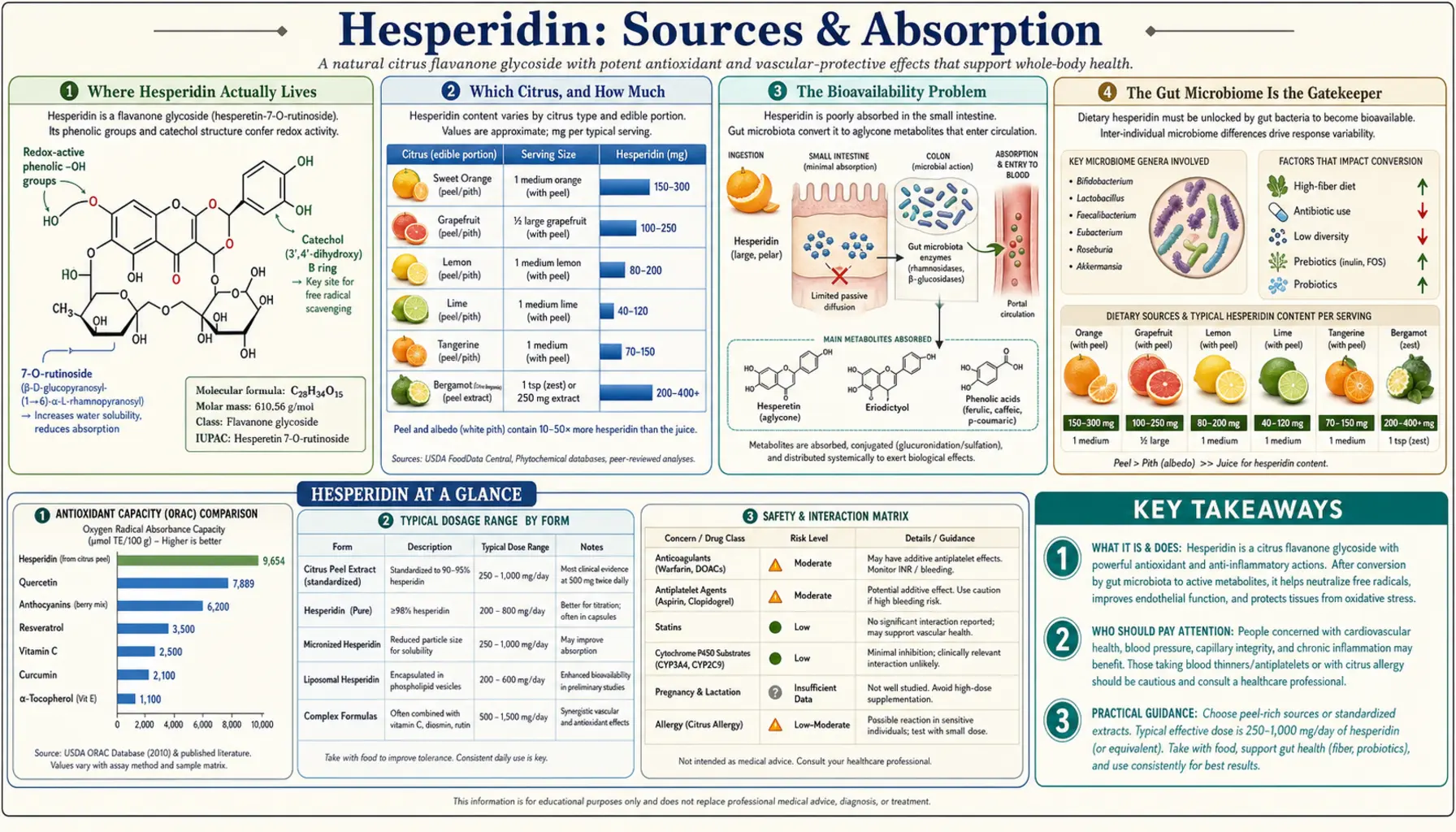
Here is the fact that reframes everything else about hesperidin: most of it is in the parts of the orange you throw away. The sweet juice is relatively poor in hesperidin; the white pith, the peel, and the papery membranes between segments are where it concentrates. And even when you do eat it, hesperidin is poorly absorbed — it is a flavonoid wrapped in a sugar coat that your small intestine cannot open. It has to travel all the way to the colon, where resident bacteria unwrap it so the body can absorb the active core. That single quirk explains the slow, delayed, wildly person-to-person-variable absorption, the whole industry of "enzymatically modified" and micronized forms, and why the pith you spit out matters more than the juice you drink. This page covers where hesperidin is, why it is hard to absorb, and how to get more of it into your blood.
Table of Contents
- Where Hesperidin Actually Lives
- Which Citrus, and How Much
- The Bioavailability Problem
- The Gut Microbiome Is the Gatekeeper
- Slow, Delayed & Variable Absorption
- Enzymatically Modified & Better-Absorbed Forms
- How to Actually Get More From Food
- Supplements: What to Look For
- Juice vs Whole Fruit, Cooking & Storage
- Key Research Papers
- Connections
- Featured Videos
Where Hesperidin Actually Lives
A citrus fruit is built in layers, and hesperidin is not distributed evenly across them:
- Flavedo — the colored outer peel. Rich in hesperidin (and in the aromatic oils and polymethoxylated flavones).
- Albedo — the white, spongy pith just under the peel. This is one of the richest edible sources of hesperidin in the whole fruit.
- Segment membranes and juice-vesicle walls — the papery skins around each segment. Also comparatively high in hesperidin.
- Juice — the sweet liquid we prize. Comparatively low in hesperidin per gram, because the flavonoid concentrates in the solid structural tissues rather than the fluid.
The practical implication is almost the opposite of common intuition: peeling an orange cleanly and discarding all the white stringy material strips away much of its hesperidin. The chemistry surveys by Garg and the citrus-composition analyses by Stuetz and colleagues document this uneven distribution, which is also why dried citrus peel — used for centuries in traditional East Asian medicine as chen pi — is such a concentrated source.
Which Citrus, and How Much
Hesperidin is the characteristic flavanone of sweet oranges, but its distribution across the citrus family is worth knowing:
- Sweet oranges and mandarins/tangerines — hesperidin is the dominant flavanone. These are the classic dietary sources.
- Lemons and limes — also rich in hesperidin, alongside another flavanone called eriocitrin.
- Bitter (Seville) oranges — particularly high hesperidin, which is why they are used industrially to extract it.
- Grapefruit — here the dominant flavanone is naringin, not hesperidin. (Naringin, together with furanocoumarins, is also behind the famous grapefruit-drug interaction — a reason not to assume all citrus flavanones behave alike.)
Exact numbers vary a great deal with cultivar, ripeness, climate, and whether you measure juice or whole fruit, so treating any single milligram figure as gospel is a mistake. The honest generalization is that a whole orange eaten with its membranes delivers substantially more hesperidin than a glass of juice, and that peel and pith are the richest parts of all.
The Bioavailability Problem
Getting hesperidin into your mouth is only half the battle; getting it into your bloodstream is the hard part. The obstacle is built into the molecule's structure. Hesperidin is a rutinoside — hesperetin joined to rutinose, a disaccharide of rhamnose and glucose. That rhamnose sugar is the problem: the human small intestine has no enzyme or transporter that can efficiently handle the rutinoside, so hesperidin passes through the upper gut largely unabsorbed.
Contrast this with flavonoids attached to a plain glucose (glucosides), which the small intestine can process and absorb relatively quickly. It is specifically the rhamnose-containing rutinose linkage that makes native hesperidin (and its cousin rutin) a "slow" flavonoid. This is not a minor inefficiency — overall absorption of native hesperidin is low, and it is the central fact that supplement and pharmaceutical formulators have spent decades trying to engineer around.
The Gut Microbiome Is the Gatekeeper
If the small intestine cannot absorb hesperidin, how does any of it get in? The answer is your gut bacteria. Unabsorbed hesperidin travels down to the colon, where resident microbes produce the enzymes the human body lacks — principally α-rhamnosidase and β-glucosidase — which snip off the sugar and release free hesperetin. Only then, in the colon, can hesperetin be absorbed across the gut wall.
This makes the microbiome a true gatekeeper, with two big consequences:
- People differ enormously. Because absorption depends on which bacteria you host and how active their enzymes are, some people are efficient "high" converters and others are poor "low" converters of the same orange. Studies such as Manach and colleagues and Pereira-Caro and colleagues repeatedly find wide inter-individual variation in how much hesperidin-derived material shows up in blood and urine.
- The colon makes new molecules. Beyond releasing hesperetin, gut bacteria break the flavonoid skeleton down further into small phenolic acids that are themselves absorbed and biologically active — work by Roowi and colleagues and Pereira-Caro maps these colonic catabolites. So the "hesperidin effect" is really the effect of a whole family of microbe-derived molecules.
This microbiome dependence is the reason the antioxidant and anti-inflammatory effects vary so much between individuals, and it is a strong argument for eating hesperidin within a fiber-rich whole-food matrix that supports a healthy colon.
Slow, Delayed & Variable Absorption
Because absorption waits on colonic bacteria, the pharmacokinetics of hesperidin look nothing like those of a rapidly absorbed nutrient. Instead of peaking in blood an hour or two after eating, hesperetin from native hesperidin typically peaks much later — on the order of five to seven hours — reflecting the time needed to reach and be processed in the colon. Manach and colleagues documented this delayed, dose-dependent, highly variable absorption from orange juice, and Kanaze and colleagues characterized the pharmacokinetics of the aglycones hesperetin and naringenin after oral dosing.
Once absorbed, hesperetin is rapidly conjugated by the liver into glucuronides and sulfates, which are the main forms circulating and are ultimately cleared in urine — the basis of the urinary-excretion measurements used by Aschoff and colleagues to compare fresh oranges with pasteurized juice. The bottom line: native hesperidin is a slow, low-efficiency, person-dependent delivery of hesperetin. That is precisely the problem the modified forms below are designed to solve.
Enzymatically Modified & Better-Absorbed Forms
Understanding the rutinose bottleneck makes the various "improved" hesperidin products easy to decode. Each attacks the same absorption problem from a different angle:
- Hesperetin-7-glucoside (the monoglucoside). Replace the troublesome rutinose with a single glucose, and the small intestine can absorb it directly — no colon detour required. In a randomized human crossover trial, Nielsen and colleagues showed that this enzymatically modified hesperidin is absorbed faster and more completely than the native rutinoside.
- Glucosyl-hesperidin (α-glucosyl or "G-hesperidin"). Adding glucose units greatly improves hesperidin's water solubility, which is otherwise very poor. Better solubility means better dissolution and absorption; Kadota and colleagues detail how α-glucosyl modification solubilizes these flavonoids. Glucosyl-hesperidin is used as a functional-food ingredient, notably in Japan.
- Hesperidin 2S (the natural stereoisomer). Hesperidin exists as 2S and 2R forms; the 2S isomer is the more bioavailable one, and standardizing to it (as in the trial by Salden and colleagues) aims for more consistent delivery.
- Micronization. The pharmaceutical venotonics discussed on the Veins & Circulation page grind the flavonoid particles to roughly two micrometers or smaller, increasing surface area so more dissolves and is absorbed.
All four are different solutions to one question: how do you get more hesperetin into the blood from a stubbornly insoluble, poorly absorbed starting material?
How to Actually Get More From Food
If you want hesperidin from your diet rather than a bottle, a few practical habits matter:
- Eat the whole fruit, pith and all. Leave the white membranes on the segments instead of meticulously peeling them away — that stringy material is where much of the hesperidin is.
- Favor whole fruit over juice. A whole orange or mandarin delivers more hesperidin and comes with fiber that feeds the colon bacteria you need to unlock it — and without the concentrated sugar of juice.
- Use citrus zest and peel. Grated organic orange or lemon zest in cooking, and dried tangerine peel in broths and teas, are concentrated hesperidin sources. (Choose well-washed or organic fruit if you are eating the peel.)
- Support your gut. Because a fiber-fed, diverse microbiome does the actual unlocking, a fiber-rich overall diet plausibly improves how much hesperidin you extract from any given orange.
Supplements: What to Look For
If you choose a supplement — for the venous or cardiovascular reasons covered elsewhere — a little label literacy helps:
- Plain hesperidin (often 500–1,000 mg/day) is the cheapest and most common, but it is the poorly absorbed native rutinoside. Taking it with a meal (and having a healthy gut) is about all you can do to help it along.
- Diosmin-hesperidin / MPFF is the standardized, micronized pharmaceutical form with the venous trial evidence; it is what most of the clinical data actually used.
- Enzymatically modified or glucosyl forms, hesperidin 2S, or hesperetin itself are designed for better bioavailability and are a rational choice if absorption is your priority — though they are less commonly sold and often cost more.
- Match the form to the goal, and keep expectations modest. No supplement form turns hesperidin into a dramatic drug; the improvements are about getting a reliably absorbed, standardized dose.
Juice vs Whole Fruit, Cooking & Storage
A few finer points round out the picture. Hesperidin is relatively heat-stable, so cooking with zest or peel does not destroy it wholesale. In fact hesperidin's poor water solubility can cause it to precipitate as a cloud or sediment in stored citrus juice — the harmless whitish haze sometimes seen in orange juice is partly hesperidin coming out of solution. Comparisons of fresh oranges with pasteurized juice, such as the urinary-excretion study by Aschoff and colleagues, show that the food matrix (whole fruit vs processed juice, pulp retained vs removed) measurably shifts how much flavanone the body ultimately absorbs and excretes.
None of these details change the headline: the richest, best-value hesperidin is in whole citrus eaten with its pith and membranes, and the body's ability to use it depends on the colon. Juice is a weaker source made weaker still by its sugar load. When in doubt, eat the orange, not just its juice — and don't be so quick to peel away the white stuff.
Key Research Papers
- Manach C, et al. (2003). Bioavailability in humans of the flavanones hesperidin and narirutin after the ingestion of two doses of orange juice. Eur J Clin Nutr. — PubMed 12571654
- Nielsen IL, et al. (2006). Bioavailability is improved by enzymatic modification of the citrus flavonoid hesperidin in humans: a randomized, double-blind, crossover trial. J Nutr. — PubMed 16424119
- Kanaze FI, et al. (2007). Pharmacokinetics of the citrus flavanone aglycones hesperetin and naringenin after single oral administration in human subjects. Eur J Clin Nutr. — PubMed 17047689
- Pereira-Caro G, et al. (2014). Orange juice (poly)phenols are highly bioavailable in humans. Am J Clin Nutr. — PubMed 25332336
- Pereira-Caro G, et al. (2015). In vitro colonic catabolism of orange juice (poly)phenols. Mol Nutr Food Res. — PubMed 25545994
- Roowi S, et al. (2009). Yoghurt impacts on the excretion of phenolic acids derived from colonic breakdown of orange juice flavanones in humans. Mol Nutr Food Res. — PubMed 19415668
- Aschoff JK, et al. (2016). Urinary excretion of citrus flavanones and their major catabolites after consumption of fresh oranges and pasteurized orange juice. Mol Nutr Food Res. — PubMed 27488098
- Stuetz W, et al. (2010). Polymethoxylated flavones, flavanone glycosides, carotenoids, and antioxidants in different citrus fruits. J Agric Food Chem. — PubMed 20420369
- Kadota K, et al. (2023). Unveiling the flavone-solubilizing effects of α-glucosyl rutin and hesperidin. Food Funct. — PubMed 37938858
- Garg A, et al. (2001). Chemistry and pharmacology of the citrus bioflavonoid hesperidin. Phytother Res. — PubMed 11746857
- Morand C, et al. (2011). Hesperidin contributes to the vascular protective effects of orange juice: a randomized crossover study. Am J Clin Nutr. — PubMed 21068346
PubMed Topic Searches
- PubMed: Hesperidin bioavailability in humans
- PubMed: Hesperidin, gut microbiota & rhamnosidase
- PubMed: Glucosyl-hesperidin solubility & absorption
- PubMed: Hesperidin content in citrus peel & pith
- PubMed: Flavanone absorption — juice vs whole fruit
External Resources
- PubChem — Hesperidin — structure and solubility data
- USDA FoodData Central — food composition database
- Linus Pauling Institute — Flavonoids
Connections
- Hesperidin Overview
- Hesperidin Benefits Hub
- Hesperidin for Veins & Circulation
- Hesperidin for Heart & Blood Pressure
- Antioxidant & Anti-Inflammatory Mechanisms
- Rutin (Also a Rutinoside)
- Quercetin
- Anthocyanins
- Vitamin C
- Vitamin C Benefits
- Remedies
- All Antioxidants
- Chen Pi (Aged Tangerine Peel) — the chen pi named above: dried Citrus reticulata peel stored for years, the most hesperidin-dense form of the citrus peel this page tells you not to discard.