Rutin: The Buckwheat Flavonoid for Capillaries, Veins, and Circulation
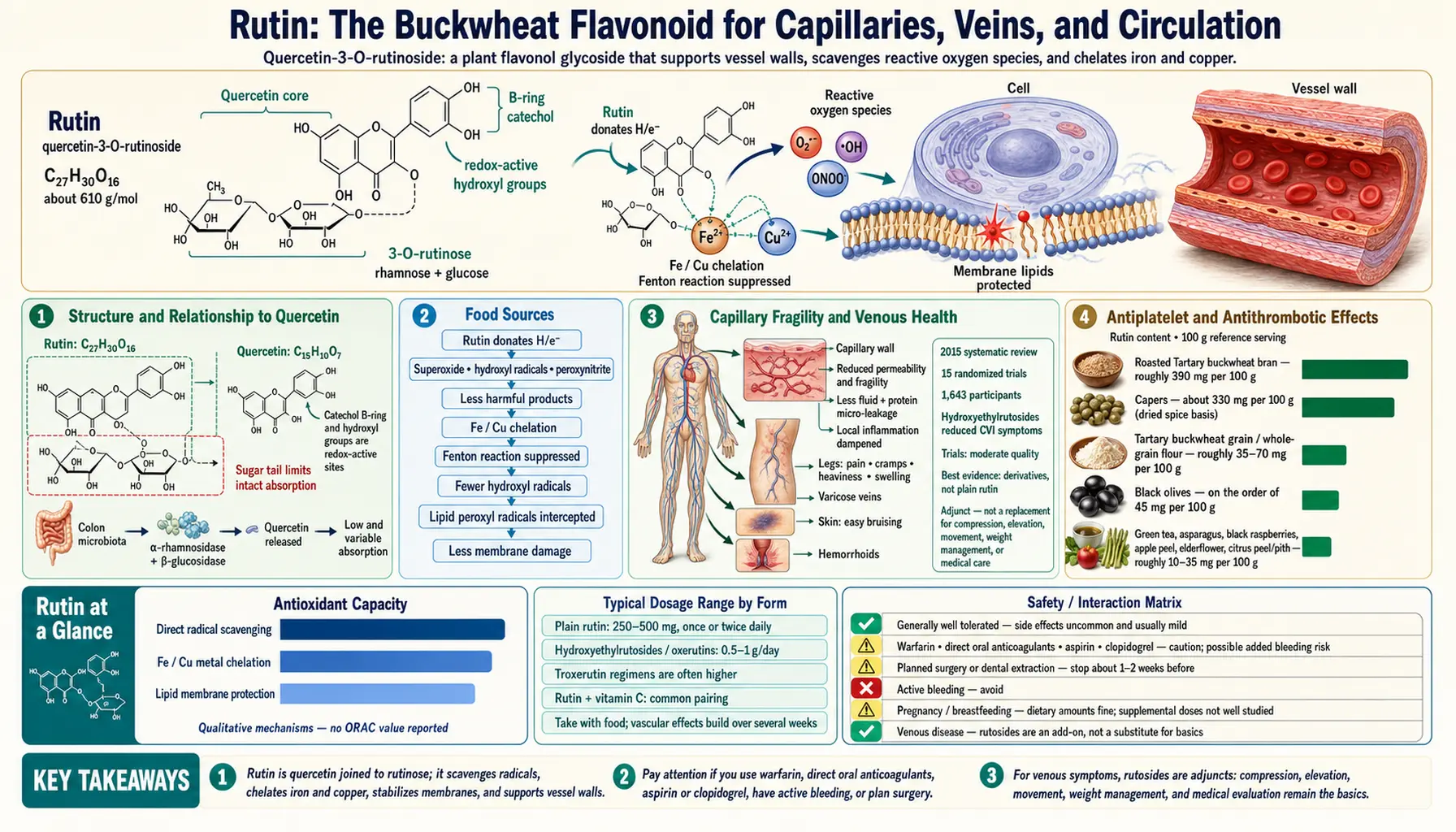
Rutin — chemically quercetin-3-O-rutinoside, and known in older literature as rutoside or sophorin — is a flavonol glycoside built from the antioxidant quercetin joined to the disaccharide sugar rutinose. It is the form in which quercetin is most often stored in plants, and it is abundant in buckwheat, capers, asparagus, apple peel, citrus, elderflower, and tea. For most of the twentieth century rutin was grouped with hesperidin and other citrus "bioflavonoids" under the now-obsolete label vitamin P — the "P" standing for capillary permeability — because early researchers observed that these compounds reduced the fragility and leakiness of small blood vessels.
This article covers what rutin actually is and how the gut converts it back to quercetin, where it occurs in food and in what amounts, the venous and capillary uses that made it famous (chronic venous insufficiency, varicose veins, and hemorrhoids), the laboratory and early-clinical interest in its anti-clotting effects, its antioxidant and metal-binding chemistry, its broader anti-inflammatory and metabolic actions, and how it is dosed and tolerated. Throughout, the goal is to separate the strong evidence (mostly for semisynthetic rutoside derivatives) from the preliminary signals (mostly for plain rutin), in plain language.
Table of Contents
- Structure and Relationship to Quercetin
- Food Sources
- Capillary Fragility and Venous Health
- Antiplatelet and Antithrombotic Effects
- Antioxidant and Metal-Chelation Mechanism
- Anti-Inflammatory and Metabolic Effects
- Forms, Dosing, and Bioavailability
- Safety and Interactions
- Research Papers
- Connections
- Featured Videos
Structure and Relationship to Quercetin
Rutin is a glycoside — a molecule with a sugar attached. Specifically, it is the flavonol quercetin with the disaccharide rutinose bonded at the 3-position of quercetin's C-ring. Rutinose itself is two simple sugars linked together: rhamnose and glucose. The molecular formula is C27H30O16 (molar mass about 610 g/mol), versus quercetin's much smaller C15H10O7.
That bulky sugar tail is the single most important fact about rutin's biology. Humans do not absorb intact rutin well from the small intestine; instead, it travels to the colon, where bacterial enzymes (notably α-rhamnosidase and β-glucosidase from the gut microbiota) cleave off the rutinose and release free quercetin. The liberated quercetin and its bacterial breakdown products (phenolic acids such as 3,4-dihydroxyphenylacetic acid) are then absorbed. In a real sense, much of rutin's systemic activity is quercetin's activity, delivered slowly and dependent on a person's gut flora — which is one reason absorption of plain rutin is both low and variable from person to person.
Sitting at the surface of cells and in the vessel wall, however, rutin can act in its own right: as an intact molecule it stabilizes membranes, binds metals, and scavenges free radicals before any sugar is removed. The semisynthetic derivatives discussed below (the hydroxyethylrutosides) were engineered precisely to keep that intact-molecule vascular activity while improving solubility and absorption.
Food Sources
Buckwheat is the iconic dietary source of rutin — it is essentially the only common staple grain that contains meaningful amounts, and buckwheat's faint greenish tint and its long folk reputation as a "vessel" food trace back to this flavonoid. Tartary buckwheat is especially rich. Representative reported contents (fresh weight unless noted) include:
- Tartary buckwheat bran (roasted) — roughly 390 mg per 100 g, the densest food source
- Capers — about 330 mg per 100 g (dried spice basis)
- Tartary buckwheat grain / whole-grain buckwheat flour — roughly 35–70 mg per 100 g
- Black olives — on the order of 45 mg per 100 g
- Green tea infusion, asparagus, black raspberries, apple peel, elderflower, and citrus (especially the peel and pith) — roughly 10–35 mg per 100 g
Two practical points follow. First, the rutin is concentrated in the parts we often discard — the buckwheat bran, the apple skin, and the white citrus pith — so refining and peeling strip much of it away. Second, even a generous diet supplies only a few tens of milligrams of rutin a day, whereas the venous studies below used standardized doses ten to thirty times higher, which is why supplements and rutoside derivatives, not buckwheat porridge, are what the clinical literature actually tests.
Capillary Fragility and Venous Health
Rutin's oldest and best-supported use is in the small blood vessels. In the 1930s and 1940s, work on citrus flavonoids (the "vitamin P" era) suggested that these compounds reduced capillary permeability and fragility — the tendency of tiny vessels to leak fluid into tissue and to rupture into easy bruising. Vitamin P was later dropped as a vitamin designation, because rutin is not essential to life and no deficiency disease exists. But the underlying vascular observation endured, and it became the foundation of the venoactive (vein-acting) drug class.
The most studied agents are not plain rutin but its semisynthetic cousins, the hydroxyethylrutosides — marketed as oxerutins and the closely related single-component troxerutin, under brand names such as Venoruton and Paroven. These are used for chronic venous insufficiency (CVI): the condition behind aching, heavy, swollen legs, visible varicose veins, and skin changes that arises when leg-vein valves fail and blood pools against gravity. A 2015 systematic review of 15 randomized trials (1,643 participants) found that hydroxyethylrutosides significantly reduced symptoms such as leg pain, cramps, and heaviness compared with placebo, while noting that the trials were of only moderate quality. The same derivatives have been tested for hemorrhoids — which are, in effect, varicose veins of the anal canal — where troxerutin (often combined with carbazochrome) showed benefit for acute symptoms and post-surgical recovery in controlled studies. The plausible mechanism is a real one: these flavonoids appear to tighten the capillary wall, reduce micro-leakage of fluid and protein, and dampen the local inflammation that accompanies venous congestion.
Two honest caveats keep this in perspective. First, the strong evidence is for the standardized derivatives, not for over-the-counter "rutin" tablets, whose absorption is poorer and whose dosing is rarely standardized. Second, venoactive flavonoids are adjuncts: in serious venous disease, graduated compression stockings, leg elevation, weight management, and movement remain the backbone of treatment, and a trial of oxerutins for preventing venous-ulcer recurrence showed no advantage over compression alone. Rutosides can ease symptoms; they do not replace the basics.
Antiplatelet and Antithrombotic Effects
Separate from its vein-wall effects, rutin has drawn serious laboratory interest as a potential anti-clotting agent — and this is the area most prone to over-hyping, so it deserves careful framing. In 2012, a Harvard/Beth Israel group led by Robert Flaumenhaft screened a large library of compounds for inhibitors of protein disulfide isomerase (PDI), an enzyme released at sites of vessel injury that is required to kick-start clot formation. Quercetin-3-rutinoside — rutin — emerged as the most potent antithrombotic hit in their model, blocking both platelet clumping and fibrin generation in mice without the bleeding penalty seen with conventional blood thinners.
Because PDI sits upstream of clotting in a way that is especially relevant to venous thromboembolism (deep-vein clots and the pulmonary emboli they can cause), this finding generated genuine excitement and follow-on work, including a lipid-based oral nano-formulation designed to overcome rutin's poor absorption and a zinc-rutin complex that inhibits PDI even more strongly in the laboratory. It is important to be precise about the state of evidence: this is preclinical and very-early-clinical science. The antithrombotic data come from cell systems, animal models, and small early-phase human studies of PDI inhibition — not from large randomized trials showing that taking rutin prevents clots or strokes in people. Rutin is not an approved anticoagulant and should not be used as one. The practical takeaway for now is the safety mirror image of this research (see below): because rutin has a measurable antiplatelet action, it warrants caution alongside prescription blood thinners and around surgery.
Antioxidant and Metal-Chelation Mechanism
Rutin is a capable direct antioxidant. Its flavonol backbone carries several hydroxyl groups, including the catechol arrangement on the B-ring, that let it donate hydrogen atoms or electrons to quench reactive oxygen species — superoxide, hydroxyl radicals, and peroxynitrite among them — converting them to less harmful products. This is the same chemistry that powers quercetin and most plant flavonols.
Rutin's more distinctive contribution is metal chelation. Free iron and copper ions catalyze the Fenton reaction, which manufactures the extremely damaging hydroxyl radical from ordinary hydrogen peroxide. Rutin binds these transition metals and locks them into inert complexes that can no longer drive that reaction, so it shuts off radical production at the source rather than only mopping up radicals after they form. A classic 1989 study by Afanas'ev and colleagues compared rutin and quercetin directly in iron-dependent lipid peroxidation and found that, while both worked, the chelation mechanism mattered more for rutin than for quercetin — and that the iron–flavonoid complexes retained radical-scavenging activity of their own. In short, rutin fights oxidative stress on three fronts at once: blocking superoxide, suppressing hydroxyl-radical formation via the Fenton reaction, and intercepting the lipid peroxyl radicals that propagate membrane damage.
Anti-Inflammatory and Metabolic Effects
Beyond the vessel wall, rutin behaves as a broad anti-inflammatory and metabolic modulator in laboratory and animal models. It downregulates the master inflammatory switch NF-κB and lowers pro-inflammatory messengers such as TNF-α, IL-6, IL-1β, and COX-2. A 2022 review in Pharmacological Research synthesized this literature and connected rutin's anti-inflammatory action to improvements in metabolic measures — blood sugar handling, lipids, and insulin sensitivity — across preclinical studies of obesity and diabetes.
Human data are starting to catch up but remain limited. A 2023 randomized, double-blind, placebo-controlled trial gave adults with type 2 diabetes 1 gram of rutin daily for three months and reported significant reductions in systolic and diastolic blood pressure, mean arterial pressure, and heart rate, alongside rises in the antioxidant enzymes superoxide dismutase, catalase, and glutathione peroxidase and improvements in several quality-of-life domains. This is one promising trial, not a body of confirmatory evidence, but it is consistent with the cardiovascular and antioxidant mechanisms above — and it studied plain rutin at a defined dose, which is exactly the gap most of the supplement literature leaves open.
Forms, Dosing, and Bioavailability
The central challenge with rutin is the same low oral bioavailability described in the structure section: as a sugar-bearing glycoside it is poorly absorbed intact and depends on colonic bacteria to release quercetin. Supplement and pharmaceutical forms try to work around this:
- Plain rutin (rutoside) — widely sold as a stand-alone or buckwheat-derived supplement, commonly 250–500 mg, once or twice daily; absorption is modest and variable.
- Hydroxyethylrutosides / oxerutins / troxerutin (Venoruton, Paroven) — semisynthetic, more water-soluble derivatives used specifically for venous disease, typically dosed around 0.5–1 g/day (troxerutin regimens are often higher); these, not plain rutin, are what the venous trials actually used.
- Rutin with vitamin C — a classic "C-bioflavonoid complex" pairing. Vitamin C helps regenerate oxidized flavonoids and the two are traditionally combined for capillary support; combination products are common.
- Quercetin instead of rutin — because rutin is largely a quercetin pro-form, people seeking systemic quercetin effects sometimes choose an absorbable quercetin form (such as a phytosome) directly; see the quercetin page for those options.
A trial dose of rutin or a rutoside for leg heaviness or easy bruising is reasonable, taken with food, and continued for several weeks since vascular effects build gradually rather than working acutely.
Safety and Interactions
- Generally very well tolerated. Rutin and the rutoside derivatives have a long use history with a good safety record; side effects are uncommon and usually mild (occasional headache, flushing, rash, or digestive upset).
- Antiplatelet effect — the key interaction. Because rutin inhibits clot formation (the PDI mechanism above), combining it with anticoagulants or antiplatelet drugs (warfarin, the direct oral anticoagulants, aspirin, clopidogrel) could theoretically add to bleeding risk. Use caution, and tell your clinician you take it.
- Stop before surgery. For the same reason, it is prudent to discontinue rutin/rutoside supplements about one to two weeks before any planned surgery or dental extraction, and to avoid them with active bleeding.
- Pregnancy and breastfeeding. Dietary amounts from food are fine; supplemental doses are not well studied, so avoid them unless a clinician advises otherwise.
- Not a substitute for venous-disease basics. For varicose veins, leg swelling, or recurrent venous ulcers, compression, elevation, movement, and medical evaluation come first; rutosides are an add-on for symptom relief.
Research Papers
Peer-reviewed references behind the claims on this page, spanning rutin's pharmacology, venous-disease derivatives, antithrombotic mechanism, antioxidant chemistry, and a human blood-pressure trial. Each citation's year/volume/pages link resolves to the paper via its DOI.
- Ganeshpurkar A, Saluja AK. The pharmacological potential of rutin. Saudi Pharmaceutical Journal — 2017;25(2):149–164.
- Muvhulawa N, Dludla PV, Ziqubu K, Mthembu SX, et al. Rutin ameliorates inflammation and improves metabolic function: a comprehensive analysis of scientific literature. Pharmacological Research — 2022;178:106163.
- Aziz Z, Tang WL, Chong NJ, Tho LY. A systematic review of the efficacy and tolerability of hydroxyethylrutosides for improvement of the signs and symptoms of chronic venous insufficiency. Journal of Clinical Pharmacy and Therapeutics — 2015;40(2):177–185.
- Jasuja R, Passam FH, Kennedy DR, Kim SH, et al. Protein disulfide isomerase inhibitors constitute a new class of antithrombotic agents. Journal of Clinical Investigation — 2012;122(6):2104–2113.
- Chen D, Liu Y, Liu P, Zhou Y, et al. Orally delivered rutin in lipid-based nano-formulation exerts strong antithrombotic effects by protein disulfide isomerase inhibition. Drug Delivery — 2022;29(1):1824–1835.
- Liao X, Ji P, Chi K, Chen X, et al. Enhanced inhibition of protein disulfide isomerase and anti-thrombotic activity of a rutin derivative: rutin:Zn complex. RSC Advances — 2023;13(17):11464–11471.
- Afanas'ev IB, Dorozhko AI, Brodskii AV, Kostyuk VA, et al. Chelating and free radical scavenging mechanisms of inhibitory action of rutin and quercetin in lipid peroxidation. Biochemical Pharmacology — 1989;38(11):1763–1769.
- Bazyar H, Zare Javid A, Ahangarpour A, Zaman F, et al. The effects of rutin supplement on blood pressure markers, some serum antioxidant enzymes, and quality of life in patients with type 2 diabetes mellitus compared with placebo. Frontiers in Nutrition — 2023;10:1214420.
Live PubMed Searches
- Rutin pharmacology and quercetin glycoside
- Hydroxyethylrutosides and chronic venous insufficiency
- Troxerutin in venous disease and hemorrhoids
- Rutin, protein disulfide isomerase, and thrombosis
- Rutin, iron chelation, and lipid peroxidation
- Rutin, NF-κB, and metabolic inflammation
- Rutin, blood pressure, and type 2 diabetes (RCT)
- Buckwheat rutin content and food sources
Connections
- Quercetin
- Albert Szent-Györgyi — discovered the flavonoids ("vitamin P") and vitamin C itself
- Hesperidin
- Grape Seed Extract
- Bilberry
- Pycnogenol
- Anthocyanins
- Luteolin
- Apigenin
- Vitamin C
- Hypertension
- Cardiovascular Disease
- Diabetes
- Oxidative Stress
- Immune Boosting
- Green Tea
- Antioxidants