Hesperidin — Benefits Deep Dive
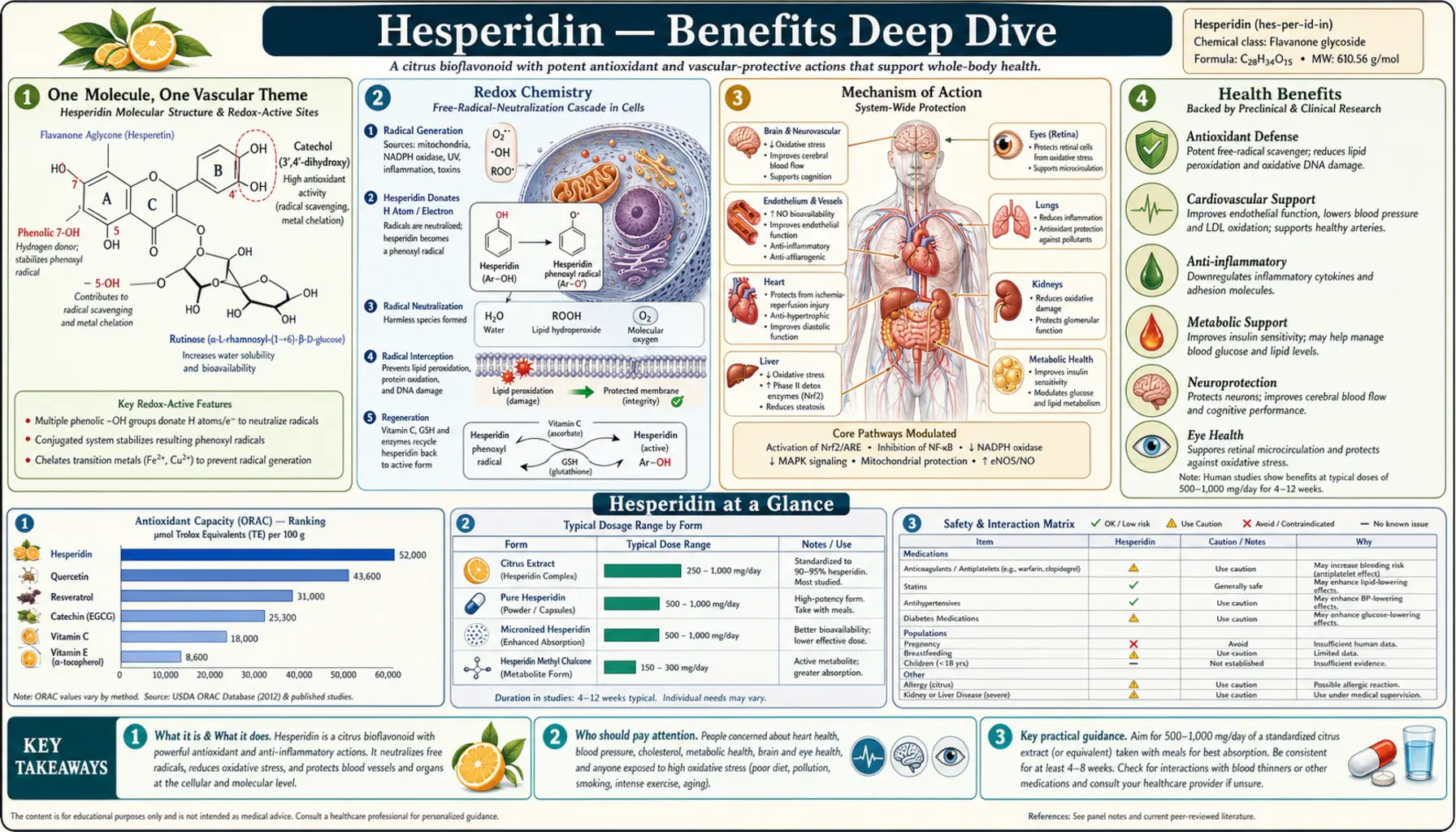
Hesperidin is the signature flavanone of the orange — a flavonoid that lives mostly in the white pith and segment membranes we usually throw away, not in the juice. Chemically it is hesperetin bound to a rutinose sugar, and that sugar is the key to its whole story: hesperidin is poorly absorbed in the small intestine and must travel to the colon, where gut bacteria unlock the active aglycone. Its best-documented use is not as a general "antioxidant" but as a venotonic — part of the diosmin-plus-hesperidin combinations prescribed across Europe for heavy, aching, swollen legs and hemorrhoids. A second, promising-but-still-modest line of evidence links hesperidin-rich orange juice to better endothelial function and small reductions in blood pressure. The four deep-dive pages below separate the strong evidence from the hopeful, keep the numbers honest, and explain why the form and the sugar matter as much as the dose.
Deep-Dive Articles
Veins & Circulation
Hesperidin's strongest evidence. How the diosmin-plus-hesperidin combination (micronized purified flavonoid fraction, MPFF) increases venous tone, reduces capillary leak, and calms the vein-wall inflammation behind chronic venous insufficiency, varicose-vein symptoms, leg edema, and hemorrhoids — and what the RELIEF study and Cochrane reviews actually show.
Heart & Blood Pressure
Endothelial function, nitric oxide, blood pressure, and lipids. The Morand orange-juice crossover trial, the Rizza metabolic-syndrome trial, and where the honest edges are — effects are real but small, mostly on surrogate markers, and not every trial is positive.
Antioxidant & Anti-Inflammatory
The mechanisms. Why direct free-radical scavenging is a minor part of the story, and how hesperetin and its metabolites really act — switching on the Nrf2 antioxidant-defense program and quieting NF-κB-driven inflammation (TNF-α, IL-6, CRP).
Sources & Absorption
Where hesperidin actually is (peel, pith, membranes — far more than juice), the low-bioavailability problem, the central role of the gut microbiome, and how enzymatically modified forms such as glucosyl-hesperidin and the natural 2S isomer are designed to get more of it into your blood.
Table of Contents
- Deep-Dive Articles
- One Molecule, One Vascular Theme
- Key Research Papers: Veins, Circulation & Hemorrhoids
- Key Research Papers: Heart, Blood Pressure & Endothelium
- Key Research Papers: Antioxidant & Anti-Inflammatory Mechanisms
- Key Research Papers: Sources, Forms & Absorption
- External Authoritative Resources
- Connections
- Featured Videos
One Molecule, One Vascular Theme
Many antioxidants are pitched as doing a little of everything. Hesperidin is more focused: nearly all of its credible benefits point back to blood vessels. That is not a coincidence — it reflects where the molecule concentrates its effects.
- The vein wall and the microcirculation — hesperidin (and its semi-synthetic partner diosmin) increases the tone of vein walls, reduces the leakiness and fragility of the smallest capillaries, and dampens the low-grade inflammation where white blood cells stick to and injure the venous endothelium. This is the mechanism behind its use in chronic venous insufficiency, leg edema, varicose-vein symptoms, and hemorrhoids, and it is the part of the story with the most human trial data.
- The arterial endothelium — the same single cell layer that lines veins also lines arteries, and hesperetin (the absorbed aglycone) nudges endothelial cells to make more nitric oxide, the signal that relaxes and protects arteries. This underlies the endothelial-function and blood-pressure findings, though here the effects are smaller and less consistent.
- The cellular stress-response wiring — rather than mopping up radicals directly, hesperidin's metabolites appear to work by turning on the cell's own Nrf2 antioxidant-defense program and turning down NF-κB inflammation. This "indirect" antioxidant action is why circulating levels can be low yet still biologically meaningful.
The practical catch that ties it all together is absorption. Hesperidin as it exists in an orange is a glycoside — a flavonoid wearing a sugar coat — and that sugar keeps it from crossing the small-intestine wall. It has to reach the colon, where resident bacteria snip off the sugar so the body can absorb the hesperetin inside. Absorption is therefore slow, incomplete, and highly variable from person to person depending on their gut flora. This is why the pharmaceutical venotonics are micronized (ground to tiny particles) and why supplement makers sell enzymatically modified forms — both are attempts to solve the same delivery problem.
Throughout these pages we keep two honest guardrails. First, hesperidin is an adjunct, not a cure: for venous disease it complements compression and lifestyle measures rather than replacing them. Second, most cardiovascular findings are on surrogate markers (flow-mediated dilation, blood pressure, inflammatory proteins) in short trials, not on hard outcomes like heart attacks — encouraging, but not the same thing.
Key Research Papers: Veins, Circulation & Hemorrhoids
- Coleridge-Smith P, et al. (2005). Venous leg ulcer: a meta-analysis of adjunctive therapy with micronized purified flavonoid fraction. Eur J Vasc Endovasc Surg. — PubMed 15936227
- Perera N, et al. (2012). Phlebotonics for haemorrhoids. Cochrane Database Syst Rev. — PubMed 22895941
- Jantet G (2002). Chronic venous insufficiency: worldwide results of the RELIEF study. Angiology. — PubMed 12025911
- Lyseng-Williamson KA, Perry CM (2003). Micronised purified flavonoid fraction: a review of its use in chronic venous insufficiency, venous ulcers and haemorrhoids. Drugs. — PubMed 12487623
- Giannini I, et al. (2015). Flavonoids mixture (diosmin, troxerutin, hesperidin) in the treatment of acute hemorrhoidal disease. Tech Coloproctol. — PubMed 25893991
- Cazaubon M, et al. (2021). Is there a difference in the clinical efficacy of diosmin and micronized purified flavonoid fraction for the treatment of chronic venous disorders? Vasc Health Risk Manag. — PubMed 34556990
- Gohel MS, Davies AH (2009). Pharmacological agents in the treatment of venous disease: an update of the available evidence. Curr Vasc Pharmacol. — PubMed 19601855
Key Research Papers: Heart, Blood Pressure & Endothelium
- Morand C, et al. (2011). Hesperidin contributes to the vascular protective effects of orange juice: a randomized crossover study in healthy volunteers. Am J Clin Nutr. — PubMed 21068346
- Rizza S, et al. (2011). Citrus polyphenol hesperidin stimulates production of nitric oxide in endothelial cells while improving endothelial function and reducing inflammatory markers in patients with metabolic syndrome. J Clin Endocrinol Metab. — PubMed 21346065
- Salden BN, et al. (2016). Randomized clinical trial on the efficacy of hesperidin 2S on validated cardiovascular biomarkers in healthy overweight individuals. Am J Clin Nutr. — PubMed 27797708
- Heidari Z, et al. (2025). Effects of hesperidin supplementation on cardiometabolic markers: a systematic review and meta-analysis. Nutr Rev. — PubMed 39038797
- Mohammadi M, et al. (2019). Hesperidin, a major flavonoid in orange juice, might not affect lipid profile and blood pressure: a systematic review. Phytother Res. — PubMed 30632207
Key Research Papers: Antioxidant & Anti-Inflammatory Mechanisms
- Parhiz H, et al. (2015). Antioxidant and anti-inflammatory properties of the citrus flavonoids hesperidin and hesperetin: an updated review. Phytother Res. — PubMed 25394264
- Roohbakhsh A, et al. (2015). Molecular mechanisms behind the biological effects of hesperidin and hesperetin for the prevention of cancer and cardiovascular diseases. Life Sci. — PubMed 25625242
- Garg A, et al. (2001). Chemistry and pharmacology of the citrus bioflavonoid hesperidin. Phytother Res. — PubMed 11746857
- Li J, et al. (2021). Hesperetin ameliorates hepatic oxidative stress and inflammation via the PI3K/AKT-Nrf2-ARE signaling pathway. Food Funct. — PubMed 33977953
Key Research Papers: Sources, Forms & Absorption
- Manach C, et al. (2003). Bioavailability in humans of the flavanones hesperidin and narirutin after the ingestion of two doses of orange juice. Eur J Clin Nutr. — PubMed 12571654
- Nielsen IL, et al. (2006). Bioavailability is improved by enzymatic modification of the citrus flavonoid hesperidin in humans: a randomized, double-blind, crossover trial. J Nutr. — PubMed 16424119
- Pereira-Caro G, et al. (2014). Orange juice (poly)phenols are highly bioavailable in humans. Am J Clin Nutr. — PubMed 25332336
- Stuetz W, et al. (2010). Polymethoxylated flavones, flavanone glycosides, carotenoids, and antioxidants in different citrus fruits. J Agric Food Chem. — PubMed 20420369
External Authoritative Resources
- PubChem — Hesperidin — structure, identifiers, chemical and safety data
- PubChem — Hesperetin — the absorbed, active aglycone form
- Linus Pauling Institute — Flavonoids — authoritative scientific overview of dietary flavonoids
- USDA FoodData Central — food composition database
- PubMed — All research on hesperidin
Connections
- Hesperidin (Main Page)
- Hesperidin for Veins & Circulation
- Hesperidin for Heart & Blood Pressure
- Antioxidant & Anti-Inflammatory Mechanisms
- Sources & Absorption
- All Antioxidants
- Rutin
- Quercetin
- Pycnogenol
- Grape Seed Extract
- Vitamin C
- Varicose Veins
- Hemorrhoids
- Hypertension
- Metabolic Syndrome