Hesperidin for Veins & Circulation
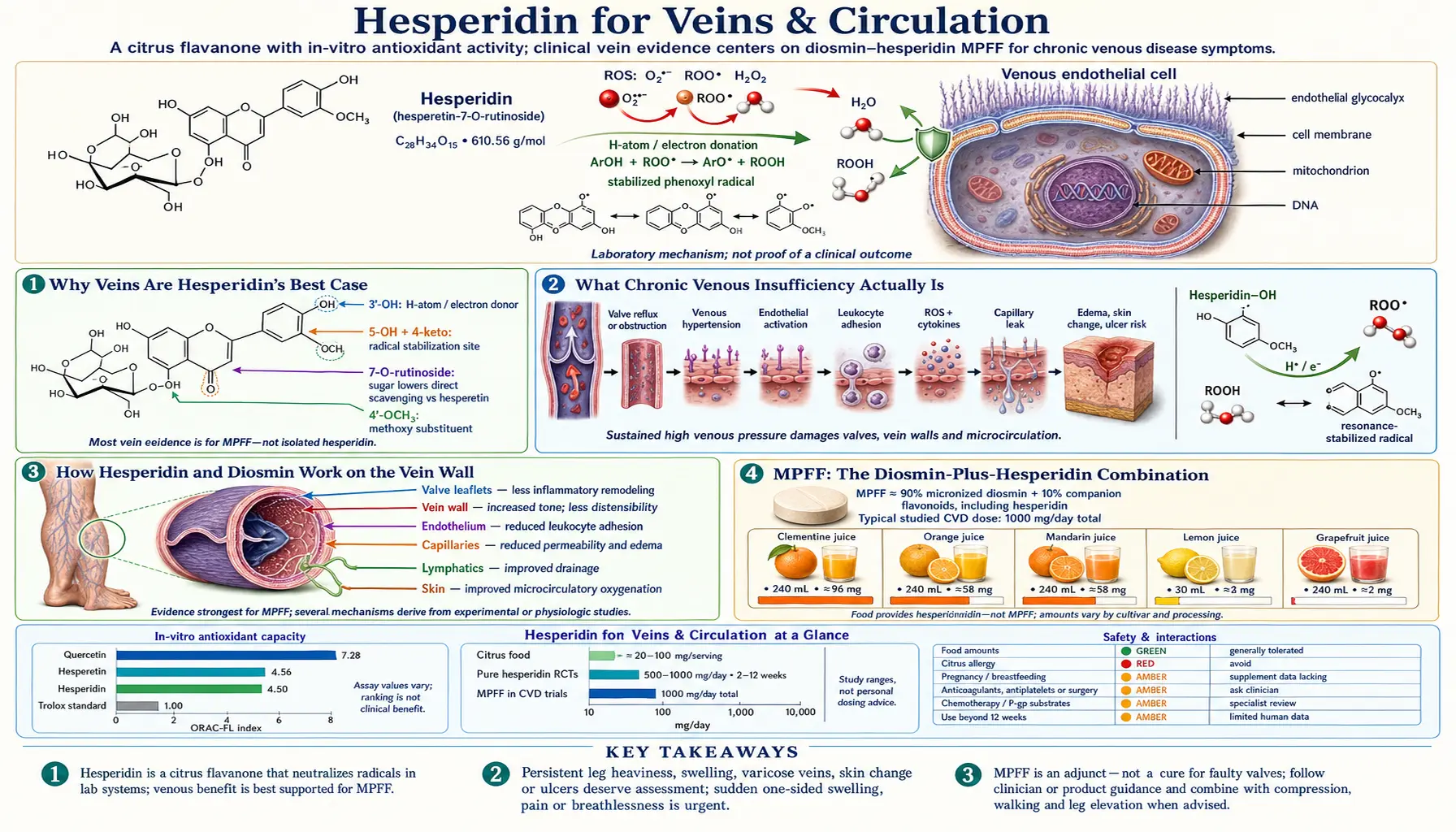
If hesperidin has one genuinely well-earned reputation, it is as a venotonic — a substance that helps tired, heavy, swollen legs and the strained veins of hemorrhoids. Across much of Europe and Latin America, a combination of diosmin (made from hesperidin) plus hesperidin has been prescribed for decades under names like Daflon and Detralex for chronic venous insufficiency and hemorrhoidal attacks. This is the corner of the hesperidin story with the most human trial data, the clearest mechanism, and a place in real vascular-surgery guidelines. It is still an adjunct — it works alongside compression stockings, movement, and weight management rather than replacing them — but the effect on symptoms and swelling is real. This page explains what venous insufficiency is, exactly how these flavonoids act on the vein wall, and what the RELIEF study and the Cochrane reviews actually found.
Table of Contents
- Why Veins Are Hesperidin's Best Case
- What Chronic Venous Insufficiency Actually Is
- How Hesperidin and Diosmin Work on the Vein Wall
- MPFF: The Diosmin-Plus-Hesperidin Combination
- The Evidence in Chronic Venous Insufficiency
- Venous Leg Ulcers
- Hemorrhoids
- How It Is Used: Doses, Forms & Realistic Expectations
- Safety, Pregnancy & Interactions
- Key Research Papers
- Connections
- Featured Videos
Why Veins Are Hesperidin's Best Case
Most of the health claims made for flavonoids are extrapolations from test-tube antioxidant assays. Hesperidin's venous use is different: it grew out of decades of clinical practice and a stack of randomized and observational human trials, and it is one of the few flavonoid applications that appears in professional treatment guidelines. The European Society for Vascular Surgery and international consensus documents on chronic venous disease list micronized purified flavonoid fraction (MPFF) — the diosmin-plus-hesperidin combination — among the venoactive drugs that can be used to relieve venous symptoms and edema, and as a possible adjunct to compression for healing venous leg ulcers.
That does not make it a miracle. The honest summary is that these flavonoids produce a modest, symptom-level benefit: less aching and heaviness, less swelling by the end of the day, sometimes faster ulcer healing when added to standard care. They do not repair failed vein valves, dissolve varicose veins, or replace the mechanical benefit of compression. But for a common, uncomfortable, quality-of-life-eroding problem, a modest and reasonably safe benefit is worth understanding.
What Chronic Venous Insufficiency Actually Is
Blood returning from the legs has to travel uphill against gravity to reach the heart. Leg veins manage this with two tools: the squeezing action of calf muscles (the "calf pump") and a series of one-way valves that keep blood from sliding back down between squeezes. Chronic venous insufficiency (CVI) develops when those valves leak. Blood refluxes downward and pools in the lower leg, raising the pressure inside the veins — a state called venous hypertension.
Sustained venous hypertension is what produces the familiar cluster of symptoms and signs:
- Aching, heaviness, and fatigue in the legs, typically worse at the end of the day and after prolonged standing
- Edema (swelling) around the ankle and lower leg
- Night cramps and restless-legs sensations
- Visible varicose veins and spider veins
- Skin changes over time — brown pigmentation (hemosiderin staining), dry itchy eczema, and hardening of the skin and fat (lipodermatosclerosis)
- Venous leg ulcers in the most advanced stage, usually near the inner ankle
Clinicians grade severity with the CEAP classification, running from C0 (no visible signs) through C3 (edema), C4 (skin changes), C5 (healed ulcer), and C6 (active ulcer). Hesperidin-based venotonics are used across this spectrum, mainly to reduce symptoms and edema in the earlier stages and as an add-on for ulcer healing in the advanced stages. For the broader vein picture see our Varicose Veins page.
How Hesperidin and Diosmin Work on the Vein Wall
Venoactive flavonoids act at several points in the venous-hypertension cascade rather than through a single dramatic mechanism. The best-characterized actions are:
- Increased venous tone. Diosmin and hesperidin prolong the constricting effect of noradrenaline (norepinephrine) on the vein wall. A vein with better tone empties more efficiently and refluxes less, which lowers the pressure driving the symptoms.
- Reduced capillary leak and fragility. Venous hypertension makes the smallest capillaries leaky, letting fluid and proteins seep into the tissue — that is the edema. These flavonoids reduce capillary hyperpermeability and increase capillary resistance, which translates to less swelling. This capillary-protective effect is why the older literature grouped hesperidin with vitamin C under the now-obsolete label "vitamin P."
- Better lymphatic drainage. The lymphatic system is the tissue's backup drainage. Flavonoid fractions increase the frequency and intensity of lymphatic contractions, helping clear the excess fluid that pools in a congested leg.
- Calming vein-wall inflammation. This is the mechanism modern research emphasizes most. Venous hypertension causes white blood cells (leukocytes) to stick to and roll along the venous endothelium, then migrate into the wall and release enzymes and inflammatory mediators that progressively damage the valves and the wall itself — the so-called "leukocyte trapping" model of CVI progression. MPFF reduces this leukocyte adhesion and activation, protects the endothelium, and lowers inflammatory markers, which may slow the underlying disease rather than merely masking symptoms.
Notice that these are all vascular actions, not general antioxidant hand-waving. The same anti-inflammatory, endothelium-protecting theme reappears in the arterial and blood-pressure story and is grounded in the Nrf2 and NF-κB mechanisms covered on the other pages.
MPFF: The Diosmin-Plus-Hesperidin Combination
Most of the venous trial evidence does not use plain hesperidin. It uses a specific pharmaceutical preparation, and it is worth understanding exactly what that is because the labels can be confusing.
Diosmin is made from hesperidin. Industrially, hesperidin extracted from citrus peel is chemically converted (by dehydrogenation) into diosmin. So hesperidin is literally the starting material for the drug. The two molecules are close chemical cousins — diosmin is a flavone, hesperidin a flavanone — and they are used together.
MPFF (micronized purified flavonoid fraction), sold as Daflon 500 and Detralex among other names, is standardized to 90% diosmin and 10% other flavonoids expressed as hesperidin. The word micronized matters: the particles are ground to roughly two micrometers or smaller, which dramatically improves how much dissolves and gets absorbed compared with ordinary coarse powder. Non-micronized diosmin-hesperidin products also exist and are generally considered somewhat less bioavailable, though a 2021 comparison concluded the clinical difference between well-made diosmin preparations and MPFF is smaller than once assumed.
Related but distinct venoactive agents you may see compared in the literature include the hydroxyethylrutosides (a rutin derivative), horse-chestnut seed extract (aescin), and calcium dobesilate. Hesperidin-based MPFF is the most extensively studied of the group. This is also why the micronization and modified-form story is so central: the whole pharmaceutical effort is aimed at overcoming hesperidin's poor natural absorption.
The Evidence in Chronic Venous Insufficiency
The headline trial is RELIEF (Reflux assEssment and quaLity of lIfe improvement with micronized Flavonoids), reported by Jantet. RELIEF followed more than 5,000 patients with venous symptoms across 23 countries for six months of MPFF treatment and documented meaningful improvements in leg symptoms, ankle swelling, and quality-of-life scores, with benefit seen whether or not visible reflux was present on ultrasound. It is a large, real-world dataset — but it is important to be honest that RELIEF was an open-label study without a placebo group, which limits how much of the improvement can be attributed to the drug rather than to time, attention, and expectation.
The stronger evidence comes from randomized, placebo-controlled trials pooled in systematic reviews. Cochrane reviews of phlebotonics for venous insufficiency have generally concluded that flavonoids probably reduce edema slightly and may relieve some symptoms such as heaviness, cramps, and restless legs, while cautioning that the certainty of the evidence is low to moderate and the effect sizes are small. In other words: a genuine but modest signal, riding on top of — not instead of — compression therapy, which remains the cornerstone of CVI management. Reviews of the venoactive drug class by Gohel and Davies, by Lyseng-Williamson and Perry, and by Cazaubon and colleagues reach the same measured conclusion.
Venous Leg Ulcers
Venous leg ulcers are the painful, slow-healing wounds that can develop at the end stage of CVI. Standard treatment is compression bandaging plus wound care, but these ulcers are notoriously stubborn. The most clinically useful venous finding for hesperidin-based therapy is here.
A meta-analysis by Coleridge-Smith and colleagues pooled randomized trials of MPFF added to conventional care (compression and local wound treatment) for venous ulcers. Adding MPFF improved the chance of healing and shortened time to healing, with the benefit most apparent for ulcers that were moderately sized (roughly under 10 cm²) and relatively recent (present less than six months). On the strength of this analysis, several vascular-surgery guidelines list MPFF as a reasonable adjunct to compression for difficult venous ulcers — not a stand-alone treatment, and not a substitute for the bandaging that does the mechanical work.
The practical takeaway for a patient with a venous ulcer is clear: compression comes first, and a hesperidin-based flavonoid may be added by the clinician to nudge healing along, but it does not change the fundamentals of wound care.
Hemorrhoids
Hemorrhoids are, in effect, varicose veins of the anal canal, so it is not surprising that the same venoactive flavonoids are used for them. This is one of the most common real-world uses of diosmin-hesperidin worldwide, especially for acute flare-ups.
The key evidence is a Cochrane review by Perera and colleagues on phlebotonics for hemorrhoids. Pooling the available trials, the reviewers found that flavonoid phlebotonics improved several outcomes compared with control — less bleeding, less itching, less discharge, and greater overall symptom relief — and reduced symptoms after hemorrhoid surgery. The reviewers were careful to flag that many included trials were small, heterogeneous, and methodologically imperfect, so the certainty of the evidence is limited. A separate randomized trial by Giannini and colleagues found that a flavonoid mixture of diosmin, troxerutin, and hesperidin improved symptoms in acute hemorrhoidal disease.
In practice, a typical use is a short course at higher "loading" doses during an acute hemorrhoidal attack — often paired with fiber, fluids, and topical care — to shorten the episode of bleeding and pain. See our Hemorrhoids page for the full management picture, of which flavonoids are only one part.
How It Is Used: Doses, Forms & Realistic Expectations
Because regulatory status differs by country, none of the following is a prescription — it is a description of how these products are commonly used so you can have an informed conversation with a clinician or pharmacist.
- Chronic venous insufficiency: MPFF is typically taken as 500 mg twice daily (1,000 mg/day), or as a single 1,000 mg daily formulation, over weeks to months. Benefit on symptoms and swelling builds gradually rather than overnight.
- Acute hemorrhoidal attack: a common regimen front-loads the dose — for example several tablets per day for the first few days, then tapering — before returning to a maintenance dose or stopping. Product labels vary; follow the specific package or clinician instructions.
- Plain hesperidin supplements (as opposed to standardized diosmin-hesperidin drugs) are sold in the 500–1,000 mg/day range, but they are far less standardized and less studied for venous endpoints, and their poor absorption is a real limitation — see Sources & Absorption.
Set expectations honestly. These flavonoids ease symptoms and swelling; they do not fix incompetent valves, shrink existing varicose veins, or remove the need for compression stockings, leg elevation, movement, and weight management — the measures that address the underlying mechanics. For significant varicose veins or advanced disease, definitive treatments (endovenous ablation, sclerotherapy, or surgery) target the cause; flavonoids are supportive care.
Safety, Pregnancy & Interactions
- General tolerability. Diosmin-hesperidin is usually well tolerated. The most common side effects are mild and gastrointestinal — upset stomach, nausea, or loose stools — and occasional headache or dizziness. Serious adverse effects are rare in the trial record.
- Pregnancy and breastfeeding. Diosmin-hesperidin is used in some countries for pregnancy-related hemorrhoids and leg symptoms, but high-quality safety data in pregnancy are limited. The conservative position, which we endorse, is to use it in pregnancy or lactation only under the guidance of an obstetric clinician.
- Drug interactions. Documented interactions are few, but caution is reasonable if you take anticoagulant or antiplatelet medication, because flavonoids can have mild effects on platelet function; mention any supplement to your prescriber. Note that the well-known "grapefruit juice" drug interaction is driven mainly by furanocoumarins and the flavonoid naringin, not by hesperidin, so orange-derived hesperidin is not the usual culprit — but tell your pharmacist what you are taking regardless.
- Not a substitute for evaluation. New leg swelling, especially if one-sided, painful, or sudden, can signal a blood clot (deep vein thrombosis) rather than simple venous insufficiency and needs prompt medical assessment — do not self-treat it with a flavonoid.
Key Research Papers
- Coleridge-Smith P, et al. (2005). Venous leg ulcer: a meta-analysis of adjunctive therapy with micronized purified flavonoid fraction. Eur J Vasc Endovasc Surg. — PubMed 15936227
- Perera N, et al. (2012). Phlebotonics for haemorrhoids. Cochrane Database Syst Rev. — PubMed 22895941
- Jantet G (2002). Chronic venous insufficiency: worldwide results of the RELIEF study. Angiology. — PubMed 12025911
- Jantet G (2000). RELIEF study: first consolidated European data. Angiology. — PubMed 10667641
- Lyseng-Williamson KA, Perry CM (2003). Micronised purified flavonoid fraction: a review of its use in chronic venous insufficiency, venous ulcers and haemorrhoids. Drugs. — PubMed 12487623
- Giannini I, et al. (2015). Flavonoids mixture (diosmin, troxerutin, hesperidin) in the treatment of acute hemorrhoidal disease. Tech Coloproctol. — PubMed 25893991
- Cazaubon M, et al. (2021). Is there a difference in the clinical efficacy of diosmin and micronized purified flavonoid fraction for the treatment of chronic venous disorders? Vasc Health Risk Manag. — PubMed 34556990
- Gohel MS, Davies AH (2009). Pharmacological agents in the treatment of venous disease: an update of the available evidence. Curr Vasc Pharmacol. — PubMed 19601855
- Cesarone MR, et al. (2005). HR (0-[β-hydroxyethyl]-rutosides) in comparison with diosmin+hesperidin in chronic venous insufficiency. Angiology. — PubMed 15678250
- Meyer OC (1994). Safety and security of Daflon 500 mg in venous insufficiency and in hemorrhoidal disease. Angiology. — PubMed 8203791
- Gloviczki ML, et al. (2025). The role of venoactive compounds in the treatment of chronic venous disease. J Vasc Surg Venous Lymphat Disord. — PubMed 40348378
PubMed Topic Searches
- PubMed: Diosmin-hesperidin & chronic venous insufficiency
- PubMed: Micronized purified flavonoid fraction (MPFF)
- PubMed: Flavonoid phlebotonics & hemorrhoids
- PubMed: Hesperidin, capillary permeability & edema
- PubMed: Venoactive drugs & venous ulcer healing
External Resources
- PubChem — Diosmin — structure and chemical data for the diosmin drug
- PubChem — Hesperidin
- Linus Pauling Institute — Flavonoids
Connections
- Hesperidin Overview
- Hesperidin Benefits Hub
- Hesperidin for Heart & Blood Pressure
- Antioxidant & Anti-Inflammatory Mechanisms
- Sources & Absorption
- Varicose Veins
- Hemorrhoids
- Pycnogenol (Venous Support)
- Grape Seed Extract
- Rutin
- Quercetin
- Vitamin C
- Cardiology & Vascular Conditions
- All Antioxidants