Alpha Lipoic Acid for Neuroprotection & Cognition
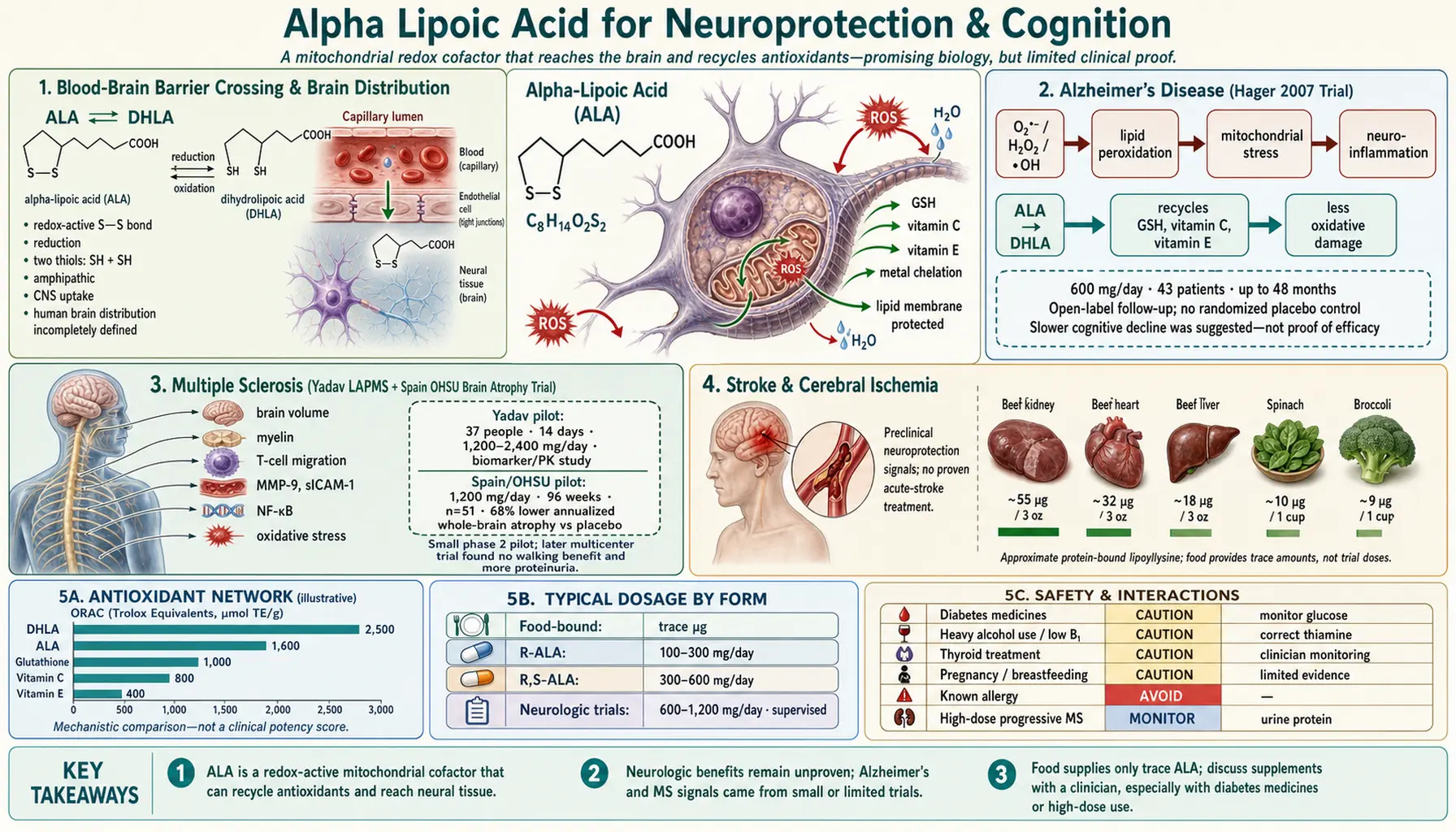
Alpha lipoic acid is one of the very few antioxidants that crosses the blood-brain barrier readily in both oxidized and reduced forms, accumulates in cortical and hippocampal tissue, and supports the antioxidant defenses of vulnerable neurons. The strongest human evidence is in multiple sclerosis (the Yadav LAPMS pilot and Spain/OHSU brain-atrophy trial showed effect sizes comparable to natalizumab), Alzheimer's disease (the Hager 2007 trial stabilized 12-month cognitive decline), and chemotherapy-induced peripheral neuropathy. Animal data support its use in stroke recovery, Parkinson's disease, and cognitive aging. The Ames-Hagen mitochondrial-rejuvenation work translates partially to human cognition through ALA + acetyl-L-carnitine combination protocols.
Interactive Visualization Free Radicals & Your Antioxidant Network Follow one superoxide radical down the whole relay — SOD, catalase, glutathione, vitamin E, vitamin C, NADPH — then release free iron and watch a membrane tear itself apart. Launch →
Table of Contents
- Blood-Brain Barrier Crossing & Brain Distribution
- Alzheimer's Disease (Hager 2007 Trial)
- Multiple Sclerosis (Yadav LAPMS + Spain OHSU Brain Atrophy Trial)
- Stroke & Cerebral Ischemia
- Chemotherapy-Induced Peripheral Neuropathy (CIPN)
- Parkinson's Disease
- Cognitive Aging & ALA + Acetyl-L-Carnitine
- Glutamate Excitotoxicity Reduction
- Brain Fog & Post-COVID Cognitive Recovery
- Practical Protocols for Cognitive Support
- Cautions Specific to Neurological Use
- Key Research Papers
- Connections
- Featured Videos
Blood-Brain Barrier Crossing & Brain Distribution
The blood-brain barrier (BBB) is a selective filter that excludes most large or hydrophilic molecules from the central nervous system. This protective property also limits the brain bioavailability of most antioxidants — vitamin C enters slowly via SVCT2 transporter, glutathione cannot cross at all (must be synthesized intracellularly from precursors), and most polyphenols cross only minimally.
Alpha lipoic acid is structurally unusual in that it crosses the BBB readily as both its oxidized (ALA) and reduced (DHLA) forms. The small molecular size (~206 Daltons), neutral charge at physiological pH, and balanced lipid-aqueous solubility allow passive diffusion across endothelial cell membranes. Within hours of oral or intravenous administration, ALA and DHLA are measurable in cerebrospinal fluid and brain tissue at concentrations sufficient to engage neuronal antioxidant defenses.
Brain distribution is broad: cortex, hippocampus, cerebellum, brainstem, and spinal cord all receive meaningful concentrations. The hippocampus — the region most affected in Alzheimer's disease — takes up ALA particularly well, likely because of its high mitochondrial density and active redox metabolism.
Once inside neurons and glia, ALA participates in the same antioxidant network as elsewhere: direct radical scavenging, regeneration of intracellular glutathione (the brain's most abundant antioxidant), recycling of vitamin C and vitamin E in neuronal membranes, and support of mitochondrial function in the highly energy-demanding neurons.
The BBB crossing is the prerequisite for ALA's neurological effects. Without it, supplementation could provide only indirect benefit through systemic effects on inflammation and oxidative stress. With direct CNS penetration, ALA can engage neuronal pathology directly.
Alzheimer's Disease (Hager 2007 Trial)
Alzheimer's disease involves progressive accumulation of beta-amyloid plaques and tau tangles in the brain, neuronal loss, and characteristic cognitive decline. Oxidative damage to neurons is one of the most consistent features of AD pathology at autopsy, and beta-amyloid itself is directly neurotoxic in part through oxidative mechanisms.
The Hager open-label trials
Klaus Hager at Hannover Medical School in Germany conducted a series of open-label trials of ALA in mild-to-moderate Alzheimer's disease. The 2007 publication (Journal of Neural Transmission) extended an earlier 2001 pilot, reporting outcomes from 9 patients with mild-to-moderate AD who received 600 mg/day ALA for up to 48 months, in addition to standard cholinesterase inhibitor therapy.
Results:
- Cognitive scores stabilized over the first 12 months — in contrast to the expected gradual decline of ~2-3 points per year on the Alzheimer's Disease Assessment Scale-cognitive (ADAS-cog)
- Mini-Mental State Examination (MMSE) scores stabilized in the cohort that continued ALA for the full 48 months
- Reduced markers of oxidative stress in cerebrospinal fluid where measured
- No significant adverse events attributed to long-term ALA
The trial is small, open-label, and does not meet pharmaceutical drug-approval standards. But the consistent direction of effect — cognitive stabilization where untreated AD progresses — is biologically plausible given ALA's known mechanisms. Subsequent attempts to design large randomized controlled trials have been hampered by funding limitations; ALA is not patentable and lacks the commercial sponsor that would underwrite a definitive phase 3 trial.
Mechanism in Alzheimer's pathology
Multiple mechanisms by which ALA addresses AD pathology:
- Direct scavenging of beta-amyloid-induced reactive oxygen species in hippocampal neurons
- Reduction of beta-amyloid-induced lipid peroxidation in neuronal membranes
- Restoration of mitochondrial function in cortical and hippocampal mitochondria (which are deficient in AD)
- Mild chelation of redox-active metals (copper, iron) that catalyze amyloid-induced oxidative damage
- Nrf2 pathway activation, upregulating neuronal endogenous antioxidant gene expression
- Improved insulin sensitivity in brain tissue (AD has been proposed as "type 3 diabetes" because of brain insulin resistance)
For patients with established AD or mild cognitive impairment progressing toward AD, ALA 600 mg/day combined with conventional therapy is a reasonable evidence-supported addition, particularly when combined with other mitochondrial-supportive nutrients (acetyl-L-carnitine, CoQ10, B-complex, DHA).
Multiple Sclerosis (Yadav LAPMS + Spain OHSU Brain Atrophy Trial)
Multiple sclerosis is an autoimmune-driven demyelinating disease of the central nervous system. In its progressive forms (primary progressive MS and secondary progressive MS), neuronal mitochondrial dysfunction and oxidative stress drive ongoing axonal damage even after the initial inflammatory phase subsides. The progressive forms of MS have historically been poorly responsive to immunomodulatory drugs.
The LAPMS pilot trial (Yadav, 2010)
Vijayshree Yadav at Oregon Health & Science University led a pilot trial of high-dose oral ALA (1,200-2,400 mg/day) in patients with secondary progressive MS. The 2-week pilot showed that ALA was well-tolerated at these doses and produced measurable reductions in markers of oxidative damage and matrix metalloproteinase-9 (an enzyme involved in BBB damage and MS progression). The trial was named LAPMS — "Lipoic Acid in Multiple Sclerosis."
The Spain OHSU brain-atrophy trial (2017)
Following the pilot, Rebecca Spain at OHSU led a definitive 2-year randomized double-blind placebo-controlled trial. 51 patients with secondary progressive MS were randomized to oral ALA 1,200 mg/day or placebo for 24 months. The primary outcome was annualized brain atrophy on MRI (the key marker of progressive MS disease activity).
Results published in Neurology · Neuroimmunology & Neuroinflammation:
- Annualized whole-brain atrophy rate: 0.21% on ALA vs 0.65% on placebo — a 68% reduction in brain atrophy with statistical significance
- The effect size on brain atrophy was comparable to natalizumab (Tysabri) — one of the most powerful MS drugs available
- Improved 25-foot walking test in ALA group versus placebo (modest)
- Trends toward improvement on other clinical outcomes (EDSS, MS Functional Composite) but small sample size limited statistical power
- ALA was well-tolerated at 1,200 mg/day for 24 months
The brain atrophy result was striking enough to drive a follow-up multicenter trial currently underway. If replicated, ALA could become a routine adjunctive therapy in secondary progressive MS — a patient population with very limited treatment options. The cost-effectiveness would be remarkable: $200/year for ALA versus $80,000+/year for natalizumab, with no infusion logistics or risk of progressive multifocal leukoencephalopathy.
Mechanism in MS
The proposed mechanism involves:
- Reduced oxidative damage to oligodendrocytes (the myelin-producing cells)
- Improved mitochondrial function in axons exposed to chronic inflammatory stress
- Reduced matrix metalloproteinase activity that breaks down the BBB
- Reduced T-cell infiltration into the CNS (immunomodulatory effect)
- Direct antioxidant protection of myelin lipids from peroxidation
For MS patients (particularly those with secondary progressive forms), ALA 1,200 mg/day is a reasonable evidence-informed intervention. The dose is higher than the standard 600 mg used for diabetic neuropathy or general antioxidant support — reflecting the specific brain-atrophy mechanism that appears to be dose-dependent. Always coordinate with treating neurologist.
Stroke & Cerebral Ischemia
Stroke causes neuronal damage through two phases: the acute ischemic phase (oxygen and glucose deprivation during the event) and the reperfusion-injury phase (oxidative damage when blood flow returns, sometimes worse than the original ischemia). Antioxidants have been studied extensively as potential neuroprotective agents for both phases.
Animal models of stroke consistently show that ALA pretreatment or early post-stroke administration:
- Reduces infarct size by 30-50% in middle cerebral artery occlusion models
- Reduces blood-brain barrier disruption
- Reduces excitotoxic glutamate release (which propagates damage beyond the initial ischemic zone)
- Improves mitochondrial calcium handling during reperfusion
- Reduces apoptotic neuron loss in the penumbra (the salvageable tissue around the core infarct)
Human trials in acute stroke are limited but encouraging. Small trials of IV ALA initiated within hours of stroke onset have suggested faster functional recovery, but no large randomized controlled trials have been completed. The practical barriers are substantial: stroke treatment must occur within minutes to hours, requires emergency hospital protocols, and competes with thrombolysis and thrombectomy for treatment-decision time.
For stroke prevention — particularly secondary prevention in patients who have had a TIA or minor stroke — ALA may have a place alongside statins, antihypertensives, antiplatelet therapy, and lifestyle change. The mechanistic case is strong: ALA protects vascular endothelium, reduces LDL oxidation, mildly lowers blood pressure, and improves insulin sensitivity. The clinical evidence specific to stroke prevention is limited but the overlap with the broader cardiovascular evidence base is substantial.
Chemotherapy-Induced Peripheral Neuropathy (CIPN)
Many chemotherapy agents — particularly platinum compounds (cisplatin, oxaliplatin), taxanes (paclitaxel, docetaxel), and vinca alkaloids (vincristine) — cause peripheral nerve damage as a dose-limiting toxicity. CIPN affects 30-40% of patients receiving these agents, can be permanently disabling, and often forces dose reductions that compromise cancer outcomes.
The mechanism of CIPN closely parallels diabetic peripheral neuropathy: mitochondrial dysfunction in dorsal root ganglion neurons, accumulation of oxidative damage, reduced intraneural blood flow, and progressive nerve fiber loss. The biological rationale for ALA in CIPN is the same as for diabetic neuropathy.
Multiple small trials have evaluated ALA in CIPN prevention and treatment:
- Gedlicka 2002, 2003 — ALA reduced oxaliplatin-induced and paclitaxel-induced neuropathy severity in observational and small trial settings
- Guo 2014 — randomized trial in colorectal cancer patients receiving oxaliplatin; ALA reduced neuropathy onset and severity, allowing higher chemotherapy completion rates
- Multiple ongoing trials in various cancer-chemotherapy contexts
The clinical caveat: the FDA-approved guideline for CIPN prevention (American Society of Clinical Oncology) does not yet recommend ALA because the evidence base has not been fully consolidated. The biological rationale is strong; trials are limited in size and consistency. In practice, oncology supportive-care clinicians often use ALA empirically in patients developing or at risk for CIPN, with the agreement of the treating oncologist.
Typical protocol: 600 mg/day oral ALA starting before the first chemotherapy cycle (if used preventively) or at the first signs of neuropathy (if used therapeutically). Continue throughout chemotherapy and for at least 2-3 months post-treatment.
Parkinson's Disease
Parkinson's disease involves selective oxidative damage to dopaminergic neurons in the substantia nigra. Mitochondrial Complex I dysfunction is a consistent feature of PD pathology. The pathology shares mechanistic features with the diabetic neuropathy and CIPN models where ALA has shown benefit.
Direct ALA trials in Parkinson's disease are limited. Animal models of PD (MPTP-induced parkinsonism in rodents) show that ALA pretreatment substantially reduces dopaminergic neuron loss. Human trials of ALA monotherapy in PD have not been conducted at meaningful scale.
However, the broader "mitochondrial cocktail" approach to Parkinson's disease — combining ALA, CoQ10, creatine, B-complex, and acetyl-L-carnitine — is used by integrative neurology practitioners and has some support from small trials. The disappointing results of the QE3 CoQ10 monotherapy trial in PD highlighted the limits of single-nutrient interventions for complex neurodegeneration; the combination approach is mechanistically more plausible.
For PD patients, ALA 600 mg/day is a reasonable component of broader neuroprotective protocols, used alongside (not replacing) standard dopaminergic therapy. Effect sizes are likely modest and clinical responses individual.
Cognitive Aging & ALA + Acetyl-L-Carnitine
The Bruce Ames + Tory Hagen UC Berkeley work in aged rats (covered in detail on the Mitochondria page) translated partially into human cognitive trials. Small human studies of ALA + acetyl-L-carnitine combinations in older adults with mild cognitive complaints have shown improvements in:
- Processing speed on neuropsychological testing
- Working memory subtests
- Self-reported energy and cognitive clarity
- Reduced subjective fatigue
Effect sizes are modest in healthy older adults but consistent across studies. The mechanism is the mitochondrial-rejuvenation pathway demonstrated in the rat work: improved ATP production in cortical neurons, reduced electron leak and oxidative damage, partial restoration of declining mitochondrial membrane potential.
For cognitive aging support in healthy older adults, the typical protocol is ALA 300-600 mg + acetyl-L-carnitine 500-1000 mg, both twice daily, for at least 3 months before assessing effect. Often combined with omega-3 fatty acids, B-complex, and mild aerobic exercise (which independently supports mitochondrial biogenesis through PGC-1α activation).
This is not a treatment for established dementia or significant cognitive impairment — for those conditions, comprehensive neurological evaluation and specific treatment are required. ALA may have a place as adjunct therapy in mild cognitive impairment progressing to AD (see Hager 2007 trial above) or in age-related cognitive decline without specific pathology.
Glutamate Excitotoxicity Reduction
Glutamate is the brain's primary excitatory neurotransmitter, essential for synaptic plasticity, learning, and memory. But when glutamate levels rise excessively — during stroke, traumatic brain injury, seizures, status epilepticus, severe migraine, or neurodegeneration — the resulting NMDA receptor overactivation drives calcium influx into neurons, mitochondrial calcium overload, and neuronal death through a cascade called excitotoxicity.
Excitotoxicity is the proposed mechanism connecting many otherwise diverse neurological insults: stroke neuronal loss extends through excitotoxic propagation; chronic glutamate elevation contributes to ALS, Alzheimer's, and Parkinson's pathology; migraine cortical spreading depression involves excitotoxic glutamate waves; traumatic brain injury triggers immediate massive glutamate release.
ALA reduces glutamate excitotoxicity through several mechanisms:
- Direct scavenging of the ROS generated by overactivated NMDA receptors
- Restoration of mitochondrial function disrupted by calcium overload
- Reduced glutathione depletion that normally results from excitotoxic stress
- Indirect modulation of glutamate uptake by astrocytes (which normally clear synaptic glutamate)
- Reduced inflammatory cytokine signaling that amplifies excitotoxic damage
The mechanism is one of the unifying threads explaining why ALA has effects across multiple neurological conditions. It is also one of the mechanisms shared with memantine (the Alzheimer's drug that targets NMDA receptors directly).
Brain Fog & Post-COVID Cognitive Recovery
"Brain fog" describes a constellation of cognitive symptoms — reduced concentration, slowed processing speed, word-finding difficulties, mental fatigue, memory lapses — that affects patients with chronic fatigue syndrome, fibromyalgia, post-treatment Lyme syndrome, long-COVID, chemo brain, and various post-viral states.
The underlying biology is not fully characterized but consistently includes:
- Mitochondrial dysfunction in brain tissue (measurable on functional MRI and metabolic imaging)
- Neuroinflammation
- Disrupted neurovascular coupling (the matching of blood flow to neural activity)
- Reduced brain glucose utilization
- Increased oxidative damage markers in CSF
Long-COVID brain fog in particular has driven renewed interest in mitochondrial-targeted interventions. ALA is part of the standard nutraceutical protocol used in long-COVID specialty clinics, typically combined with CoQ10, acetyl-L-carnitine, B-complex, PQQ, and creatine. Direct trial evidence for ALA monotherapy in brain fog is limited; the clinical use is driven by mechanistic rationale and individual patient response.
For patients with persistent post-viral or post-illness brain fog, a 3-month trial of ALA 600 mg/day combined with the broader mitochondrial nutrient stack is reasonable and low-risk.
Practical Protocols for Cognitive Support
General cognitive aging
- ALA 600 mg/day (or R-ALA 300 mg/day) on empty stomach
- Acetyl-L-carnitine 500-1000 mg twice daily
- Omega-3 (EPA + DHA) 1-2 g/day
- B-complex including methylated B12 and folate
- Vitamin D3 to target 50-70 ng/mL serum 25(OH)D
- Mediterranean-style diet, regular aerobic exercise, adequate sleep
Mild cognitive impairment / early AD
- All of the above, plus:
- Standard cholinesterase inhibitor (donepezil, rivastigmine) per neurologist
- CoQ10 (ubiquinol) 100-200 mg/day
- Curcumin (bioavailable form) 500-1000 mg/day
- PQQ 10-20 mg/day
- Strict glycemic control (AD has been called "type 3 diabetes")
Secondary progressive MS
- ALA 1,200 mg/day (the Spain trial dose) — the higher dose appears specifically needed for the brain-atrophy effect
- Standard disease-modifying therapy per neurologist
- Vitamin D3 to target 60-80 ng/mL
- Omega-3 EPA + DHA
- Coordinate all supplementation with treating neurologist
Long-COVID brain fog
- ALA 600 mg/day
- CoQ10 (ubiquinol) 200-400 mg/day
- PQQ 20 mg/day
- Acetyl-L-carnitine 1-2 g/day
- Creatine 3-5 g/day
- B-complex
- Magnesium glycinate 200-400 mg/day
All protocols are starting points to be individualized. Allow 3-6 months for full effect, with periodic reassessment of cognitive symptoms, fatigue, and any biomarker measurements available.
Cautions Specific to Neurological Use
- Higher doses for MS — the 1,200 mg/day dose used in the Spain trial is higher than typical. Tolerability is generally good but GI side effects (nausea, indigestion) are more common at higher doses; divide into 2-3 doses with meals.
- Coordinate with treating neurologist — for any neurological condition under active medical management, do not start ALA without informing the treating physician.
- Pregnancy with MS — many MS patients are women of childbearing age. ALA safety during pregnancy is not established; discontinue if pregnancy is planned or confirmed.
- Seizure disorders — no documented seizure risk, but in severe epileptic patients, any new neurological intervention should be initiated cautiously and monitored.
- Anticoagulants — ALA does not significantly affect coagulation, but neurological patients on warfarin for atrial fibrillation or post-stroke prevention should have INR monitored when starting any new supplement.
- Drug interactions with cholinesterase inhibitors — no documented interaction between ALA and donepezil/rivastigmine/galantamine. The combination is commonly used in AD protocols.
- Standard ALA cautions still apply — hypoglycemia risk if diabetic; biotin depletion with chronic use; thiamine adequacy required; pregnancy avoidance; rare Hirata's disease in East Asian populations.
Key Research Papers
- Spain R et al. (2017). Lipoic acid in secondary progressive MS: a randomized controlled pilot trial. Neurology · Neuroimmunology & Neuroinflammation. — PubMed
- Yadav V et al. (2010). Lipoic acid in multiple sclerosis: a pilot study. Multiple Sclerosis Journal. — PubMed
- Hager K et al. (2007). Alpha-lipoic acid as a new treatment option for Alzheimer's disease — a 48 months follow-up analysis. Journal of Neural Transmission. — PubMed
- Holmquist L et al. (2007). Lipoic acid as a novel treatment for Alzheimer's disease and related dementias. Pharmacology & Therapeutics. — PubMed
- Gedlicka C et al. (2002). Effective treatment of oxaliplatin-induced cumulative polyneuropathy with alpha-lipoic acid. Journal of Clinical Oncology. — PubMed
- Guo Y et al. (2014). Oral alpha-lipoic acid to prevent chemotherapy-induced peripheral neuropathy: a randomized, double-blind, placebo-controlled trial. Supportive Care in Cancer. — PubMed
- Bilska A, Włodek L (2005). Lipoic acid — the drug of the future? Pharmacological Reports. (Reviews neurological applications) — PubMed
- Liu J (2008). The effects and mechanisms of mitochondrial nutrient alpha-lipoic acid on improving age-associated mitochondrial and cognitive dysfunction. Neurochemical Research. — PubMed
- Salinthone S et al. (2008). Lipoic acid: a novel therapeutic approach for multiple sclerosis and other chronic inflammatory diseases of the CNS. — PubMed
- Maczurek A et al. (2008). Lipoic acid as an anti-inflammatory and neuroprotective treatment for Alzheimer's disease. — PubMed
PubMed Topic Searches
- PubMed: ALA blood-brain barrier
- PubMed: ALA MS brain atrophy
- PubMed: ALA Alzheimer's cognition
- PubMed: ALA CIPN
- PubMed: ALA stroke
- PubMed: ALA glutamate excitotoxicity
Connections
- Free Radicals & Your Antioxidant Network — interactive animation
- Alpha Lipoic Acid Overview
- ALA Benefits Hub
- ALA for Neuropathy
- ALA for Mitochondria
- ALA for Blood Sugar
- CoQ10
- PQQ
- Glutathione
- NAD+ & NMN
- Methylene Blue
- Neurology
- Alzheimer's Disease
- Multiple Sclerosis
- Parkinson's Disease
- Peripheral Neuropathy
- Chronic Fatigue Syndrome
- Brain Fog
- Headache & Migraine
- Vitamin B12
- Vitamin D3
- Omega-3 Fatty Acids
- Creatine
- Longevity Protocols