Alpha Lipoic Acid — Benefits Deep Dive
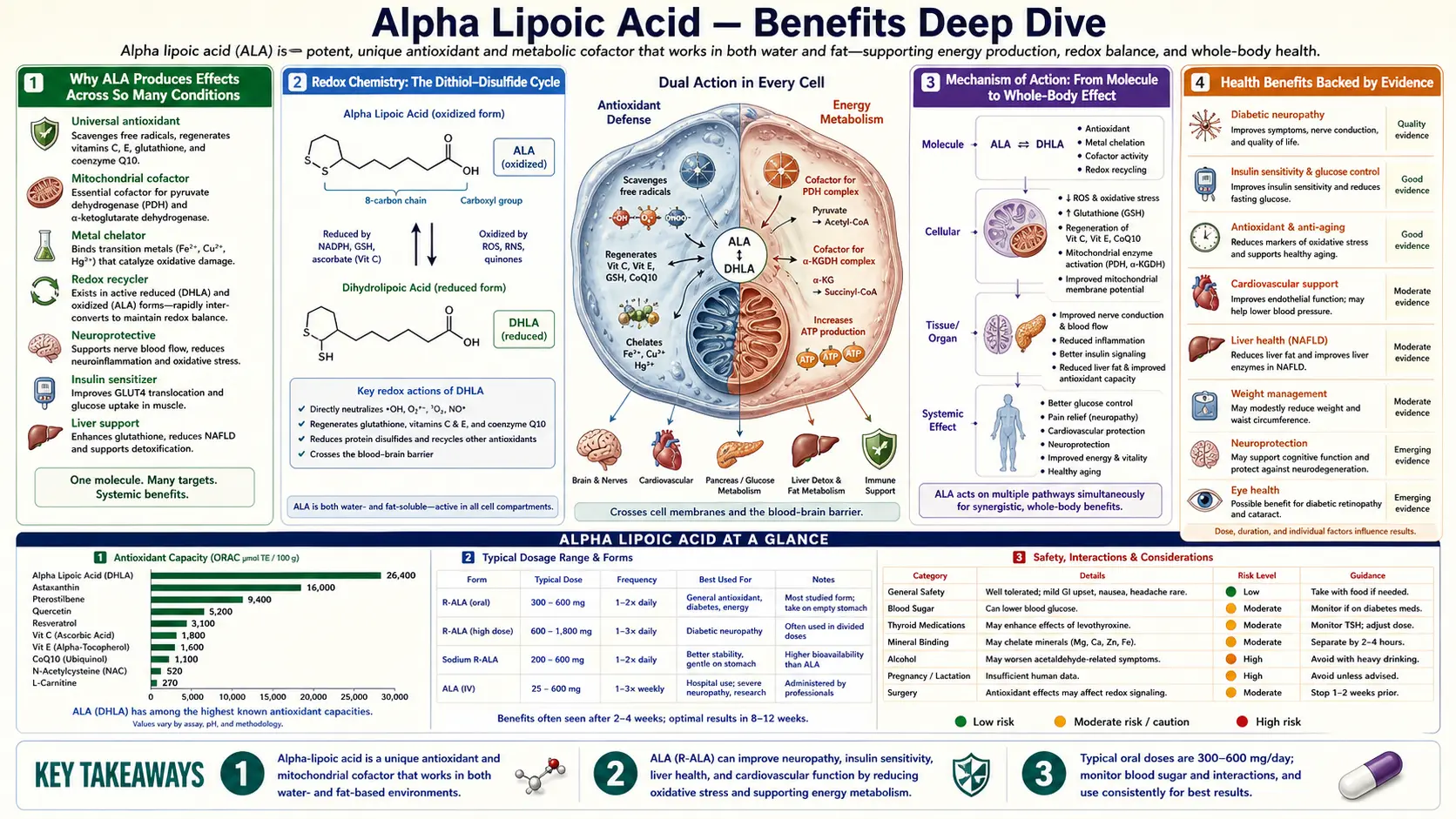
Alpha Lipoic Acid produces clinically meaningful effects across an unusually wide range of conditions because four distinct biochemical mechanisms operate simultaneously inside every cell: mitochondrial enzyme cofactor activity (PDH and α-KGDH lipoylation), antioxidant-network regeneration (vitamin C, vitamin E, glutathione, CoQ10 all recycled), heavy-metal chelation through its dithiol structure, and signaling effects on Nrf2, AMPK, and aldose reductase. Each benefit page below explores one specific therapeutic application in clinical-trial depth.
Deep-Dive Articles
Diabetic Peripheral Neuropathy
The headline indication. Prescription drug in Germany since 1966. Trial-by-trial deep dive through ALADIN I/II/III, SYDNEY 1/2, NATHAN 1 (4-year), DEKAN, ORPIL. IV vs oral protocols, when to choose each, week-by-week timeline for clinical response, and how ALA addresses all five hyperglycemia-damage pathways in peripheral nerve tissue.
Mitochondrial Function & Bioenergetics
Why ALA is the only molecule that is simultaneously an antioxidant AND a coenzyme for four mitochondrial enzyme complexes (PDH, α-KGDH, BCKDH, GCS). The Bruce Ames and Tory Hagen UC Berkeley aging research that reversed mitochondrial decline in old rats. ALA + acetyl-L-carnitine protocols for chronic fatigue, post-viral syndromes, and cognitive aging.
Blood Sugar & Insulin Sensitivity
The AMPK-activation mechanism that mimics exercise at the cellular level. GLUT4 translocation in skeletal muscle. Meta-analyses of HbA1c reduction (Han, Mijnhout). Practical combinations with berberine, metformin, and chromium for prediabetes and metabolic syndrome. The hypoglycemia caution that matters when adding ALA to insulin or sulfonylureas.
Neuroprotection & Cognition
ALA is one of the few antioxidants that crosses the blood-brain barrier readily in both oxidized and reduced forms. Deep dive into the Hager 2007 Alzheimer's trial, the Yadav LAPMS + OHSU multiple sclerosis trials (effect size comparable to natalizumab), stroke recovery data, and chemotherapy-induced peripheral neuropathy. Why ALA pairs naturally with acetyl-L-carnitine for cognitive aging.
Interactive Visualization Free Radicals & Your Antioxidant Network Follow one superoxide radical down the whole relay — SOD, catalase, glutathione, vitamin E, vitamin C, NADPH — then release free iron and watch a membrane tear itself apart. Launch →
Table of Contents
- Deep-Dive Articles
- Why ALA Produces Effects Across So Many Conditions
- Research Papers: Diabetic Neuropathy
- Research Papers: Mitochondria & Bioenergetics
- Research Papers: Blood Sugar & Insulin Sensitivity
- Research Papers: Neuroprotection & Cognition
- Research Papers: Cross-Cutting (Forms, Safety, Mechanism)
- External Authoritative Resources
- Connections
- Featured Videos
Why ALA Produces Effects Across So Many Conditions
Most nutraceuticals have one or two primary mechanisms of action that produce a narrow range of clinical effects. ALA is unusual because it operates through four distinct mechanisms simultaneously, and each of the four maps to a different category of clinical benefit:
- Mitochondrial enzyme cofactor — lipoylation of PDH, α-KGDH, BCKDH, and the glycine cleavage system supports ATP production at the rate-limiting steps of carbohydrate, fat, and protein oxidation. This mechanism drives effects on fatigue, cognitive energy, and cellular aging.
- Universal antioxidant network regenerator — the only molecule that recycles vitamin C, vitamin E, glutathione, and CoQ10 from their oxidized forms back to active forms. This drives effects on every condition where oxidative stress is a contributor — cardiovascular, neurodegeneration, aging, immunity.
- Aldose reductase inhibitor + intraneural blood flow — addresses the polyol pathway and microvascular dysfunction that cause diabetic peripheral neuropathy. This is the mechanism behind the German prescription approval and the ALADIN trial series.
- AMPK activator + GLUT4 translocator — mimics the metabolic signals of exercise in skeletal muscle, improving insulin-mediated glucose disposal and reducing the inflammatory oxidative stress that drives insulin resistance.
Additional mechanisms operate as well — heavy-metal chelation through the dithiol structure, Nrf2 pathway activation upregulating endogenous antioxidant genes, and blood-brain barrier crossing that enables central nervous system protection. The combination is why ALA shows up across diabetic complications, neurodegenerative disease, metabolic syndrome, hepatology, dermatology, and longevity research with a credible mechanistic story in each case.
Research Papers: Diabetic Neuropathy
- ALADIN I (Ziegler 1995, Diabetologia) — PubMed: ALADIN I 1995
- ALADIN II (Reljanovic 1999) — PubMed: ALADIN II
- ALADIN III (Ziegler 1999, Diabetes Care) — PubMed: ALADIN III
- SYDNEY 1 (Ametov 2003, Diabetes Care) — PubMed: SYDNEY 1 Ametov
- SYDNEY 2 (Ziegler 2006, Diabetes Care) — PubMed: SYDNEY 2 dose-response
- NATHAN 1 (Ziegler 2011, Diabetes Care) — the 4-year landmark trial — PubMed: NATHAN 1
- DEKAN trial (Ziegler 1997) — cardiac autonomic neuropathy — PubMed: DEKAN cardiac autonomic
- ORPIL trial — PubMed: ORPIL alpha lipoic acid
- Mijnhout meta-analysis (2012) — PubMed: Mijnhout meta-analysis
- Han meta-analysis (2012) — PubMed: Han meta-analysis
- ALA mechanism in diabetic nerve damage (5 pathways) — PubMed: ALA aldose reductase polyol pathway
- Intraneural blood flow and ALA — PubMed: ALA intraneural blood flow
Research Papers: Mitochondria & Bioenergetics
- Lipoylation of PDH and α-KGDH (mechanism) — PubMed: lipoylation PDH α-KGDH
- Bruce Ames + Tory Hagen aging research (PNAS 2002) — PubMed: Ames-Hagen aged rats PNAS
- ALA + acetyl-L-carnitine combination — PubMed: ALA + acetyl-L-carnitine combination
- ALA and mitochondrial membrane potential restoration — PubMed: ALA mitochondrial membrane potential
- ALA chronic fatigue syndrome trials — PubMed: ALA chronic fatigue syndrome
- ALA fibromyalgia trials — PubMed: ALA fibromyalgia
- Lipoic acid synthase (LIAS) and endogenous synthesis — PubMed: LIAS endogenous synthesis
- R-alpha lipoic acid vs racemic in mitochondrial function — PubMed: R-ALA mitochondrial function
- ALA and AMPK / mTOR pathway in skeletal muscle mitochondria — PubMed: ALA AMPK mTOR muscle
Research Papers: Blood Sugar & Insulin Sensitivity
- ALA and HbA1c meta-analyses — PubMed: ALA HbA1c meta-analyses
- ALA AMPK activation in skeletal muscle — PubMed: ALA AMPK skeletal muscle
- ALA GLUT4 translocation — PubMed: ALA GLUT4 translocation
- ALA insulin sensitivity in metabolic syndrome — PubMed: ALA insulin sensitivity HOMA-IR
- ALA fasting glucose reduction trials — PubMed: ALA fasting glucose
- ALA in prediabetes and impaired glucose tolerance — PubMed: ALA prediabetes
- ALA + berberine combination metabolic syndrome — PubMed: ALA + berberine combination
- ALA and hypoglycemia interaction with insulin / sulfonylureas — PubMed: ALA hypoglycemia interactions
- ALA and gestational diabetes — PubMed: ALA gestational diabetes
Research Papers: Neuroprotection & Cognition
- Hager 2007 Alzheimer's disease trial — PubMed: Hager AD trial 2007
- Yadav LAPMS multiple sclerosis pilot — PubMed: Yadav LAPMS MS pilot
- OHSU multiple sclerosis brain atrophy trial (Spain 2017) — PubMed: OHSU MS brain atrophy 2017
- ALA blood-brain barrier crossing pharmacokinetics — PubMed: ALA BBB crossing
- ALA stroke and cerebral ischemia (animal data) — PubMed: ALA stroke
- ALA chemotherapy-induced peripheral neuropathy (CIPN) — PubMed: ALA CIPN
- ALA in Parkinson's disease neuroprotection — PubMed: ALA Parkinson's
- ALA cognitive aging and processing speed — PubMed: ALA cognitive aging
- ALA + acetyl-L-carnitine cognitive function trials — PubMed: ALA + acetyl-L-carnitine cognition
- ALA glutamate excitotoxicity protection — PubMed: ALA glutamate excitotoxicity
Research Papers: Cross-Cutting (Forms, Safety, Mechanism)
- R-alpha lipoic acid vs racemic bioavailability — PubMed: R-ALA bioavailability
- Sodium R-lipoate (Na-R-ALA) stability — PubMed: Na-R-ALA stability
- Antioxidant recycling: ALA regenerates vitamin C, vitamin E, glutathione, CoQ10 — PubMed: ALA antioxidant recycling network
- ALA and Nrf2 pathway activation — PubMed: ALA Nrf2
- ALA heavy metal chelation (mercury, lead, arsenic) — PubMed: ALA heavy metal chelation
- Andy Cutler protocol (frequent low-dose oral ALA for mercury) — PubMed: Cutler protocol
- Insulin Autoimmune Syndrome (Hirata's disease) and ALA — PubMed: IAS Hirata HLA-DRB1*04:06
- ALA biotin interaction (long-term high dose) — PubMed: ALA biotin depletion
- ALA thiamine dependency (PDH activation) — PubMed: ALA thiamine PDH
- ALA safety profile across long-term use — PubMed: ALA long-term safety
External Authoritative Resources
- Linus Pauling Institute — Lipoic Acid Micronutrient Information Center — the single most authoritative scientific summary of ALA biology and clinical evidence, regularly updated
- NCCIH — Herbs and Supplements at a Glance
- MedlinePlus — Alpha Lipoic Acid
- PubMed — All research on alpha lipoic acid (~12,000 papers as of 2026)
Connections
- Free Radicals & Your Antioxidant Network — interactive animation
- Alpha Lipoic Acid (Main Page)
- ALA for Diabetic Neuropathy
- ALA for Mitochondrial Function
- ALA for Blood Sugar
- ALA for Neuroprotection
- All Antioxidants
- CoQ10
- Glutathione
- NAC
- Oxidative Stress
- Diabetes
- Peripheral Neuropathy
- Hemoglobin A1c
- Fasting Insulin