Methionine — Benefits Deep Dive
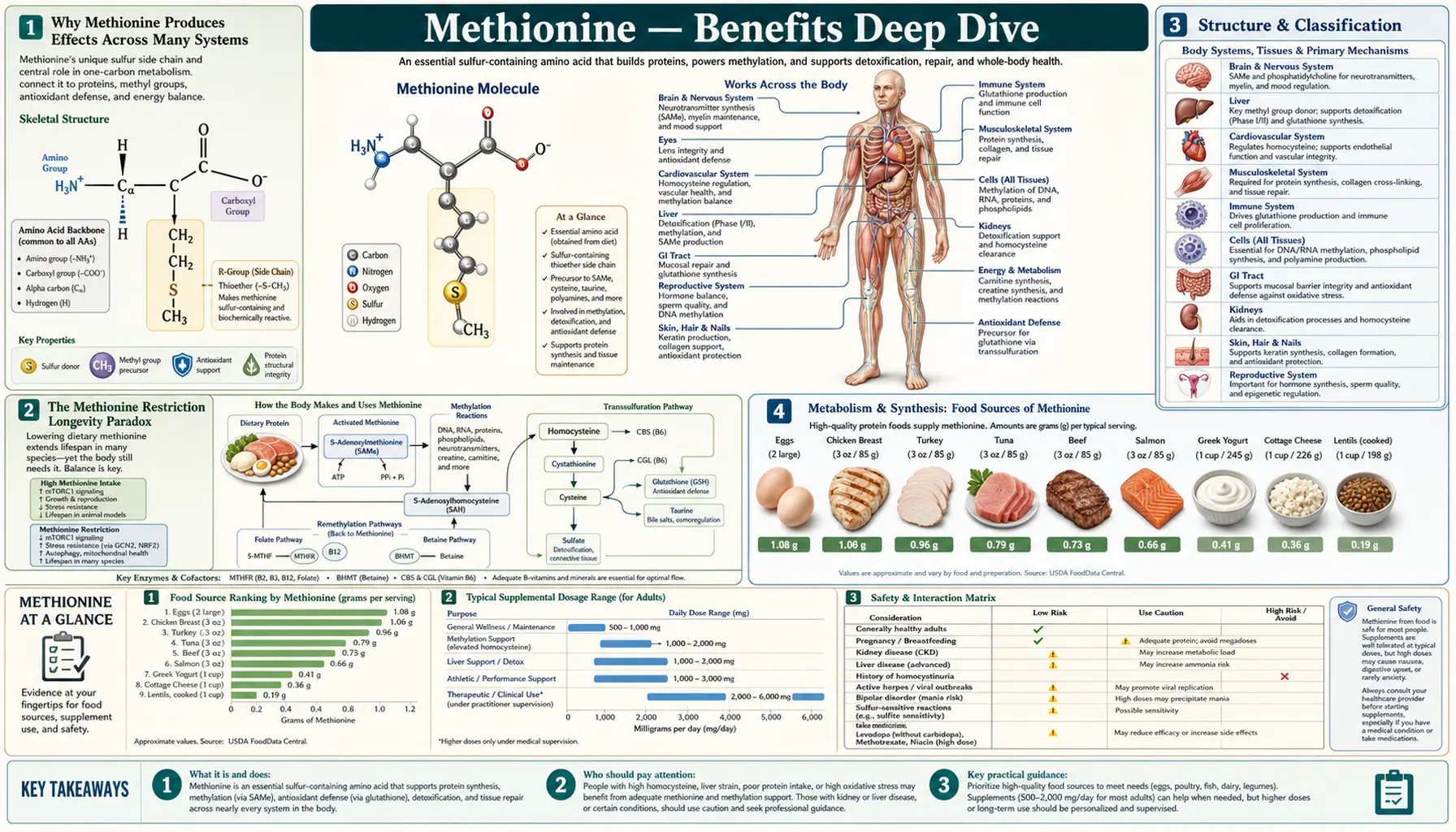
Methionine is the essential sulfur amino acid that sits at the upstream entry point for nearly every sulfur-dependent process in human biochemistry. As the precursor to S-adenosylmethionine (SAMe), it is the source of methyl groups for more than 200 distinct methyltransferase reactions that regulate gene expression, neurotransmitter synthesis, hormone clearance, and phospholipid production. As the gateway to the transsulfuration pathway, it supplies the cysteine that becomes glutathione (the master antioxidant), the metallothionein that binds heavy metals, the keratin that builds hair and nails, and the sulfated glycosaminoglycans that cushion joints. Methionine is also the textbook example of a limiting amino acid — the smallest-quantity amino acid in essentially every legume protein, making it the rate-limiting nutrient in plant-protein-dominant diets. And in a counterintuitive twist, decades of rodent longevity research suggest that dietary methionine restriction extends maximum lifespan by 30-45%, raising real questions about whether typical Western high-protein dietary patterns supply more methionine than is optimal for healthy aging. The four benefit pages below walk through each of these dimensions — the methylation pipeline, the liver-protective effects with SAMe clinical trials, the heavy-metal and Phase II detoxification chemistry, and the keratin/hair/nail nutrition story including the methionine-restriction longevity paradox.
Deep-Dive Articles
Methylation & SAMe
The full methionine cycle from methionine to SAMe to SAH to homocysteine and back, the 200+ SAMe-dependent methyltransferases, MTHFR and MTR remethylation enzymes, the obligate B12/folate/B6 cofactor requirements, DNA and histone methylation as the basis of epigenetics, neurotransmitter biosynthesis (epinephrine, melatonin, COMT-mediated catecholamine clearance), phosphatidylcholine via PEMT, and SAMe clinical trials in depression (Papakostas 2010 SSRI augmentation), liver disease, and osteoarthritis.
Liver Health
The Mato 1999 trial of SAMe in alcoholic cirrhosis (17 percentage-point mortality reduction in Child-Pugh A and B), the Ribalta 1991 trial of SAMe in intrahepatic cholestasis of pregnancy, the methionine-choline-deficient (MCD) diet as the dominant rodent model of NASH, PEMT-dependent phosphatidylcholine synthesis and VLDL export, hepatic glutathione and acetaminophen toxicity (NAC mechanism), and the methionine restriction longevity counterpoint in the context of hepatic methionine handling.
Detoxification
The methionine-cysteine-glutathione pipeline for Phase II conjugation, glutathione S-transferase (GST) enzymes and mercapturic acid excretion, metallothionein chemistry and acute heavy metal binding, the specific mechanisms for mercury/lead/cadmium, AS3MT-mediated arsenic methylation (folate trial data from Bangladesh), COMT-mediated estrogen clearance, HNMT-mediated histamine intolerance, and the sulfation/PAPS pathway built on cysteine catabolism through molybdenum-dependent sulfite oxidase.
Hair & Nails
Keratin biology with hair shaft proteins at 17% cysteine by composition, the disulfide crosslinking chemistry that underlies hair and nail mechanical strength (and that perm solutions exploit), methionine as the limiting amino acid in essentially every legume protein, PDCAAS and DIAAS protein quality scoring, why vegan diets often produce hair/nail concerns, the differential diagnosis of brittle nail syndrome and the major hair loss conditions, and the practical nutritional stack for keratin-tissue optimization.
Table of Contents
- Deep-Dive Articles
- Why Methionine Produces Effects Across Many Systems
- The Methionine Restriction Longevity Paradox
- Research Papers: Methylation & SAMe
- Research Papers: Liver Health
- Research Papers: Detoxification
- Research Papers: Hair & Nails
- Research Papers: Cross-Cutting (Restriction, Longevity, Safety)
- External Authoritative Resources
- Connections
- Featured Videos
Why Methionine Produces Effects Across Many Systems
Most amino acids contribute one principal function (most are simply protein building blocks; some have one named secondary signaling role such as glutamate as neurotransmitter or arginine as nitric oxide precursor). Methionine is unusual in operating through four distinct chemical mechanisms simultaneously, each of which has independent clinical consequences:
- Methyl group donation via SAMe — methionine is the metabolic source of S-adenosylmethionine, the donor for more than 200 methyltransferase enzymes including those that produce DNA methylation, histone methylation, neurotransmitters, phosphatidylcholine, creatine, and methylated steroid hormones. This is the mechanism behind the depression and mood applications, the SAMe clinical trial program, the MTHFR-and-methylation clinical paradigm, and the elevated-homocysteine cardiovascular story. See our Methylation and SAMe deep-dive for the full mechanism.
- Sulfur donation via transsulfuration to cysteine and glutathione — methionine's sulfur is irreversibly committed to cysteine through the cystathionine beta-synthase and cystathionine gamma-lyase enzymes, and the cysteine is then the rate-limiting precursor for glutathione synthesis. This is the mechanism behind the antioxidant defense, Phase II detoxification, heavy metal binding via metallothionein, and the acetaminophen-NAC clinical paradigm. See our Detoxification deep-dive.
- Direct incorporation into structural proteins — methionine is the initiating amino acid of every eukaryotic protein synthesis event (the methionine-tRNA recognizes the AUG start codon), and is incorporated into the primary sequence of every protein the body builds. In hair, nail, and skin specifically, methionine and its downstream cysteine are essential for the keratin protein family that constitutes most of the structural mass. See our Hair and Nails deep-dive.
- Lipotropic effect on hepatic phospholipid synthesis — via the PEMT pathway, methionine-derived SAMe provides the methyl groups for the conversion of phosphatidylethanolamine to phosphatidylcholine, which is the limiting step for hepatic VLDL assembly and triglyceride export. This is the mechanism behind the fatty liver and methionine-choline-deficient diet models, and behind the SAMe clinical trials in alcoholic liver disease and intrahepatic cholestasis. See our Liver Health deep-dive.
The integration of these four mechanisms is what makes methionine status so consequential across so many organ systems. Methionine deficiency simultaneously degrades methylation (mood, cognition, neurotransmitter clearance, epigenetic regulation), glutathione (oxidative stress and detoxification), keratin synthesis (hair, nail, skin quality), and hepatic lipid metabolism (fatty liver risk). Conversely, methionine repletion and SAMe supplementation can address all four pathways simultaneously, which is part of the rationale for SAMe as an integrative-medicine intervention with breadth of effect across multiple clinical indications.
The complication is the homocysteine intermediate. Adequate methionine flux through the methionine cycle produces homocysteine as an obligatory metabolite, and homocysteine accumulation is itself a cardiovascular risk factor and an indicator of impaired remethylation or transsulfuration. The clinical management implication is that methionine intake must be coupled to adequate B-vitamin cofactor status (B12, folate, B6) to ensure that the cycle completes and homocysteine does not accumulate.
The Methionine Restriction Longevity Paradox
An honest treatment of methionine's clinical significance must address the apparent paradox that decades of rodent dietary intervention studies have established methionine restriction as one of the most robust longevity interventions known in mammalian models. The original observation by Orentreich and colleagues in 1993 was that rats fed a methionine-restricted diet (0.17% methionine vs 0.86% in control chow) lived approximately 30% longer in mean lifespan and 40% longer in maximum lifespan. Subsequent independent studies in multiple rat and mouse strains (Miller 2005 in Aging Cell, several Buffenstein and Aiello laboratory studies, and the National Institute on Aging's Interventions Testing Program) have largely replicated the longevity effect.
Several mechanistic threads have been documented:
- FGF21 secretion from the liver — methionine restriction (and broader essential amino acid restriction) triggers hepatic FGF21 release, a metabolic hormone that increases insulin sensitivity, promotes fat oxidation, and may mediate part of the longevity effect
- Reduced mTORC1 signaling — methionine and leucine are the two amino acids most potent at activating the mTORC1 nutrient-sensing complex. Methionine restriction reduces mTORC1, which is downstream of essentially all known longevity interventions (caloric restriction, rapamycin, dietary protein restriction, intermittent fasting)
- Reduced mitochondrial reactive oxygen species production — methionine-restricted mitochondria produce less hydrogen peroxide at complex I, the principal source of age-related mitochondrial oxidative damage
- Improved insulin sensitivity — methionine restriction acutely improves hepatic and peripheral insulin sensitivity, often within days, even in established obese rodent models
- Epigenetic remodeling — the changed SAH/SAMe ratio under methionine restriction produces widespread changes in DNA methylation patterns and histone modifications, some of which align with patterns seen in longer-lived species
Whether methionine restriction extends healthspan in humans is unknown. Short-term human trials (typically 1-3 months) of methionine restriction via plant-protein-dominant or whey-isolate vegan diets show consistent metabolic improvements: reduced fasting insulin, lower fasting glucose, improved lipid profile, lower plasma methionine and homocysteine, and increased FGF21. The trials have not been long enough or large enough to detect lifespan or hard cardiovascular endpoints. The closest population-level data come from epidemiologic observations on plant-protein-dominant dietary patterns (Mediterranean, Okinawan, Adventist), which show favorable mortality and healthspan associations — though these patterns differ from controlled methionine restriction in many other variables.
The clinical synthesis for the practitioner and the patient is nuanced:
- For patients with existing methionine-pathway-dependent conditions (alcoholic liver disease, intrahepatic cholestasis, treatment-resistant depression with documented methylation impairment, established methionine deficiency from severely restricted protein intake or malabsorption) — the clinical evidence strongly supports methionine and SAMe pathway optimization. The longevity literature is not a reason to under-treat established disease.
- For otherwise healthy adults on typical Western high-protein dietary patterns — the longevity literature raises legitimate questions about whether 2-3 g/day of methionine (typical of animal-protein-heavy patterns) is optimal for healthy aging compared to 1.0-1.5 g/day. The conservative middle ground is moderate protein intake (0.8-1.2 g/kg/day) with a mix of animal and plant protein sources rather than predominantly animal or predominantly plant.
- For patients pursuing high-protein dietary patterns for body composition or athletic performance (carnivore diets, very-high-protein ketogenic patterns, bodybuilding cycles with 1.6-2.2 g/kg/day protein) — the rodent longevity literature suggests an underappreciated tradeoff. The acute benefits for body composition and metabolic markers may be offset by long-term effects on biological aging through mTORC1 activation. The data are not strong enough to discourage these patterns in adults who otherwise have clinical reasons to pursue them, but patients should know the question exists.
- For aging-focused interventions in healthy adults (longevity-focused supplementation, intermittent fasting, dietary protein cycling, rapamycin protocols off-label) — the methionine restriction literature is one of the more robust mechanistic foundations supporting moderate protein intake, periodic protein cycling, and a meaningful contribution of plant proteins in the dietary pattern.
The honest scientific position is that methionine restriction is a real and reproducible longevity intervention in rodents with substantial mechanistic basis, the human translation is biologically plausible but unproven at the lifespan/mortality endpoint level, and the appropriate clinical use of this information is to weight it against the equally real evidence that methionine-and-SAMe support is therapeutic in specific established disease states. A reasonable default for the otherwise healthy adult is moderate methionine intake (1.0-1.5 g/day) with adequate B-vitamin cofactors, with both higher and lower targets reserved for specific clinical indications.
Research Papers: Methylation & SAMe
- Cantoni GL (1953). S-adenosylmethionine: a new intermediate formed enzymatically from L-methionine and adenosinetriphosphate — PubMed: Cantoni 1953
- Selhub J (1999). Homocysteine metabolism (Annual Review of Nutrition) — PubMed: Selhub 1999
- Frosst P et al. (1995). MTHFR C677T common mutation (Nature Genetics) — PubMed: Frosst 1995
- Mucida D et al. (2007). Retinoic acid and Th17/Treg differentiation balance (Science) — PubMed: Mucida 2007
- Papakostas GI et al. (2010). SAMe augmentation of SSRIs in non-responder depression (American Journal of Psychiatry) — PubMed: Papakostas 2010
- Galizia I et al. (2016). SAMe for depression in adults (Cochrane Database of Systematic Reviews) — PubMed: Galizia 2016 Cochrane
- Sharma A et al. (2017). SAMe for neuropsychiatric disorders clinician review (Journal of Clinical Psychiatry) — PubMed: Sharma 2017
- Friso S et al. (2002). MTHFR-folate interaction on genomic DNA methylation (PNAS) — PubMed: Friso 2002
- Reik W (2007). Stability and flexibility of epigenetic gene regulation (Nature) — PubMed: Reik 2007
- Mato JM, Martínez-Chantar ML, Lu SC (2008). Methionine metabolism and liver disease (Annual Review of Nutrition) — PubMed: Mato 2008
- Lu SC, Mato JM (2012). SAMe in liver health injury and cancer (Physiological Reviews) — PubMed: Lu Mato 2012
- Stipanuk MH (2004). Sulfur amino acid metabolism (Annual Review of Nutrition) — PubMed: Stipanuk 2004
Research Papers: Liver Health
- Mato JM et al. (1999). SAMe in alcoholic liver cirrhosis multicenter RCT (Journal of Hepatology) — PubMed: Mato 1999
- Vance DE (2014). PEMT phospholipid methylation and NAFLD (Biochemistry and Cell Biology) — PubMed: Vance 2014
- Anstee QM, Goldin RD (2006). MCD diet mouse model of NASH (International Journal of Experimental Pathology) — PubMed: Anstee Goldin 2006
- Ribalta J et al. (1991). SAMe in intrahepatic cholestasis of pregnancy (Hepatology) — PubMed: Ribalta 1991
- Zhang L et al. (2017). UDCA and SAMe for ICP network meta-analysis (Hepatology Research) — PubMed: ICP meta-analysis
- Anstee QM, Day CP (2012). SAMe therapy in liver disease review (Journal of Hepatology) — PubMed: Anstee Day 2012
- Lieber CS (2002). SAMe for liver disorders treatment (American Journal of Clinical Nutrition) — PubMed: Lieber 2002
- Zeisel SH (2006). Choline critical role and dietary requirements (Annual Review of Nutrition) — PubMed: Zeisel 2006
- Corrales FJ et al. (1992). SAMe and intracellular thiol-disulfide redox equilibrium (Journal of Clinical Investigation) — PubMed: Corrales SAMe redox
- Hwang J et al. (2017). Acetaminophen-induced hepatotoxicity and NAC mechanism (Antioxidants Redox Signaling) — PubMed: APAP/NAC mechanism
- Day CP, James OF (1998). Steatohepatitis: a tale of two "hits"? (Gastroenterology) — PubMed: Day Two-Hit
- Sanyal AJ (2019). Past, present and future perspectives in NAFLD (Nature Reviews Gastroenterology & Hepatology) — PubMed: Sanyal NAFLD review
Research Papers: Detoxification
- Stipanuk MH (2004). Sulfur amino acid metabolism (Annual Review of Nutrition) — PubMed: Stipanuk transsulfuration
- Hayes JD, Flanagan JU, Jowsey IR (2005). Glutathione transferases (Annual Review of Pharmacology and Toxicology) — PubMed: Hayes GST review
- Klaassen CD, Liu J, Diwan BA (2009). Metallothionein and cadmium toxicity (Toxicology and Applied Pharmacology) — PubMed: Metallothionein/cadmium
- Bridges CC, Zalups RK (2005). Molecular mimicry and toxic metal transport (Toxicology and Applied Pharmacology) — PubMed: Bridges Zalups mimicry
- Vahter M (2002). Mechanisms of arsenic biotransformation (Toxicology) — PubMed: Vahter arsenic
- Gamble MV et al. (2006). Folate and arsenic methylation Bangladesh trial (American Journal of Clinical Nutrition) — PubMed: Gamble Bangladesh
- Yager JD, Davidson NE (2006). Estrogen carcinogenesis in breast cancer (NEJM) — PubMed: Yager NEJM 2006
- Tunbridge EM et al. (2006). COMT Val158Met cognition and psychosis (Biological Psychiatry) — PubMed: COMT Val158Met
- Maintz L, Novak N (2007). Histamine and histamine intolerance (American Journal of Clinical Nutrition) — PubMed: Maintz Novak histamine
- Klaassen CD, Reisman SA (2010). Nrf2 antioxidative response and liver (Toxicology and Applied Pharmacology) — PubMed: Nrf2 review
- Atmaca G (2004). Antioxidant effects of sulfur-containing amino acids (Yonsei Medical Journal) — PubMed: Atmaca 2004
- Townsend DM, Tew KD, Tapiero H (2003). The importance of glutathione in human disease (Biomedicine & Pharmacotherapy) — PubMed: Townsend 2003 GSH
Research Papers: Hair & Nails
- Schweizer J et al. (2007). Consensus nomenclature for mammalian keratins (Journal of Cell Biology) — PubMed: Schweizer 2007
- Rogers MA et al. (2006). Human hair keratin-associated proteins (International Review of Cytology) — PubMed: Rogers KAPs 2006
- Wolfram LJ (2003). Human hair physicochemical composite (Journal of the American Academy of Dermatology) — PubMed: Wolfram 2003
- Schaafsma G (2000). PDCAAS protein quality scoring (Journal of Nutrition) — PubMed: Schaafsma PDCAAS
- Mathai JK, Liu Y, Stein HH (2017). DIAAS values for dairy and plant proteins (British Journal of Nutrition) — PubMed: Mathai DIAAS
- Young VR, Pellett PL (1994). Plant proteins in human amino acid nutrition (American Journal of Clinical Nutrition) — PubMed: Young Pellett 1994
- Rushton DH (2002). Nutritional factors and hair loss (Clinical and Experimental Dermatology) — PubMed: Rushton 2002
- Trueb RM (2016). Serum biotin levels in women with hair loss (International Journal of Trichology) — PubMed: Trueb biotin 2016
- Mahajan VK et al. (2008). Brittle nail syndrome clinical and dermoscopic study (Indian Journal of Dermatology Venereology and Leprology) — PubMed: Brittle nail syndrome
- Famenini S et al. (2017). Demographics of women with female pattern hair loss and the effectiveness of spironolactone therapy (Journal of the American Academy of Dermatology) — PubMed: FPHL demographics
- Goluch-Koniuszy ZS (2016). Nutrition of women with hair loss during menopause (Przeglad Menopauzalny) — PubMed: Goluch-Koniuszy 2016
- Glynis A (2012). A double-blind placebo-controlled study evaluating the efficacy of an oral supplement in women with self-perceived thinning hair (Journal of Clinical and Aesthetic Dermatology) — PubMed: Glynis hair supplement trial
Research Papers: Cross-Cutting (Restriction, Longevity, Safety)
- Orentreich N et al. (1993). Low methionine ingestion by rats extends life span (Journal of Nutrition) — PubMed: Orentreich 1993
- Miller RA et al. (2005). Methionine-deficient diet extends mouse lifespan and slows aging (Aging Cell) — PubMed: Miller 2005
- Sanchez-Roman I, Barja G (2013). Regulation of longevity and oxidative stress by nutritional interventions: role of methionine restriction (Experimental Gerontology) — PubMed: Sanchez-Roman Barja 2013
- Lees EK et al. (2014). Methionine restriction restores a younger metabolic phenotype in adult mice with alterations in fibroblast growth factor 21 (Aging Cell) — PubMed: Lees FGF21 2014
- Plaisance EP et al. (2011). Short-term methionine restriction increases hepatic insulin sensitivity in human subjects (American Journal of Physiology) — PubMed: Plaisance human trial
- Cellarier E et al. (2003). Methionine dependency and cancer treatment (Cancer Treatment Reviews) — PubMed: Methionine cancer dependency
- Boschmann M et al. (2010). Postprandial energy expenditure and renal acid handling in healthy humans after intake of meat or protein supplementation (Journal of Nutrition) — PubMed: Boschmann meat trial
- McCarty MF, DiNicolantonio JJ, O'Keefe JH (2015). The low-methionine content of vegan diets may make methionine restriction feasible as a life extension strategy (Medical Hypotheses) — PubMed: McCarty vegan hypothesis
- Garlick PJ (2006). Toxicity of methionine in humans (Journal of Nutrition) — PubMed: Garlick methionine toxicity
- Brosnan JT, Brosnan ME (2006). The sulfur-containing amino acids: an overview (Journal of Nutrition) — PubMed: Brosnan sulfur overview
- Mota-Martínez MT et al. (2020). Methionine restriction extends lifespan but does not improve health-span (Geroscience) — PubMed: Methionine restriction healthspan
- WHO/FAO/UNU (2007). Protein and amino acid requirements in human nutrition. WHO Technical Report Series 935 — PubMed: WHO/FAO/UNU 2007
External Authoritative Resources
- Linus Pauling Institute — Micronutrient Information Center — comprehensive scientific resources on amino acid and B-vitamin biology
- NIH Office of Dietary Supplements — All Fact Sheets (covers SAMe and the methylation cofactors)
- WHO — Protein and Amino Acid Requirements in Human Nutrition (WHO Technical Report 935, 2007)
- MedlinePlus — SAMe (S-adenosylmethionine)
- MedlinePlus — Methionine
- PubMed — All research on Methionine (~30,000+ papers)
- PubMed — All research on SAMe (~15,000+ papers)
Connections
- All Amino Acids
- Methionine (Main Page)
- Methionine for Methylation and SAMe
- Methionine for Liver Health
- Methionine for Detoxification
- Methionine for Hair and Nails
- Cysteine
- Taurine
- Glycine
- Lysine
- Threonine
- N-Acetylcysteine (NAC)
- NAC & Glutathione
- Vitamin B6
- Vitamin B12
- Homocysteine Lab Test
- Sulfur
- Selenium
- Zinc
- Molybdenum and Detoxification
- Heavy Metals
- Detoxification
- Oxidative Stress
- Depression
- Fatty Liver Disease
- Organ Meats
- Collagen
- Creatine
- Eggs