Methionine: Food Sources & Daily Intake
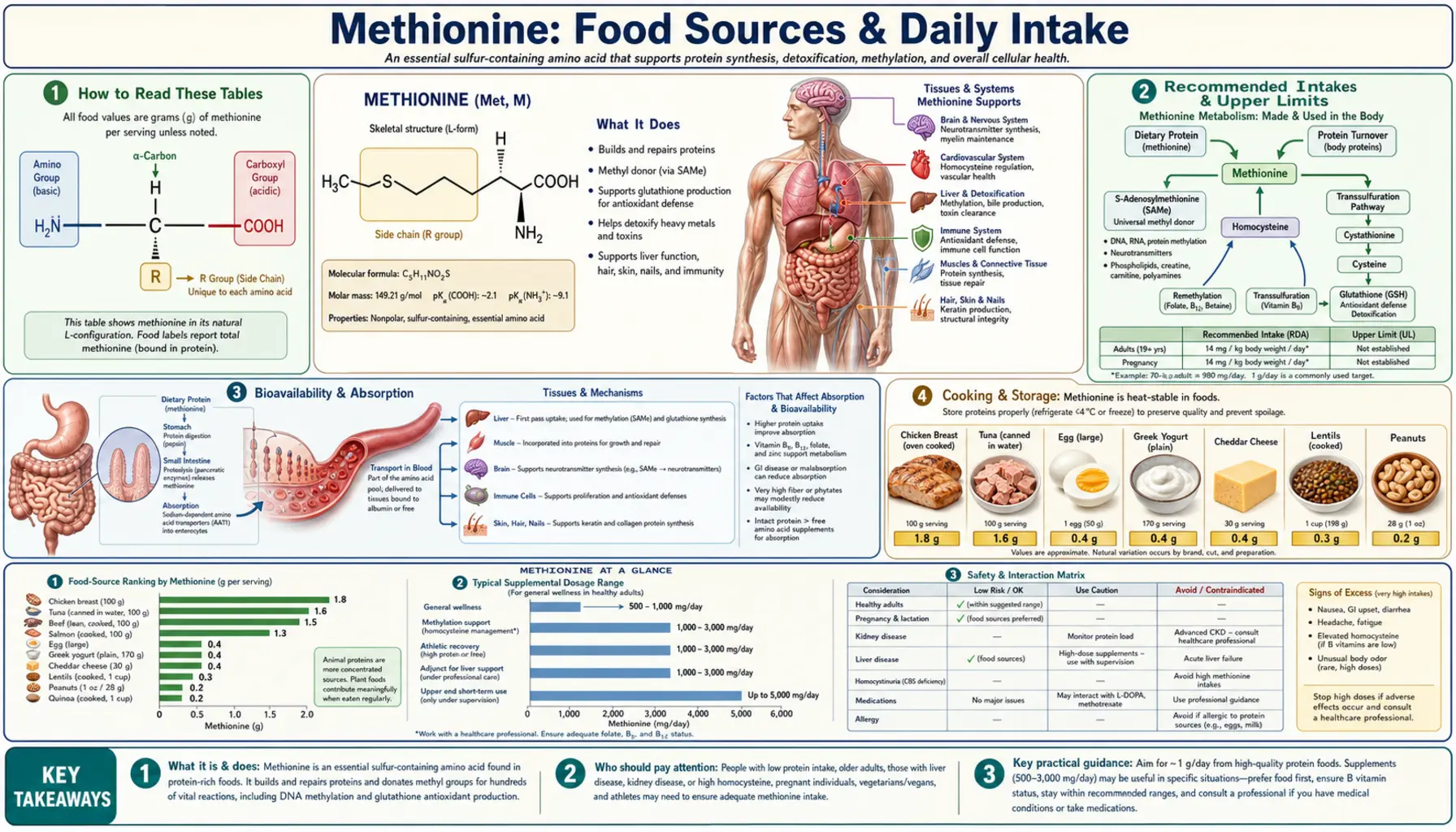
Methionine is an essential, sulfur-containing amino acid with three jobs that touch nearly every cell. It is the “start” signal that begins almost every protein the body builds. It is the precursor of SAMe (S-adenosylmethionine), the universal methyl donor that powers methylation reactions on DNA, proteins and neurotransmitters. And through the trans-sulfuration pathway it supplies the sulfur for cysteine and glutathione, the body’s master antioxidant. Because it is essential, the body cannot make it, so it must come from food. The richest sources are concentrated animal proteins — eggs, fish, poultry, meat and hard cheese — along with a few standout plant foods such as Brazil nuts, sesame and sunflower seeds. The table below shows grams of methionine per 100 g of food; there is no FDA Daily Value for individual amino acids, so amounts are absolute.
| Methionine: Food Sources & Daily Intake | |||||
|---|---|---|---|---|---|
| Rank | Food (serving) | Per 100 g | Glucose | Fructose | Notes |
| 1 | Egg (Dried) ~1/3 cup / 28 g | 🟢 1.5 g | 0.6 | 0 | Most concentrated; whole fresh egg is lower. |
| 2 | Brazil Nuts 1 oz / 28 g | 🟢 1.1 g | 0 | 0 | Top plant source of methionine. |
| 3 | Parmesan Cheese 1 oz / 28 g | 🟢 1.0 g | — | — | Concentrated dairy protein. |
| 4 | Salmon 3 oz / 85 g | 🟢 0.9 g | 0 | 0 | |
| 5 | Beef Meat 3 oz / 85 g | 🟢 0.8 g | 0 | 0 | |
| 6 | Tuna 3 oz / 85 g | 🟢 0.8 g | 0 | 0 | |
| 7 | Pork 3 oz / 85 g | 🟡 0.7 g | 0 | 0 | |
| 8 | Turkey Breast 3 oz / 85 g | 🟡 0.7 g | 0 | 0 | |
| 9 | Cod 3 oz / 85 g | 🟡 0.7 g | 0 | 0 | Lean, methionine-dense. |
| 10 | Chicken Organ Meats 3 oz / 85 g | 🟡 0.7 g | — | — | Nutrient-dense organ meat (giblets). |
| 11 | Halibut 3 oz / 85 g | 🟡 0.6 g | 0 | 0 | |
| 12 | Cheddar Cheese 1 oz / 28 g | 🟡 0.6 g | 0 | 0 | |
| 13 | Sesame Seeds 1 oz / 28 g | 🟡 0.6 g | — | — | Strong plant source. |
| 14 | Pork Organ Meats 3 oz / 85 g | 🟡 0.5 g | — | — | Nutrient-dense organ meat. |
| 15 | Sunflower Seeds 1 oz / 28 g | 🟡 0.5 g | — | — | |
| 16 | Beef Organ Meats 3 oz / 85 g | 🟡 0.5 g | — | — | Nutrient-dense organ meat. |
| 17 | Brown Rice 1 cup / 195 g | ⚪ 0.1 g | 0 | 0 | Common staple. |
Table of Contents
- How to Read These Tables
- Recommended Intakes & Upper Limits
- Bioavailability & Absorption
- Cooking & Storage
- Vegetarian & Vegan Sources
- Who Needs to Pay Attention
- Data Sources & References
- Connections
- Featured Videos
How to Read These Tables
- Essential sulfur amino acid. Your body cannot synthesize methionine, so a regular dietary supply matters — it is the only sulfur amino acid the diet must provide directly (the body can make cysteine from it, but not the reverse). The nine essential amino acids must come from food; the other eleven the body can build itself.
- Grams per 100 g, not %DV. There is no FDA Daily Value for individual amino acids, so this table reports the absolute grams per 100 g of food and ranks foods by that. A typical serving is shown beside each food.
- Complete vs incomplete protein. Animal foods are “complete” — they carry all the essential amino acids in good proportion and are methionine-dense. Legumes are the classic exception: methionine is their limiting amino acid, which is why beans pair so well with methionine-rich grains and seeds.
Recommended Intakes & Upper Limits
Your personal target depends on age, sex and pregnancy. The Daily Value used for the %DV column above is a single label figure; the table below is the age-specific guidance.
| Reference | Adult value | Notes |
|---|---|---|
| Essential? | Yes — essential (sulfur AA) | The body cannot make it; it must come from food. It is the only sulfur amino acid the diet must supply directly. |
| Adult requirement | ~10 mg/kg/day (15 with cysteine) | WHO/FAO/UNU 2007: ~10 mg/kg/day methionine alone, or ~15 mg/kg/day for total sulfur amino acids (methionine + cysteine). |
| ≈ for a 70 kg adult | ~700 mg/day | Easily met by a normal protein intake (~0.8 g protein/kg). |
| Why it matters | Methylation, SAMe & glutathione | Converted to SAMe (the body’s universal methyl donor) and to cysteine for glutathione; also initiates protein synthesis. |
Bioavailability & Absorption
Methionine from food is well absorbed as part of dietary protein. What matters most is total protein quality and quantity: animal proteins (eggs, fish, poultry, meat, dairy) are complete and methionine-rich, while legumes are naturally low in methionine and benefit from being combined with grains, nuts or seeds. A separate research note: scientists study methionine restriction — deliberately lowering dietary methionine — for its effects on metabolism and lifespan in animals, but this is an experimental research area, not a recommendation for healthy people, who simply need an adequate everyday supply.
Cooking & Storage
Amino acids are stable to ordinary cooking — methionine is not destroyed by normal heat, and cooking actually makes protein easier to digest. Methionine can be slowly oxidized by very high, prolonged heat or by exposure to air over long storage, but everyday cooking has little effect. No special handling is needed.
Vegetarian & Vegan Sources
Methionine is the one essential amino acid that takes real planning on a plant-based diet, because legumes — the staple plant protein — are naturally low in it (methionine is their limiting amino acid). The best plant sources are Brazil nuts, sesame and sunflower seeds, and whole grains, all of which are methionine-richer than beans. The classic, time-tested strategy is to combine legumes with grains and seeds across the day (think lentils with rice, hummus with bread, beans with seeds) — together they supply all the essential amino acids in good balance. Total protein simply needs to be a bit higher than for omnivores to comfortably reach the methionine target.
Who Needs to Pay Attention
Outright methionine deficiency is rare in anyone eating enough total protein; the people who should pay attention are those with low overall protein intake — some older adults, people recovering from illness, and very-low-calorie or poorly planned plant-based dieters. At the other end, methionine is metabolized through homocysteine, and clearing homocysteine safely depends on vitamins B6, B12 and folate. A diet that is high in methionine but short on those B vitamins can let homocysteine rise, which is why adequate B6/B12/folate matters alongside protein. High-dose methionine supplements are generally unnecessary for healthy people and should not be taken casually.
Data Sources & References
- NIH MedlinePlus — Amino acids
- Linus Pauling Institute — protein and essential amino acids
- PubMed — methionine, SAMe and methylation metabolism
- PubMed — methionine, homocysteine and B-vitamin status
Connections
- All Amino Acids
- Methionine (Main Page)
- Methionine Benefits
- Methionine History
- Cysteine
- Lysine
- Threonine
- Eggs