Glutamic Acid — Benefits Deep Dive
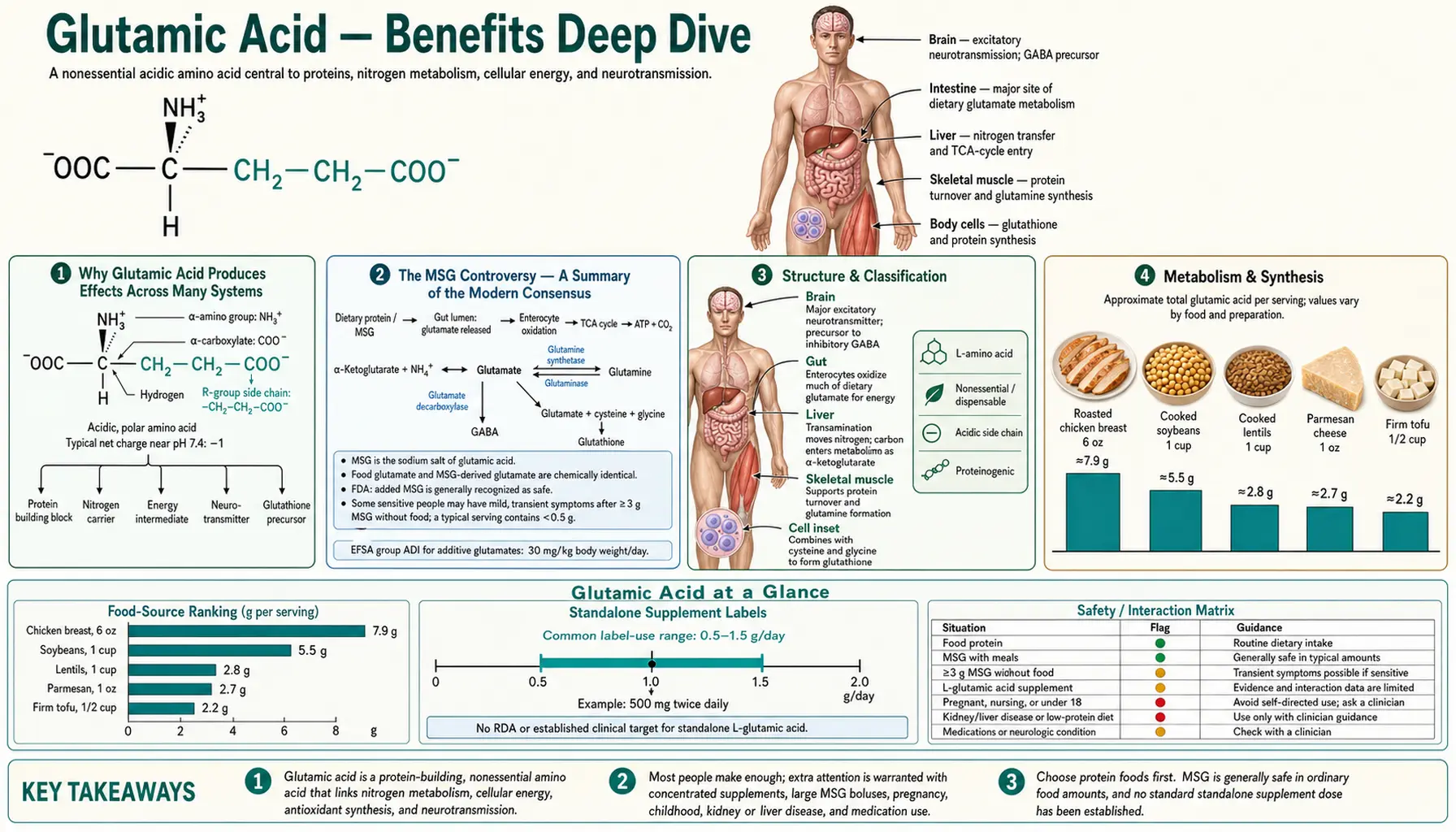
Glutamic acid is the single most metabolically connected molecule in the entire human body — the brain's major excitatory neurotransmitter (present at roughly half of all CNS synapses), the immediate biochemical precursor to GABA (the brain's major inhibitory neurotransmitter, made by removing one carboxyl group from glutamate via the PLP-dependent enzyme GAD), the universal nitrogen donor and acceptor of intermediary amino acid metabolism (essentially every transaminase uses glutamate / alpha-ketoglutarate as one substrate pair), and the umami molecule that lets the human tongue and gut detect protein content in food. Four deep-dive pages below explore each of these distinct roles — the neurotransmitter biology that drives learning and excitotoxicity, the GABA-synthesizing chemistry that vitamin B6 makes possible, the nitrogen flow that connects amino-acid catabolism to the urea cycle, and the controversial dietary saga of MSG from Ikeda's 1908 discovery through "Chinese Restaurant Syndrome" to the modern scientific consensus that MSG is safe at typical dietary intake.
Deep-Dive Articles
Neurotransmission & Excitatory Signaling
Glutamate as the brain's major excitatory neurotransmitter, present at roughly 50% of all CNS synapses. Ionotropic receptors (NMDA, AMPA, kainate) and metabotropic mGluR1-8. The NMDA receptor as molecular coincidence detector, long-term potentiation as the cellular basis of learning, the astrocyte glutamate-glutamine cycle, and the excitotoxic cascade that drives secondary damage in stroke, ALS, and Huntington's. NMDA-antagonist drugs — memantine for Alzheimer's, ketamine and esketamine for treatment-resistant depression, dextromethorphan combined with bupropion. Magnesium as the body's natural NMDA channel blocker.
GABA Production from Glutamate
The single-step enzymatic conversion of the brain's major excitatory neurotransmitter into its major inhibitory neurotransmitter by glutamic acid decarboxylase (GAD) using pyridoxal-5'-phosphate (PLP, the active vitamin B6) as essential cofactor. GAD65 (synaptic, phasic inhibition) vs GAD67 (cytoplasmic, tonic inhibition). GABA-A receptor pharmacology — benzodiazepines, barbiturates, alcohol, neurosteroids, and anesthetics all converge here. The autoimmune disorders that target GAD itself: stiff-person syndrome (anti-GAD65 essentially pathognomonic) and a substantial minority of type 1 diabetes.
Nitrogen Metabolism & the Urea Cycle
Glutamate as the universal nitrogen donor and acceptor of amino-acid metabolism. Transamination chemistry, ALT and AST as everyday clinical liver markers, glutamate dehydrogenase as the ammonia gateway, alpha-ketoglutarate cycling with the citric acid cycle, the brain's glutamate-glutamine cycle between astrocytes and neurons, the muscle-liver glutamine and alanine cycles, hepatic encephalopathy when the urea cycle fails, and the inborn errors of metabolism (OTC deficiency, citrullinemia, NAGS deficiency) that cause life-threatening hyperammonemia in neonates.
Glutamate, Umami & the MSG Controversy
Kikunae Ikeda's 1908 isolation of glutamate from kombu broth and the naming of umami as the "fifth taste." The T1R1+T1R3 umami receptor and its synergistic enhancement by IMP/GMP ribonucleotides. The 1968 Kwok letter to NEJM that launched "Chinese Restaurant Syndrome," decades of methodologically poor science, and the modern regulatory consensus (FDA GRAS, EFSA, JECFA) that MSG is safe at typical dietary intake. Natural high-glutamate foods (tomatoes, Parmesan, anchovies, shiitake, kombu, breast milk), MSG's role in sodium reduction, and the migraine-trigger signal in susceptible patients.
Table of Contents
- Deep-Dive Articles
- Why Glutamic Acid Produces Effects Across Many Systems
- The MSG Controversy — A Summary of the Modern Consensus
- Research Papers: Neurotransmission & Excitotoxicity
- Research Papers: GABA Synthesis & Anti-GAD Autoimmunity
- Research Papers: Nitrogen Metabolism & Urea Cycle
- Research Papers: Umami, MSG & the Safety Literature
- Research Papers: Cross-Cutting (Metabolism, Status, Safety)
- External Authoritative Resources
- Connections
- Featured Videos
Why Glutamic Acid Produces Effects Across Many Systems
Most amino acids occupy a single biochemical niche — tryptophan as the serotonin / melatonin precursor, tyrosine as the dopamine / norepinephrine / thyroid hormone precursor, histidine as the histamine precursor. Glutamic acid is unique in operating through at least four fundamentally different mechanisms, in three different molecular forms (free glutamic acid, ionized glutamate, and glutamine), across essentially every organ system. Each of these mechanisms maps to a distinct category of clinical effect:
- Direct neurotransmitter signaling (ionotropic NMDA, AMPA, kainate channels and metabotropic mGluR receptors) — glutamate is the brain's major fast excitatory neurotransmitter, mediating approximately 90% of fast synaptic transmission. This is the mechanism behind learning and long-term potentiation, the excitotoxic damage seen in stroke and ALS, and the entire NMDA-antagonist drug class. The drugs that act here include ketamine, memantine, dextromethorphan, lamotrigine, riluzole, and nitrous oxide.
- Neurotransmitter precursor function (glutamate → GABA) — the brain's GAD enzyme uses PLP (vitamin B6) as cofactor to convert glutamate into GABA, the major inhibitory neurotransmitter. This is the mechanism behind benzodiazepine pharmacology, the stiff-person syndrome anti-GAD autoimmune disorder, the GAD65 autoantibodies used to identify pre-clinical type 1 diabetes, and the pediatric pyridoxine-dependent epilepsy phenotype. The same single enzymatic step that makes a neuron GABAergic is the conversion that defines half of all CNS inhibitory circuits.
- Universal nitrogen carrier (transamination, glutamate dehydrogenase, urea cycle entry) — glutamate / alpha-ketoglutarate is the substrate pair of essentially every aminotransferase in the body, making glutamate the funnel through which dietary amino-acid nitrogen passes en route to urea synthesis or to new amino-acid biosynthesis. This is the mechanism behind ALT and AST as clinical liver markers, the urea cycle, hepatic encephalopathy, and the inborn errors of metabolism that cause life-threatening hyperammonemia. The brain's glutamate-glutamine cycle between astrocytes and neurons connects neurotransmitter recycling to whole-body ammonia handling in one tightly choreographed biochemical loop.
- Umami taste signaling (T1R1+T1R3 receptors on tongue and gut) — the dedicated taste receptor for free glutamate, with synergistic enhancement by 5'-ribonucleotides (IMP from meat, GMP from mushrooms). This is the mechanism behind the umami taste discovered by Ikeda in 1908, the entire MSG industry founded that same year, the satiety-promoting effect of high-protein meals, cephalic-phase digestive responses, and the long cultural controversy around "Chinese Restaurant Syndrome". Free glutamate signals protein content to the body and triggers preparation for amino-acid digestion.
The therapeutic complication is that the same molecule that drives learning can, when uncleared from extracellular space, kill the neurons it normally activates. This excitotoxicity is one of the final common pathways for stroke, traumatic brain injury, status epilepticus, ALS, and Huntington's disease. The body protects against this through extensive compartmentalization: the blood-brain barrier excludes peripheral glutamate, astrocyte transporters rapidly clear synaptic glutamate, and the urea cycle disposes of nitrogen waste before it can accumulate as toxic ammonia. The clinical practice of supporting glutamate-mediated functions is therefore largely about supporting the cofactors and recycling machinery (vitamin B6, magnesium, glutamine, alpha-ketoglutarate, intact liver function) rather than directly supplementing glutamate itself.
The MSG Controversy — A Summary of the Modern Consensus
Because the MSG story remains one of the most persistent food-safety myths in modern history, it deserves a summary callout on this hub page even though the full deep-dive is on the Glutamate & MSG page. The key points:
- Discovery (1908) — Kikunae Ikeda isolated glutamic acid from kombu seaweed broth at Tokyo Imperial University and identified it as the molecule responsible for the umami taste. He and Saburosuke Suzuki patented MSG manufacturing and founded Ajinomoto, which still produces most of the world's MSG today.
- The 1968 Kwok letter — physician Robert Ho Man Kwok sent a casual 257-word letter to the NEJM describing vague symptoms he experienced at Chinese restaurants, speculating that MSG might be one cause. This launched "Chinese Restaurant Syndrome" as a popular and medical concept, despite the letter providing no actual evidence and the symptoms being non-specific.
- Decades of poor science — early animal studies (Olney 1969) used non-dietary routes (subcutaneous injection in neonatal mice) and extremely high doses to produce neuronal lesions in brain regions outside the BBB. These findings were misrepresented as showing dietary MSG could damage adult human brains, which they did not show. Early human challenge studies were largely open-label, methodologically poor, and consistently failed to demonstrate a reproducible MSG-symptom syndrome under proper double-blind conditions.
- Modern scientific consensus — the FDA classifies MSG as Generally Recognized as Safe (GRAS, no ADI specified); the EFSA in 2017 set an ADI of 30 mg/kg/day; JECFA classifies MSG as "ADI not specified" (the most favorable safety classification). A small minority of self-identified sensitive individuals may experience mild, brief, self-limited symptoms at high doses of pure MSG taken on an empty stomach. There is no evidence of population-level harm at typical dietary intakes, and no evidence that dietary MSG causes brain excitotoxicity (because the BBB and enterocyte first-pass metabolism protect the brain from peripheral glutamate fluctuations).
- The migraine signal — the strongest evidence-based signal for any MSG effect is in the migraine population, where some controlled provocation studies have shown increased headache frequency with high-dose MSG challenge. Migraine patients who notice MSG as a personal trigger should avoid it; the general population need not.
- Cultural rehabilitation — in 2020 Merriam-Webster updated its definition of "Chinese Restaurant Syndrome" to acknowledge the term's origins in racism. Major chefs and food writers have publicly rehabilitated MSG in Western cuisine. The umami fifth taste is now standard curriculum in physiology classes after the 2000 discovery of the T1R1+T1R3 receptor.
- The biology — MSG-derived glutamate is biochemically identical to the free glutamate naturally present in tomatoes, Parmesan, mushrooms, anchovies, fish sauce, and breast milk. The body cannot distinguish between them. Total daily dietary glutamate intake is 10-20 grams from natural protein sources; added MSG typically contributes a small fraction of this background.
- Sodium reduction — MSG contains approximately one-third the sodium of table salt at equivalent palatability, making strategic MSG substitution one possible public-health strategy for reducing population sodium intake in processed foods.
The bottom line for clinical practice: respect individual sensitivities, recommend whole foods over heavily processed foods on general nutritional grounds, but do not categorically restrict MSG or recommend MSG-free diets as a population-level health intervention. The evidence does not support that approach.
Research Papers: Neurotransmission & Excitotoxicity
- Bliss TV, Lomo T (1973). Long-lasting potentiation of synaptic transmission in the dentate area of the anaesthetized rabbit. Journal of Physiology. — PubMed
- Olney JW (1969). Brain lesions, obesity, and other disturbances in mice treated with monosodium glutamate. Science. — PubMed
- Choi DW (1988). Glutamate neurotoxicity and diseases of the nervous system. Neuron. — PubMed
- Zarate CA et al. (2006). A randomized trial of an N-methyl-D-aspartate antagonist in treatment-resistant major depression. Archives of General Psychiatry. — PubMed
- Reisberg B et al. (2003). Memantine in moderate-to-severe Alzheimer's disease. NEJM. — PubMed
- Rothstein JD et al. (1995). Selective loss of glial glutamate transporter GLT-1 in amyotrophic lateral sclerosis. Annals of Neurology. — PubMed
- Hardingham GE, Bading H (2010). Synaptic versus extrasynaptic NMDA receptor signalling: implications for neurodegenerative disorders. Nature Reviews Neuroscience. — PubMed
- Nowak L et al. (1984). Magnesium gates glutamate-activated channels in mouse central neurones. Nature. — PubMed
- Bensimon G, Lacomblez L, Meininger V (1994). A controlled trial of riluzole in amyotrophic lateral sclerosis. NEJM. — PubMed
- Iadecola C, Anrather J (2011). The immunology of stroke: from mechanisms to translation. Nature Medicine. — PubMed
Research Papers: GABA Synthesis & Anti-GAD Autoimmunity
- Roberts E, Frankel S (1950). Gamma-aminobutyric acid in brain: its formation from glutamic acid. Journal of Biological Chemistry. — PubMed
- Erlander MG et al. (1991). Two genes encode distinct glutamate decarboxylases. Neuron. — PubMed
- Asada H et al. (1997). Cleft palate and decreased brain GABA in mice lacking the 67-kDa isoform of GAD. PNAS. — PubMed
- Solimena M et al. (1988). Autoantibodies to glutamic acid decarboxylase in stiff-man syndrome, epilepsy, and type I diabetes. NEJM. — PubMed
- Baekkeskov S et al. (1990). Identification of the 64K autoantigen in insulin-dependent diabetes as GAD. Nature. — PubMed
- Mills PB et al. (2006). Mutations in antiquitin in pyridoxine-dependent seizures. Nature Medicine. — PubMed
- Sigel E, Steinmann ME (2012). Structure, function, and modulation of GABA(A) receptors. JBC. — PubMed
- Meldrum BS (1989). GABAergic mechanisms in the pathogenesis and treatment of epilepsy. British Journal of Clinical Pharmacology. — PubMed
- Meltzer-Brody S et al. (2018). Brexanolone in postpartum depression: phase 3 trials. The Lancet. — PubMed
- Dalakas MC (2009). Stiff-person syndrome and related disorders. Nature Reviews Neurology. — PubMed
Research Papers: Nitrogen Metabolism & Urea Cycle
- Krebs HA, Henseleit K (1932). Untersuchungen über die Harnstoffbildung im Tierkörper. Klinische Wochenschrift. — PubMed
- Cooper AJ, Plum F (1987). Biochemistry and physiology of brain ammonia. Physiological Reviews. — PubMed
- Stanley CA et al. (1998). Hyperinsulinism and hyperammonemia in infants with regulatory mutations of GLUD1. NEJM. — PubMed
- Felig P (1973). The glucose-alanine cycle. Metabolism. — PubMed
- Newsholme P et al. (2003). Glutamine and glutamate as vital metabolites. Brazilian Journal of Medical and Biological Research. — PubMed
- Haussinger D et al. (2000). Hepatic encephalopathy in chronic liver disease: astrocyte swelling and low-grade cerebral edema. Journal of Hepatology. — PubMed
- Wise DR, Thompson CB (2010). Glutamine addiction: a new therapeutic target in cancer. Trends in Biochemical Sciences. — PubMed
- Dang L et al. (2009). Cancer-associated IDH1 mutations produce 2-hydroxyglutarate. Nature. — PubMed
- Heyland D et al. (2013). REDOXS trial — glutamine and antioxidants in critically ill patients. NEJM. — PubMed
- Tuchman M, Caldovic L et al. (2008). N-carbamylglutamate in NAGS deficiency. Pediatric Research. — PubMed
Research Papers: Umami, MSG & the Safety Literature
- Ikeda K (1909). On a new seasoning. Journal of the Chemical Society of Tokyo [translated]. — PubMed
- Kwok RH (1968). Chinese-restaurant syndrome. NEJM. — PubMed
- Geha RS et al. (2000). Review of alleged reaction to monosodium glutamate and outcome of a multicenter double-blind placebo-controlled study. Journal of Nutrition. — PubMed
- Chaudhari N et al. (2000). A metabotropic glutamate receptor variant functions as a taste receptor. Nature Neuroscience. — PubMed
- Nelson G et al. (2002). An amino-acid taste receptor. Nature. — PubMed
- Beyreuther K et al. (2007). Consensus meeting: monosodium glutamate — an update. European Journal of Clinical Nutrition. — PubMed
- EFSA Panel on Food Additives (2017). Re-evaluation of glutamic acid and salts as food additives. EFSA Journal. — PubMed
- Henry-Unaeze HN (2017). Update on food safety of monosodium L-glutamate. Pathophysiology. — PubMed
- Yamaguchi S, Ninomiya K (2000). Umami and food palatability. Journal of Nutrition. — PubMed
- Markel H (2018). The history of monosodium glutamate and "Chinese Restaurant Syndrome." JAMA. — PubMed
Research Papers: Cross-Cutting (Metabolism, Status, Safety)
- Brosnan JT, Brosnan ME (2013). Glutamate: a truly functional amino acid. Amino Acids. — PubMed
- Reeds PJ, Burrin DG, Stoll B, Jahoor F (2000). Intestinal glutamate metabolism. Journal of Nutrition. — PubMed
- Cooper AJ et al. (1979). The metabolic fate of 13N-labeled ammonia in rat brain. JBC. — PubMed
- Hawkins RA (2009). The blood-brain barrier and glutamate. American Journal of Clinical Nutrition. — PubMed
- Erecinska M, Silver IA (1990). Metabolism and role of glutamate in mammalian brain. Progress in Neurobiology. — PubMed
- Lieth E et al. (2001). The glutamate-glutamine cycle in retina. Investigative Ophthalmology and Visual Science. — PubMed
- Mazzio EA, Soliman KF (2003). Glutamate-dependent toxicity in neural systems. Neuroscience. — PubMed
- Hertz L (2013). The glutamate-glutamine cycle is not stoichiometric: fates of glutamate in brain. Journal of Neuroscience Research. — PubMed
- Stegink LD et al. (1986). Plasma glutamate concentrations in adult subjects ingesting monosodium glutamate. American Journal of Clinical Nutrition. — PubMed
- Walker R, Lupien JR (2000). The safety evaluation of monosodium glutamate. Journal of Nutrition. — PubMed
External Authoritative Resources
- NIH Office of Dietary Supplements — Fact Sheets (browse amino acids and related supplements)
- FDA — Questions and Answers on Monosodium Glutamate (MSG)
- EFSA — Re-evaluation of glutamic acid (E 620) and glutamate salts as food additives (2017)
- WHO / JECFA — Safety evaluation of certain food additives
- Umami Information Center (Tokyo-based educational organization on umami science and culinary history)
- MedlinePlus — Natural Products and Supplements
- PubMed — All research on glutamic acid / glutamate (over 200,000+ papers)
Connections
- All Amino Acids
- Glutamic Acid (Main Page)
- Neurotransmission & Excitatory Signaling
- GABA Production from Glutamate
- Nitrogen Metabolism & Urea Cycle
- Glutamate, Umami & MSG
- Glutamine (Astrocyte Recycling Partner)
- Glycine (NMDA Co-Agonist)
- Taurine
- Alanine (Alanine Cycle Partner)
- Aspartic Acid
- Arginine
- Proline
- Vitamin B6 (PLP Cofactor)
- Magnesium (Natural NMDA Blocker)
- MSG (Toxins Index)
- Anxiety
- Epilepsy
- Migraine
- Cirrhosis & Liver Disease
- NAC & Glutathione
- Gut-Brain Axis
- Stress Management
- Milk Thistle (Liver Support)