Vitamin A — Benefits Deep Dive
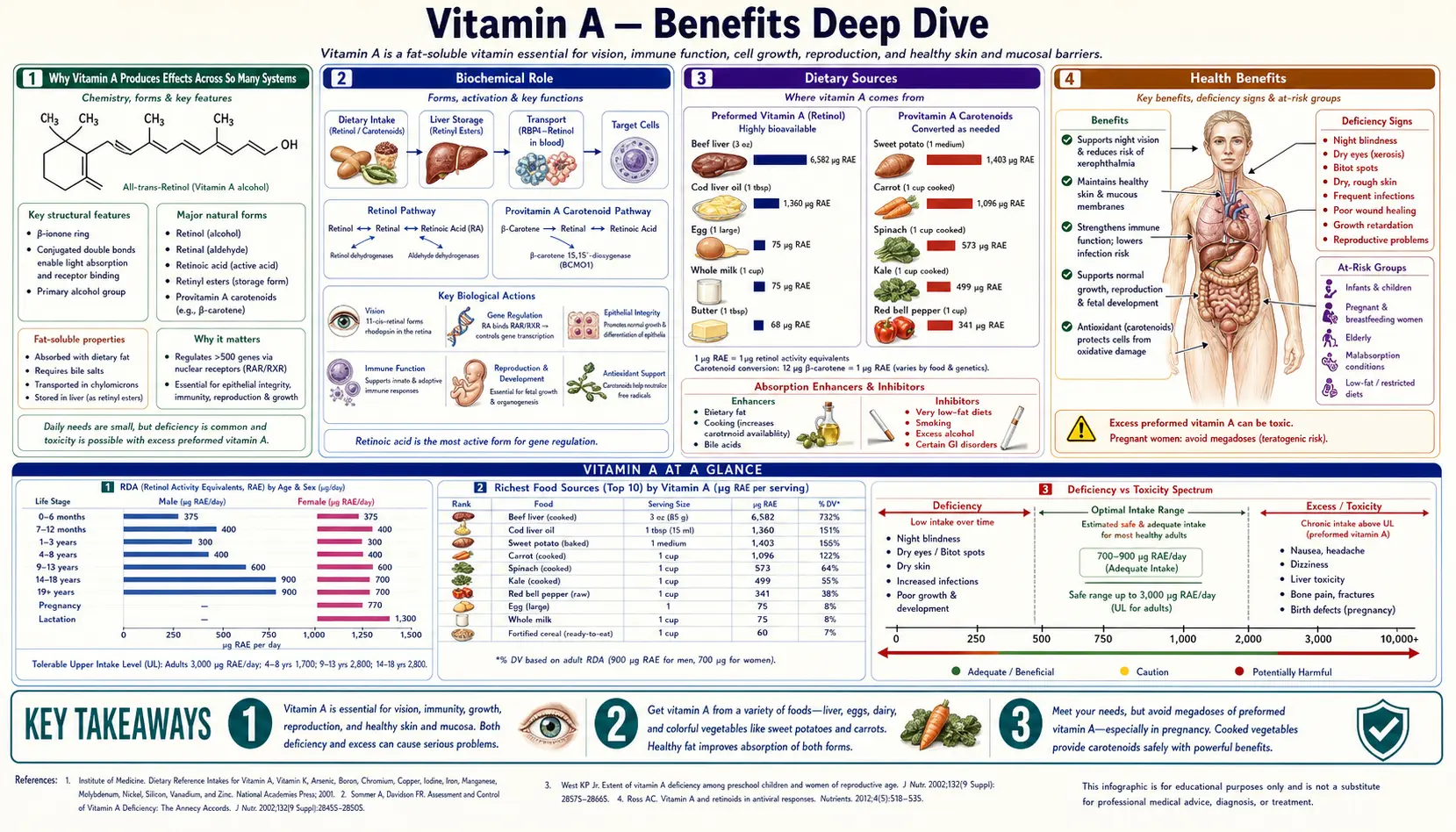
Vitamin A is the single fat-soluble vitamin most universally required across the major organ systems. It is the only molecule the human body uses both as a visual chromophore (11-cis-retinal in rhodopsin) and as a nuclear-receptor ligand (all-trans-retinoic acid binding RAR/RXR to regulate hundreds of genes). Four benefit pages below explore the conditions where Vitamin A produces the largest clinical effect — preventable blindness, immune-mediated infection mortality, dermatology and cellular differentiation disorders, and the metabolism that determines whether plant-source beta-carotene or animal-source retinol is the right choice for any given individual.
Deep-Dive Articles
Vision & Eye Health
The 11-cis-retinal rhodopsin cycle, night blindness (nyctalopia) as first deficiency sign, xerophthalmia and corneal melting in severe deficiency, Bitot's spots, the WHO finding that Vitamin A deficiency remains the leading preventable cause of childhood blindness, the AREDS / AREDS2 trials and the substitution of Lutein and Zeaxanthin for beta-carotene in the second-generation formulation.
Immune Function
Why Vitamin A is the original "anti-infective vitamin." T-cell maturation and Th17/Treg balance via retinoic acid signaling, mucosal immunity at the gut and respiratory epithelium, the WHO 2×200,000 IU measles protocol that halves mortality in deficient children, gut barrier integrity, and the deficiency-driven cascade that increases susceptibility to respiratory and diarrheal infection.
Skin & Cellular Differentiation
The retinoid mechanism in keratinocyte differentiation, topical tretinoin (Retin-A) for acne and photoaging, oral isotretinoin (Accutane) for severe nodulocystic acne, acitretin for psoriasis, the gentler retinaldehyde alternative, retinyl esters in OTC cosmetics, and the strict pregnancy contraindication for oral retinoids due to teratogenicity.
Beta-Carotene vs Preformed Retinol
The BCMO1 (beta-carotene oxygenase 1) enzyme converts plant beta-carotene to retinol with highly variable efficiency — ratios of 1:12 to 1:24 are typical, and common BCMO1 polymorphisms reduce conversion by ~40%. Why some individuals require preformed retinol from animal sources, the ATBC and CARET trial cautions for smokers (beta-carotene as pro-oxidant under high oxidative stress), upper-limit toxicity, liver storage kinetics, and teratogenicity.
Table of Contents
- Deep-Dive Articles
- Why Vitamin A Produces Effects Across So Many Systems
- Research Papers: Vision & Eye Health
- Research Papers: Immune Function
- Research Papers: Skin & Cellular Differentiation
- Research Papers: Forms, Conversion, and Toxicity
- Research Papers: Cross-Cutting (Mechanism, Status, Safety)
- External Authoritative Resources
- Connections
- Featured Videos
Why Vitamin A Produces Effects Across So Many Systems
Most vitamins act through one principal mechanism (water-soluble cofactors typically donate a chemical group to a specific enzyme reaction). Vitamin A is unusual because it operates through two fundamentally different mechanisms in two different molecular forms, and a third role as substrate for the visual chromophore. Each of the three maps to a distinct category of clinical effect.
- Photochemistry (11-cis-retinal in rhodopsin) — the retinal isomer covalently bound to opsin in retinal rod cells absorbs a photon and isomerizes to all-trans-retinal, initiating the visual transduction cascade. This mechanism drives the eye-health effects: night blindness, xerophthalmia, and the dose-dependent reversibility of early deficiency-driven vision loss.
- Nuclear-receptor signaling (all-trans-retinoic acid binding RAR/RXR) — retinoic acid binds to the retinoic acid receptor (RAR) family of nuclear transcription factors, which heterodimerize with retinoid X receptor (RXR) and bind retinoic acid response elements (RAREs) in promoter regions of hundreds of target genes. This is the mechanism behind epithelial differentiation, the topical and oral retinoid drug class, and the teratogenicity warning, and behind much of the immune-modulating effect on T-cell maturation and Th17/Treg balance.
- Mucosal epithelial maintenance — the same retinoic acid signaling that drives skin keratinocyte differentiation also maintains the mucosal epithelium of the gut, lungs, conjunctiva, and reproductive tract. Loss of mucosal integrity is the unifying mechanism that links Vitamin A deficiency to increased respiratory and diarrheal infection mortality in deficient populations.
The therapeutic complication is that the same molecule can produce two distinct toxicity syndromes: acute hypervitaminosis A (headache, nausea, increased intracranial pressure, peeling skin) from a single megadose, and chronic hypervitaminosis A (hepatotoxicity, bone loss, alopecia) from sustained intake above approximately 3,000 mcg RAE per day. Most consequentially, retinoic acid at high concentration is a known teratogen — the reason oral isotretinoin requires monthly pregnancy testing under the iPLEDGE program in the United States. The fourth deep-dive page explores why the form of Vitamin A matters as much as the dose: provitamin A carotenoids are converted to retinol on demand by the BCMO1 enzyme, with built-in regulatory feedback that prevents toxicity, while preformed retinol bypasses that feedback and accumulates in the liver.
Research Papers: Vision & Eye Health
- WHO global prevalence of Vitamin A deficiency and childhood blindness — PubMed: WHO childhood blindness
- Sommer A, classic field trials on Vitamin A and child mortality (Indonesia) — PubMed: Sommer Indonesia trials
- 11-cis-retinal and the rhodopsin visual cycle — PubMed: 11-cis-retinal rhodopsin cycle
- Xerophthalmia classification and clinical staging (WHO X1A through XS) — PubMed: WHO xerophthalmia staging
- AREDS original trial (Age-Related Eye Disease Study, AREDS Research Group 2001) — PubMed: AREDS 2001
- AREDS2 trial (Lutein/Zeaxanthin substituted for beta-carotene) — PubMed: AREDS2
- Vitamin A supplementation and reduction of childhood mortality (Cochrane review) — PubMed: Cochrane child mortality
- Night blindness (nyctalopia) as earliest sign of Vitamin A deficiency — PubMed: Nyctalopia and deficiency
- Vitamin A supplementation in pregnancy and maternal night blindness (Nepal trial) — PubMed: Nepal maternal trial
- Retinal pigment epithelium and the RPE65 enzyme in the visual cycle — PubMed: RPE65 visual cycle
Research Papers: Immune Function
- WHO 200,000 IU twice-dose protocol for measles in children — PubMed: WHO measles protocol
- Hussey GD et al., Vitamin A and measles mortality reduction (NEJM 1990) — PubMed: Hussey NEJM 1990
- Retinoic acid and Th17 / Treg differentiation balance — PubMed: RA Th17/Treg balance
- Vitamin A and gut-associated lymphoid tissue (GALT) homing of T cells — PubMed: RA gut-homing T cells
- Vitamin A in respiratory infection: meta-analysis — PubMed: Respiratory infection meta-analysis
- Vitamin A and diarrheal disease mortality reduction — PubMed: Diarrheal disease mortality
- Mucosal IgA production and Vitamin A status — PubMed: Secretory IgA
- Retinoic acid and dendritic cell function in mucosal immunity — PubMed: RA dendritic cells
- Natural killer cell function and Vitamin A — PubMed: NK cells and Vitamin A
- Vitamin A deficiency and HIV mother-to-child transmission research — PubMed: HIV vertical transmission
Research Papers: Skin & Cellular Differentiation
- Tretinoin (all-trans-retinoic acid) for acne vulgaris — PubMed: Topical tretinoin for acne
- Isotretinoin (Accutane) for severe nodulocystic acne — PubMed: Isotretinoin for acne
- Acitretin and oral retinoids for psoriasis — PubMed: Acitretin for psoriasis
- Topical retinoid mechanism: RAR/RXR nuclear receptor signaling — PubMed: RAR/RXR keratinocyte signaling
- Tretinoin for photoaging: Kligman classic trial — PubMed: Kligman photoaging trial
- Retinaldehyde as a gentler alternative to tretinoin — PubMed: Retinaldehyde topical
- Retinyl palmitate and retinyl esters in cosmetic formulations — PubMed: Retinyl ester cosmetics
- iPLEDGE program and isotretinoin teratogenicity prevention — PubMed: iPLEDGE program
- Bexarotene (RXR-selective retinoid) for cutaneous T-cell lymphoma — PubMed: Bexarotene CTCL
- ATRA (all-trans-retinoic acid) for acute promyelocytic leukemia — PubMed: ATRA for APL
Research Papers: Forms, Conversion, and Toxicity
- BCMO1 (beta-carotene-15,15'-monooxygenase) and central cleavage mechanism — PubMed: BCMO1 central cleavage
- BCMO1 genetic polymorphisms reducing conversion efficiency (Lietz, Hickenbottom) — PubMed: BCMO1 polymorphisms
- Beta-carotene to retinol conversion ratio (1:12 plant matrix; 1:24 leafy greens) — PubMed: Conversion ratio
- ATBC trial (alpha-tocopherol beta-carotene cancer prevention study) — PubMed: ATBC trial
- CARET trial (beta-carotene and retinol efficacy trial in smokers) — PubMed: CARET trial
- Hypervitaminosis A and hepatotoxicity case series — PubMed: Hepatotoxicity
- Vitamin A teratogenicity (Lammer 1985 NEJM) — PubMed: Lammer NEJM 1985
- Retinyl palmitate vs retinyl acetate bioavailability — PubMed: Palmitate vs acetate
- Hepatic stellate cell storage of retinyl esters — PubMed: Stellate cell storage
- Vitamin A and bone loss / osteoporosis at high chronic intake — PubMed: Retinol and bone loss
Research Papers: Cross-Cutting (Mechanism, Status, Safety)
- Retinol-binding protein (RBP4) and serum Vitamin A transport — PubMed: RBP4 transport
- Vitamin A status assessment: serum retinol limitations and relative dose response (RDR) — PubMed: Status assessment
- Vitamin A and zinc interaction (zinc required for RBP synthesis) — PubMed: A × zinc interaction
- Vitamin A and Vitamin D synergy / antagonism at the receptor level — PubMed: A × D receptor interaction
- Vitamin A, K2, and D triumvirate in calcium metabolism — PubMed: A/D/K2 triumvirate
- Fat malabsorption and Vitamin A deficiency (celiac, Crohn's, pancreatic insufficiency) — PubMed: Malabsorption
- Cystic fibrosis and fat-soluble vitamin deficiency — PubMed: CF and Vitamin A
- Vitamin A and thyroid hormone (T3 / RXR heterodimer signaling) — PubMed: A and thyroid
- Cod liver oil and combined Vitamins A and D historical evidence — PubMed: Cod liver oil history
- Linus Pauling Institute comprehensive Vitamin A review — PubMed: LPI review
External Authoritative Resources
- Linus Pauling Institute — Vitamin A Micronutrient Information Center — the single most authoritative scientific summary of Vitamin A biology, regularly updated
- NIH Office of Dietary Supplements — Vitamin A Fact Sheet (Health Professionals)
- WHO — Vitamin A Deficiency Fact Sheet (global epidemiology, supplementation programs)
- MedlinePlus — Vitamin A
- PubMed — All research on Vitamin A / retinol (~140,000+ papers)
Connections
- All Vitamins
- Vitamin A (Main Page)
- Vitamin A for Vision & Eye Health
- Vitamin A for Immune Function
- Vitamin A for Skin & Cellular Differentiation
- Beta-Carotene vs Preformed Retinol
- Vitamin D3
- Vitamin K2
- Vitamin E
- Zinc
- Macular Degeneration
- Acne
- Organ Meats (Beef Liver)
- Immune Boosting
- Sweet Potatoes (Beta-Carotene)
- Kale