Vitamin A: History and Discovery
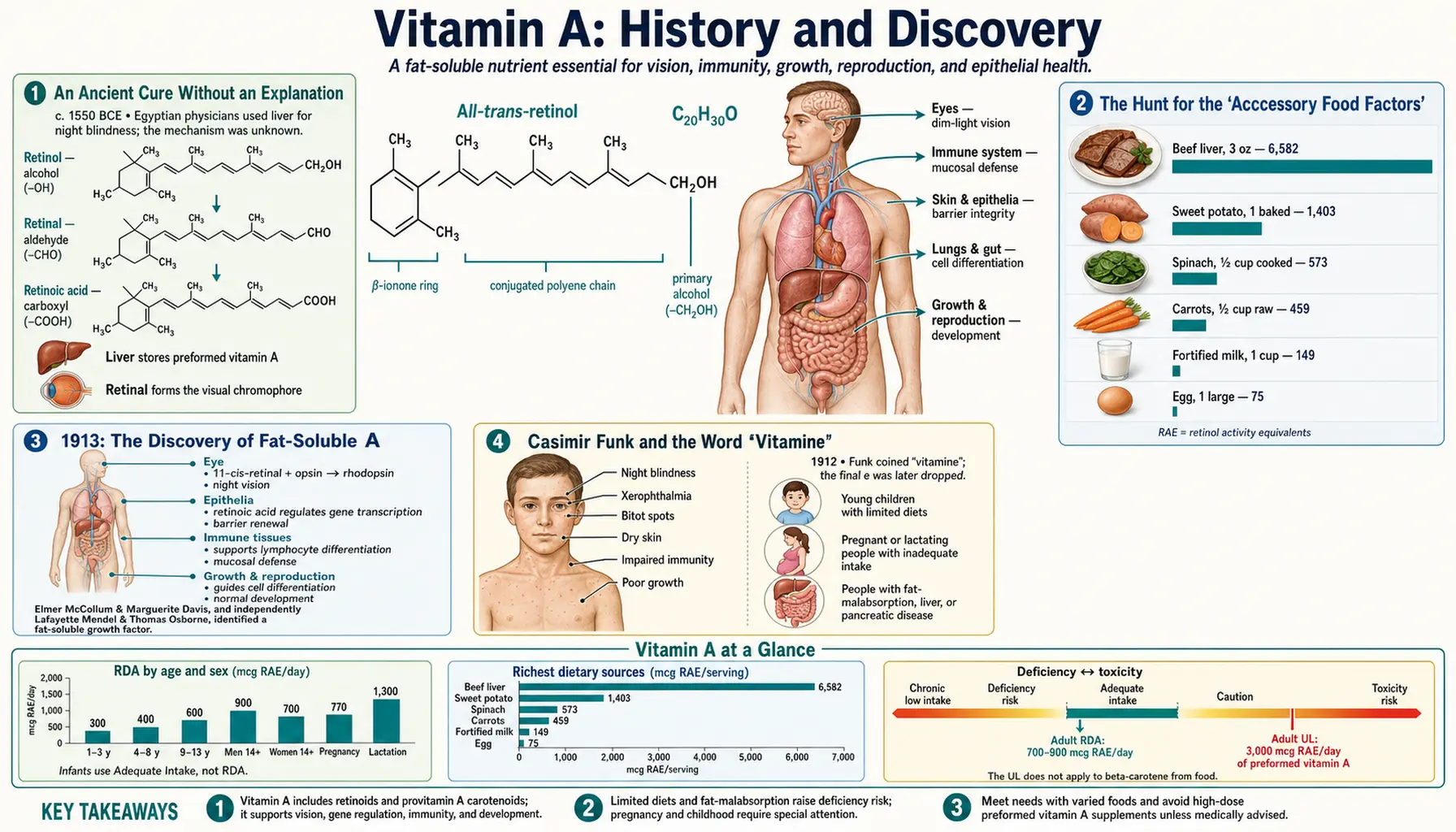
More than three thousand years before anyone knew what a vitamin was, physicians had already stumbled onto a cure for one of its deficiency diseases. Healers in ancient Egypt, Babylon and Greece — faced with patients who went blind as the sun went down — reached for animal liver, and it worked. They could not have said why. The answer would not arrive until the twentieth century, when one of the great races of nutritional science unfolded: rival teams at Wisconsin and Yale identifying a mysterious "fat-soluble" growth factor in 1913, a Polish chemist coining the word "vitamine," and a string of chemists eventually isolating, naming, drawing and finally synthesising the molecule we now call retinol — work that earned at least two Nobel Prizes. This article tells that story as the documented record actually supports it, naming the real people who did the work and flagging where credit is genuinely shared.
Table of Contents
- An Ancient Cure Without an Explanation
- The Hunt for the "Accessory Food Factors"
- 1913: The Discovery of Fat-Soluble A
- Casimir Funk and the Word "Vitamine"
- How "Fat-Soluble A" Became "Vitamin A"
- From Carotene to Crystal: Structure and Naming the Molecule
- George Wald and the Chemistry of Sight
- Making It in the Factory: Synthesis and Public Health
- Research Papers and References
- Connections
- Featured Videos
An Ancient Cure Without an Explanation
The earliest chapter of vitamin A's history is a chapter about a single, dramatic symptom: night blindness — the inability to see in dim light. It is one of the first signs of vitamin A deficiency, and because it is so distinctive, ancient physicians noticed it long before anyone could explain it. The remarkable thing is that they also found a remedy that genuinely works.
The Ebers Papyrus, an Egyptian medical text usually dated to around 1500 BC, records the use of roasted ox liver for an eye complaint. Centuries later the Greeks took up the same idea: the tradition associated with Hippocrates (roughly 460–370 BC) recommended eating liver — in one version, raw beef liver soaked in honey — for night blindness. According to a historical review by H. A. Al Binali in the journal Heart Views, the ancient Egyptians, the Babylonians, the Greeks and many cultures after them all used animal liver to treat the condition. We now know exactly why this worked: liver is the body's storehouse for vitamin A, and feeding it to a deficient patient simply replaced what was missing.
It is worth being clear about what this ancient record is and is not. These healers had discovered an effective treatment through observation, but they had no concept of a vitamin, of deficiency, or of the chemistry involved — they did not "discover vitamin A." What they left us is something subtler and rather wonderful: more than a thousand years of evidence that a specific food cured a specific blindness, a clue that the scientists of the early twentieth century would finally be able to read.
The Hunt for the "Accessory Food Factors"
For most of the nineteenth century, scientists believed food could be fully accounted for by its protein, fat, carbohydrate, minerals and water. The idea that a healthy diet might also need tiny amounts of some additional, unknown substances took a long time to take hold. The French physiologist François Magendie noted as early as 1816 that dogs fed restricted diets developed corneal ulcers and died — an observation that, in hindsight, points straight at vitamin A deficiency, though he could not interpret it that way at the time.
The decisive groundwork came later. In the 1880s the Russian physician Nikolai Lunin, working in Switzerland, showed that mice could not survive on the purified building blocks of milk alone — something else in whole milk was essential for life. In 1906 the English biochemist Frederick Gowland Hopkins argued for the existence of "accessory food factors," minute dietary components without which animals failed to thrive. (Hopkins would later share the 1929 Nobel Prize in Physiology or Medicine for this line of work.) And in 1909–1912 the German researcher Wilhelm Stepp demonstrated that whatever this essential factor was, it could be removed from food by dissolving it out with fat solvents — in other words, it was fat-soluble.
This was the intellectual stage on which vitamin A was found. By around 1912 a handful of researchers were convinced that ordinary food contained unidentified, vitally important substances, that at least one of them dissolved in fat, and that its absence caused disease. What no one had yet done was pin a specific factor to a specific source and a specific deficiency. That is what happened next.
1913: The Discovery of Fat-Soluble A
The event most often called the discovery of vitamin A took place in 1913, and it happened twice at once — in two American laboratories working independently. At the University of Wisconsin, the biochemist Elmer V. McCollum and his colleague Marguerite Davis were running careful feeding experiments on rats. At Yale, Thomas B. Osborne and Lafayette B. Mendel were pursuing the same question. Both teams found the same thing: rats fed fats such as lard or olive oil failed to grow and sickened, while rats given butterfat or egg yolk thrived. Something essential for growth was present in animal fats like butter but missing from lard and most plant oils.
This is a textbook example of simultaneous independent discovery, and the credit is genuinely shared rather than disputed. As the historian of nutrition Richard Semba documents in his review "On the ‘discovery’ of vitamin A," both groups reached the conclusion at essentially the same time, and their papers appeared in the same period in the Journal of Biological Chemistry. By most accounts McCollum and Davis submitted their manuscript a few weeks ahead of the Yale team, which is why McCollum's laboratory is most often named first — but the honest picture is of two teams arriving together. Semba makes the larger point well: the full characterisation of vitamin A unfolded over roughly 130 years and involved many hands, so it is more accurate to speak of vitamin A's discovery as a process than to crown a single discoverer.
McCollum gave the new factor a deliberately modest, non-committal name. Rather than claim to know what it was, he labelled it by where it was found and the letter he assigned to it: "fat-soluble A," to distinguish it from a separate "water-soluble B" factor (the future B vitamins) that he and others were also tracking. That simple alphabetical bookkeeping — A for the fat-soluble factor, B for the water-soluble one — is the origin of the letter that has named this vitamin ever since.
Casimir Funk and the Word "Vitamine"
The familiar word itself comes from a different scientist and a different deficiency disease. In 1912, the Polish-born biochemist Casimir Funk (Kazimierz Funk), then working at the Lister Institute in London, isolated a concentrate from rice husks that could relieve beriberi — a disease of the nerves and heart caused, we now know, by lack of thiamine (vitamin B1). Believing the curative substances were chemical compounds called amines that were essential to life, Funk fused the Latin vita ("life") with "amine" and proposed the term "vitamine." He set out the idea in a 1912 paper, "The etiology of the deficiency diseases," in the Journal of State Medicine, where he argued that several distinct vitamines existed, each preventing a specific deficiency disease such as beriberi, scurvy, pellagra and rickets.
Two clarifications keep this part of the story accurate. First, Funk did not discover vitamin A; his concentrate was aimed at beriberi, a B-vitamin deficiency. His lasting contribution to vitamin A's history is conceptual and linguistic: he gave the whole emerging field its name and a powerful unifying idea — that a class of trace dietary substances prevents a class of diseases. Second, his chemistry was not quite right. As later work showed, not all of these substances are amines — vitamin A, for one, is not — which set up the small but famous change of spelling described in the next section.
How "Fat-Soluble A" Became "Vitamin A"
For a few years the field used two parallel vocabularies: McCollum's practical "fat-soluble A" and "water-soluble B," and Funk's evocative "vitamine." The modern name is a merger of the two, and the person who engineered it was the British biochemist Jack Cecil Drummond.
In 1920, Drummond proposed a tidy compromise. He suggested dropping the final "e" from vitamine — precisely because, as had become clear, not all of these factors are amines and the "-amine" ending was misleading — leaving the chemically neutral word "vitamin." He then proposed keeping McCollum's convenient letters to tell the individual vitamins apart. The fat-soluble factor that McCollum and the Yale group had found in 1913 thus became vitamin A; the water-soluble factor became vitamin B; and the anti-scurvy factor then being defined became vitamin C. (The terms "fat-soluble A" and "vitamin A" are usually dated to about 1918 and 1920 respectively.)
This is why the vitamin carries a bare letter rather than a descriptive chemical name: the letter is a historical fossil from McCollum's 1913 laboratory shorthand, preserved by Drummond's 1920 nomenclature and never replaced. "Vitamin A" literally means "the first of the vital trace factors we found," and it has carried that name for over a century.
From Carotene to Crystal: Structure and Naming the Molecule
Knowing that "vitamin A" existed and knowing what it was were two very different things. Through the 1920s a crucial clue emerged from the plant world: the orange pigment carotene, abundant in carrots and other vegetables, somehow acted like vitamin A in the body. The man who explained the connection was the Swiss organic chemist Paul Karrer, working at the University of Zurich.
In 1930–1931, Karrer's laboratory worked out the chemical structure of beta-carotene, and then showed that the vitamin A molecule (retinol) corresponds, in effect, to roughly half of a beta-carotene molecule — the chemical basis for why the body can convert the plant pigment into the vitamin. Karrer went on to establish the structure of vitamin A itself in the early 1930s. This was the first time a vitamin's structure had been determined, and it transformed vitamin A from a mysterious "factor" into a defined chemical compound. For this body of work Karrer was awarded the 1937 Nobel Prize in Chemistry, with the official citation "for his investigations on carotenoids, flavins and vitamins A and B2." He shared the prize with the British chemist Walter Norman Haworth, who was honoured for his work on carbohydrates and vitamin C — so the very first Nobel Prize touching vitamin A was shared between the chemists who had cracked vitamins A and C.
A pure sample came next. In 1937, the American chemists Harry N. Holmes and Ruth E. Corbet reported the isolation of vitamin A in crystalline form from fish-liver oil — the first time the substance had been obtained pure rather than as an active extract. The molecule's modern chemical names, retinol and the related retinal and retinoic acid, come from its central role in the retina; that role is the subject of the next section.
George Wald and the Chemistry of Sight
If the ancient cure for night blindness was the first hint of vitamin A's power, the explanation of how vitamin A lets us see was one of the crowning achievements of twentieth-century biochemistry — and it belongs largely to the American scientist George Wald of Harvard University.
Beginning with research in the early 1930s and continuing for three decades, Wald demonstrated that vitamin A is a physical component of the light-sensitive pigments in the eye. He showed that the visual pigment rhodopsin ("visual purple") of the retina's rod cells is built from a protein, which he called opsin, joined to a form of vitamin A — the aldehyde now called retinal. When light strikes the retina, it changes the shape of the retinal molecule, which splits it from the opsin and sets off the chain of events that becomes a nerve signal to the brain. This is why a person short of vitamin A loses night vision first: without enough retinal, the rods cannot rebuild their rhodopsin fast enough to see in dim light. Three thousand years after the Egyptians fed liver to the night-blind, Wald had supplied the molecular reason it worked.
For these discoveries Wald received the 1967 Nobel Prize in Physiology or Medicine, "for their discoveries concerning the primary physiological and chemical visual processes in the eye." He shared the prize with Ragnar Granit and Haldan Keffer Hartline, whose own work illuminated different parts of how the eye and nervous system process light. Wald's share is the part of the story that ties vitamin A directly to vision — the second Nobel Prize, thirty years after Karrer's, to grow out of the science of this single vitamin.
Making It in the Factory: Synthesis and Public Health
Knowing vitamin A's structure opened the final practical question: could chemists build it from scratch, rather than extracting tiny amounts from fish livers? The answer, achieved in the 1940s, turned vitamin A from a scarce natural extract into a cheap, mass-produced compound — the step that made worldwide supplementation possible.
The first laboratory routes to vitamin A were published in 1946–1947 by the Dutch chemists Josef Arens and David van Dorp, working at Organon. At almost the same time, a team led by Otto Isler at the Swiss pharmaceutical company Hoffmann-La Roche developed a related synthesis better suited to large-scale manufacture, and industrial production of synthetic vitamin A began at the end of the decade. A detailed account of these competing routes is given in a 2016 review of the industrial synthesis of vitamin A by G. L. Parker, L. K. Smith and I. R. Baxendale in the journal Tetrahedron.
The human consequences have been enormous. Cheap synthetic vitamin A made it feasible to treat and prevent deficiency on a global scale — vitamin A deficiency remains a leading cause of preventable childhood blindness and raises the risk of death from infections such as measles and diarrhoeal disease in undernourished children. Large supplementation programmes have since saved many lives, and the staple-food fortification and high-dose supplement capsules that make this possible all descend directly from that 1940s breakthrough. From an Egyptian remedy of roasted liver to a synthetic crystal produced by the tonne, the history of vitamin A is finally a story with a happy and very practical ending — the modern science of which is covered in the companion Vitamin A Benefits articles and on the main Vitamin A page.
Research Papers and References
The list below combines key peer-reviewed historical reviews of vitamin A with curated PubMed topic-search links into the discovery, nomenclature, and structural-chemistry literature, plus authoritative resources from NobelPrize.org. Historical primary texts (the Ebers Papyrus and the Hippocratic writings) and early papers (Funk's 1912 Journal of State Medicine article; the 1913 Journal of Biological Chemistry reports of McCollum & Davis and of Osborne & Mendel) are named in the article as historical sources. Author names, titles, and journals are given as plain text; only the stable DOI, PMID, or archive link is hyperlinked, and each opens in a new tab.
- Semba RD. On the ‘discovery’ of vitamin A. Annals of Nutrition and Metabolism. 2012;61(3):192-198. — doi:10.1159/000343124 · PMID: 23183288
- Al Binali HAH. Night blindness and ancient remedy. Heart Views. 2014;15(4):136-139. — doi:10.4103/1995-705X.151098 Search PubMed
- Parker GL, Smith LK, Baxendale IR. Development of the industrial synthesis of vitamin A. Tetrahedron. 2016;72(13):1645-1652. — doi:10.1016/j.tet.2016.02.029
- The Nobel Prize in Chemistry 1937 — Paul Karrer ("for his investigations on carotenoids, flavins and vitamins A and B2"). — NobelPrize.org: Paul Karrer, Chemistry 1937
- The Nobel Prize in Physiology or Medicine 1967 — George Wald (visual processes in the eye), shared with Ragnar Granit and Haldan Keffer Hartline. — NobelPrize.org: George Wald, Medicine 1967
- Vitamin A — history and discovery PubMed: vitamin A history and discovery
- Vitamin A, vision, rhodopsin and retinal PubMed: vitamin A, rhodopsin and vision
External Authoritative Resources
- NIH Office of Dietary Supplements — Vitamin A and Carotenoids
- NobelPrize.org — Frederick Gowland Hopkins (Medicine 1929, accessory food factors)
- PubMed — All research on vitamin A deficiency history
Connections
- All Vitamins
- Vitamin A
- Vitamin A Benefits
- Beta-Carotene
- Vitamin C
- Vitamin D3
- Macular Degeneration
- Organ Meats