Vitamin A: Food Sources & Daily Intake
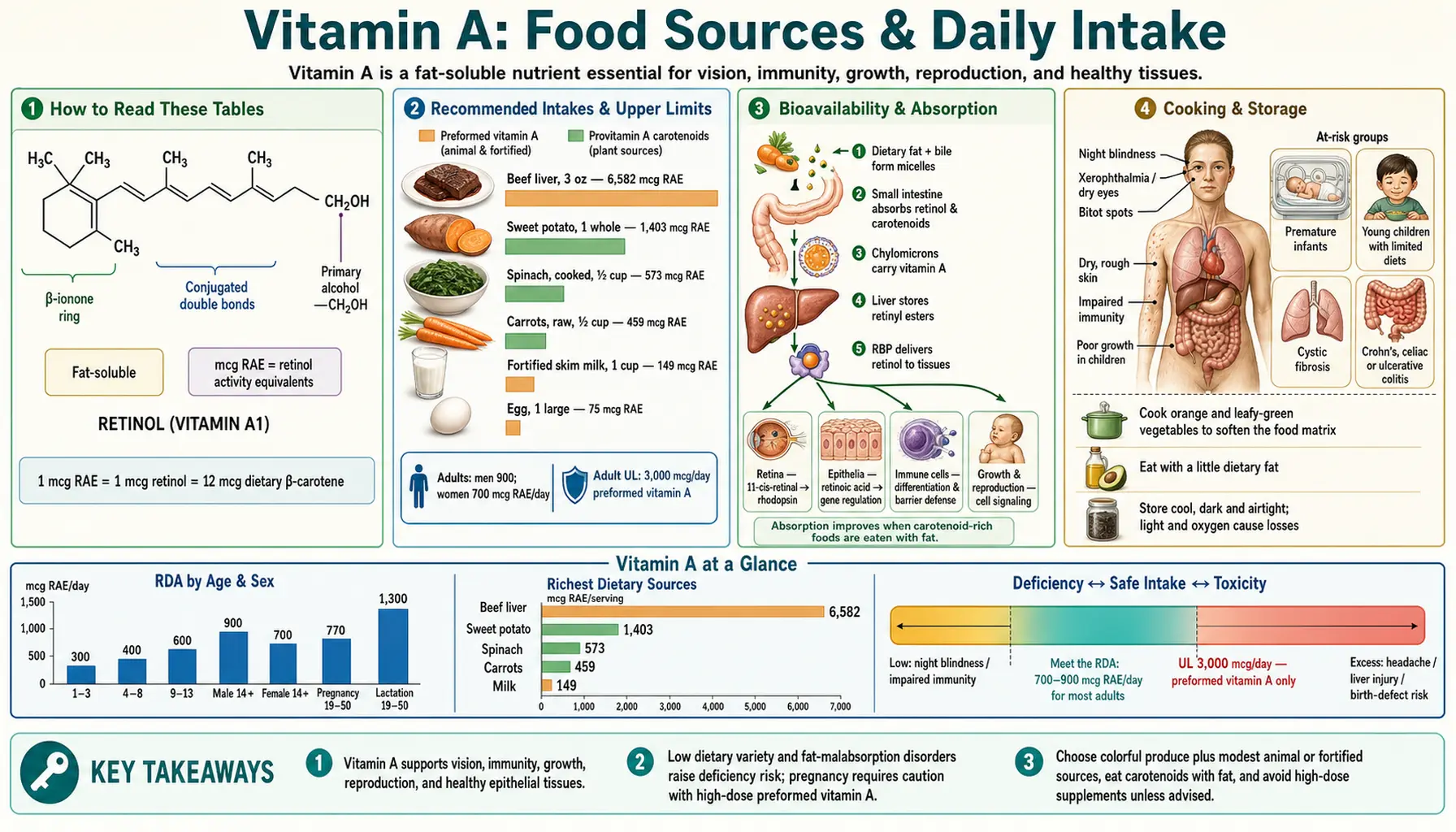
Vitamin A reaches your plate in two very different forms, and the distinction governs every number in the table below. Preformed vitamin A (retinol) comes from animal foods — liver, cod liver oil, dairy, eggs — and is absorbed efficiently and stored in the liver. Provitamin A (chiefly beta-carotene) comes from deeply colored plants — sweet potato, pumpkin, carrots, dark leafy greens — and your body converts it to retinol only as needed. Both are expressed in a common currency, micrograms of Retinol Activity Equivalents (mcg RAE), so the foods can be compared on one scale.
| Vitamin A: Food Sources & Daily Intake | |||||||
|---|---|---|---|---|---|---|---|
| Rank | Food (serving) | Form | Per 100 g | %DV / 100g | Glucose | Fructose | Notes |
| 1 | Cod Liver Oil 1 tsp / 4.5 g | 🥩 Retinol | 30,000 mcg RAE | 🟢 3,333% | — | — | Also a top Vitamin D source. |
| 2 | Beef Liver 3 oz / 85 g | 🥩 Retinol | 9,440 mcg RAE | 🟢 1,049% | 0 | 0 | ⚠ Exceeds adult upper limit (preformed) — limit in pregnancy. |
| 3 | Chicken Liver 3 oz / 85 g | 🥩 Retinol | 3,980 mcg RAE | 🟢 442% | 0 | 0 | ⚠ Exceeds adult upper limit (preformed) — limit in pregnancy. |
| 4 | Chicken Organ Meats 3 oz / 85 g | 🥩 Retinol | 3,980 mcg RAE | 🟢 442% | — | — | Nutrient-dense organ meat (giblets). ⚠ Exceeds adult upper limit (preformed) — limit in pregnancy. |
| 5 | Sweet Potato (With Skin) 1 medium / 150 g | 🌱 β-carotene | 961 mcg RAE | 🟢 107% | 0.6 | 0.5 | Eat with a little fat to absorb. |
| 6 | Carrots ½ cup / 78 g | 🌱 β-carotene | 852 mcg RAE | 🟢 95% | 0.4 | 0.4 | Cooking ↑ carotene availability. |
| 7 | Carrots, Raw 1 cup / 128 g | 🌱 β-carotene | 835 mcg RAE | 🟢 93% | 0.6 | 0.6 | |
| 8 | Pumpkin, Canned ½ cup / 122 g | 🌱 β-carotene | 778 mcg RAE | 🟢 86% | — | — | |
| 9 | Butter, Salted 1 tbsp / 14 g | 🥩 Retinol | 684 mcg RAE | 🟢 76% | — | — | |
| 10 | Butternut Squash ½ cup / 102 g | 🌱 β-carotene | 558 mcg RAE | 🟢 62% | — | — | |
| 11 | Spinach ½ cup / 90 g | 🌱 β-carotene | 524 mcg RAE | 🟢 58% | — | — | Oxalates present; pairs with fat. |
| 12 | Beef Organ Meats 3 oz / 85 g | 🥩 Retinol | 419 mcg RAE | 🟡 47% | 0 | 0 | Nutrient-dense organ meat. |
| 13 | Collard Greens ½ cup / 95 g | 🌱 β-carotene | 380 mcg RAE | 🟡 42% | — | — | |
| 14 | Cheddar Cheese 1 oz / 28 g | 🥩 Retinol | 316 mcg RAE | 🟡 35% | 0.1 | 0 | |
| 15 | Cantaloupe (Melon), Raw 1 cup / 160 g | 🌱 β-carotene | 232 mcg RAE | 🟡 26% | 2.1 | 2.4 | |
| 16 | Apricots, Dried ½ cup / 65 g | 🌱 β-carotene | 180 mcg RAE | 🟡 20% | 33.1 | 12.5 | |
| 17 | Pork Organ Meats 3 oz / 85 g | 🥩 Retinol | 78 mcg RAE | ⚪ 9% | — | — | Nutrient-dense organ meat. |
Table of Contents
- How to Read These Tables
- Recommended Intakes & Upper Limits
- Bioavailability & Absorption
- Cooking & Storage
- Vegetarian & Vegan Sources
- Who Needs to Pay Attention
- Data Sources & References
- Connections
- Featured Videos
How to Read These Tables
- Two units, one scale. Older labels used International Units (IU); the science and U.S. labels now use mcg RAE, which already accounts for the fact that beta-carotene is far less potent gram-for-gram than retinol (roughly 12 mcg of food beta-carotene yields 1 mcg RAE). Every number here is in mcg RAE unless stated.
- %DV vs RDA. The %DV column compares a serving against the single FDA Daily Value of 900 mcg RAE used on nutrition labels. Your personal target (the RDA) depends on age, sex and pregnancy — see the second table.
- Per 100 g vs per serving. Per-100 g lets you compare foods fairly; the serving size shown beside each food is what you actually eat. A spice or a garnish can look enormous per 100 g yet contribute little in a real portion — always read the serving.
Recommended Intakes & Upper Limits
Your personal target depends on age, sex and pregnancy. The Daily Value used for the %DV column above is a single label figure; the table below is the age-specific guidance.
| Life stage | RDA / AI (mcg RAE/day) | Upper limit (mcg/day) |
|---|---|---|
| Infants 0–6 mo | 400* (AI) | 600 |
| Infants 7–12 mo | 500* (AI) | 600 |
| Children 1–3 y | 300 | 600 |
| Children 4–8 y | 400 | 900 |
| Children 9–13 y | 600 | 1,700 |
| Males 14+ y | 900 | 2,800 → 3,000 |
| Females 14+ y | 700 | 2,800 → 3,000 |
| Pregnancy | 750–770 | 2,800 → 3,000 |
| Lactation | 1,200–1,300 | 2,800 → 3,000 |
Bioavailability & Absorption
The amount in the food is not the amount you absorb. Three factors matter most for vitamin A:
- Form. Retinol from animal foods is absorbed at roughly 70–90%. Beta-carotene from plants is absorbed far less efficiently and must then be converted — and a common variant in the BCO1 (beta-carotene oxygenase) gene reduces that conversion by up to ~40% in some people, who therefore lean more on animal sources.
- Dietary fat. Vitamin A is fat-soluble. A little oil, butter or avocado with your carrots or greens dramatically increases carotenoid uptake; fat-free preparations waste much of it.
- Food matrix & cooking. Carotenoids are locked inside plant cell walls. Light cooking, puréeing and chopping break those walls and raise the carotene you can absorb — cooked carrots and pumpkin out-deliver raw.
Cooking & Storage
Unlike the water-soluble vitamins (C and the B group), vitamin A is heat-stable and is not leached away by boiling water, so ordinary cooking preserves it well. Gentle cooking of orange and green vegetables actually increases the beta-carotene your body can extract. The main losses come from prolonged high-heat frying and from light/oxygen exposure over time, so store oils (including cod liver oil) cool, dark and sealed.
Vegetarian & Vegan Sources
There is no preformed vitamin A in any plant food — plants supply provitamin A carotenoids only. That is good news for plant-based eaters: the orange and dark-green vegetables at the top of the plant list (sweet potato, pumpkin, carrots, spinach, kale, butternut squash) easily cover the RDA, the body self-limits conversion so plant sources cannot cause toxicity, and excess simply tints the skin harmlessly (carotenemia). The one caution is the minority with reduced BCO1 conversion, who may need larger or more varied carotenoid intake to maintain status.
Who Needs to Pay Attention
Groups who most need to prioritize vitamin A sources or testing: people with fat-malabsorption conditions (celiac disease, Crohn’s, cystic fibrosis, pancreatic insufficiency or after bariatric surgery), infants and young children in low-intake settings, and those with very low-fat diets. The opposite caution applies to preformed retinol: liver and cod liver oil are so concentrated that a single serving can exceed the daily upper limit, which matters especially in pregnancy — the table flags these. Beta-carotene from food carries no such limit.
Data Sources & References
- NIH Office of Dietary Supplements — Vitamin A Fact Sheet (DV, RDA, UL)
- Linus Pauling Institute — Vitamin A Micronutrient Information Center
- PubMed — beta-carotene to retinol conversion and BCO1 polymorphism
Connections
- All Vitamins
- Vitamin A (Main Page)
- Vitamin A Benefits
- Vitamin A History
- Organ Meats (Beef Liver)
- Sweet Potatoes
- Kale
- Eggs
- Beta-Carotene
- Zinc (A transport cofactor)
- Vitamin D3
- Macular Degeneration